A forest of 212 carved columns, an unfinished tiled minaret, a harem lined with blue majolica, the khans' fortress and Khiva's tallest tower. A detailed guide to the five sights that define Ichan-Kala, with what to look for and 2026 tips.
Facts, prices and schedules checked on November 4, 2026
The Juma Mosque in Khiva is one of the most unusual mosques in the Muslim world: no dome, no courtyard, no tiled portal, just a low, dim hall held up by more than two hundred carved wooden columns. A few streets away stand four other sights that define Khiva (Xiva): the Kalta Minor, the tiled stump of a minaret that was meant to be the tallest in Central Asia; Tash-Hauli, the khan's palace and harem; the Kunya-Ark, the old fortress; and the Islam Khoja minaret, the highest point in town.
Our Ichan-Kala guide covers the walled old town as a whole: the gates, the combined ticket and how to spend your days. This article goes deeper into these five places. It explains what you are looking at, what details to look for, how long each needs and which extras are worth paying for, so you can see them with a guide's eye even if you visit on your own.
The Juma Mosque in Khiva: history
Khiva's Friday mosque stands in the middle of Ichan-Kala, on the main street that joins the west and east gates. A Friday mosque has stood on this site for a very long time: the 10th-century Arab geographer al-Muqaddasi described one in Khiva, and some of the columns inside are that old.
The present building is from the late 18th century. It was rebuilt in 1788 to 1789 under Abdurahman Mehtar, a senior official of the khanate, and inscriptions on the carved doors record the work. The builders kept the ancient plan of an Arab-style hypostyle hall, a single roofed space filled with columns, and reused old columns from the previous mosque and, according to tradition, from other buildings across Khorezm.
The hall measures about 55 by 46 metres. From the street you see only plain brick walls and a few carved doors. Inside, 212 wooden columns stand in 17 rows, holding up a flat timber roof. Three openings in the roof let in shafts of daylight; around one of them grows a small tree, and in the middle of the day the light falls in pools across the floor. The effect is quiet and cool even in July, which is why the hall has been compared to a forest.
How to read the wooden columns
The columns are the reason to come, and they reward slow looking. They were carved at different times over about eight centuries, so the hall is effectively a museum of Khorezmian woodcarving.
- The oldest columns: about 25 columns date from the 10th to 16th centuries. Four of the most valuable, from the 10th to 11th centuries, carry carved Kufic inscriptions recording that they were given to the mosque by a religious scholar. Ask the attendant or your guide to point them out.
- Dated carving: some columns and doors carry carved dates, including 1316, 1517, 1788 and 1789.
- Shapes: early columns are slender, with simple bulb-shaped bases and dense geometric patterns. Later ones are thicker, with vine scrolls, leaves and flowers carved in deep relief.
- Bases: most columns stand on carved stone or wooden bases, which kept the wood off the damp floor and allowed old columns to be lifted and reused.
Many columns were replaced or repaired during restoration in the 1990s, so not every column is ancient; part of the pleasure is spotting the difference. Look also for the mihrab, the prayer niche facing Mecca, with a carved plaster (ganch) half-dome painted with irises and rose hips.
The mosque is part of the Ichan-Kala museum ticket. Allow 30 to 40 minutes, and come in the late morning or around noon, when the light shafts are strongest.
Climbing the Juma Mosque minaret
Next to the mosque rises its minaret, one of the oldest in Khiva, with a few narrow bands of turquoise brick and an arcaded lantern at the top. Uzbekistan's national heritage register gives its height as about 32.5 metres, with a base 6.2 metres across, and 81 steps lead up inside.
When it is open, the climb costs a small extra fee and takes about 10 minutes up and down. The staircase is narrow, steep and dark, so bring a phone torch and avoid it if you are uncomfortable in tight spaces. The reward is a fine view along the main street to Kalta Minor and over the flat roofs of Ichan-Kala.
If you only climb one tower in Khiva, choose the Islam Khoja minaret (below) for the higher view, or the Ak-Sheikh Bobo watchtower in the Kunya-Ark for sunset. The Juma minaret is a good alternative when those are crowded.
Kalta Minor: the unfinished minaret
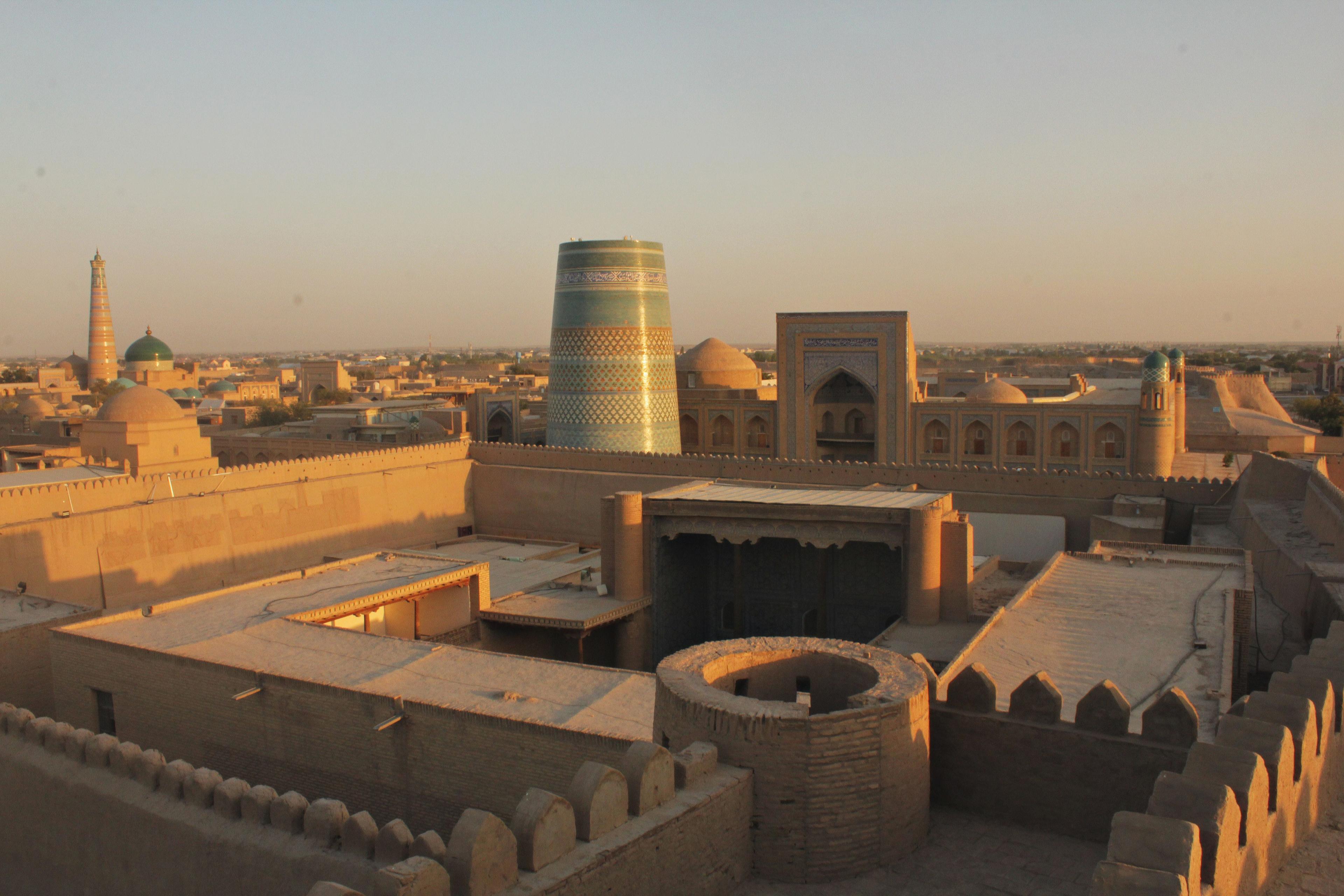
Just inside the west gate stands Kalta Minor, the "short minaret". It was begun in the early 1850s by Muhammad Amin Khan, who wanted the tallest minaret in the Islamic world. Estimates of the planned height range from 70 to more than 100 metres; local legend says it was to be tall enough to see Bukhara. Work stopped in 1855, when the khan was killed in battle against the Turkmen near Merv, and the tower was never finished.
What survives is about 29 metres tall with a huge base, about 14 metres across, which gives it its distinctive barrel shape. It is also the first minaret in Central Asia covered entirely in glazed tile and brick, in bands of turquoise, blue, green and white, with a band of inscriptions. In the morning sun it is the most colourful building in Khiva.
Kalta Minor is joined to the Muhammad Amin Khan Madrasah, the largest madrasah in Khiva, built in the same years and now used as a hotel. The minaret cannot be climbed, so the visit is about looking: walk round it, then see it from the walls near the west gate and from the rooftops along the main street, where it lines up with the Islam Khoja minaret. Another legend says the khan's architect fled to Bukhara rather than build a taller tower there; it is a story, but it explains why every guide in Khiva mentions Bukhara at this point.
Kunya-Ark: the khans' fortress
Opposite Kalta Minor, the Kunya-Ark ("old fortress") was the citadel and residence of the khans of Khiva. Arang Khan began it in 1686 at the western edge of Ichan-Kala, and it grew into a town within the town, with its own mosques, harem, mint, arsenal, stables and offices.
The highlights inside:
- The Kurinish-khana: the khan's reception hall and throne room. Damaged by Persian invaders in the 18th century, it was rebuilt in the early 19th century under Iltuzar Khan. Its two-column iwan is faced entirely in blue and white majolica. In the courtyard is a round brick platform where a yurt was set up: the khans of Khiva liked to receive guests in a felt tent, a memory of their nomadic roots.
- The summer mosque: an open iwan lined with majolica by the master tile-maker Abdullah Jin, with a painted ceiling in gold and red on blue. It is one of the most beautiful small spaces in Khiva.
- The mint: built together with the mosque, now a small museum of coins and paper money issued by the khanate.
- The harem: added under Muhammad Rahim Khan II in the second half of the 19th century.
- The Ak-Sheikh Bobo bastion: a two-storey iwan built into the city wall, used as a lookout post. Today it is the classic viewpoint over Ichan-Kala, with Kalta Minor in the foreground.
Allow about an hour. The Ark is included in the Ichan-Kala ticket, but the Ak-Sheikh Bobo terrace usually costs extra and may close before sunset in summer, so check the time.
Tash-Hauli: palace, harem and court
Tash-Hauli ("stone courtyard") is the palace Allakuli Khan built near the east gate in the 1830s, when he decided the Kunya-Ark was no longer grand enough. It has more than 260 rooms arranged around three courtyards, linked by narrow, twisting corridors that were said to be designed to confuse intruders.
- The harem: built first, it is the highlight. Along one side of a long courtyard stand five tall iwans, one for the khan and four for his four wives, each with a carved wooden column and walls covered in blue and white majolica. The tiles are attributed to Abdullah Jin, and the ceilings are painted in red, yellow and gold.
- The Ishrat-Hauli: the reception courtyard, built in 1830 to 1832, where the khan received ambassadors. Guests were lodged in yurts on two round brick platforms that still stand in the courtyard.
- The Arz-Hauli: the court of justice, built in 1837 to 1838, where the khan heard disputes and passed judgement.
A well-known legend says the first architect, Usto Nur Muhammad, was executed for telling the khan the palace could not be finished in two years; his successor took eight. Sources disagree on the details, but it gives a sense of how the khanate was ruled.
The khans lived here until 1880, when Muhammad Rahim Khan II moved back to the Kunya-Ark. Allow 40 minutes to an hour; the light in the harem courtyard is best in the morning.
Islam Khoja minaret: the tallest tower in Khiva
In the south-east of Ichan-Kala rises the Islam Khoja minaret, built in 1908 to 1910 together with a small madrasah. At around 57 metres it is the tallest structure in Khiva, banded in turquoise and white tiles, and the top platform, about 45 metres up, is the highest viewpoint in town. You can see it from almost everywhere in the old city, and from the desert on the approach.
It was built by Islam Khoja, the grand vizier of the khanate and its leading reformer, who also founded a hospital, a post office, a telegraph line and a European-style school. His modernising made powerful enemies, and in 1913 he was murdered, reportedly with the approval of the khan. The minaret is his monument.
The climb is the best view in Khiva: about 118 steep, narrow steps in the dark to a small gallery with windows on all sides. It costs extra (typically 50,000 to 100,000 som in 2026) and is not for anyone with knee problems or claustrophobia. Next door, the Islam Khoja Madrasah houses a museum of Khorezmian applied arts: carpets, carved wood, ceramics, metalwork and jewellery.
Tickets: what is included and what costs extra
All five sights are inside Ichan-Kala and covered by its combined museum ticket, bought at the west gate (Ota Darvoza) and usually at the other gates. As of November 2026, reported prices for the main ticket for foreign visitors are about 200,000 to 250,000 som, valid for one or two days; our Ichan-Kala guide has the details.
Typically included: the Juma Mosque, the Kunya-Ark interior, Tash-Hauli and the Islam Khoja Madrasah museum.
Usually extra, paid in cash at each entrance:
- Islam Khoja minaret climb: about 50,000 to 100,000 som.
- Juma Mosque minaret climb: a small fee, when open.
- Ak-Sheikh Bobo watchtower in the Kunya-Ark: roughly 35,000 to 100,000 som, depending on the source.
- Walk along the city walls: a small fee.
Prices in Khiva have risen quickly, and several travellers have reported being asked for more than the printed price, so keep your receipt, check the figure at the window, and carry small notes in som.
A route through the five sights
The five sights lie along or just off the main street between the west and east gates, so they make a natural half-day walk of about four hours with visits.
- 08:00: Enter by the west gate. Kalta Minor first, in the early light, before the groups arrive.
- 08:30: The Kunya-Ark: the Kurinish-khana, the summer mosque and the mint.
- 09:45: Along the main street to the Juma Mosque. Spend time with the columns; climb the minaret if it is open.
- 10:45: South-east to the Islam Khoja Madrasah museum and the minaret climb, while it is still cool.
- 11:45: Tash-Hauli, ending in the harem courtyard.
- Late afternoon: back to the Kunya-Ark for the Ak-Sheikh Bobo watchtower, or to a rooftop café for sunset over Kalta Minor.
In summer, start even earlier and rest at midday; in winter, many sights close around 17:00. Our Khiva travel guide suggests how to fit this into one or two days, and how to reach Khiva by the new high-speed train or by flight to Urgench.
Visiting Khiva's monuments with TourEast
On our tours that include Khiva we plan a full day inside Ichan-Kala, with a local guide who knows the columns of the Juma Mosque one by one. If you want more time in Khiva, or to combine it with the desert fortresses of Khorezm, we can plan a small-group or private itinerary around it.