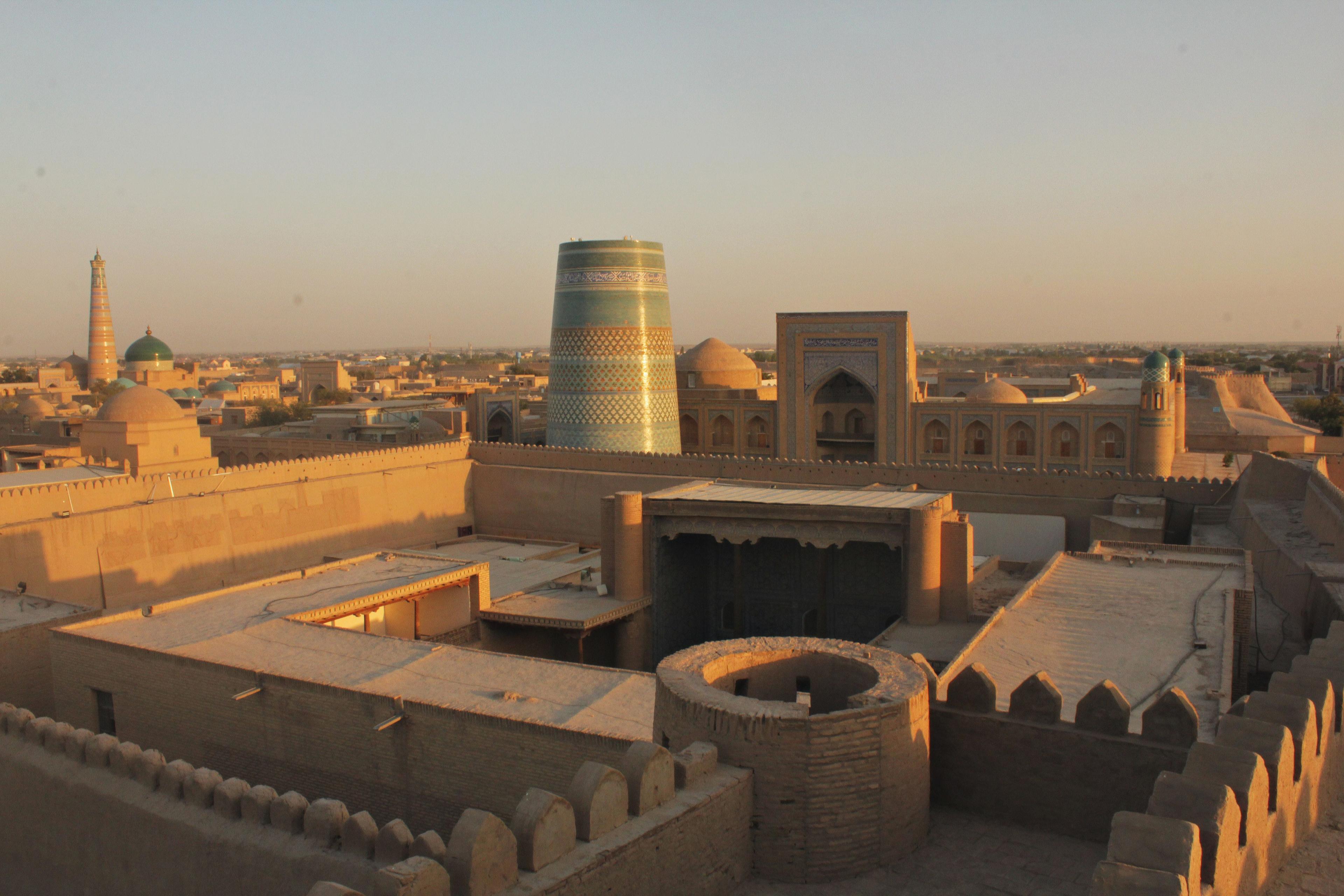
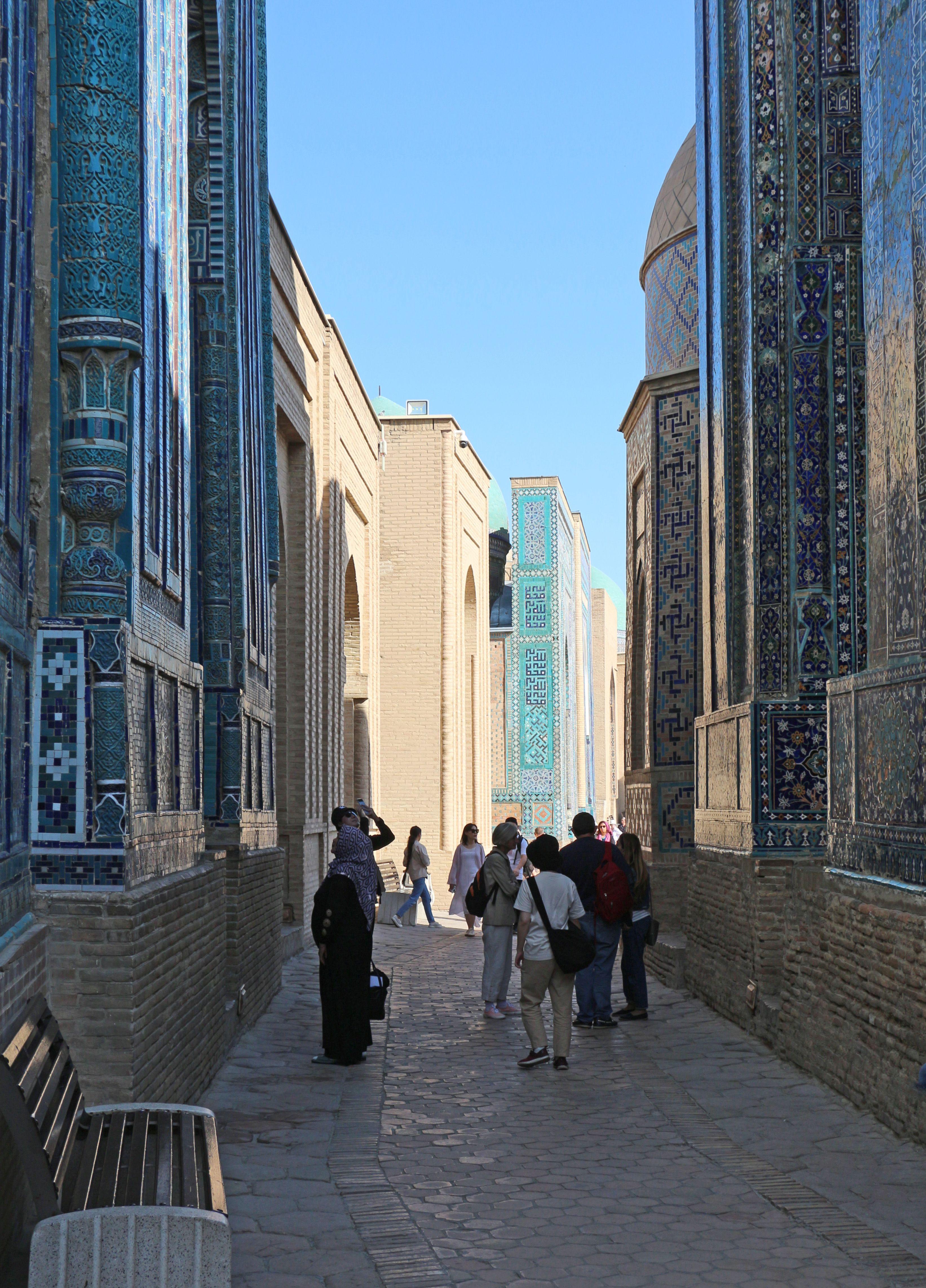
A narrow street of blue-tiled mausoleums climbing a hill, built over eight centuries around the shrine of the Prophet's cousin. How to read the tilework, how to behave at a pilgrimage site, and practical details for visiting Shah-i-Zinda as of November 2026.
Facts, prices and schedules checked on November 4, 2026
If the Registan is Samarkand's public face, Shah-i-Zinda is its soul. Ask a dozen travellers which place in Uzbekistan stayed with them most, and many will name this narrow lane of mausoleums on the slope of the ancient Afrosiyab hill.
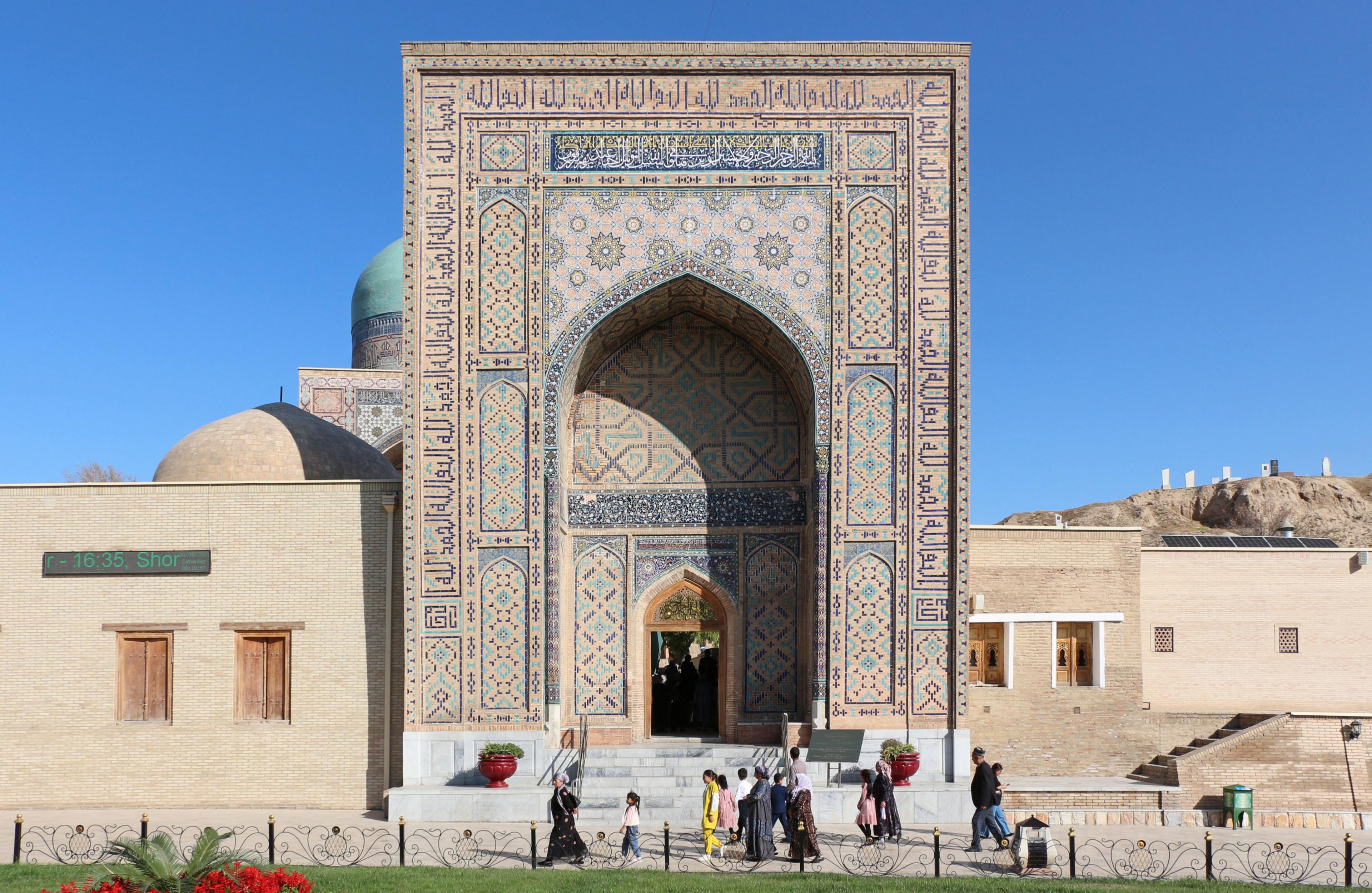
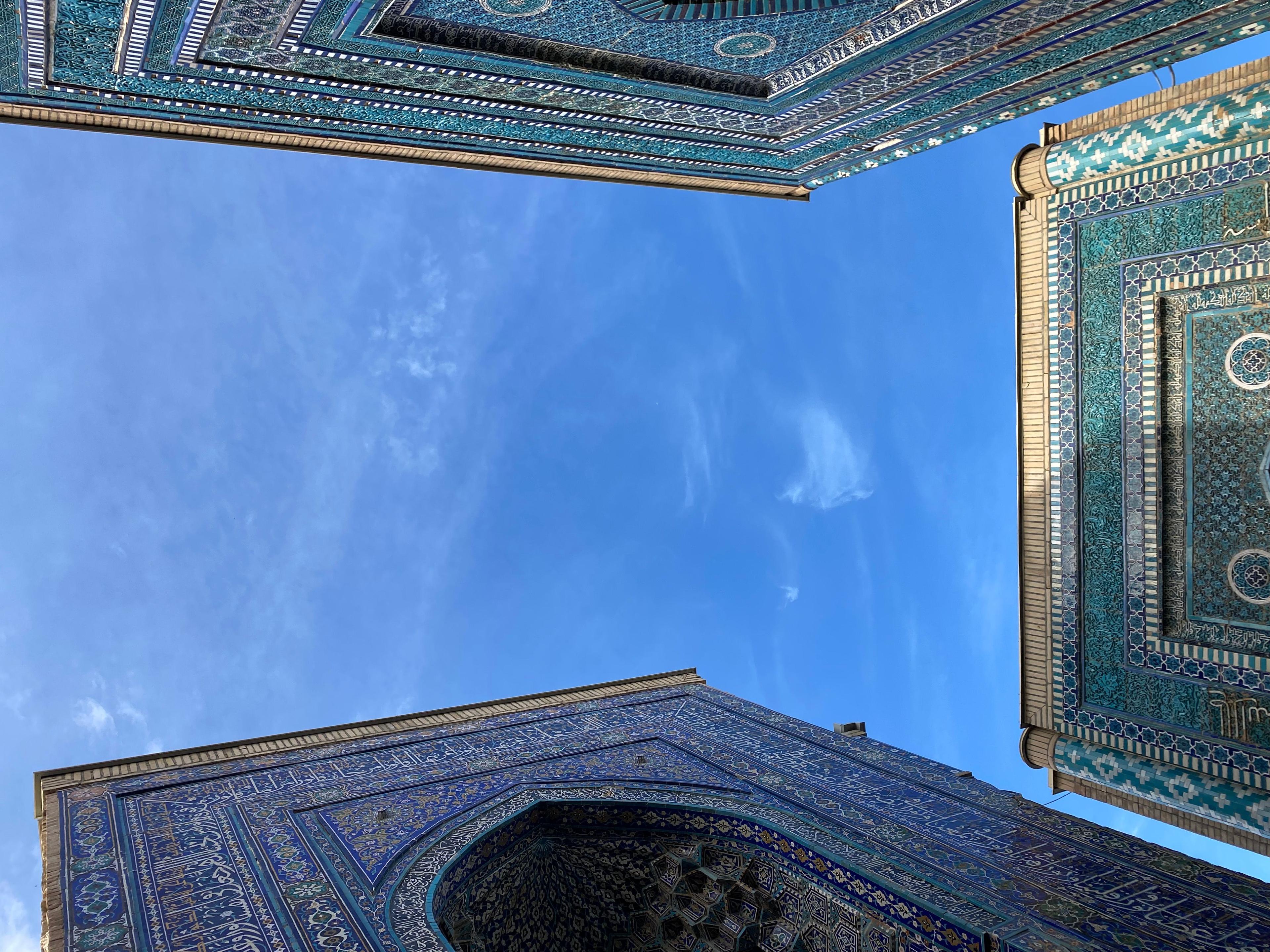
The name means "the Living King". Over roughly eight centuries, from the 11th to the 19th, more than twenty buildings grew up around a revered grave, most of them in the late 14th and 15th centuries when Timur's family, generals and scholars chose to be buried here. The result is a street of portals and turquoise domes so densely tiled that it feels less like a cemetery than a gallery of Timurid ceramic art.
It is also an active place of pilgrimage. Knowing a little of its story and its customs will make your visit richer and more comfortable.
The legend of Kusam ibn Abbas
At the top of the complex lies the shrine of Kusam ibn Abbas (Qutham ibn Abbas), a cousin of the Prophet Muhammad. He is believed to have come to Samarkand with the Arab armies in the second half of the 7th century to spread Islam, and to have died here.
Local legend tells it more vividly. Kusam was attacked while at prayer and beheaded. Instead of falling, he picked up his head and walked down into a deep well, or in some versions into an underground garden, where he lives on to this day. Hence the "Living King".
Historians treat the story as legend, but its power is real. Kusam's tomb made this one of the most important pilgrimage sites in Central Asia, and that is why Timur's relatives wanted to rest close to him. You will still hear a traditional local saying that several pilgrimages to Shah-i-Zinda carry special spiritual merit; it reflects how deeply the shrine is woven into local faith.
How the complex is laid out
Shah-i-Zinda is a single path, which makes it easy to explore. The buildings fall into three groups, lower, middle and upper, joined by domed passages called chartak.
- Entrance portal (Darvozakhona): built in the 1430s, traditionally attributed to Ulugbek's son Abdulaziz. A 19th-century summer mosque and a small madrasah stand beside it.
- The staircase: a steep flight of roughly 40 steps leads up the hillside. Tradition says you should count the steps on the way up and again on the way down; if the numbers match, your sins are forgiven. Pilgrims climb respectfully, and many touch the steps as they go.
- The middle group: the most spectacular section, a narrow lane where mausoleums face each other across a few metres of paving.
- The upper group and the Kusam ibn Abbas complex: at the far end, with the oldest surviving fabric and the shrine itself.
Walk up slowly and then come back down; the views and the light are different in each direction.
The mausoleums worth stopping for
You do not need to identify every building to enjoy Shah-i-Zinda, but a few deserve a pause.
- Qazi-zade Rumi mausoleum: the large double-domed building near the bottom, from the first half of the 15th century. It is traditionally linked to the astronomer Qazi-zade Rumi, Ulugbek's teacher, although some scholars think it was built for a woman of the ruling family.
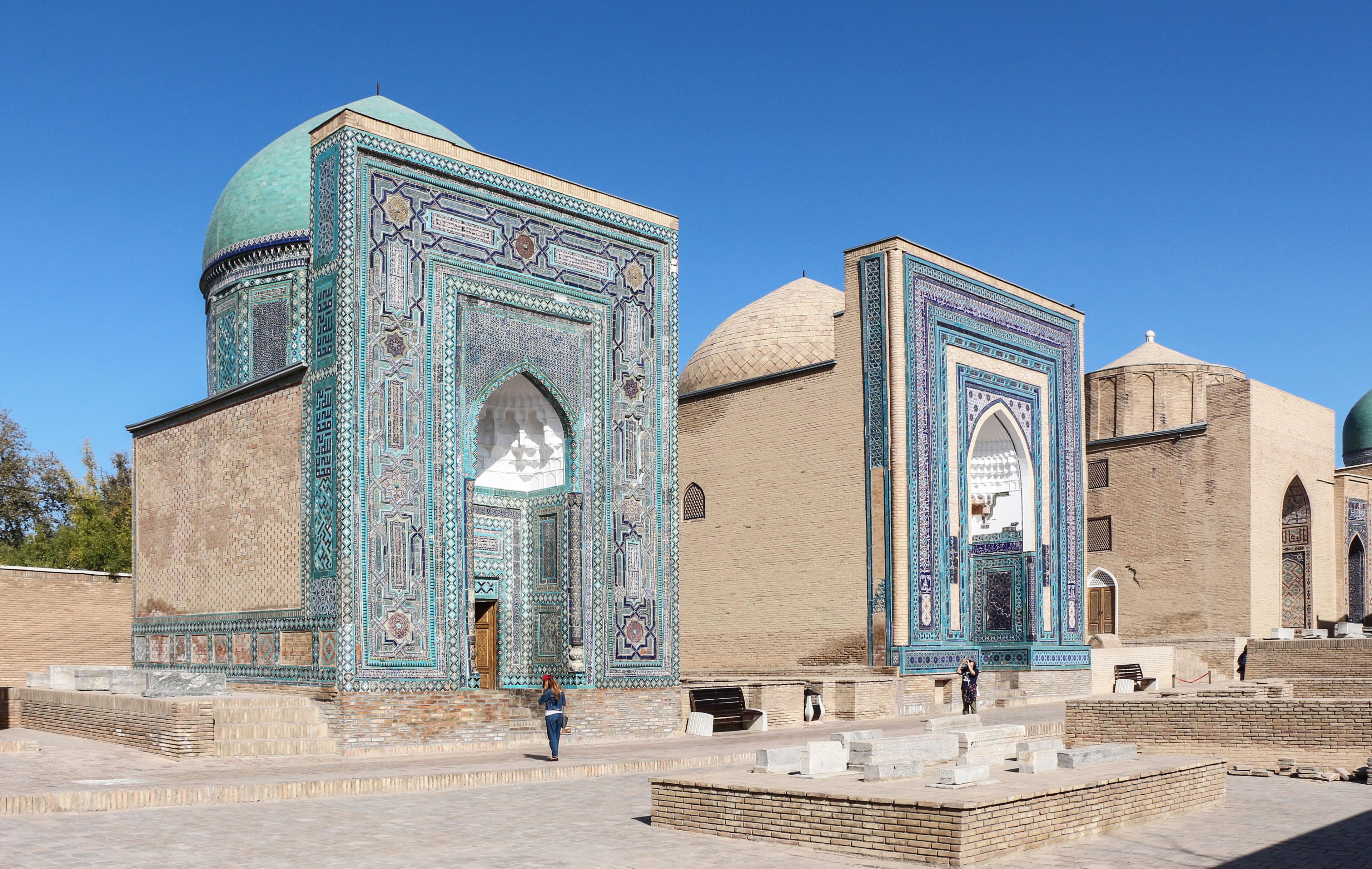
- Shadi Mulk Aka mausoleum (1372): built for Timur's niece. Many specialists consider its carved terracotta tiles the finest in the complex: look at the portal, where every surface is covered in deeply cut floral and geometric patterns glazed in turquoise and cobalt.
- Shirin Bika Aka mausoleum (1385): the tomb of Timur's sister, across the lane, with mosaic faience and painted interior.
- Usto Ali Nasafi and Amir Burunduk mausoleums: in the middle group, named after a master builder and one of Timur's commanders.
- Tuman Aka complex (around 1405): mausoleum and mosque of one of Timur's wives, with a fine carved wooden door.
- Kusam ibn Abbas complex: at the top, the mosque and the shrine (ziyaratkhana). Through a lattice you can see the tomb itself, covered in tiles. Pilgrims pray quietly here.
Inside many mausoleums the domes are painted or gilded, and the interiors are often cool and dim. Let your eyes adjust before you look up.
Reading the tilework
Shah-i-Zinda is effectively a textbook of 14th and 15th-century ceramic techniques, and noticing the differences makes the walk far more interesting.
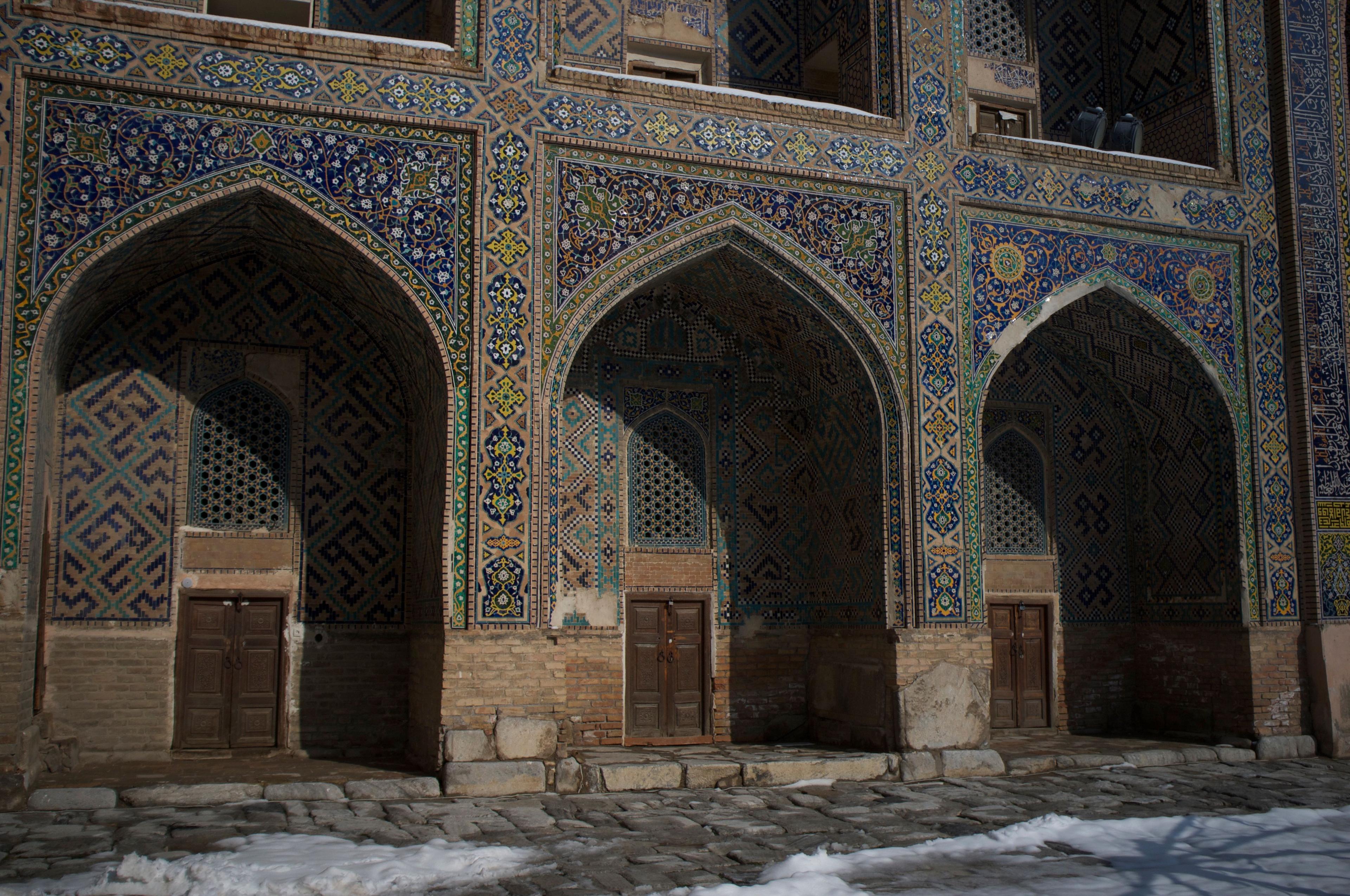
- Carved glazed terracotta: patterns cut deep into the clay before glazing, creating a three-dimensional surface that changes as the sun moves. This is the signature of the earlier Timurid buildings.
- Mosaic faience: tiny pieces of single-coloured glazed tile cut and assembled like a jigsaw. It produces the crispest lines and richest colour.
- Majolica: designs painted onto a white ground and fired, allowing more colours on a single tile.
- Epigraphy: bands of Arabic and Persian inscription, from flowing script to square Kufic built into the brickwork. Some record the names of the deceased; others are Quranic verses and poetry.
The palette is dominated by turquoise and deep cobalt, with white, ochre and occasional green. Turquoise was more than decoration: in a dusty, sun-scorched landscape it suggested water, paradise gardens and the sky.
Be aware that Shah-i-Zinda was heavily restored, especially in the 2000s, and some of that work was criticised by UNESCO specialists for replacing too much original material. The most authentic tilework tends to be the slightly faded, irregular surfaces; the brightest, most uniform panels are often new. Both are beautiful, but the old pieces tell you what the Timurid craftsmen achieved.
Etiquette at a pilgrimage site
Shah-i-Zinda is a functioning shrine, visited daily by Uzbek families, pilgrims from across the region and couples on their wedding day. Visitors are warmly welcomed, and a few simple courtesies are appreciated.
- Dress modestly: shoulders and knees covered for everyone. Women are not required to cover their hair to walk through the complex, but a light scarf is respectful at the Kusam ibn Abbas shrine and in the mosque.
- Speak quietly, especially at the upper end. You may hear a mullah reciting prayers for a group; wait until he finishes before walking through.
- When people raise their hands and pass them over their faces at the end of a prayer, it is fine to stand still and wait.
- Do not step on graves or lean on tombstones, and do not climb on the buildings.
- Ask before photographing pilgrims, and do not photograph people while they pray.
- Some mausoleums ask visitors to remove shoes; follow the signs and what local visitors do.

Tickets and opening hours (as of November 2026)
Tickets are sold at the entrance at the bottom of the hill.
- Foreign visitors: about 50,000 som (roughly 4 USD). This rose sharply in 2025 from 15,000 som, so expect further changes.
- Hours: the complex opens early, from around 7:00 to 8:00. Closing time varies with the season, from early evening in winter to late evening in summer. Published hours conflict, so check on the day.
- Bring cash in som; card payment is not always available.
Shah-i-Zinda is not included in the Registan ticket. There is no combined ticket for Samarkand's monuments, so each site is paid separately.
Best time to visit and photography
The lane is narrow, so crowds matter more here than on the open Registan.
- Early morning is the best time: the light is soft, the complex is quiet and you will share it mainly with pilgrims. Arrive at opening time if photography is a priority.
- Midday sun lights the full height of the lane but flattens the carved tiles and makes the paving glare.
- Late afternoon brings warm side light that picks out the relief of the terracotta, and the most visitors, including tour groups and wedding shoots.
Allow one to one and a half hours, longer if you enjoy architecture or photography. Phone and camera photography are allowed; a separate camera fee has sometimes been charged at Samarkand monuments, so ask at the ticket desk. Wide-angle lenses help in the narrow lane. Tripods can block a busy path, so use them only when it is quiet, and do not fly drones.
Spring (April to May) and autumn (September to October) are the most pleasant seasons. In summer, the hillside holds the heat and there is little shade, so go early and carry water.
Getting there and combining it with nearby sights
Shah-i-Zinda lies on the north-eastern edge of the old city, about 25 minutes' walk from the Registan along Tashkent Street, passing Bibi-Khanym Mosque and Siab Bazaar on the way. A taxi from the centre takes five to ten minutes.
A good half day: Bibi-Khanym in the morning, a wander through Siab Bazaar for dried fruit and fresh bread, then Shah-i-Zinda. If you have more time, continue to the Afrosiyab Museum and the remains of the ancient city on the hill behind the necropolis, or to the Ulugbek Observatory a short drive further north-east. The large cemetery behind the complex is still in use; walk through it only quietly and respectfully.
Visiting with TourEast
Our guides can time your visit for the quiet early hours and explain the stories behind each mausoleum and its tiles. Shah-i-Zinda features in our Samarkand programmes, and we can build it into a private or small-group itinerary at the pace you prefer.