Timur's jade-covered tomb and his colossal Friday mosque: the history, the 1941 curse story, why Bibi-Khanym collapsed, 2026 tickets and hours, the evening lights and how long to spend at each.
Facts, prices and schedules checked on November 4, 2026
Gur-e-Amir and the Bibi-Khanym Mosque are the two great monuments Amir Timur left in Samarkand: the tomb where he lies under a slab of dark green jade, and the colossal Friday mosque he raised after his Indian campaign. One is intimate and golden inside, the other is all scale, sky and broken grandeur. Together they tell you more about Timur than any museum.
This guide covers what travellers ask us most often: the history of both buildings, the story of the 1941 opening of Timur's tomb, why Bibi-Khanym collapsed and how it was rebuilt, tickets and opening hours as of November 2026, the evening lighting, and how much time to set aside. You will also find spellings that differ between maps and signs: Gur-e-Amir, Gur-Emir, Guri Amir or, in Uzbek, Amir Temur maqbarasi; Bibi-Khanym, Bibi Khanum or Bibixonim.
Both sights are a short walk from the Registan, so they fit easily into a first day in Samarkand. Our separate guides to the Registan, Shah-i-Zinda and Amir Timur's life cover those subjects in depth; here we stay with the tomb and the mosque.
Gur-e-Amir: the history of Timur's mausoleum
Gur-e-Amir means "tomb of the amir" in Persian. It was not built for Timur at all. In 1403 his favourite grandson and chosen heir, Muhammad Sultan, died of wounds after a campaign against the Ottomans, and Timur ordered a mausoleum for him beside the madrasah and khanaka that Muhammad Sultan himself had founded at the end of the 14th century.
Timur had prepared his own tomb in his home town, Shakhrisabz. But he died in February 1405 at Otrar, in today's Kazakhstan, while leading a winter campaign against Ming China. Snow blocked the mountain passes to Shakhrisabz, so his body was brought to Samarkand and laid in his grandson's unfinished mausoleum. His grandson Ulugh Beg, the astronomer-ruler of Samarkand, completed the building and turned it into the family tomb of the Timurid dynasty.
Buried here, according to the standard accounts:
- Amir Timur himself
- his sons Shah Rukh and Miran Shah
- his grandsons Muhammad Sultan and Ulugh Beg
- Mir Sayyid Baraka, Timur's spiritual teacher, at whose feet Timur was laid
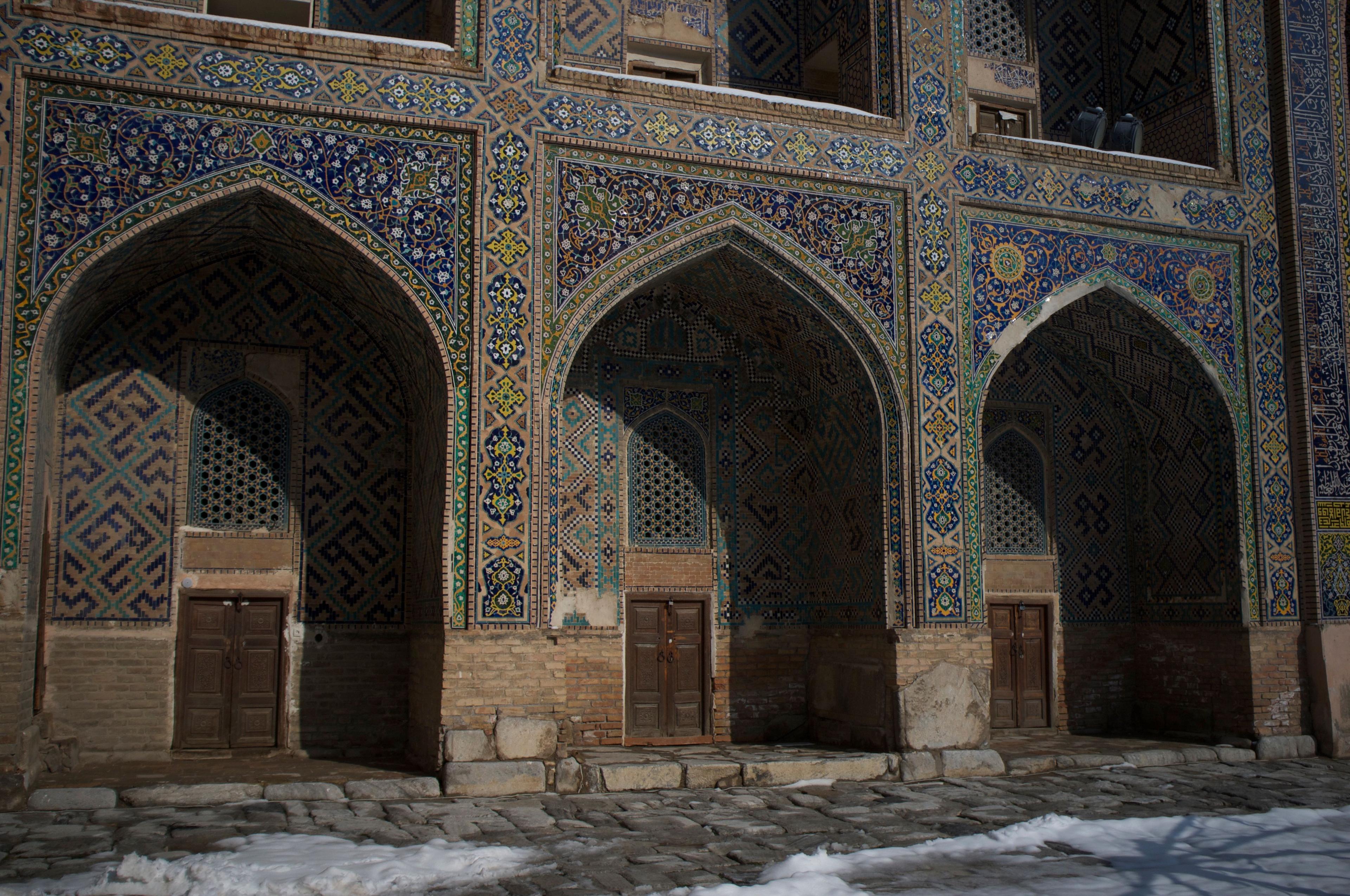
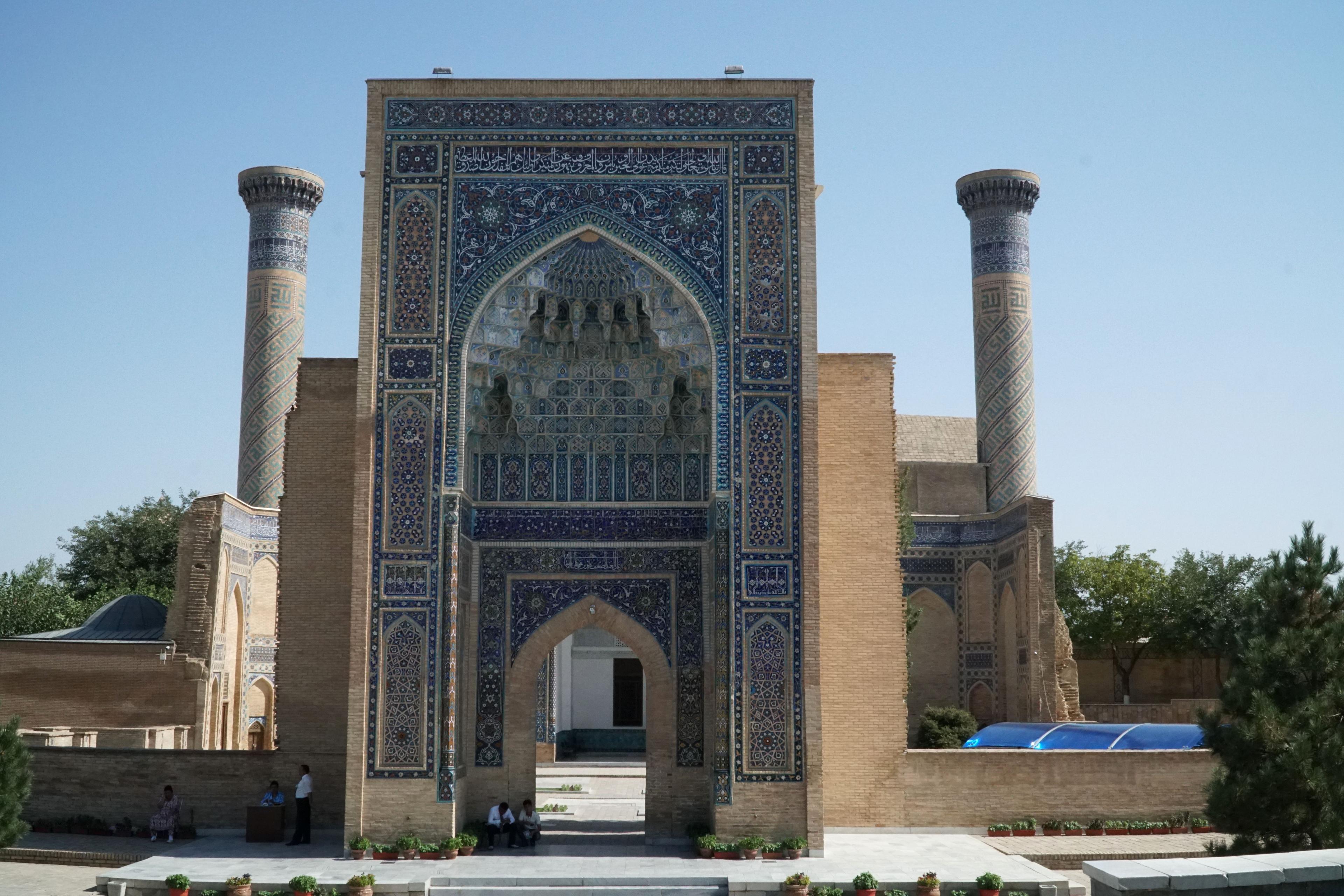
Of Muhammad Sultan's original madrasah and khanaka only foundations and fragments survive, together with the tiled entrance portal you walk through today and the stump of one minaret. The two slender minarets you see now are modern reconstructions.

What you see inside: the jade tombstone and the golden hall
From the outside, Gur-e-Amir is an octagonal building crowned by a tall drum and a ribbed, melon-shaped turquoise dome, about 15 metres across, with a band of giant Kufic calligraphy around the drum. It became a model for later Islamic architecture: the Timurid ribbed dome travelled with Timur's descendants, the Mughals, all the way to India.
Inside, the main hall is the reason most people fall silent. The lower walls are faced with onyx panels, above them run a marble cornice of stalactite carving and painted plaster, and the dome is lined with gilded and painted papier-mache relief. Much of what glitters today is the result of restorations in the Soviet period and after independence, but it follows the original scheme closely.
In the centre stand the cenotaphs, the symbolic tombstones, behind a low marble railing. Timur's is the dark green jade slab, the largest of them and broken in two. The real graves lie in a crypt directly below, which is usually closed to visitors. Ulugh Beg placed the jade over his grandfather's grave in the 1420s; Samarkand tradition says the block once stood in a palace of the Chinese emperors and later served as a throne for a Chagatai khan.
The crack has its own legend. In 1740 the Persian ruler Nadir Shah took the stone as booty. It broke on the way, his fortunes turned, and his advisers persuaded him to send it back. Whether the misfortunes were real or later embroidery, the stone came home in two pieces and has stayed that way.
Look also for the white marble cenotaph of Ulugh Beg and the carved wooden doors, and step outside to see the ruins of Muhammad Sultan's madrasah in the courtyard. A small display usually shows Gerasimov's facial reconstruction of Timur.
The curse of Timur's tomb: what happened in 1941
The most famous story about Gur-e-Amir is the 1941 opening of the tomb, and every guide in Samarkand will tell it.
In June 1941 a Soviet team led by the anthropologist Mikhail Gerasimov opened the crypt to study the Timurid remains. Sources date the opening of Timur's grave to 19 or 20 June 1941. The scientists confirmed what the chronicles said: Timur had been wounded in the right leg and right arm as a young man, the bones of his right leg had fused at the knee, and he walked with a pronounced limp, hence the Persian nickname Timur-i Lang, "Timur the Lame", from which Europe made Tamerlane. They estimated his height at about 172 cm, tall for his time. From the skull Gerasimov reconstructed the face that now appears on statues and banknotes across Uzbekistan.
On 22 June 1941, two days later, Nazi Germany invaded the Soviet Union.
From there, history and legend part ways. The popular version says the tomb bore a warning that whoever disturbed it would unleash an invader more terrible than Timur, and that local elders begged the scientists not to proceed. People close to Gerasimov later said the inscription story was invented, and historians treat it as folklore. The coincidence of dates, however, is real.
The remains were returned with full Islamic rites in December 1942 (Wikipedia gives 20 December), in the weeks when the Red Army was closing the ring around the German army at Stalingrad. Many people in Samarkand like to connect the two events. We tell it as what it is: a good story, carefully separated from the documented facts. If Timur's life and campaigns interest you, our article on Amir Timur and his empire goes into the wider history.
Bibi-Khanym Mosque: Timur's great Friday mosque
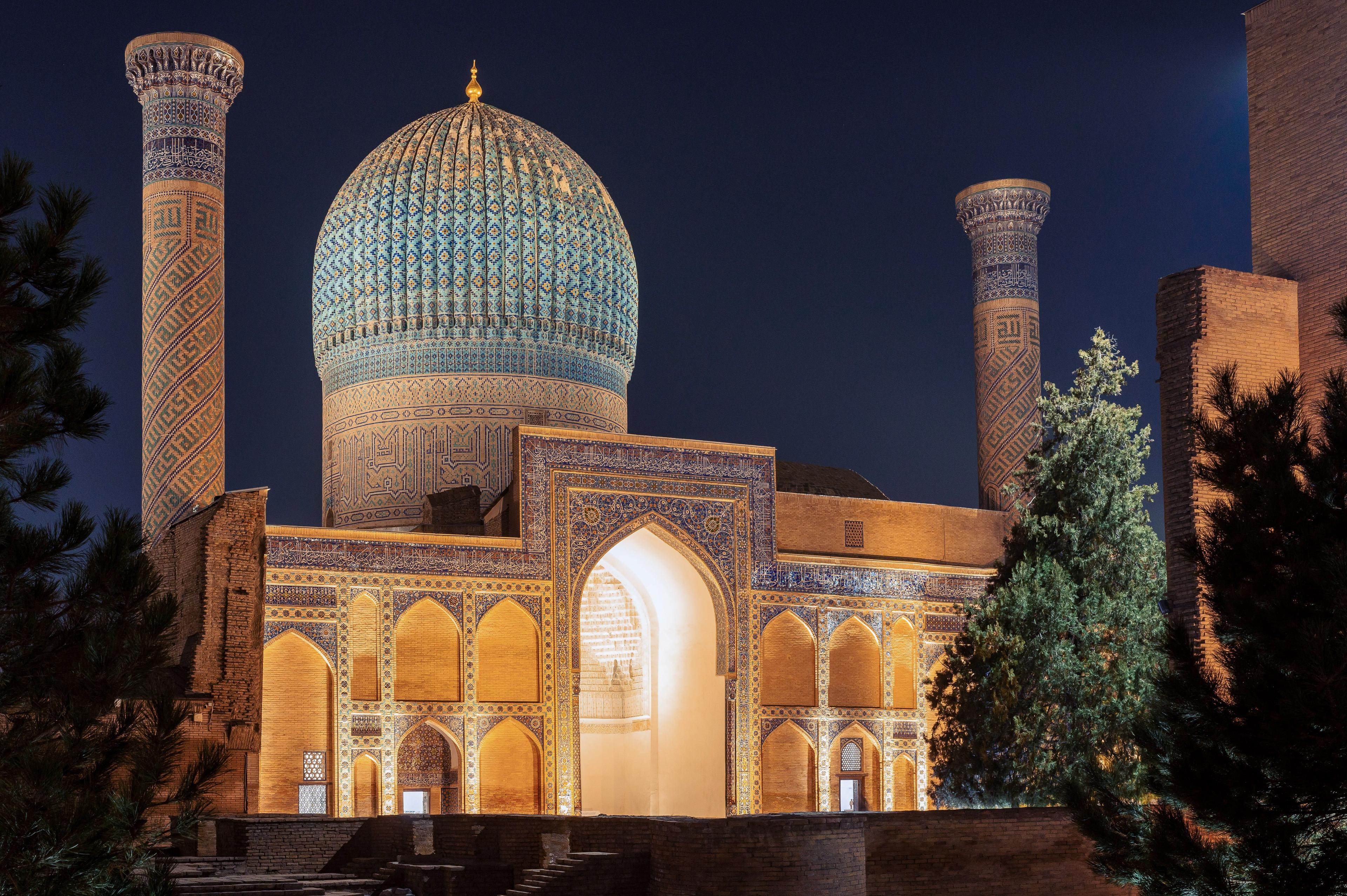
In 1399, back from his campaign in India and the sack of Delhi, Timur ordered a congregational mosque that would outshine every other in his empire. Work went on from 1399 to about 1404. Chroniclers say architects and craftsmen were brought from Iran, India and other conquered lands, and the account most often quoted says that 95 elephants hauled stone for the building. Around 500 stonemasons are said to have worked in the mountain quarries alone.
The mosque took the name of Timur's senior wife, Saray Mulk Khanum, known as Bibi-Khanym, "the elder lady". Its official name was simply the Masjid-i Jami, the Friday mosque.
The plan is the classic Persian four-iwan layout on a gigantic scale. The whole complex measured roughly 167 by 109 metres. A monumental entrance portal, originally about 35 metres high, faced a courtyard ringed by galleries on marble columns, more than 400 of them by most accounts. At the far end rose the main sanctuary under a turquoise dome about 40 metres high, with two smaller domed halls on the cross axis and minarets at the corners.
The Spanish ambassador Ruy Gonzalez de Clavijo, who reached Samarkand in 1404, left an eyewitness account of the building site. Timur, old and ill, had decided the first portal was too low and ordered it pulled down and rebuilt. He had himself carried to the site in a litter, threw meat to the workers in the foundation pits and tossed coins to the masons who pleased him.
Why Bibi-Khanym collapsed, and how it was restored
Timur's ambition outran the engineering of his time. The mosque was built at speed, on a scale at the limit of what brick and mortar could carry, in a region prone to earthquakes. Bricks were falling from the great dome within a few years of completion, and worshippers were reportedly uneasy about praying beneath it.
The decline lasted centuries:
- Repairs were abandoned by the late 16th century, and the building slowly fell into ruin.
- Local people took bricks and tiles from the crumbling walls for their own houses.
- In 1897 a strong earthquake brought down the inner arch of the main portal and parts of the domes.
- By the late 1960s only fragments stood, and scaffolding was put up simply to stop the main iwan from falling.
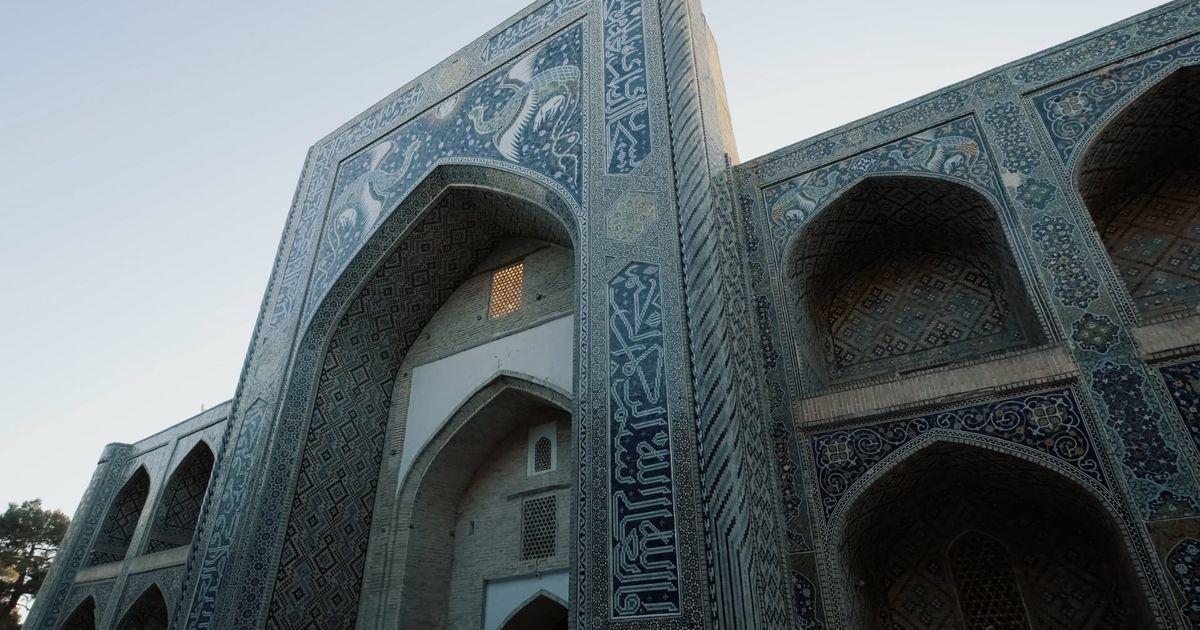
Major reconstruction began in 1974 and gathered pace after independence in 1991, with a major push in the mid-1990s; by 1999 the façade of the main portal was complete. The main portal, the sanctuary dome and the side domes were rebuilt, and much of the tilework you see is new.
That reconstruction is debated. Purists point out that parts of the mosque are now closer to a 20th-century reading of Timurid architecture than to an original, and conservation of the old fabric is still unfinished: in October 2024 the Qatar Fund for Development agreed to fund a programme of around 4.2 million US dollars, to be carried out with the Aga Khan Trust for Culture, to restore the complex. Expect scaffolding on some parts during your visit.
Our view: walk round to the back of the side halls and look at the surviving old walls. The contrast between the weathered original brick and the bright new tiles is the best history lesson the building offers.

Legends of Bibi-Khanym: the kiss and the Quran stand
Samarkand loves a story, and the mosque has two that guides always tell.
The first is the legend of the kiss. While Timur was away on campaign, Bibi-Khanym hurried to finish the mosque as a surprise. The architect, in love with her, refused to complete the great arch unless she allowed him one kiss. She offered her cheek through her hand; the kiss burned through and left a mark. When Timur returned and saw it, the architect was condemned. Some versions say he was thrown from the minaret, others that he grew wings and flew away, or was walled up in the mosque. In the most popular telling, this is why women in the region began to wear veils. It is folklore, with no historical basis, but it is part of the city's identity.
The second concerns the giant marble Quran stand in the middle of the courtyard. This lectern, about 2.3 metres long, is traditionally said to have been a gift from Ulugh Beg and once held an enormous manuscript Quran. A local belief holds that a woman who crawls beneath it will be blessed with children. You will still see women doing exactly that, so please be discreet with the camera.
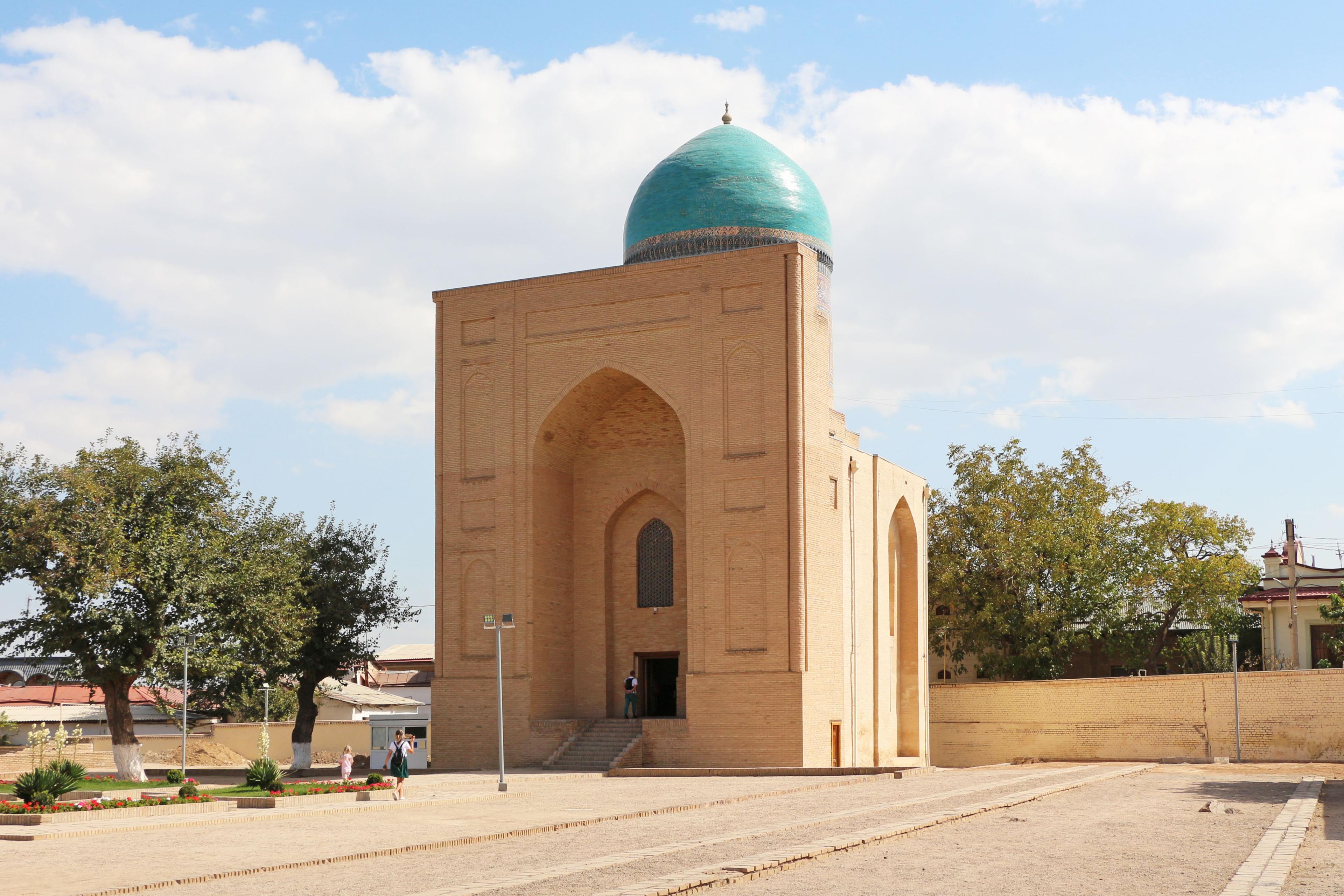
Across the street, opposite the mosque, stands a smaller domed building known as the Bibi-Khanym Mausoleum, traditionally the tomb of Saray Mulk Khanum and other women of the dynasty. It has a crypt and fine painted decoration; ask at the gate whether it is open and whether a separate ticket is needed.
Gur-e-Amir and Bibi-Khanym tickets and opening hours in 2026
Both monuments are run as museums and have their own ticket offices at the entrance. There is no single official price list online, so here is what we know as of November 2026.
- Gur-e-Amir: about 65,000 to 75,000 som for foreign adults (roughly 5.50 to 6.50 US dollars). Recent reports differ within that range.
- Bibi-Khanym Mosque: about 65,000 to 75,000 som for foreign adults, again with reports differing.
- Citizens of Uzbekistan pay a much lower local rate; children and students may be eligible for reductions.
- Payment: cash in som is the safest option. Card terminals are increasingly common but not guaranteed.
- Daytime hours: listings typically give about 9:00 to 19:00, a little shorter in winter.
- Evening hours: in September 2026 the national tourism committee announced that the Amir Temur Mausoleum and the Bibi-Khanim complex now stay open until 23:00, as part of a push for night tourism in Samarkand.
Prices in Samarkand rose sharply in 2025 and may rise again. Some reports mention a combined ticket covering the Registan, Shah-i-Zinda, Gur-e-Amir and Bibi-Khanym; we could not confirm it officially, so ask at the Registan ticket office if you plan to see all four. For live figures, check with the site on the day or ask your guide. Our guide to money in Uzbekistan explains how to carry and change cash.
Dress code: Gur-e-Amir is a mausoleum and a place of pilgrimage for many Uzbeks, so cover shoulders and knees. A light scarf is useful for women, though not usually required. Bibi-Khanym is a historic monument rather than an active mosque, but the same modest dress is appreciated. Our packing list explains what to wear in Uzbekistan.
Gur-e-Amir at night: the evening lighting
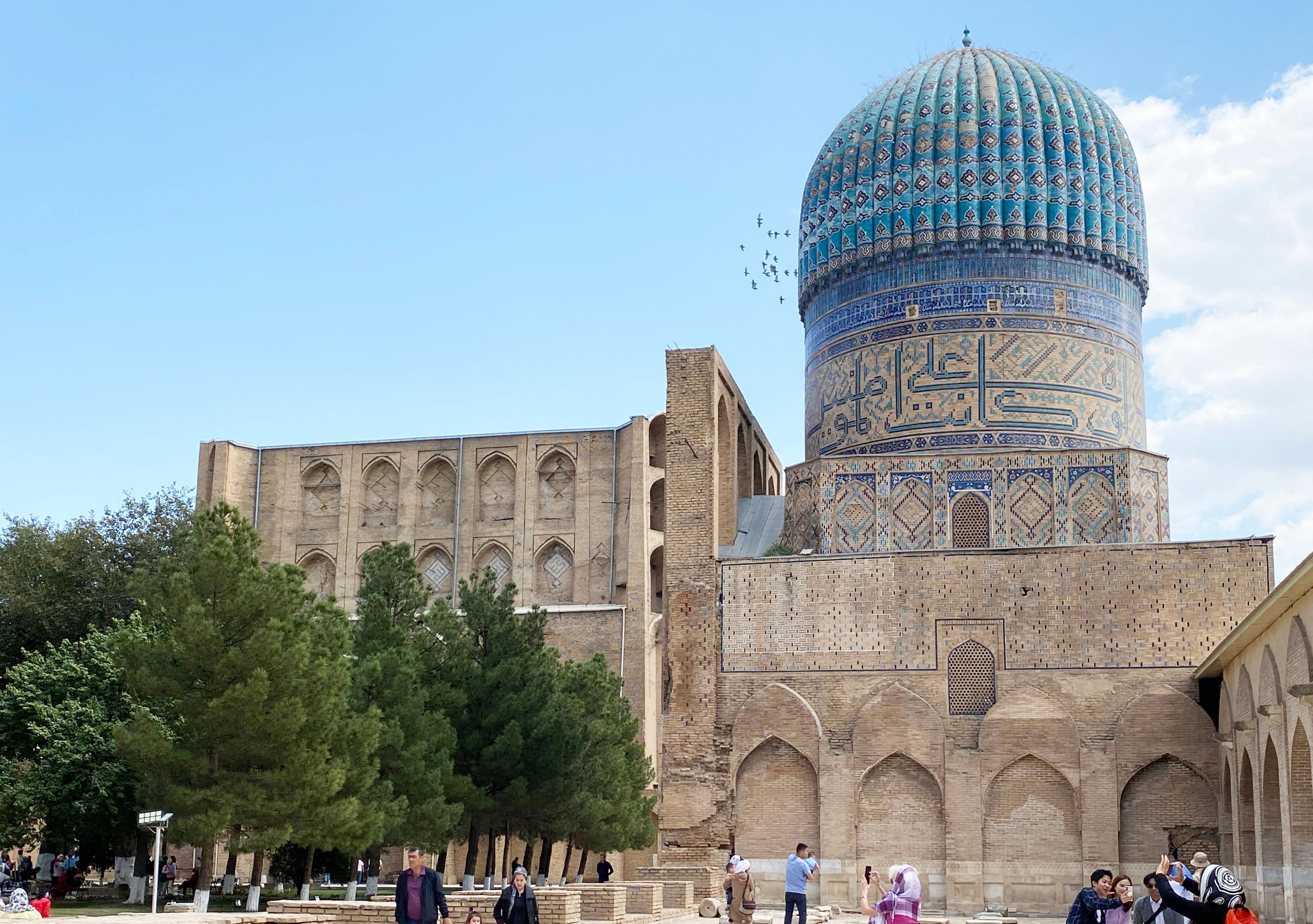
If you see only one of the two monuments after dark, make it Gur-e-Amir. In the evening the ribbed dome and the entrance portal are floodlit, the turquoise turns almost electric against the night sky, and the small square in front of the gate becomes a gathering place for local families.
A few practical tips:
- Arrive at blue hour, about 20 to 30 minutes after sunset. The sky still holds colour, the lights are on and the tiles read clearly in photographs.
- The classic view is from the square in front of the portal, with the dome framed by the gate. Walk around the outside of the complex too: the dome above the old walls is just as fine from the side streets.
- With the new evening opening, you can also step inside after dark. The gilded hall under artificial light is a different experience from the daytime visit, quieter and more intimate.
- Nearby on University Boulevard stands the large seated statue of Amir Timur, also lit in the evening.
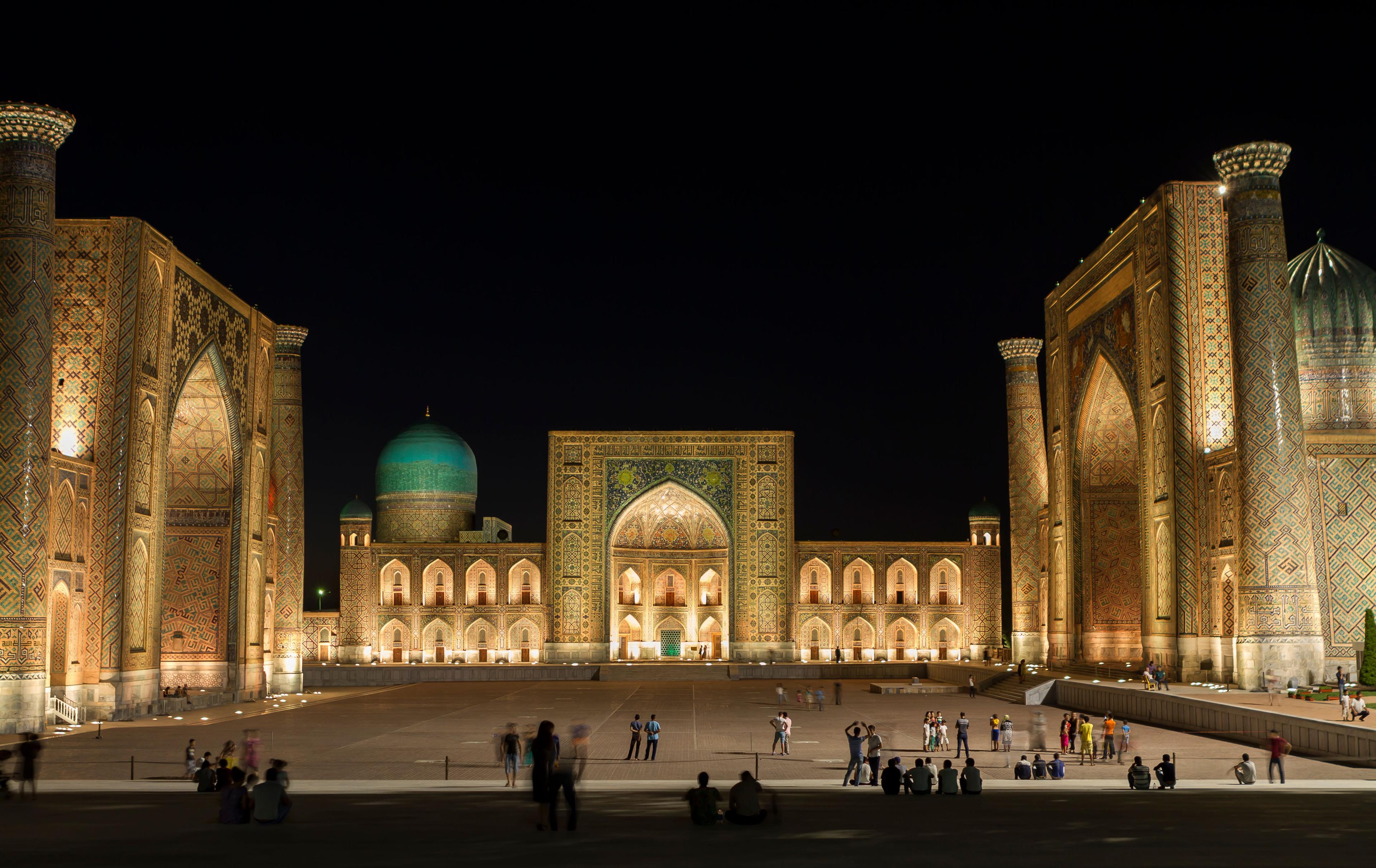
Bibi-Khanym is lit as well, and the floodlit portal is impressive from Tashkent Street, the pedestrian avenue that links it to the Registan. Many people combine the two: Gur-e-Amir at dusk, then a walk to the Registan for the evening show, then back along Tashkent Street past the illuminated mosque. Our Registan guide has the details of the evening light and music show.
In winter, lighting and evening hours can be reduced, so check locally from late November to February. Our weather by month guide helps you choose a season.
How long to spend, and how to fit them into your day
Both monuments are in the historic centre and easy to reach on foot.
- Gur-e-Amir is about a 10-minute walk south-west of the Registan, at the end of a short pedestrian street.
- Bibi-Khanym is about 10 to 15 minutes' walk north-east of the Registan along Tashkent Street, with the Siab Bazaar right beside it.
- From Bibi-Khanym it is a further 10 minutes on foot to Shah-i-Zinda.
Time needed:
- Gur-e-Amir: 45 minutes to an hour inside, plus time for the courtyard ruins. Add 20 to 30 minutes if you return in the evening.
- Bibi-Khanym: 45 minutes to an hour for the courtyard, the domed halls and a walk around the outside. Add half an hour for the mausoleum across the road and longer if you continue into the Siab Bazaar.
A classic first day in Samarkand runs like this: Gur-e-Amir in the morning, when the light is soft on the dome and before the groups arrive; then the Registan; lunch; Bibi-Khanym, the Siab Bazaar and Shah-i-Zinda in the afternoon; and back to Gur-e-Amir or the Registan after dark. If you are coming from Tashkent on the Afrosiyob train, arriving by late morning, you can still see most of this in one long day, but two days is far more comfortable. Our Samarkand travel guide and our guide to Samarkand sights beyond the Registan suggest what to add on a second or third day.
Are they worth it? Yes. Even travellers short on time should not skip Gur-e-Amir: it is small, central and quick to visit, and it is the emotional heart of the Timurid story. Bibi-Khanym is the place to understand the scale of Timur's ambition, and in the late afternoon its courtyard is one of the most peaceful spots in the old city.
Visiting Gur-e-Amir and Bibi-Khanym with TourEast
Our Samarkand guides can tell the history and the legends of both buildings side by side, and time your visit so you see Gur-e-Amir in the quiet morning and again under its evening lights. Both monuments fit easily into a Samarkand day on a small-group tour, and we can build them into a private itinerary at your own pace.