Madrasa, iwan, pishtaq, minaret, khanaka, muqarnas, girih, majolica: the words your guide uses in Samarkand, Bukhara and Khiva, explained simply, with the tilework techniques behind the blue domes and the best places to see each one.
Facts, prices and schedules checked on November 4, 2026
Islamic architecture in Uzbekistan is the reason most people come: the turquoise domes of Samarkand, the brick minaret of Bukhara, the tiled walls of Khiva. But on a guided walk the vocabulary arrives fast. Pishtaq, iwan, khanaka, muqarnas, banna'i: within an hour you have heard them all, often in the same sentence.
This guide explains those words in plain English, in a logical order: first the building types (madrasa, mosque, khanaka, mausoleum, minaret), then the parts of a building (pishtaq, iwan, dome, muqarnas), then the decoration and tile techniques (girih, banna'i, mosaic, majolica, gilding, carved plaster and wood). For each term we tell you where in Uzbekistan to see the best example, so you can spot it yourself on Registan Square or in Ichan-Kala.
A quick timeline helps. The oldest surviving monuments date from the Samanid era (9th and 10th centuries) and the Karakhanids (11th and 12th). After the Mongol destruction of the 13th century, the great building boom came under Amir Timur and his descendants, the Timurids, in the late 14th and 15th centuries. The Shaybanids and the khanates of Bukhara and Khiva continued the tradition until the 19th century.
Madrasa: the Islamic college
A madrasa is a college of religious and secular learning. Students lived in it, studied the Quran, law, grammar and, in its golden age, mathematics and astronomy.
The Central Asian madrasa follows a clear plan. You enter through a monumental portal into a square or rectangular courtyard. Around the courtyard run one or two storeys of small rooms called hujras, each the home of one or two students. In the middle of each side there is usually a large vaulted hall (an iwan), and in the corners are domed rooms: the darskhana for lectures and a small mosque. Corner towers (guldasta) often finish the outer walls.
Where to see it:
- Ulugh Beg Madrasa, Samarkand (1417 to 1420): the oldest of the three on Registan Square, built by the astronomer-ruler Ulugh Beg, where mathematics and astronomy were taught.
- Mir-i-Arab Madrasa, Bukhara (16th century): opposite the Kalyan Mosque, and still a working religious school, so visitors usually see only the entrance hall.
- Ulugh Beg Madrasa, Bukhara (1417): smaller and older-looking, a good place to see the plan without crowds.
- Muhammad Amin Khan Madrasa, Khiva (19th century): the largest madrasa in Khiva, now partly a hotel.
Many madrasas today host craft workshops in the old student cells, so you can see the hujras in use.

Mosque types: Friday mosque and neighbourhood mosque
Uzbekistan has two main types of mosque. The Friday (juma or jami) mosque is the big congregational mosque where the whole town gathered for Friday prayer. The neighbourhood mosque (guzar mosque) served a single mahalla for daily prayers and is much smaller, often with a wooden porch.
Where to see them:
- Kalyan Mosque, Bukhara: a vast Friday mosque with a courtyard framed by four iwans and a domed prayer hall, next to the Kalyan Minaret.
- Bibi-Khanym Mosque, Samarkand: Timur's colossal Friday mosque, completed in the early 15th century and heavily restored.
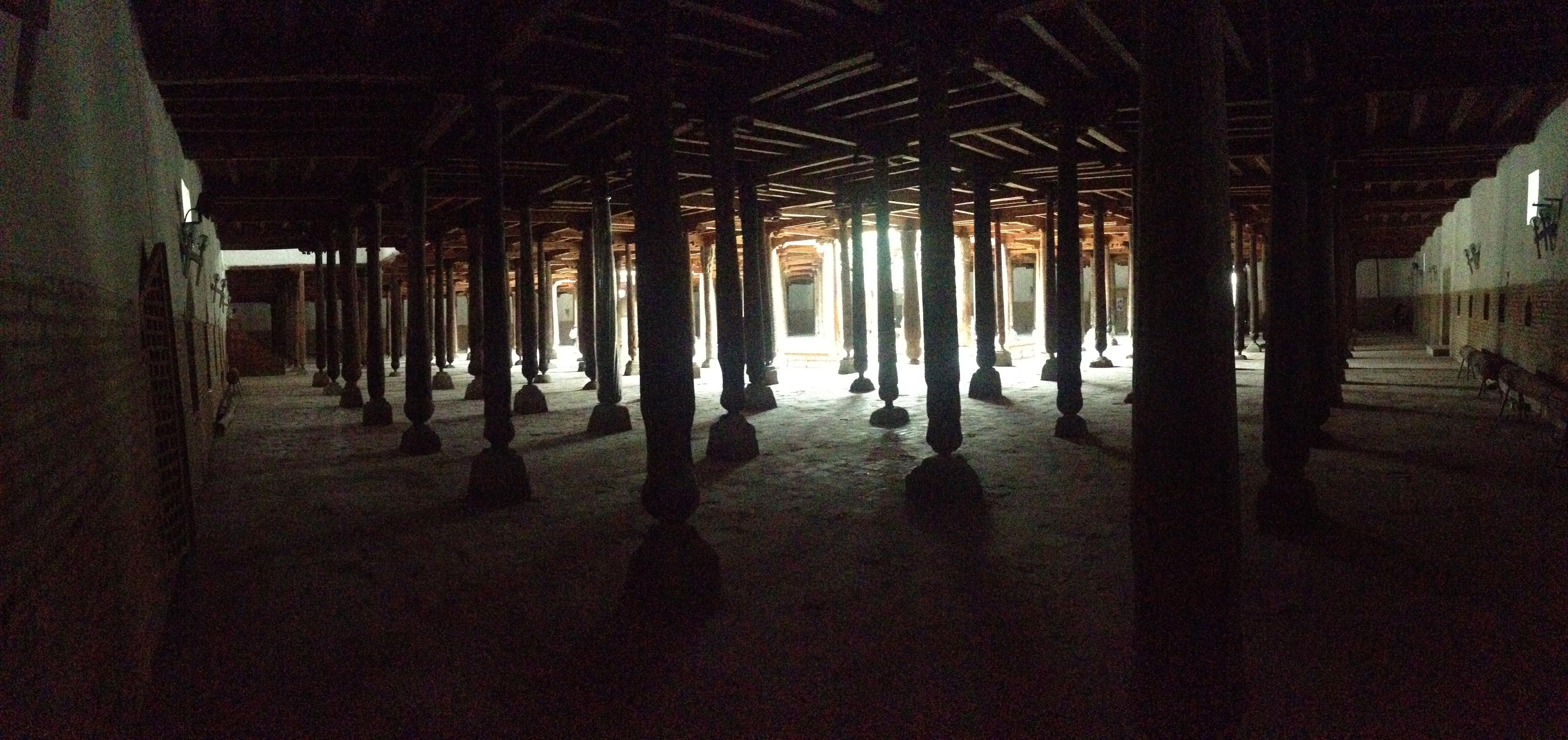
- Juma Mosque, Khiva: a completely different idea, a single flat-roofed hall supported by 212 carved wooden columns, some of them centuries older than the present building, which was rebuilt in 1788.
- Bolo Hauz Mosque, Bukhara: a neighbourhood and court mosque from the early 18th century, famous for its tall wooden porch.
When you visit a working mosque, dress modestly (shoulders and knees covered, a scarf for women) and avoid prayer times, especially at midday on Fridays.
Khanaka: the Sufi lodge
A khanaka (khanqah) is a lodge for Sufi dervishes and pilgrims, the mystical side of Islam that has been strong in Central Asia for a thousand years. The core of a khanaka is a large domed hall used for prayer and zikr, the Sufi remembrance of God through repeated phrases, sometimes with music or movement. Around it are cells where dervishes and travellers stayed.
From outside, a khanaka looks like a compact, cube-shaped building with a strong central dome and a big portal, rather than a courtyard building like a madrasa.
Where to see it:
- Nadir Divan-Begi Khanaka, Bukhara (early 17th century): on the Lyabi-Hauz pool, facing the madrasa of the same name.
- Bahauddin Naqshband complex near Bukhara: the shrine of the founder of the Naqshbandi order, with khanaka buildings and courtyards, still one of the most visited pilgrimage sites in the country.
- Faizabad Khanaka, Bukhara (late 16th century): a quieter example in the old town.
Our guide to ziyarat pilgrimage in Uzbekistan covers the Sufi shrines and visiting etiquette.
Mausoleum: from brick cube to blue dome
A mausoleum (maqbara in Arabic, gur or gumbaz locally) is a domed tomb built over the grave of a ruler, saint or scholar. Uzbekistan has some of the finest in the Islamic world, and they show the whole evolution of the style.
- Samanid Mausoleum, Bukhara (early 10th century): the oldest major Islamic monument in Central Asia, a cube under a dome, built entirely of fired brick laid in basket-weave patterns. No tiles at all, yet the play of light on the brick is extraordinary.
- Shah-i-Zinda, Samarkand (11th to 15th century): a street of mausoleums climbing a hill, an open-air museum of every tile technique the Timurids knew.
- Gur-e-Amir, Samarkand (early 15th century): the tomb of Amir Timur and his descendants, with a ribbed turquoise dome raised on a tall drum and a gilded interior.
- Pahlavan Mahmud Mausoleum, Khiva: the shrine of Khiva's patron saint, with fine 19th-century majolica inside.
The big Timurid tombs use a double dome: a low inner dome over the tomb chamber and a tall outer dome on a drum, visible from far away. Gur-e-Amir is the best place to understand it.
Minaret: towers of brick and tile
A minaret (minor in Uzbek) is the tower from which the call to prayer was once given. In Central Asia, minarets also served as landmarks and watchtowers, and they are usually round and tapering, built of brick with bands of decoration.
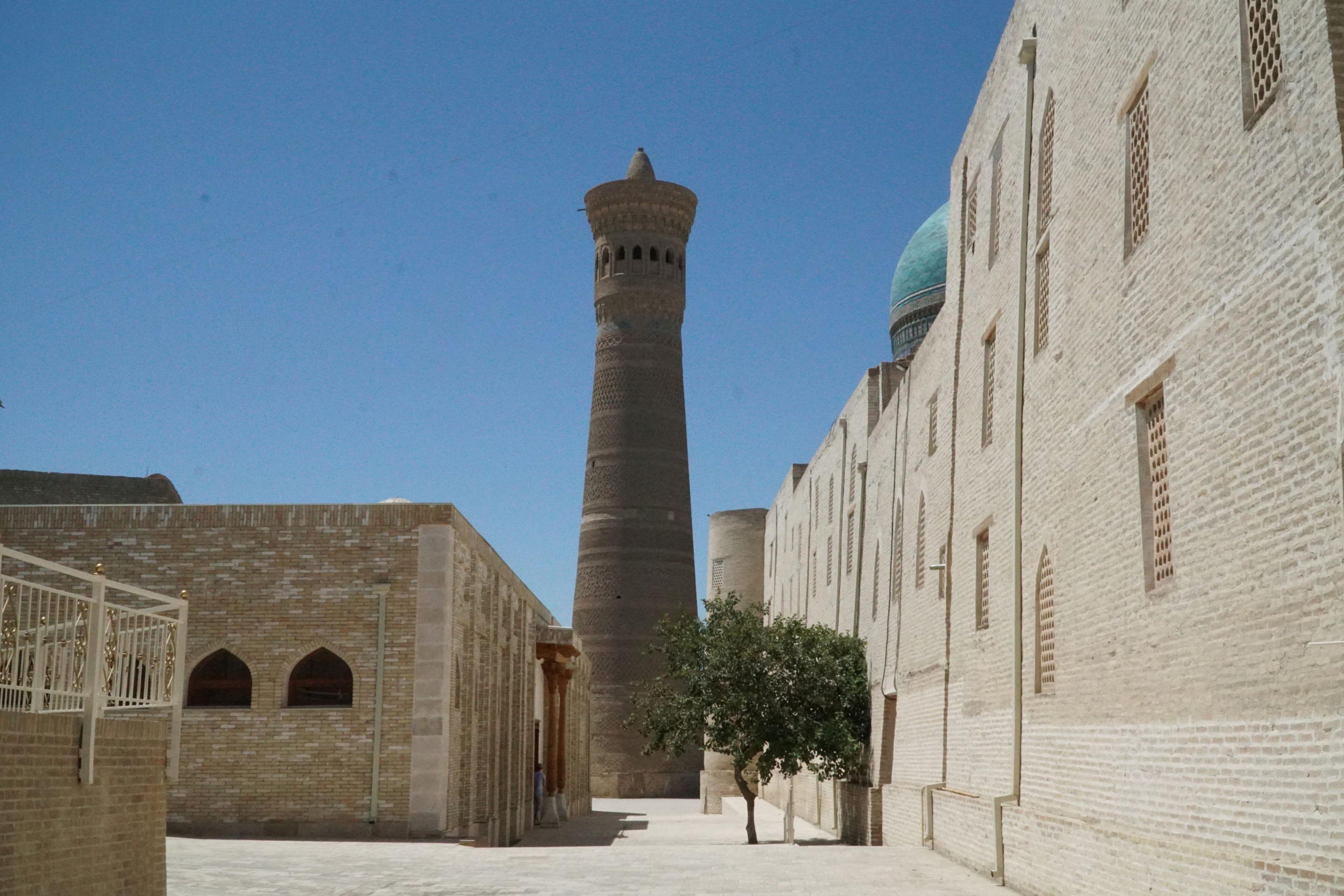
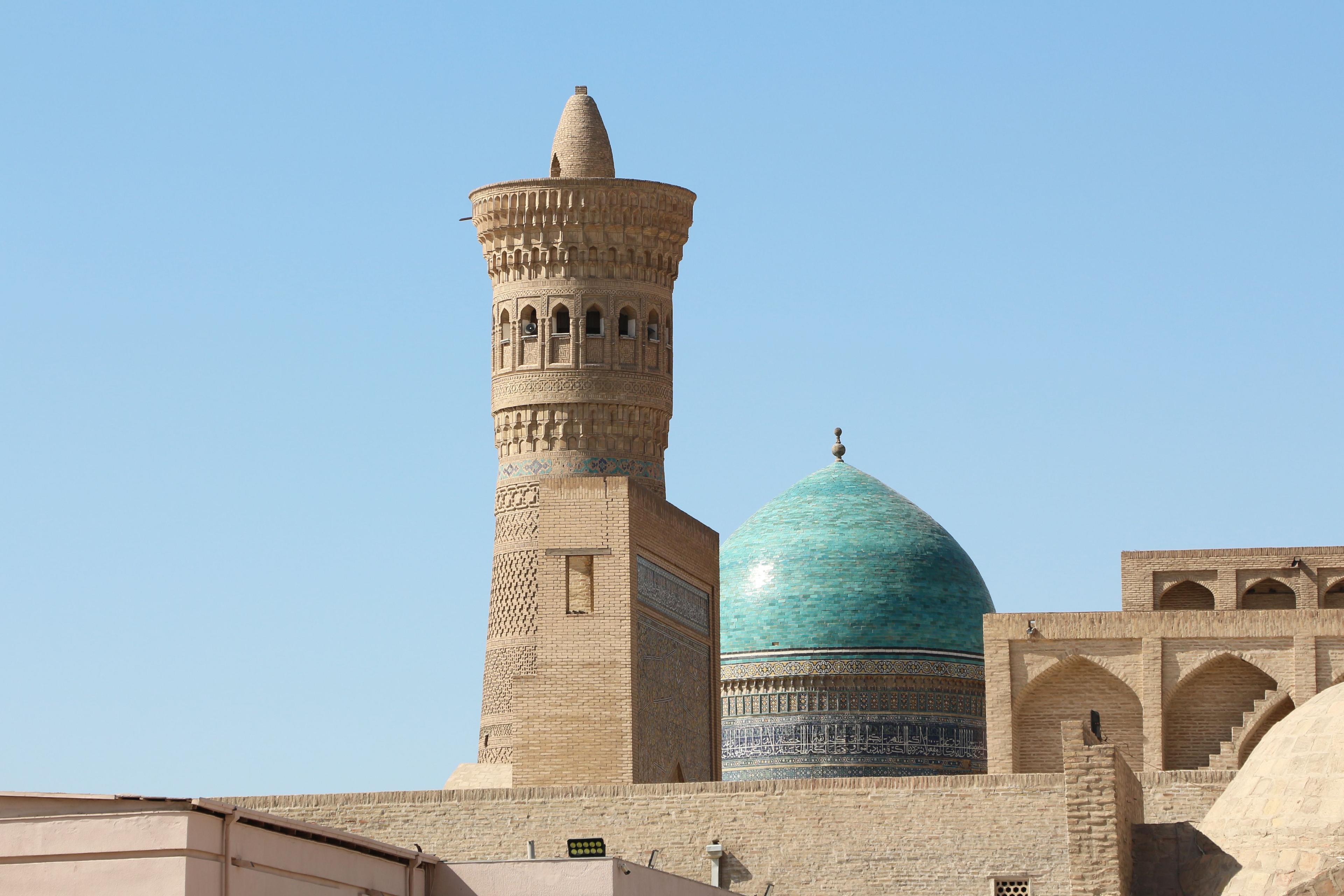
- Kalyan Minaret, Bukhara (1127): the great Karakhanid tower, about 46 metres high and around 9 metres wide at the base, decorated with bands of patterned brick and a single band of blue glazed inscription. Legend says Genghis Khan spared it when he burned the city.
- Islam Khoja Minaret, Khiva (early 20th century): the tallest in Khiva, striped with bands of turquoise and white tile.
- Kalta Minor, Khiva (19th century): a short, wide, unfinished minaret covered entirely in glazed tile, meant to be the tallest in the Islamic world before work stopped.
- The minarets of Registan Square, Samarkand: slender towers at the corners of the madrasas, some visibly leaning.
Chor Minor in Bukhara looks like a cluster of four minarets, but it is actually the gatehouse of a vanished madrasa, built in the early 19th century.

Pishtaq, iwan and muqarnas: the parts of a building
These two words come up more than any others.
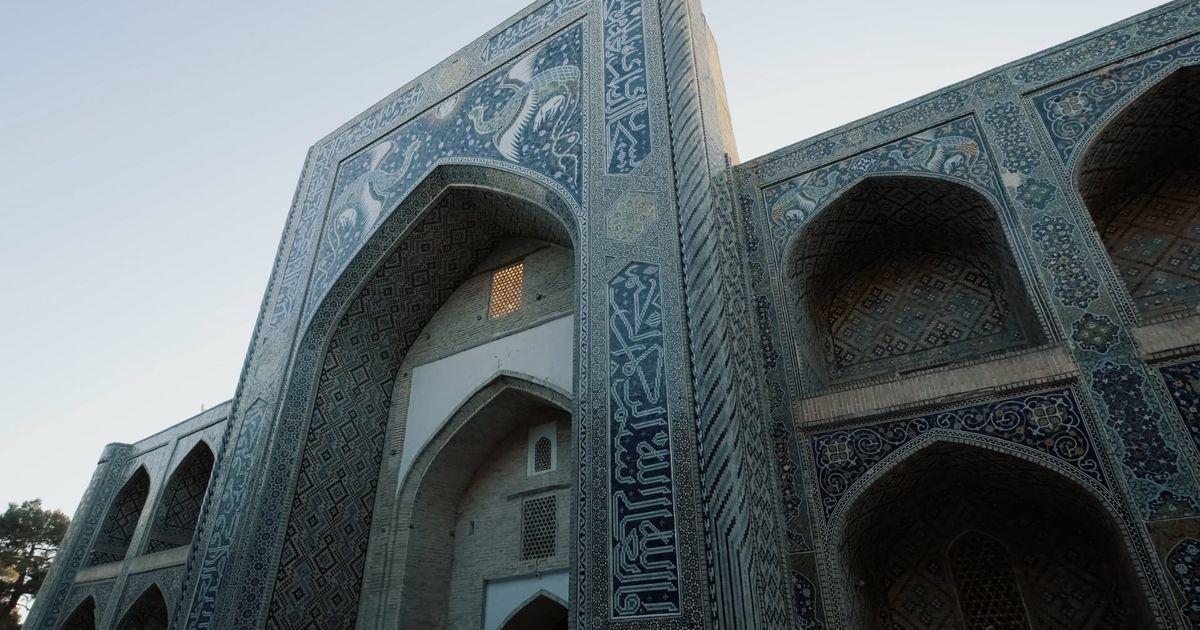
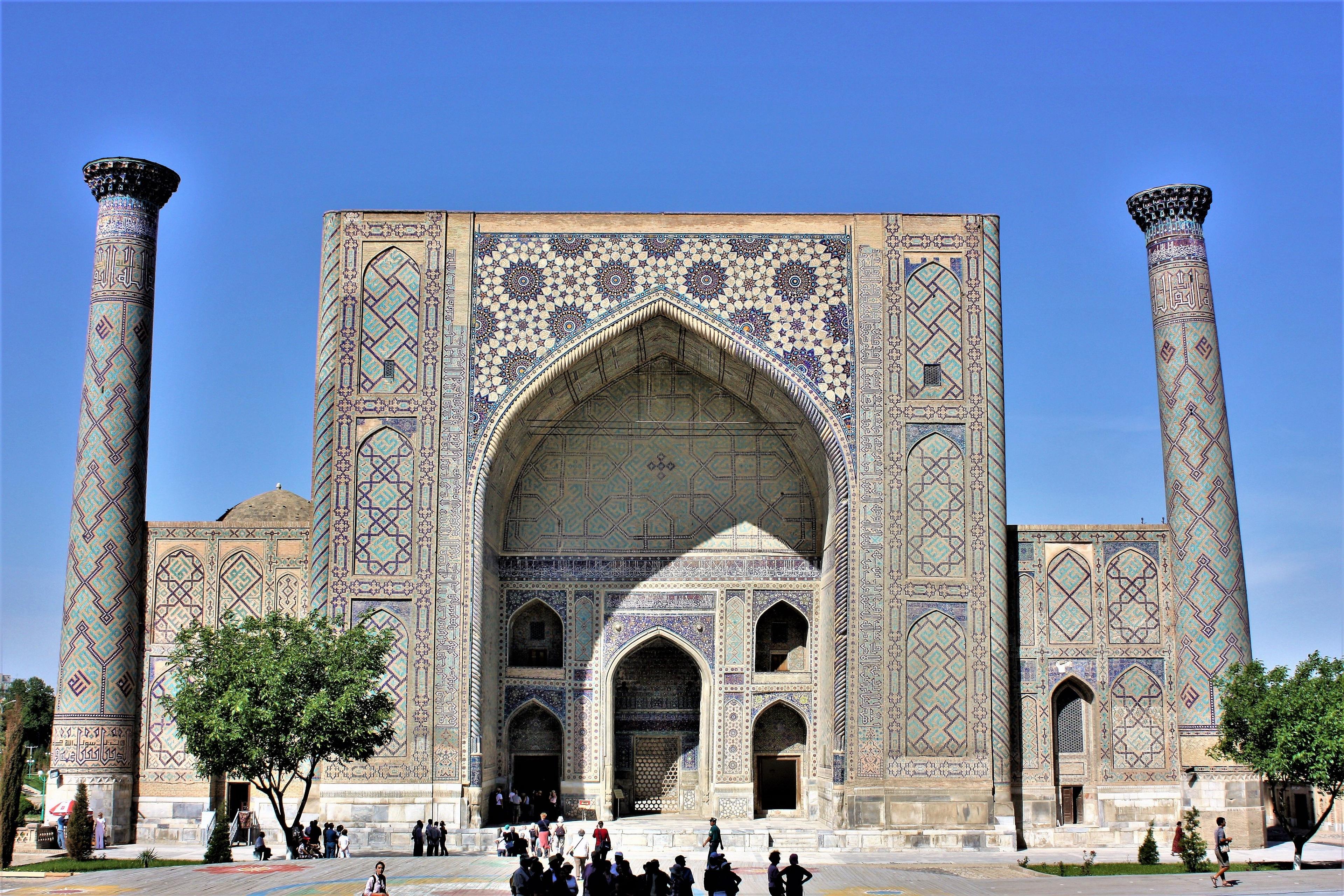
Pishtaq is the monumental portal: a tall rectangular frame rising above the roofline, with a deep pointed arch in the middle. It is a screen of prestige, covered in the richest decoration of the whole building and often flanked by minarets or slim towers. On Registan Square, all three madrasas face each other with huge pishtaqs; the Sher-Dor Madrasa portal, with its tigers chasing deer under a human-faced sun, is the most photographed.
The largest pishtaq ever attempted in the region was Timur's Ak-Saray Palace in Shakhrisabz. Only the broken stumps of the entrance survive, and they are still enormous.
Iwan (aivan in Uzbek) has two meanings. In Persian architecture it is a vaulted hall walled on three sides and open on the fourth, usually facing a courtyard; a classic mosque or madrasa has four of them, one on each side (the four-iwan plan, best seen in the Kalyan Mosque courtyard). In everyday Uzbek, an aivan is also a wooden porch or veranda with carved columns, used for summer prayer or as a shaded terrace in a house.
Where to see the wooden aivan: the Bolo Hauz Mosque in Bukhara, the summer mosque in the Kunya-Ark of Khiva and almost any traditional courtyard house.
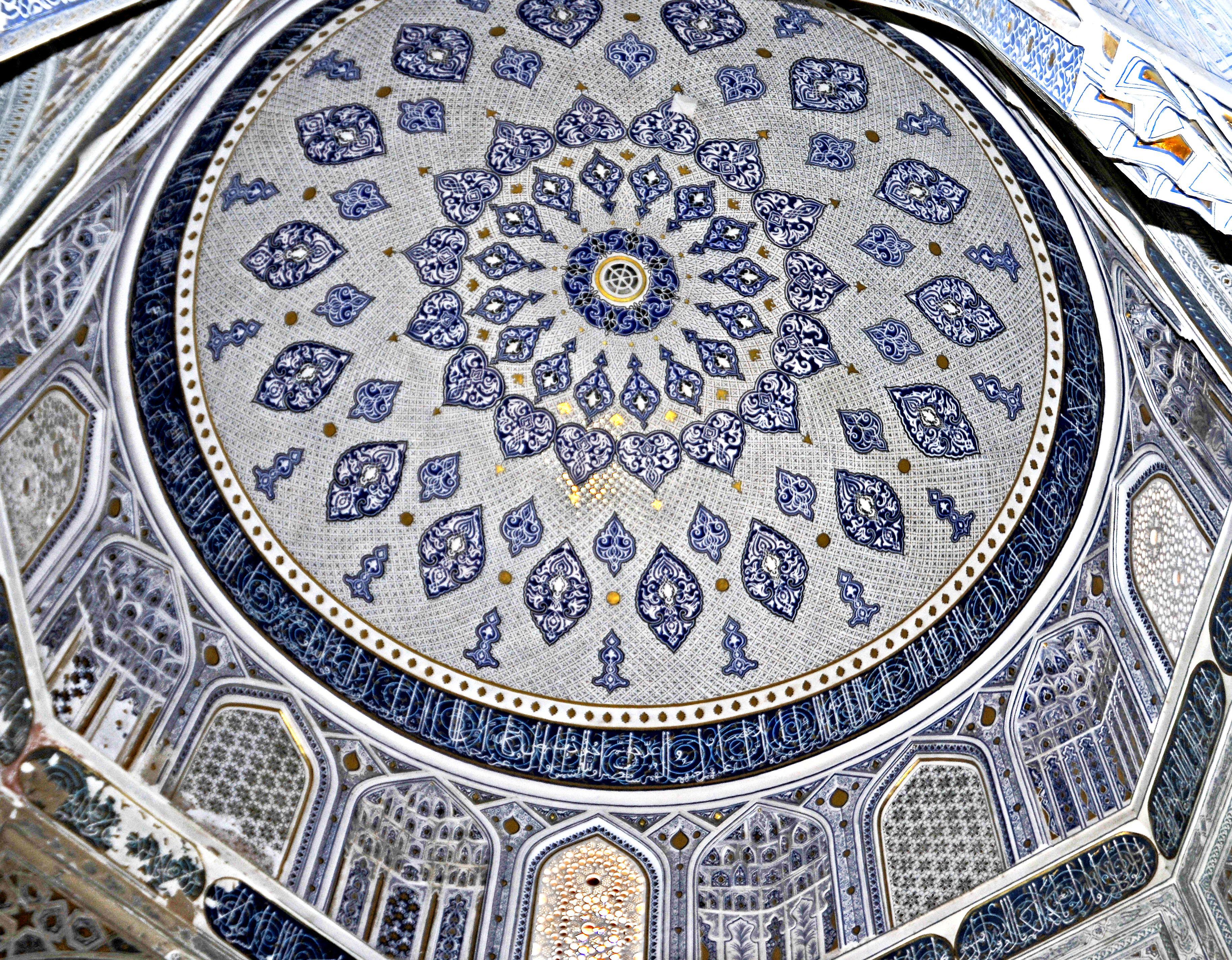
The central technical problem of Islamic architecture is how to put a round dome on a square room. The answer is a zone of transition, and the most beautiful solution is muqarnas.
Muqarnas is a three-dimensional honeycomb or stalactite vaulting made of many small niches arranged in tiers, each projecting a little beyond the one below. It turns a sharp corner into a curved surface and catches light in a thousand facets. Muqarnas can be built of brick, carved in plaster or covered in tile.
Where to see it:
- The portals of Gur-e-Amir and of several mausoleums at Shah-i-Zinda, where the half-domes inside the pishtaq are filled with tiled muqarnas.
- The Ulugh Beg Madrasa portal on Registan Square.
- The interiors of many mosques and tombs, where plaster muqarnas fill the corners under the dome.
Look up when you step under any big Timurid portal: the muqarnas is usually right above your head.
Girih and other patterns
Girih (Persian for 'knot') is the geometric strapwork you see everywhere: interlaced lines forming stars and polygons, typically with 8, 10 or 12 points, repeating across a wall. Craftsmen built these patterns from a set of standard shapes, and the mathematics behind them is sophisticated enough to interest modern scientists.
Three families of ornament share the walls:
- Girih: geometric star patterns, often on portals and vaults. The pishtaq of the Ulugh Beg Madrasa in Samarkand has a famous field of star motifs.
- Islimi: flowing plant scrolls, vines, leaves and flowers, often in white and blue on the tile panels.
- Calligraphy: Quranic verses and dedications, from angular square Kufic woven into brick walls to flowing thuluth script around portals and drums.
In Uzbek, the general term for ornament is naqsh, and you will hear guides use it for all three.
Tilework techniques: banna'i, carved tile and mosaic
The blue of Samarkand is not one technique but several, and spotting the difference makes any visit richer.
- Brick patterning: the oldest decoration, using unglazed fired brick laid in patterns. The Samanid Mausoleum and the Kalyan Minaret in Bukhara are the masterpieces.
- Banna'i ('builder's technique'): glazed bricks, usually turquoise, dark blue and white, set among plain bricks to form big geometric patterns and square Kufic inscriptions. It was relatively cheap and covered large surfaces quickly. Look for it on the side walls and minarets of Registan Square and Bibi-Khanym.
- Carved glazed terracotta: terracotta panels carved in relief and then glazed, giving deep, sculptural ornament. The 14th-century mausoleums at Shah-i-Zinda have the finest examples.
- Cut-tile mosaic: large tiles of single colours are fired, then cut into small pieces and fitted together like a jigsaw to form complex patterns, with no colours running into each other. The Timurids perfected it; the Tuman Aka mausoleum (1405) at Shah-i-Zinda and the Ulugh Beg Madrasa show it at its best.
- Cuerda seca and painted tiles: several colours painted on one tile, separated by greasy lines that keep them apart in the kiln. Quicker than mosaic, and common from the 16th and 17th centuries, for example on the Sher-Dor Madrasa.
Shah-i-Zinda is the best single place to compare them, because mausoleums of different decades stand side by side.
Majolica, gilding, ganch and carved wood
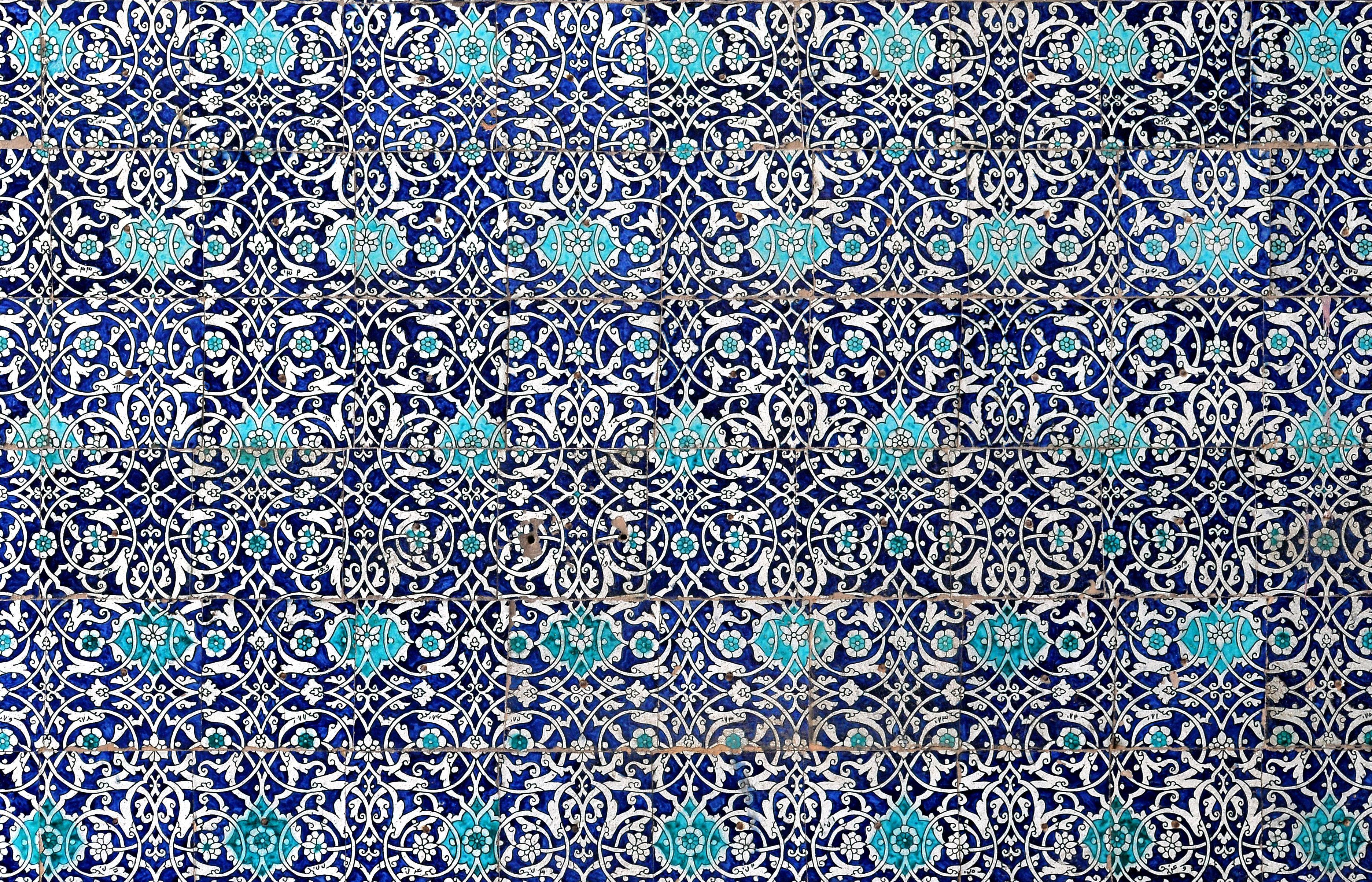
Majolica is the word guides in Uzbekistan use for glazed, hand-painted ceramic tiles, especially the cobalt-blue and white tiles of 19th-century Khiva. The pattern is painted on the tile and sealed under a glaze, so it survives the desert sun. Each tile is part of a larger repeating design, and in Khiva the workshops developed a recognisable palette of deep blue, white and turquoise with fine plant scrolls.
Where to see it: the Tash-Hauli Palace in Ichan-Kala, where the harem courtyard is lined with majolica panels; the Kalta Minor; and the interior of the Pahlavan Mahmud Mausoleum.
Three more crafts complete the picture:
- Kundal (gilding): a raised relief painted with gold, used in the most lavish interiors. The prayer hall of the Tilla-Kari Madrasa on Registan Square (mid-17th century) and the tomb chamber of Gur-e-Amir glow with it.
- Ganch: carved and sometimes painted gypsum plaster, used for interior walls, niches and window screens. The Sitorai Mohi-Khosa summer palace near Bukhara has superb late examples.
- Carved wood: columns, doors and ceilings carved with deep relief patterns. Khiva is the centre of the tradition, from the forest of columns in the Juma Mosque to the carved doors along every street of Ichan-Kala.
Many of these crafts are still alive. In Bukhara, Khiva and Samarkand you can watch woodcarvers, ganch carvers and tile painters at work; see our guide to Uzbek crafts and souvenirs.
Where to see the best Islamic architecture in Uzbekistan
If you have limited time, these are the places that show the most:
- Samarkand: Registan Square (madrasas, pishtaq, girih, banna'i), Shah-i-Zinda (every tile technique), Gur-e-Amir (double dome, muqarnas, gilding), Bibi-Khanym (Timurid scale).
- Bukhara: the Samanid Mausoleum (brick), the Po-i-Kalyan ensemble with the Kalyan Minaret and Mosque (four-iwan plan), Lyabi-Hauz with its khanaka, Bolo Hauz (wooden aivan), Chor Minor.
- Khiva: Ichan-Kala as a whole, the Juma Mosque (wooden columns), Tash-Hauli (majolica), Kalta Minor and Islam Khoja Minaret.
- Shakhrisabz: the Ak-Saray portal ruins and the Dorut Tilavat complex, a day trip from Samarkand.
Morning light is best on the Registan facades and Shah-i-Zinda; late afternoon light warms the brick of Bukhara and the walls of Khiva.
Seeing it with a guide from TourEast
Our guides in Samarkand, Bukhara and Khiva can explain all of this on site, and for travellers with a special interest we can plan an architecture-focused private tour with longer visits, craft workshops and quieter early-morning times at the main monuments.