Bukhara's favourite square and the 16th-century domed bazaars beyond it: Nadir Divan-Begi, Kukeldash, Magoki-Attori, Toki Zargaron, the Tim of Abdullakhan and Chor-Minor, with what to buy, what is free and how to spend an evening by the pool.
Facts, prices and schedules checked on November 4, 2026
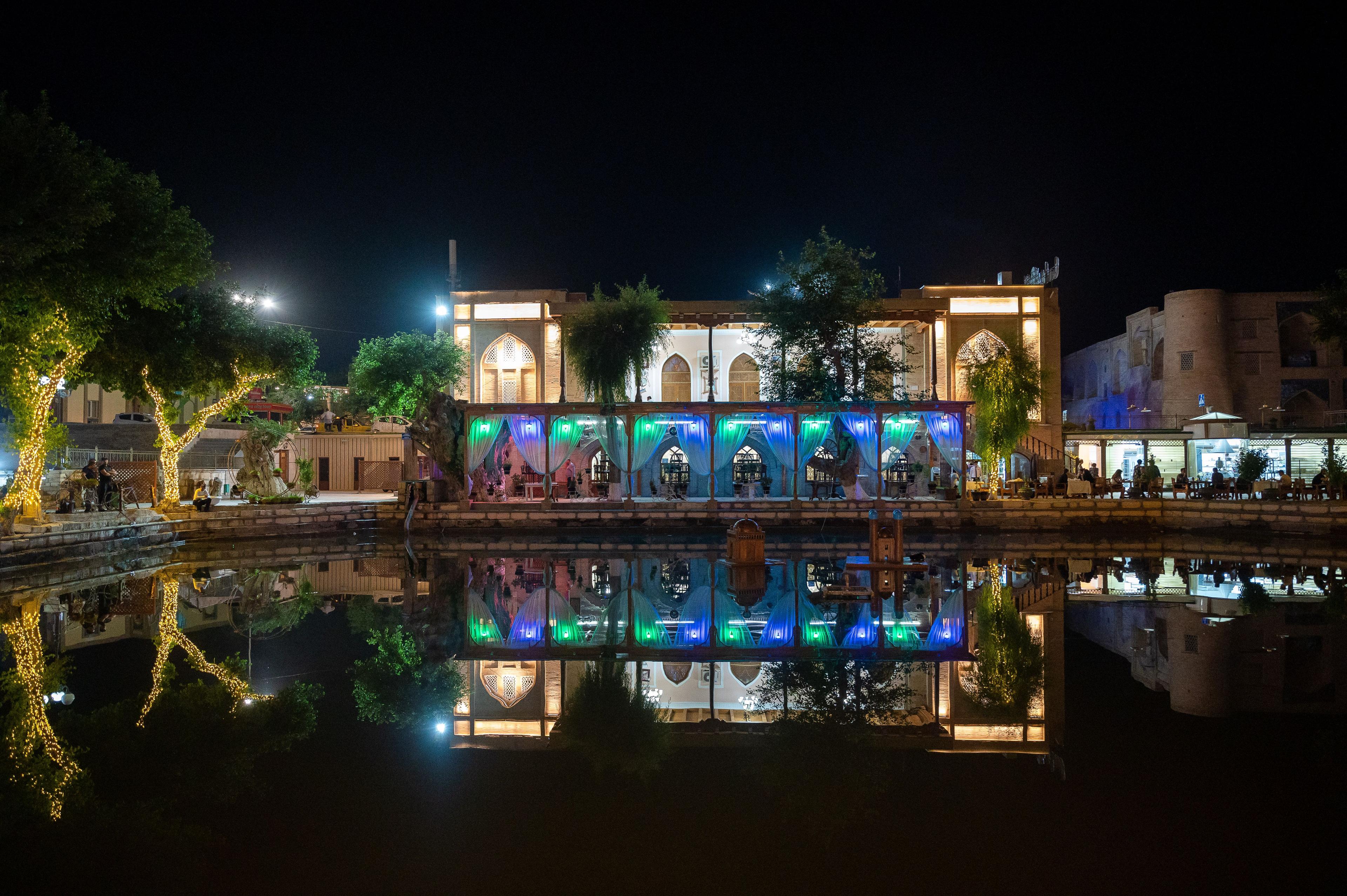
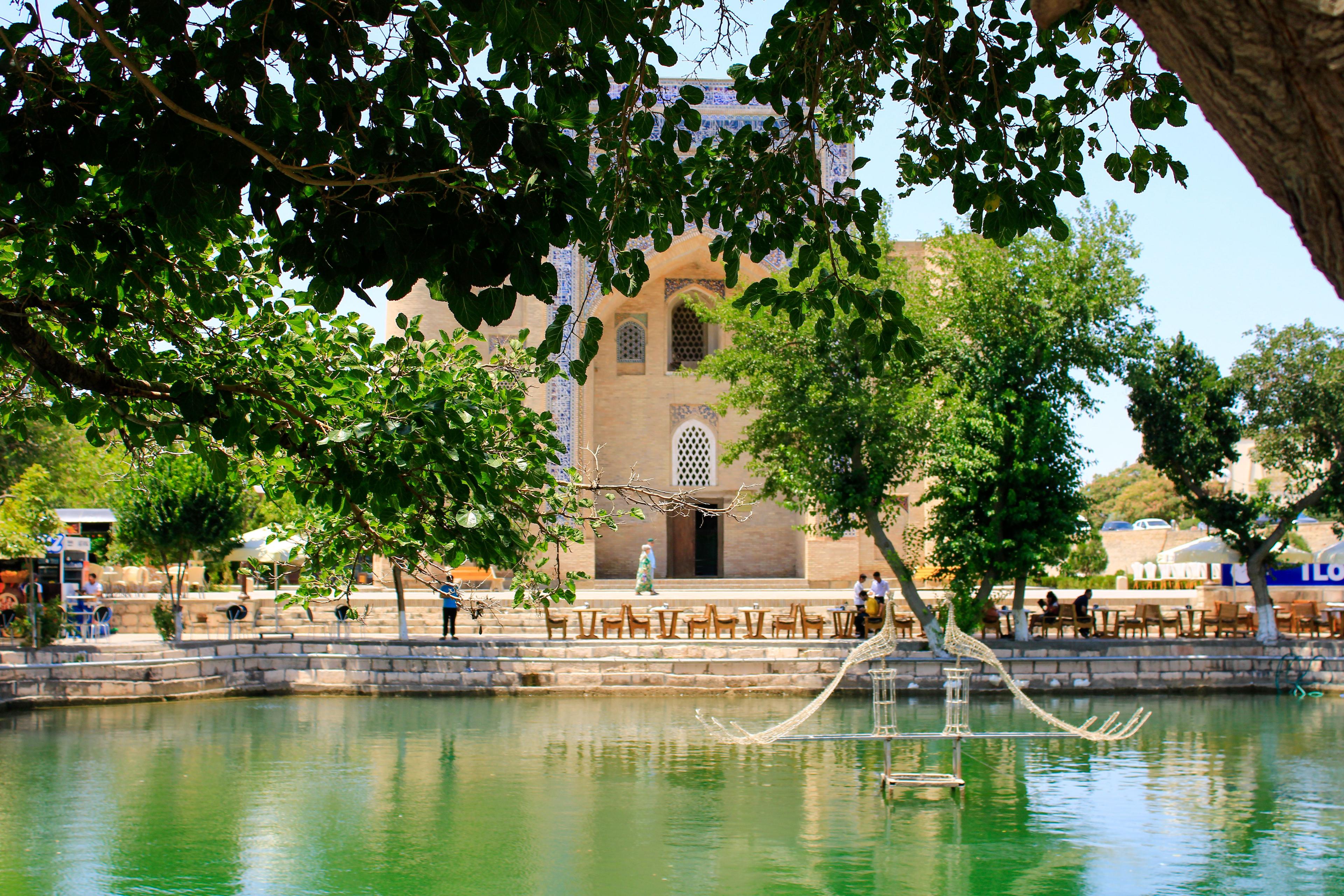
Lyabi-Hauz is where Bukhara (Buxoro) gathers. Old mulberry trees lean over a stone-lined pool, teahouse tables fill its edges, and three buildings from the 16th and 17th centuries frame the square. From here a single lane runs west under a chain of domed bazaars that have traded without interruption for more than four centuries.
This guide covers the eastern half of the old town: Lyabi-Hauz itself, the Nadir Divan-Begi Madrasah and Khanaka, the Kukeldash Madrasah, the Magoki-Attori Mosque, the trading domes (Toki Sarrafon, Toki Telpak Furushon and Toki Zargaron) with the Tim of Abdullakhan between them, and the four-towered Chor-Minor a short walk away. We also explain what each dome sold, what you can buy there now, what costs money and what is free, and how to spend an evening at the pool.
The western half of the walk, the Ark Fortress and Po-i-Kalyan, has its own guide, and our Bukhara travel guide covers the city as a whole.
Lyabi-Hauz: the pool and the Kukeldash Madrasah
The name means "by the pool". Before the 20th century Bukhara drew its drinking water from dozens of these stone reservoirs, the hauz, fed by canals from the Zarafshan river. They were also a source of disease, and most were drained and filled in during the 1920s and 1930s. Lyabi-Hauz survived because it was the centrepiece of an ensemble that had barely changed since it was built.
The pool was dug around 1620 on the orders of Nadir Divan-Begi, the vizier of Imam Quli Khan, who ruled Bukhara from 1611 to 1642. It measures roughly 46 by 36 metres, with stepped stone sides running down to the water. Local stories say Nadir had to buy out, or simply force out, the owner of a house that stood on the site, which is why the pool was once also nicknamed the "pool made by force". Treat that as folklore.
On the north side stands the Kukeldash Madrasah, the oldest and largest building of the ensemble. It was built in 1568 and 1569, under the Shaybanid ruler Abdullah Khan II, by his powerful courtier Kulbaba Kukeldash. At about 80 by 60 metres, with some 160 student cells on two floors, it is the largest madrasah in Bukhara. Strictly speaking it predates the pool by half a century, so it is a neighbour of Lyabi-Hauz rather than part of the original plan.
Look at the brick mosaic in the portal and the carved wooden doors. Part of the building has been used as a literary museum dedicated to the writers Sadriddin Ayni and Jalol Ikromiy, and some cells hold craft shops. Opening of the interior has varied with restoration work, so ask on the day.
The bronze statue of Khoja Nasreddin on his donkey, in front of the Nadir Divan-Begi Madrasah, is modern: it was made by the sculptor Yakov Shapiro and installed in 1979. Nasreddin is the wise fool of countless stories told from Turkey to China.
Nadir Divan-Begi Madrasah and Khanaka
Nadir Divan-Begi built two monuments facing each other across the water, and they are why most visitors' cameras come out.
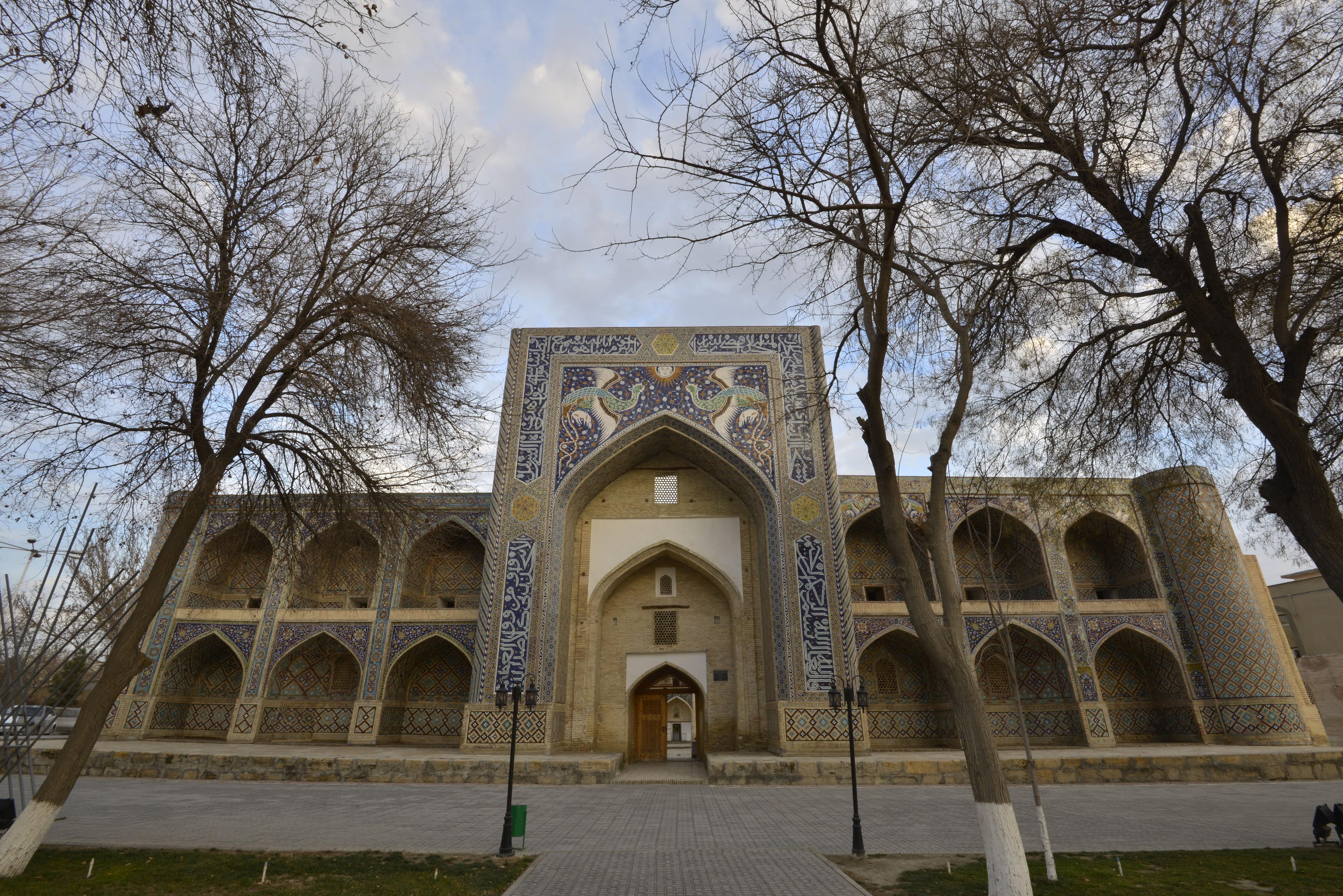
The khanaka, on the west side of the pool, came first, dated to 1619 and 1620. A khanaka is a Sufi lodge: a domed hall for prayer and gatherings, with cells for wandering dervishes around it. Its tall portal faces east across the water and is reflected in the pool, best in morning light.
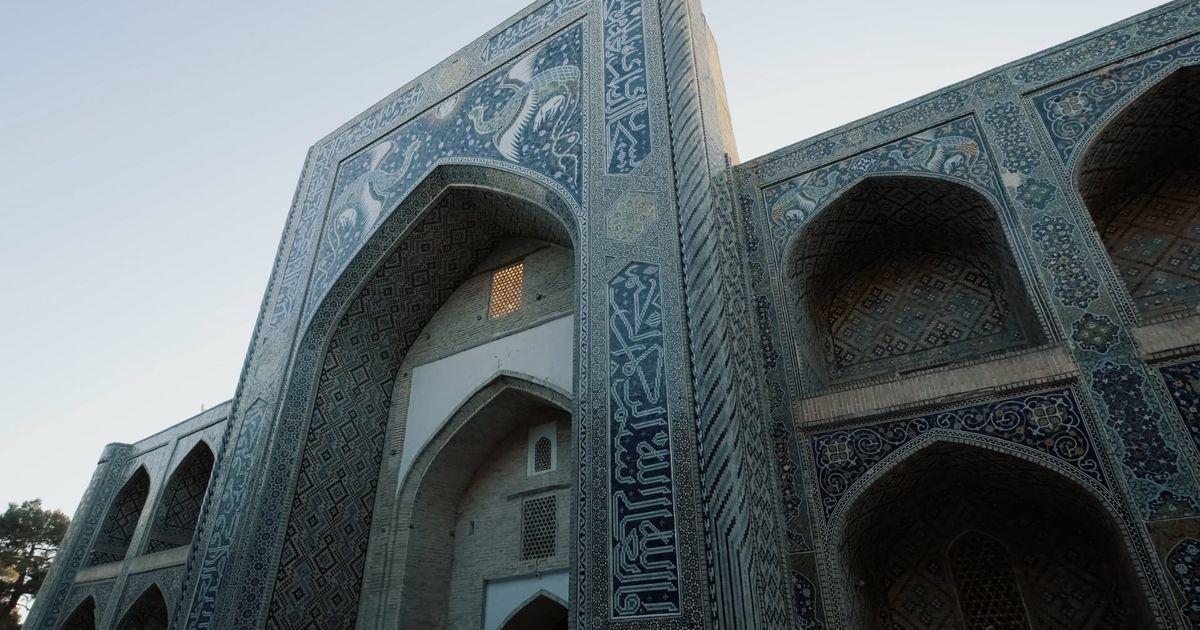
The madrasah, on the east side, followed in 1622 and 1623. A popular story says Nadir built it as a caravanserai, and that at the opening Imam Quli Khan praised it as a fine madrasah, leaving the vizier no choice but to turn it into one. Whether or not that happened, the building does have a caravanserai's layout, with no lecture halls or mosque.
The reason to look up is the portal mosaic. Two mythical birds, usually identified as the simurgh, fly towards a sun with a human face, each carrying a white animal in its claws (described as a deer or a lamb, depending on the source). Images of living creatures are rare on Islamic religious buildings, and this is one of the few in Central Asia, along with the tiger-lions of the Sher-Dor Madrasah on the Registan. Interpretations range from Persian legend to older Zoroastrian sun symbolism.
In the tourist season the madrasah courtyard hosts an evening folklore and fashion show, described in the section on evenings below. During the day the cells around the courtyard are craft and clothing shops, and you can step in to see the courtyard without a ticket.
How to walk the trading domes from Lyabi-Hauz
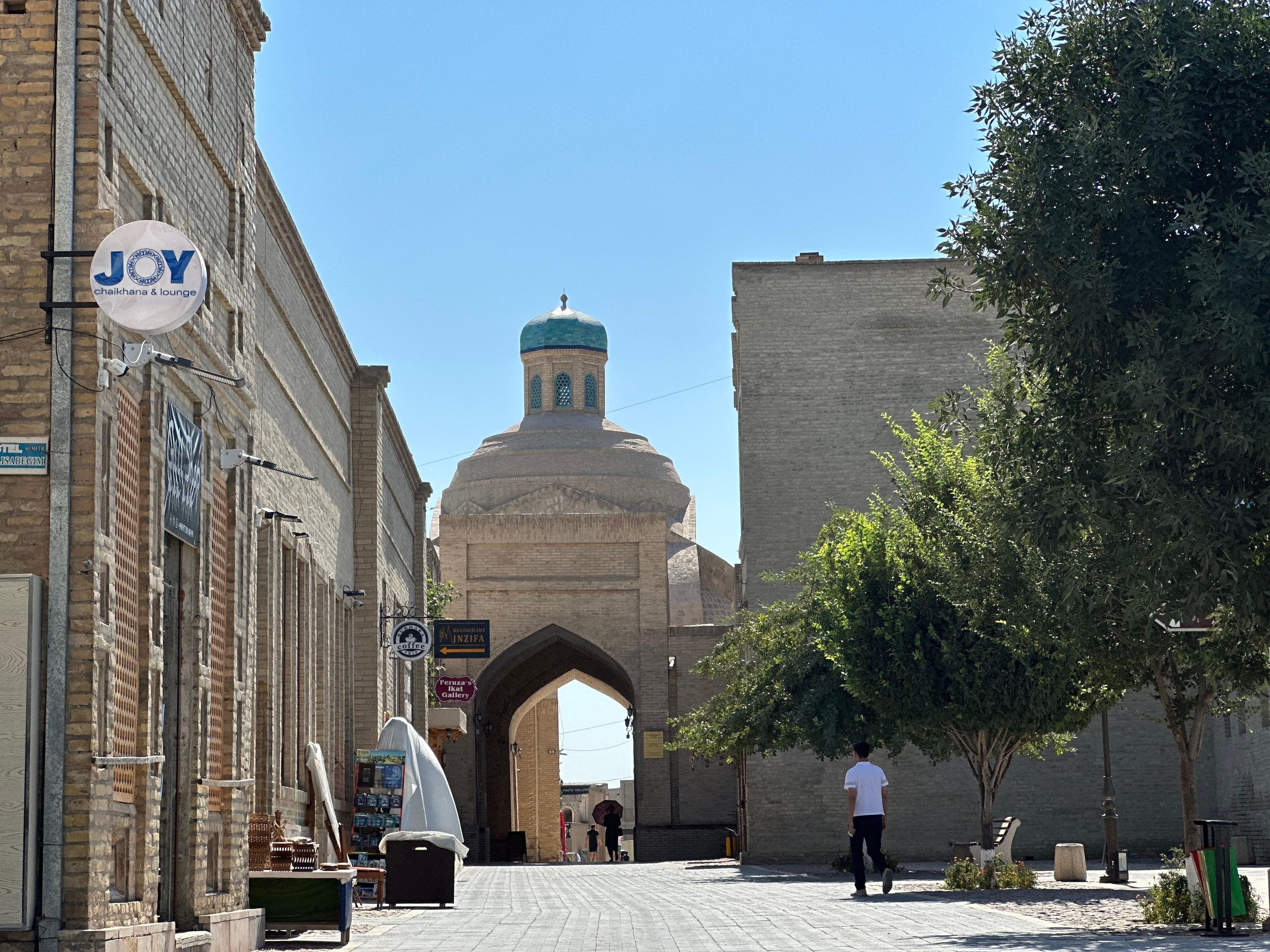
In the 16th century Bukhara was the capital of the Shaybanid state and one of the great markets of Central Asia. Its rulers covered the busiest crossroads of the bazaar with brick domes, called toki (singular tok or toq), so that trade could go on in the shade. Each dome specialised in one business. Of the many that once existed, three domes and one covered hall, the tim, survive, along a single lane that runs west from Lyabi-Hauz towards the Po-i-Kalyan.
The route is short and flat, and almost entirely pedestrian:
- Lyabi-Hauz to Toki Sarrafon: about 3 minutes' walk west.
- Toki Sarrafon to Magoki-Attori Mosque: a minute's detour to the south-west.
- On to Toki Telpak Furushon: about 3 to 5 minutes north-west.
- Tim of Abdullakhan: just off the lane between Toki Telpak Furushon and Toki Zargaron.
- Toki Zargaron: the last dome, about 15 minutes' walk from Lyabi-Hauz at a gentle pace.
- From Toki Zargaron, the Ulugbek and Abdulaziz Khan madrasahs and then the Kalyan Minaret are a few minutes further on.
Walked without stopping, the whole stretch takes 15 to 20 minutes. With time to look inside each dome and the mosque, plan for two hours; if you shop, it will take longer. The domes are not museums: there are no tickets and no gates, and the lane is a public street.
Toki Sarrafon and the Magoki-Attori Mosque
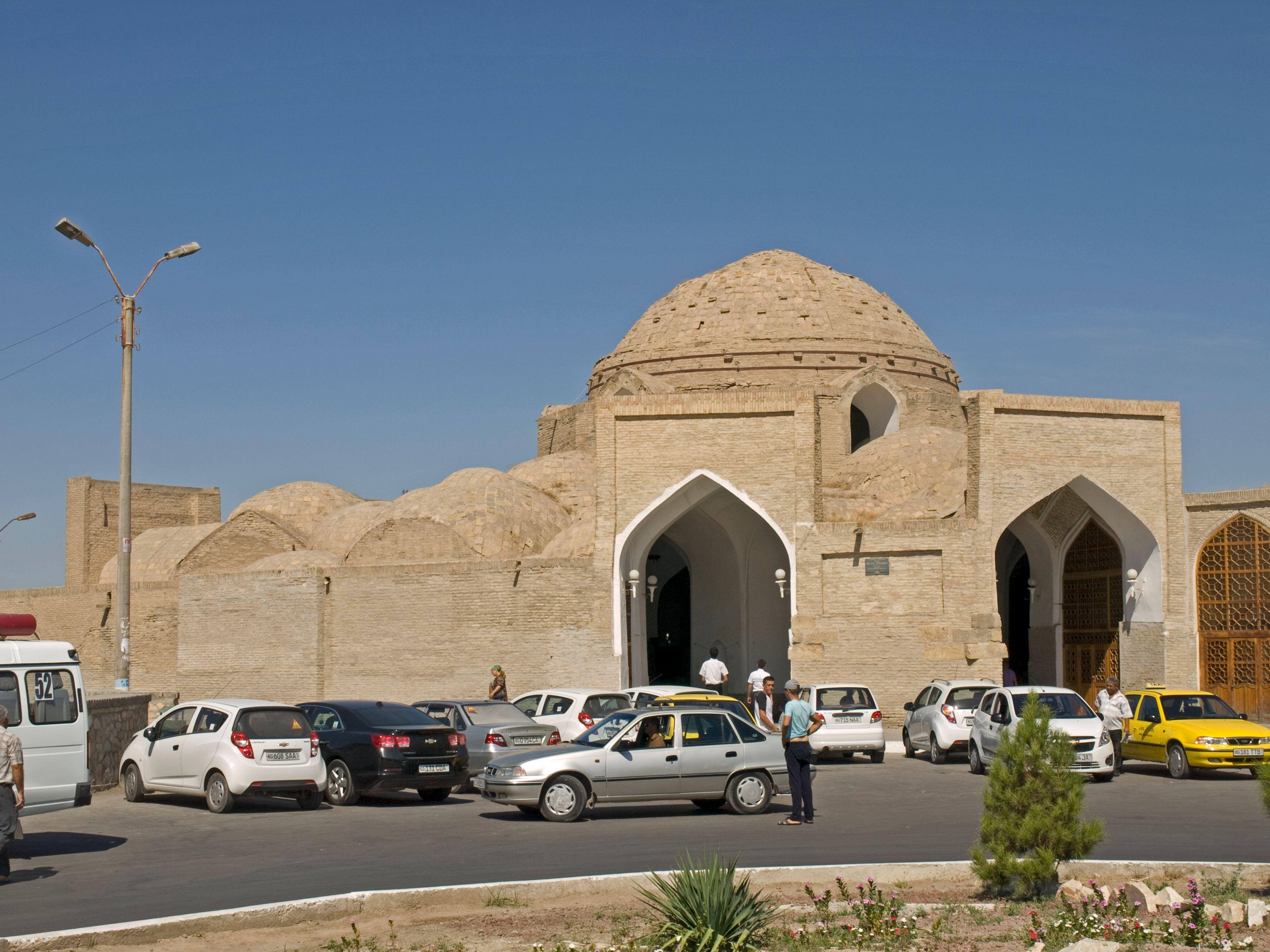
Toki Sarrafon, the money changers' dome, is the oldest of the three. It was completed in 1534 and 1535 under the Shaybanid ruler Ubaydullah Khan, and it stands over the Shahrud, the old canal that once supplied the city and the pool at Lyabi-Hauz. The canal now runs largely underground, but if you look for it you can still see the channel beside the dome.
Merchants arriving from India, Persia and Russia changed their coins here. A small mosque and a bathhouse were later added to its corners. Today the arcades hold souvenir and craft stalls, and it is a good place to get a feel for prices before you buy anything further along.
Just south-west of the dome is the Magoki-Attori Mosque, one of the oldest standing buildings in Bukhara. Its name combines "in the pit" with the attar, the herbalists and spice sellers whose market once stood here. The pit is literal. The ground around it has risen over the centuries, so the mosque's floor now lies about four and a half metres below today's street, and you walk down to its door.
The south façade, with its carved brick and terracotta ornament, dates from the 12th century under the Karakhanids. Excavations have found earlier buildings beneath it from the 9th to 11th centuries, and the site is often said to have held a pre-Islamic temple before that. Another tradition holds that Bukhara's Jewish community shared the building for worship before the city had a synagogue; historians disagree on the details.
The interior has housed a carpet museum since 1991, with a modest collection of Bukharan and Turkmen pieces.
Toki Telpak Furushon and the Tim of Abdullakhan
Toki Telpak Furushon, the hat sellers' dome, was built in 1570 and 1571 under Abdullah Khan II. It stands over a junction where five streets met, so its plan is irregular, with arched passages opening in several directions under a central dome surrounded by smaller ones. Here merchants sold the telpak, a tall fur or sheepskin hat, along with skullcaps and turban cloth. At one time booksellers also traded under it, and it was known as the booksellers' dome. Today you will find embroidered caps, textiles, ceramics, musical instruments and clothing.
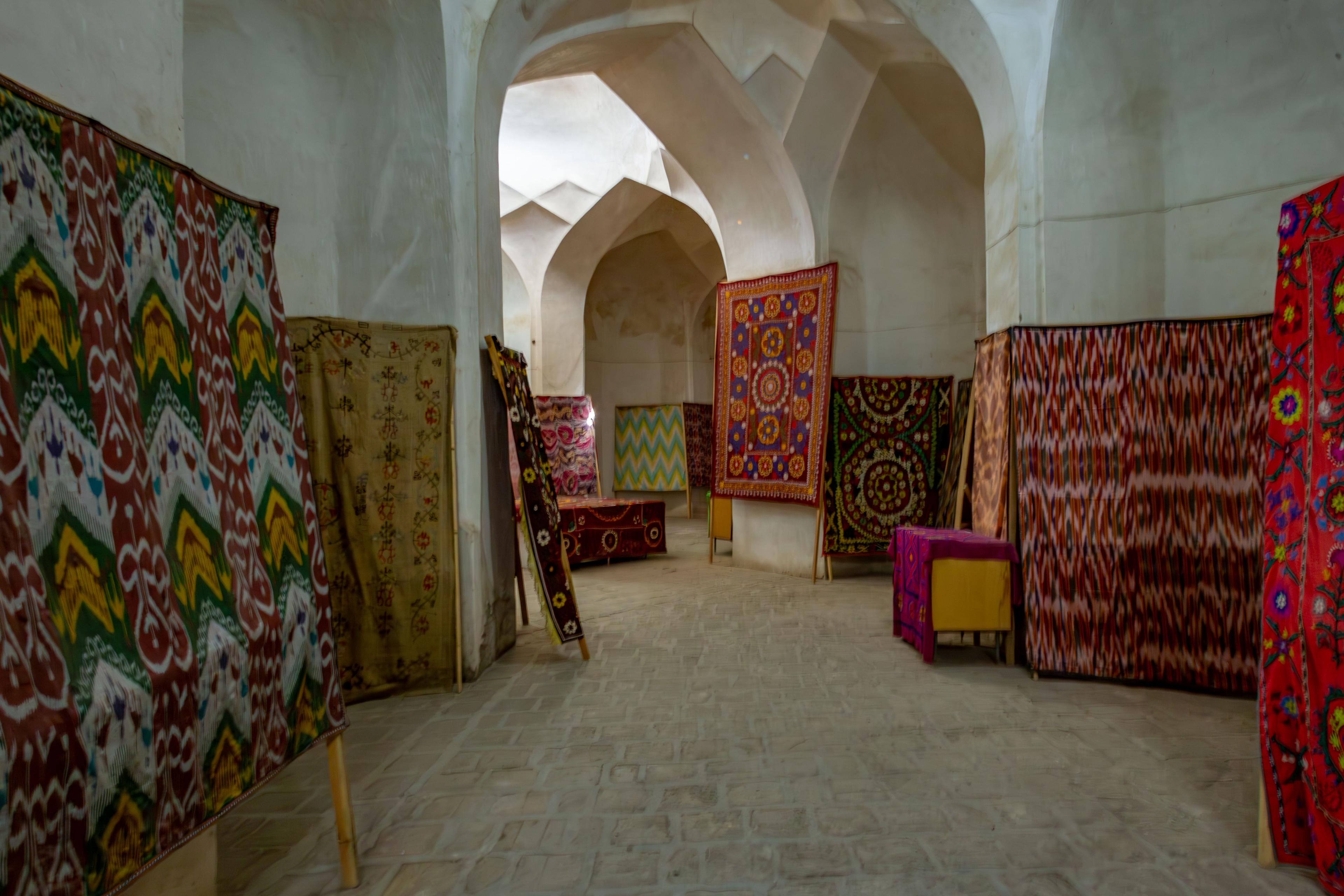
Between this dome and Toki Zargaron, set back from the lane on the north side, is the Tim of Abdullakhan, built in 1577. A tim is not a crossroads dome but a covered market hall. This one is roughly square, about 39 by 42 metres, with a high central dome and a gallery of small domed shops around it. The art historian Galina Pugachenkova counted 56 shops formed by its arched niches. It was built for the trade in silk and woollen cloth.
Step inside even if you are not shopping. Light enters only through openings high under the central dome, the brick vaults keep the hall cool in summer, and carpets hang from the walls in every direction. It is one of the best interiors in Bukhara for understanding how a covered Silk Road market actually worked.

Toki Zargaron: the jewellers' dome
Toki Zargaron, from zargar, jeweller, is the largest and most monumental of the three domes. Most sources date it to 1569 and 1570, under Abdullah Khan II, citing the 16th-century chronicler Hafiz Tanysh; some guidebooks give 1586 and 1587 instead. Its ribbed central dome, lit by sixteen small windows, rises above an octagonal base, with smaller domes around it.
The jewellers did not only sell here: they worked here, with dozens of small workshops under the arcades trading gold, silver, precious stones and coral. Jewellery is still sold under the dome, mostly silver and pieces in traditional Bukharan styles, alongside textiles and souvenirs.
Toki Zargaron is the end of the bazaar walk and the start of the monumental quarter. Directly beyond it stand the Ulugbek Madrasah, built by Timur's astronomer grandson in 1417, and the Abdulaziz Khan Madrasah opposite, and then the Po-i-Kalyan square.
Chor-Minor: a short walk north-east
Chor-Minor, "four minarets", lies about ten minutes' walk north-east of Lyabi-Hauz, through the residential lanes of the old town. It is not a mosque but the gatehouse of a madrasah built in 1807 by Khalif Niyaz-kul, a wealthy merchant. The madrasah has gone; the gatehouse with its four turquoise-domed towers stands alone in a small square.
It takes 15 to 30 minutes to see. The outside is free. The ground floor is a souvenir shop, and the shopkeepers usually let visitors climb to the roof for a small fee, paid to them directly. Recent reports range from about 5,000 to 15,000 som as of November 2026. From the roof you see the towers up close, each decorated slightly differently, which some interpret as a reference to the four religions known in Bukhara.
Go early in the morning or late in the afternoon, when the light is soft and the little square is quiet. Our Bukhara travel guide has more on its history and the 1995 tower collapse.
Shopping in the trading domes: what to buy and how to bargain
The domes and the old caravanserais around them are among the best places in Uzbekistan to see crafts being made, not only sold. Typical goods include:
- Suzani: hand-embroidered textiles, from cushion covers to large wall hangings. Hand embroidery shows small irregularities; machine work is perfectly even.
- Carpets: wool and silk, many from workshops in and around Bukhara. Ask about knot density, dyes and where it was made.
- Forged steel: knives, and the stork-shaped scissors that have become a Bukhara symbol, made by blacksmith families in workshops near the domes.
- Miniature painting, puppets, wood carving and ceramics.
- Silver jewellery, skullcaps and ikat silk.
Practical tips:
- Prices are rarely fixed. Polite bargaining is expected, and a smile works better than a hard line. Starting prices for visitors can be high, so compare a few stalls before you buy.
- Cash in som is easiest, although many larger shops now take cards. Our money guide explains cards, cash and exchange.
- For carpets, antiques and anything that looks old, ask the seller about export certificates before you pay. Our crafts and souvenirs guide covers the rules and what to look for.
- Most stalls open around 9:00 and close around 18:00 to 19:00, a little later in summer. Some close early in winter.
Lyabi-Hauz at night: teahouses, the folklore show and evening walks
Lyabi-Hauz is the closest thing old Bukhara has to nightlife, and its best hours are after sunset, when the heat goes out of the day and the madrasah façades are lit.
- Tea by the pool: the teahouses around the water serve green tea, plov, shashlik and salads at low tables or on raised tapchan platforms. They are touristy and prices are higher than in the side streets, but the setting is the reason to come. For dinner, family-run restaurants in the lanes a few minutes away often offer better food; our Uzbek food guide explains what to order.
- The folklore and fashion show: in the tourist season (roughly April to June and August to October) an hour-long programme of music, regional dances and a fashion show using local fabrics is staged in the courtyard of the Nadir Divan-Begi Madrasah. Published times are around 17:30 without dinner and 19:30 with dinner, and dinner must be ordered in advance. Prices are set by the organisers; recent visitor reports put dinner and show at roughly 200,000 to 250,000 som per person as of November 2026. Book a day ahead and check the schedule locally, as it can change or pause.
- An evening walk west: the trading domes are quiet after the shops close, and the lane leads to the lit Kalyan Minaret, one of the great night views in the country.
The square is safe and busy until late, but the lanes behind it are dimly lit, so a phone torch helps on uneven paving.
Lyabi-Hauz and the trading domes: tickets, opening hours and how long to spend
Most of this walk is free. As of November 2026:
- Lyabi-Hauz square, the pool and the statue: free, open at all times.
- Trading domes and Tim of Abdullakhan: free, as they are working bazaars. Shops keep roughly 9:00 to 18:00 or 19:00.
- Nadir Divan-Begi Madrasah and Khanaka: the courtyard of the madrasah is free to enter during shop hours. The khanaka has sometimes charged a small fee when its interior is open as an exhibition space.
- Kukeldash Madrasah: free to view from outside; interior access and the museum vary with restoration.
- Magoki-Attori Mosque and carpet museum: a small ticket, reported at between 10,000 and 40,000 som depending on the source; check at the door.
- Chor-Minor: free outside; roof access about 5,000 to 15,000 som, paid to the shop.
There is no combined ticket. Carry small notes in som, as change is not always available.
How long to spend:
- A quick look: one hour for Lyabi-Hauz and a walk through the domes to Toki Zargaron.
- A comfortable visit: half a day, with the Magoki-Attori Mosque, the Tim interior, Chor-Minor and some shopping.
- The ideal: a morning or late-afternoon walk with a guide, then return for dinner at the pool and the evening show.
Best time of day: early morning for empty lanes and soft light in the domes; late afternoon, when the sun falls on the madrasah portal; after dark for the atmosphere. In July and August the shaded domes are a good refuge at midday; see our weather by month guide.
Visiting Lyabi-Hauz and the trading domes with TourEast
Bukhara is one of our home cities, and the walk from Lyabi-Hauz through the domes is the classic way into the old town. We can arrange a guided walk as part of a small-group tour or a private itinerary, with time for craft workshops and the quieter lanes, and help with tickets for the evening show when it runs.