The pre-Islamic faith of Khorezm and Sogdiana and where to find it today: the Chilpik tower of silence near Nukus, the circular temple of Koy-Krylgan-Kala, ossuaries in the Samarkand and Tashkent museums, the Bronze Age fire sanctuary at Jarkutan, Zoroastrian traces in Navruz, and what is evidence and what is myth.
Facts, prices and schedules checked on November 4, 2026
Before the mosques and madrasahs, before the Arab armies reached the Amu Darya in the early eighth century, the people of Khorezm, Sogdiana and Bactria followed a religion of fire, water and the struggle between truth and the lie. Zoroastrianism, the faith of the Avesta, shaped the oases that became Uzbekistan for well over a thousand years, and it did not vanish with Islam. It left towers on hills where the dead were exposed, temples whose altars still show the soot of ancient fires, thousands of clay ossuaries painted with priests and mourners, and customs that every Uzbek family still practises each March without calling them by their old name.
This guide is for travellers who want to find that layer. It covers the Chilpik tower of silence near Nukus, the strange circular temple-fortress of Koy-Krylgan-Kala, the fire-worshippers' fortress of Gyaur-Kala at Mizdakhan, the ossuary collections in Samarkand and Tashkent, the Bronze Age fire sanctuary at Jarkutan near Termez, the Zoroastrian echoes in Navruz, and the old argument about whether the Avesta was composed in Khorezm. We separate what archaeologists can show from what guides like to say, and we suggest a route that fits the sites into a Silk Road trip.
Zoroastrianism in Central Asia: a short history
Zoroaster (Zarathushtra) is a figure without a secure date or birthplace; scholarly estimates range from around 1500 to 600 BC, and the language of his hymns, the Gathas, points to the eastern Iranian world, which includes the lands between the Amu Darya and the Syr Darya. Several regions have claimed him, Khorezm and Bactria among them, and none can prove it.
What is certain is that by the time of the Achaemenid Persian Empire (6th to 4th centuries BC), Khorezm, Sogdiana and Bactria were provinces where Mazda-worship, the religion we call Zoroastrianism, was practised. It continued under Alexander's successors, the Kushans, the Kangju and the Hephthalites, and it flourished in the Sogdian city-states of Samarkand, Bukhara and Penjikent in the 5th to 8th centuries AD, alongside Buddhism, Manichaeism and Christianity. The Sogdian version was local and eclectic: gods with Avestan names appear in wall paintings beside Hindu and Mesopotamian deities, and the funeral customs differed from those of Sasanian Persia.
The Arab conquest of Khorezm and Sogdiana in the early 700s brought Islam, by force in places and by conversion over generations elsewhere. Fire temples were destroyed or turned into mosques; the Khorezmian scholar al-Biruni, writing around the year 1000, records that the Arab commander Qutayba ibn Muslim killed the Khorezmian priests and burned their books. Zoroastrian communities lingered in the countryside for centuries, then faded. Unlike in Iran and India, there is no surviving Zoroastrian community in Uzbekistan today; what remains is archaeology and custom.

Chilpik: the tower of silence near Nukus
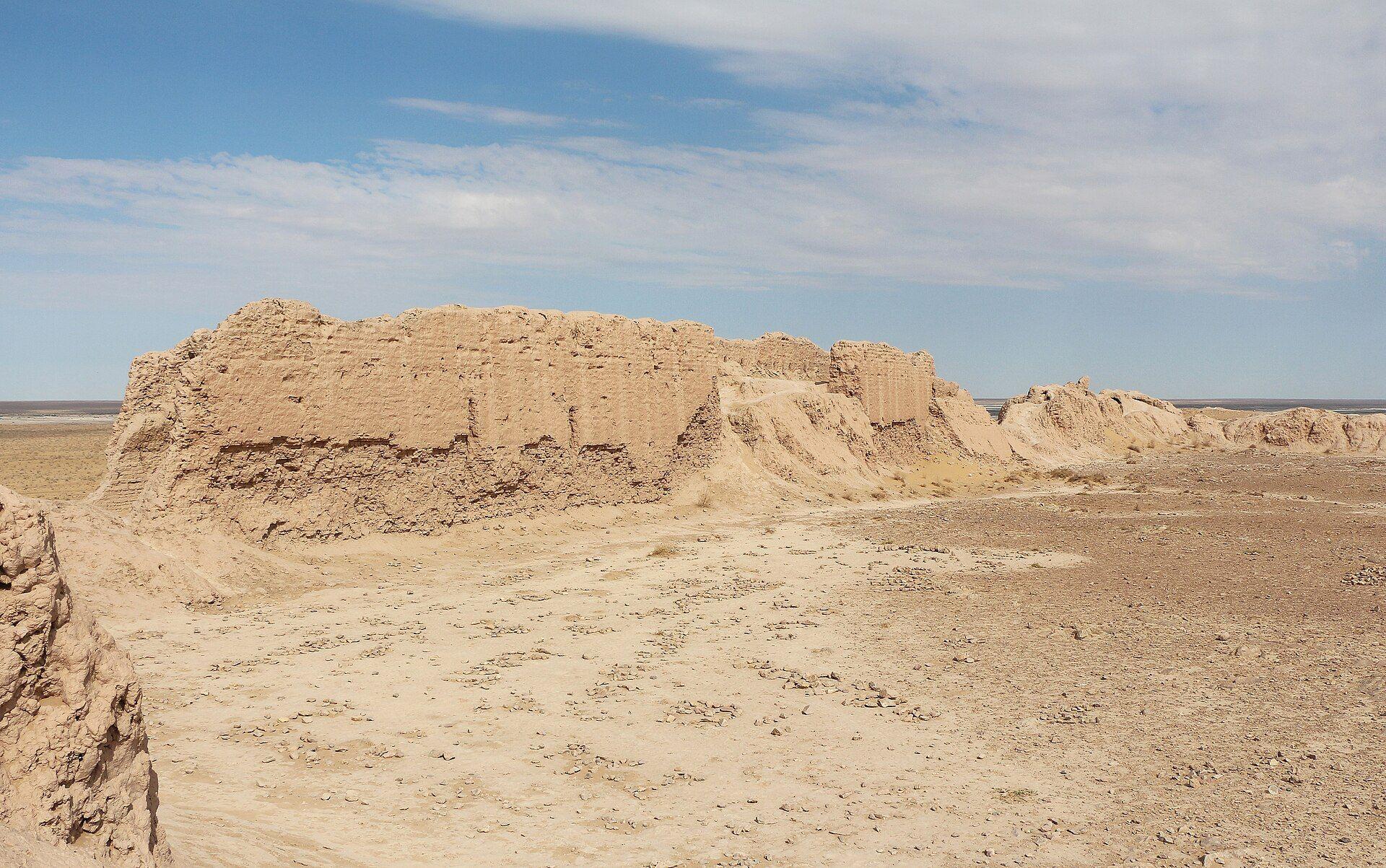
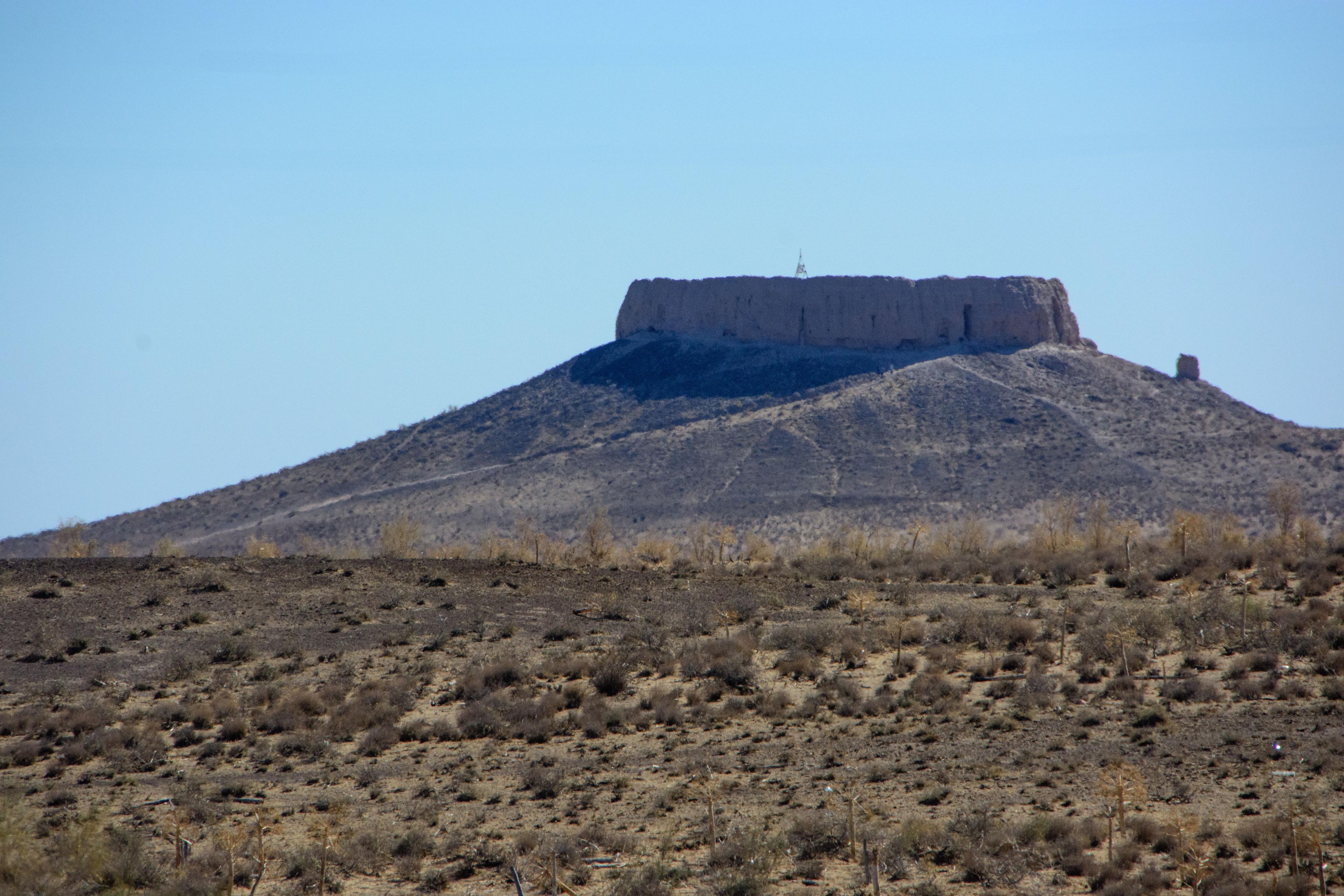
The most dramatic Zoroastrian monument in Central Asia stands about 43 km south-east of Nukus, beside the road to Turtkul and Urgench, on a natural hill rising 35 to 40 metres above the Amu Darya floodplain. Chilpik (also Chilpyk or Shilpiq) is a dakhma, a tower of silence: a ring of mud-brick walls about 15 metres high and 65 to 80 metres across, open to the sky, where Zoroastrians laid out their dead for birds and the sun to strip the flesh, so that the earth, water and fire would not be polluted by a corpse. The clean bones were then gathered into ossuaries and buried.
It is dated to around the 1st century BC to the 1st century AD, with later rebuilding, and seems to have been used until the Arab conquest in the early 8th century; some scholars think it continued, or was reused, into the 9th to 11th centuries, and the walls were later used as a watchtower. A ramp on the north side leads up to the entrance. Inside, the platform is bare; a few ossuary fragments have been found, but where the thousands of ossuaries that must have been filled here were buried is still unknown.
Local legend tells of a Khorezmian princess, Chilpik, who built the tower as a refuge after her father refused her marriage to a poor man. The tower appears on the coat of arms of Karakalpakstan.
Visiting: the climb takes ten minutes; there is no fee as of 2026 and no shade. It is an easy stop on the Nukus to Khiva road and belongs in any Karakalpakstan itinerary.
Koy-Krylgan-Kala: temple, observatory or tomb?
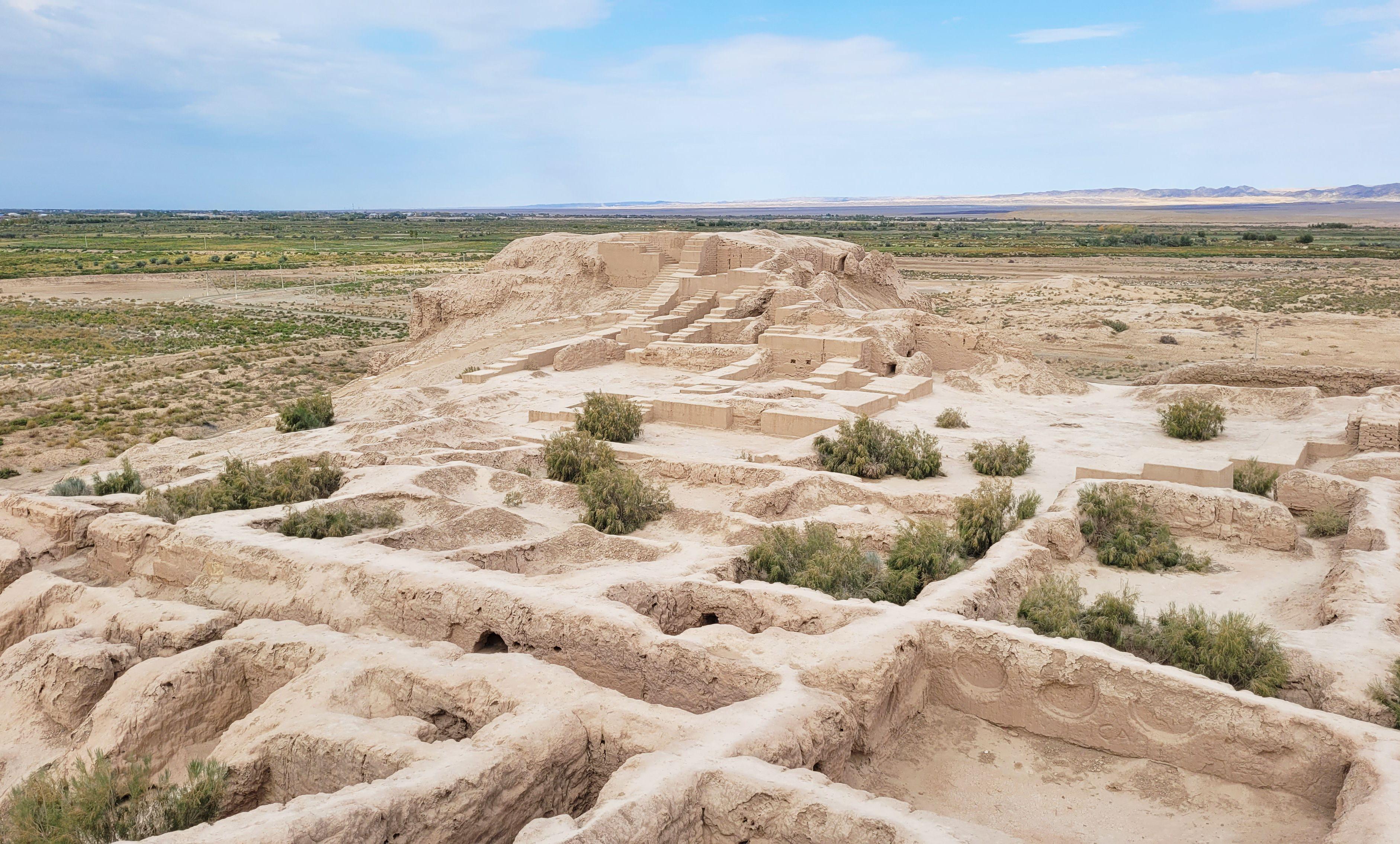
Further up the Amu Darya, in the Turtkul district among the Elliq-Qala fortresses, lies the strangest building of ancient Khorezm. Koy-Krylgan-Kala was found in 1938 by the Khorezm expedition of Sergei Tolstov and excavated in the 1950s. It is circular: an outer wall 90 metres in diameter, 7 metres thick, with nine towers and a moat, enclosing a ring of rooms and, at the centre, a two-storey round building 42 metres across and 8 metres high.
It dates to the 4th to 3rd centuries BC, which made it, at the time of its discovery, the oldest known monumental building in Central Asia. It burned or was abandoned around the 1st century BC, then reoccupied in the 2nd to 4th centuries AD as a settlement.
What it was for is argued over. Tolstov read it as a temple and dynastic mausoleum, perhaps dedicated to the water goddess Anahita and the hero-king Siyavush, with the central building holding royal tombs and the outer ring serving ritual and storage. Others have proposed an astronomical function: certain openings align with the solstices, which would fit a calendar-keeping priesthood. Ossuaries, painted ceramics, terracotta figurines and fragments of a script related to Aramaic were found here, and some scholars have linked the site to the Avestan tradition. The honest summary is that it was a religious building of the Khorezmian elite with a strong funerary element, and that the details are unproven.
Visiting: the site is badly eroded, and without a guide and a plan in hand it reads as a low circular mound. It is included on the longer fortress tours from Khiva, with Toprak-Kala and Ayaz-Kala; our Khorezm fortresses article explains the loop.
Gyaur-Kala and Mizdakhan: the fortress of the fire-worshippers
Twenty kilometres west of Nukus, beside the necropolis of Mizdakhan, the ruined fortress of Gyaur-Kala stands on a hill above the road to the Turkmen border. The name was given after the Arab conquest: gyaur, from the Persian gabr, was the word Muslims used for Zoroastrians, so this is the fortress of the unbelievers. Excavations found fire altars and hearths in its buildings, which date from the 4th century BC into the early centuries AD, and the walls still rise 10 to 15 metres in places.
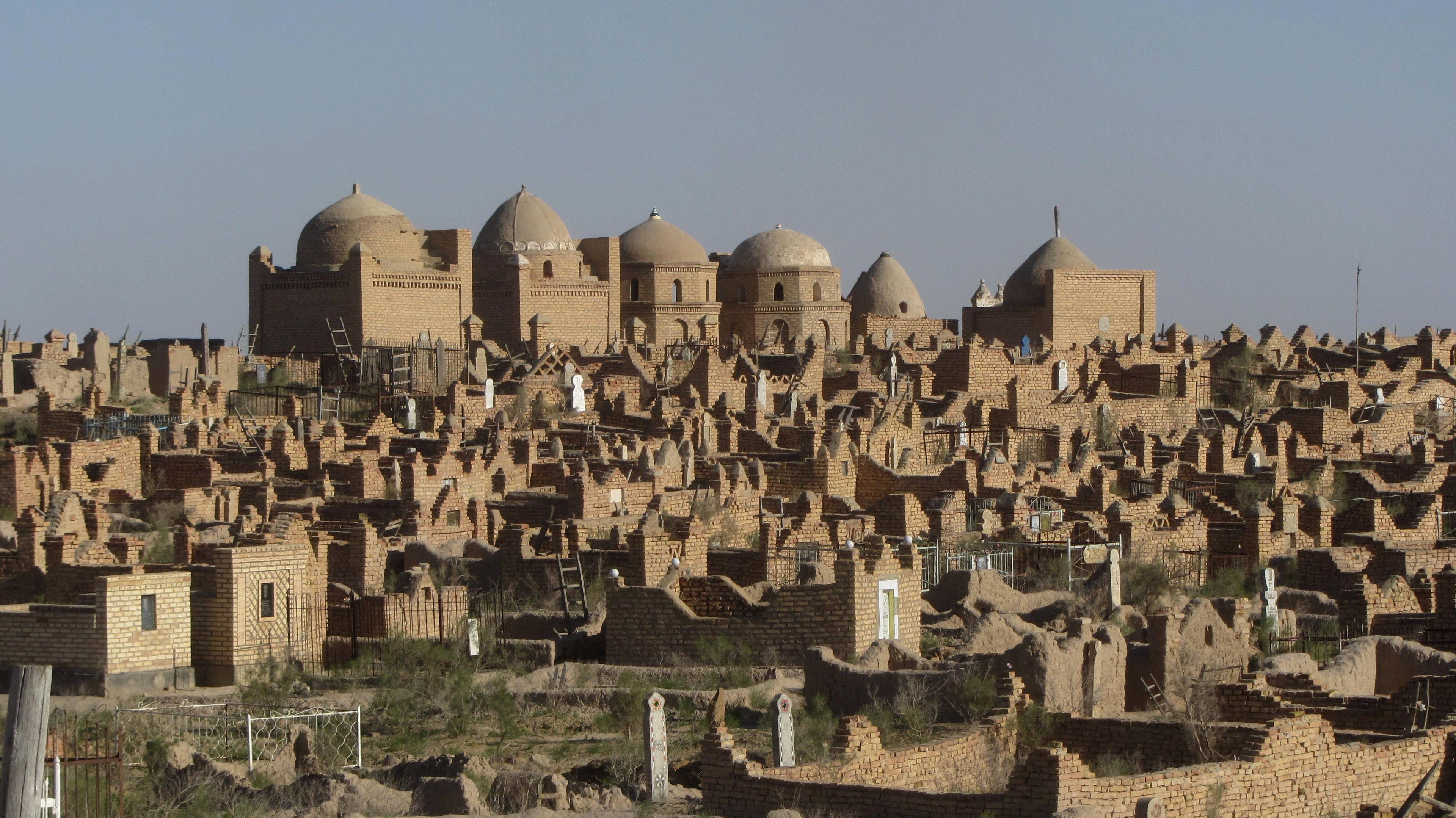
Mizdakhan itself, the vast hillside cemetery next door, has a Zoroastrian past: ossuary burials were found in its older layers, and according to tradition it was the site of a fire temple destroyed in the early 700s. Islamic mausoleums of the 12th to 14th centuries, including Mazlumkhan-Sulu, now cover the hill, and the place is a Muslim pilgrimage site; the layering of faiths on one hill is the point. Our Karakalpakstan itinerary covers both in a day from Nukus.
There is another Gyaur-Kala in Karakalpakstan, on the Amu Darya near Kyzyl-Kala and Toprak-Kala, from the same period and with the same name; guides sometimes confuse them. The one at Mizdakhan is the easy visit.
Ossuaries: the Zoroastrian dead in the museums
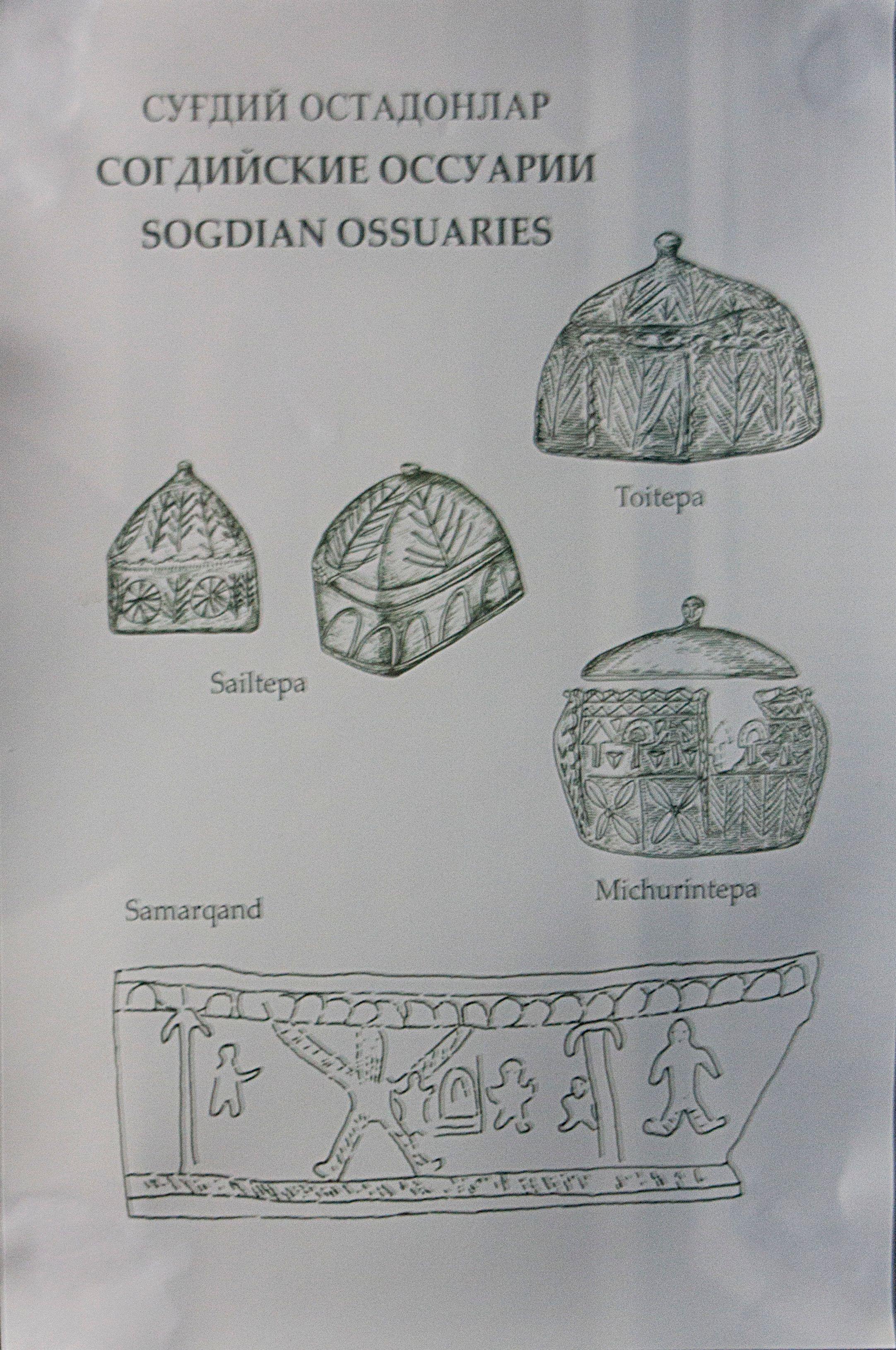
Because the faith forbade burying a corpse in the earth, Central Asian Zoroastrians developed the ossuary, a clay box or jar for the cleaned bones, and these are now the most common Zoroastrian objects in Uzbek museums. The earliest come from Khorezm in the 3rd to 2nd centuries BC; the most beautiful are Sogdian, from the 5th to 7th centuries AD, moulded and painted with scenes of priests tending fires, mourners, dancers and the gates of paradise.
Where to see them:
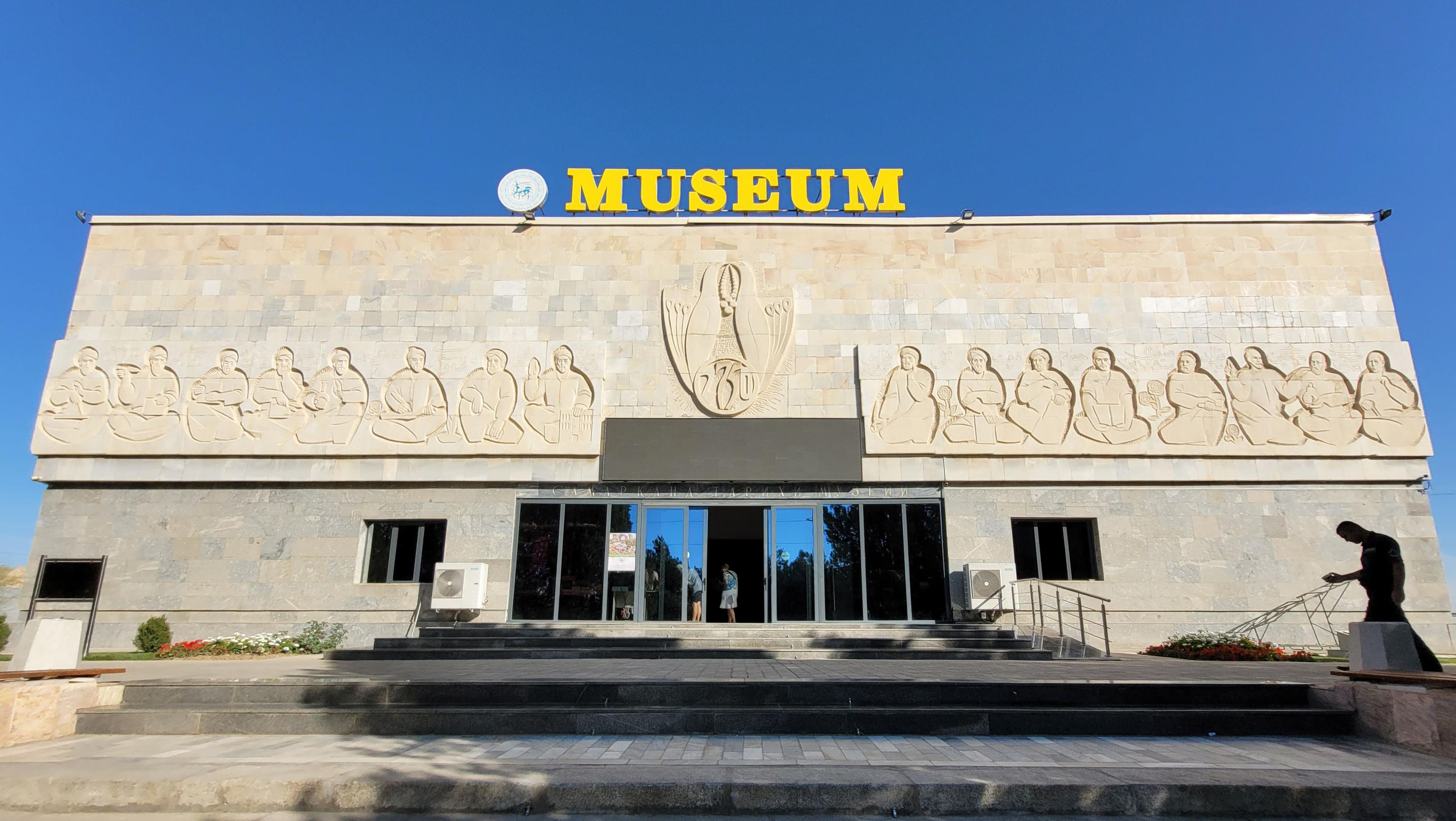
- The Afrasiab Museum in Samarkand, on the site of ancient Marakanda. Its collection of Sogdian ossuaries is the best in the country, headed by the Mulla Kurgan ossuary of the 7th century, with priests in mouth-veils performing a ritual at a fire altar. The museum also holds the Afrasiab murals of the 7th-century Sogdian king Varkhuman, which include a procession some scholars read as a Navruz-season ceremony honouring ancestors.
- The State Museum of History in Tashkent, with ossuaries from Khorezm and the Tashkent oasis, a Kushan-era Buddha and a good chronological sweep of the pre-Islamic centuries.
- The Savitsky Museum in Nukus, whose archaeology galleries show finds from the Khorezm expedition, including ossuaries from Chilpik and the fortresses.
- The Samarkand Museum of History and Culture in the city centre, with a Zoroastrian section.
- The Bukhara Ark museum and the Termez Archaeological Museum, with smaller holdings.
Ask for the ossuaries by name (ossuariy in Russian and Uzbek) and most museum staff will take you straight to them.
Jarkutan: a Bronze Age fire sanctuary near Termez
The deepest layer is in the far south. In the Sherobod district of Surkhandarya, near Termez, the settlement of Jarkutan (Dzharkutan) belongs to the Sapalli culture of the Bronze Age, roughly 2000 to 1300 BC, the urban civilisation of the Oxus that archaeologists call the Bactria-Margiana complex. Excavated since the 1970s by Uzbek teams and later with German and French colleagues, it had a fortified citadel, residential quarters, workshops and, on a separate mound, a large building identified as a temple, with a central hearth, altars and rooms where fire was kept, and furnaces in its service wing. The nearby cemetery of Buston VI contains cremation remains and burials interpreted as those of fire-worshippers.
Is this a Zoroastrian temple? No serious archaeologist says so outright: it predates any plausible date for Zoroaster, and the evidence shows a fire cult, not the Avestan religion. What Jarkutan shows is the older stratum from which Zoroastrianism grew, in exactly the region where the Gathas may have been composed. For the specialist it is one of the most important sites in Central Asia; for the general visitor it is a set of low mounds that need a guide and a plan. Finds are in the Termez Archaeological Museum and the Samarkand Museum. Our Termez and Surkhandarya article explains how to reach the area.
Navruz, sumalak and fire: Zoroastrian traces in living custom
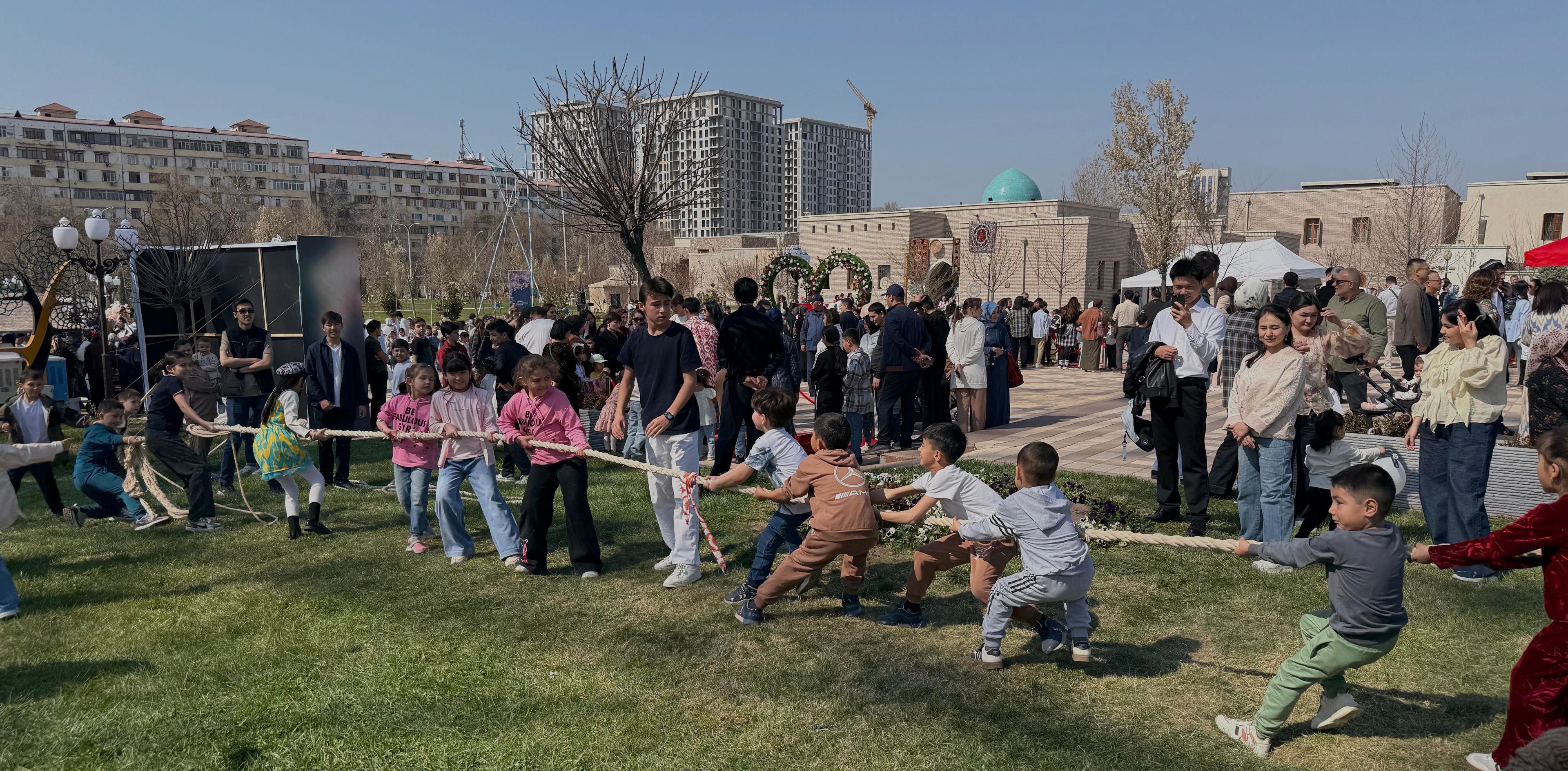
The spring equinox festival of Navruz is the most visible survival. Its name is Persian (new day), its date is solar, and its symbols belong to the old religion: the renewal of fire and water, the sprouting of grain, the honouring of ancestors before the new year. In Uzbekistan it was discouraged in the Soviet period as a religious relic and revived after 1991 as a national holiday on 21 March; UNESCO listed Nowruz as intangible heritage in 2009 with Uzbekistan among the nominating states.
Customs with Zoroastrian roots, or at least Zoroastrian cousins:
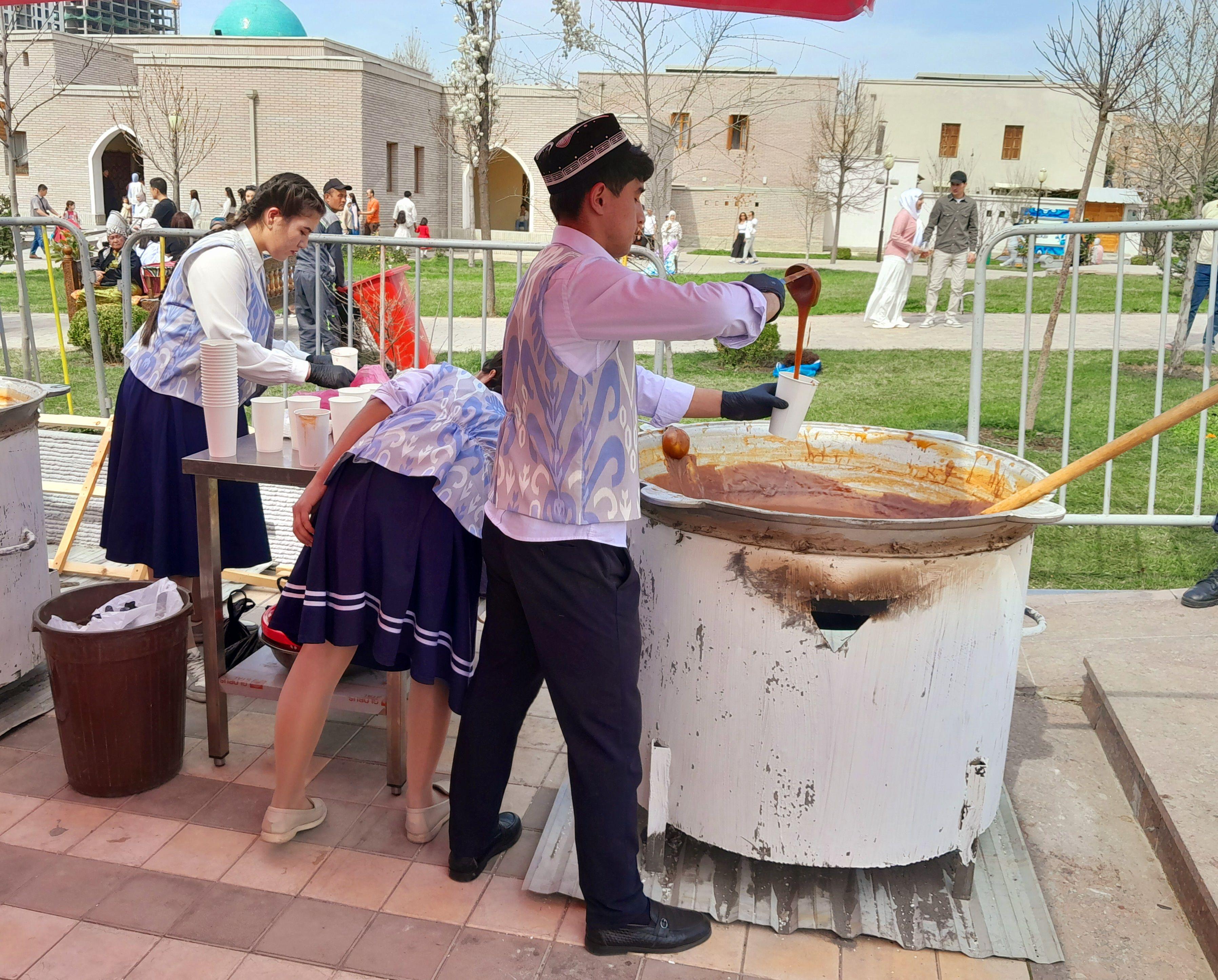
- Sumalak, the sweet paste of sprouted wheat stirred all night in a kazan by women singing: a rite of the green shoot, the first life of the year, shared with neighbours at dawn. Our Navruz article describes the cooking.
- Jumping over fires in the week before Navruz, and the cleaning of the house, which echo the Iranian Chaharshanbe Suri; in Uzbekistan the fire-jumping survives mainly in Bukhara, Samarkand and among Tajik-speaking communities, and more as a children's game than a rite.
- The visiting of graves and the preparation of food for the dead in the days before the festival, which parallels the Zoroastrian Frawardigan, the days of the ancestors' spirits.
- The lighting of candles and lamps at shrines, and the persistent folk respect for fire: you will still be told not to pour water on a hearth or blow out a candle with your breath.
None of this makes Uzbeks Zoroastrian, and most people practising these customs would be surprised to hear them called so. They are part of a Central Asian cultural continuity that runs under Islam, and the same continuity explains why Navruz is celebrated by Muslims across the region with no sense of contradiction.
Was the Avesta written in Khorezm? Myth and evidence
You will hear in Khiva and Urgench that Zoroaster was born in Khorezm and that the Avesta was composed on the banks of the Amu Darya. In 2001 Uzbekistan celebrated an anniversary of the Avesta with UNESCO participation, and an Avesta monument stands in Urgench. The claim has a scholarly pedigree: Sergei Tolstov, the Soviet archaeologist who found Koy-Krylgan-Kala, argued that Airyanem Vaejah, the mythical homeland of the Iranians in the Avesta, was Khorezm, and the idea was taken up by Uzbek scholars after independence.
Most specialists today are cautious. The Avesta's geography is vague and partly mythical; Bactria, Margiana, Sistan and Khorezm all have supporters; and the texts were transmitted orally for centuries before being written down in Sasanian Persia. What the archaeology of Khorezm shows is a strong, early and distinctive Zoroastrian culture, not the birthplace of the prophet.
A similar caution applies to the fire temples. Guides point to many a fortress as a temple with an eternal flame; genuine evidence of fire altars exists at Gyaur-Kala, at Toprak-Kala's palace, at Koy-Krylgan-Kala and in the Sogdian cities of Penjikent and Afrasiab, but most Khorezmian fortresses were forts, granaries and towns. The ossuaries, by contrast, are unambiguous: when you see one, you are looking at a Zoroastrian burial.
A visitable Zoroastrian route through Uzbekistan
The sites are spread across the country, which is why they are best folded into a Silk Road trip rather than visited on their own.
- Tashkent: the State Museum of History for the ossuaries and the chronology. Half a day.
- Samarkand: the Afrasiab Museum for the Sogdian ossuaries and the murals, plus the Afrasiab site itself. Two hours, best with a guide who knows the pre-Islamic city. The Samarkand beyond Registan article covers it.
- Bukhara: few Zoroastrian remains survive, but the Magoki-Attori Mosque near Lyabi-Hauz stands, by tradition, on the site of a pre-Islamic temple, and the Ark museum has finds.
- Termez: the Archaeological Museum, and Jarkutan with a guide for enthusiasts. A day.
- Khiva and the Elliq-Qala: Toprak-Kala, Koy-Krylgan-Kala and the second Gyaur-Kala on a fortress day. A long day.
- Nukus: Chilpik on the road from Khiva, Gyaur-Kala and Mizdakhan from the city, and the archaeology floor of the Savitsky Museum. Two days with the Aral Sea.
Time it for the week before Navruz and you add the living layer: sumalak cooking in the mahallas, fire-jumping in the old quarters of Bukhara, and the festival itself on 21 March.
A guide matters more here than for the Timurid monuments. The sites are ruins without labels, and the difference between a memorable visit and a hot walk round a mound is someone who can explain what the walls were for.
Exploring pre-Islamic Uzbekistan with TourEast
We can build a private itinerary around the Zoroastrian and pre-Islamic sites, with guides who know the Khorezm archaeology and the Sogdian collections, or add Chilpik, Koy-Krylgan-Kala, the Afrasiab Museum and the Termez museum to a classic Silk Road route. Our Desert Fortresses and Aral tour already includes Chilpik and the Elliq-Qala, and the Silk Road Grand Tour passes every museum mentioned above.
Frequently asked questions
Photo gallery