Bukhara's oldest building is a small brick cube in a park west of the Ark. Our guide to the Samanid Mausoleum and its neighbours: the Chashma-Ayub spring, the old city walls and the Bolo-Hauz Mosque, with 2026 entrance fees, hours and a walking route.
Facts, prices and schedules checked on November 4, 2026
The Samanid Mausoleum in Bukhara is a cube of baked brick barely ten metres wide, and it is one of the most admired buildings in the Islamic world. It stands in a shady park just west of the Ark Fortress, has survived more than a thousand years, including the Mongol sack of the city, and still looks startlingly modern.
It is also the start of a pleasant half-day loop. Within a few minutes' walk of the mausoleum are the Chashma-Ayub shrine over a holy spring, the best surviving stretch of Bukhara's old city walls and, across the road from the Ark, the Bolo-Hauz Mosque with its slender wooden columns reflected in a pool.
This guide explains what you are looking at in each place, what is worth paying for, the Samanid Mausoleum entrance fee and opening hours as of November 2026, and how to fit the area into a day in Bukhara (Buxoro). For the Ark itself and the Po-i-Kalyan ensemble, see our separate guide; for the old town as a whole, our Bukhara travel guide.
What is the Samanid Mausoleum?
The mausoleum (Somoniylar maqbarasi in Uzbek) is the family tomb of the Samanids, the Persian dynasty that ruled much of Central Asia and eastern Iran from Bukhara in the 9th and 10th centuries. Under them Bukhara was one of the great capitals of the Islamic world, a city of scholars, poets and libraries; the young Ibn Sina studied in the Samanid royal library.
Locally it is called the Ismail Samani Mausoleum, after Ismail ibn Ahmad (ruled 892 to 907), the dynasty's most famous ruler, who is remembered as just and pious. Historians are more cautious. A wooden lintel with a Kufic inscription, found during restoration in the 1930s, names his grandson Nasr II (ruled 914 to 943), and three male burials were discovered inside. Scholars still debate whether Ismail built it for his father Ahmad, for himself, or whether it dates from Nasr's time. Either way, it was built in the first half of the 10th century, which makes it the oldest standing building in Bukhara and one of the oldest monuments of Islamic architecture in Central Asia.
The old town of Bukhara has been a UNESCO World Heritage Site since 1993, and the mausoleum is one of its star monuments. Our article on Islamic architecture in Uzbekistan explains why architects treat it as a starting point for everything that followed.
Inside and out: how to look at the brickwork
The building is almost a perfect cube, about 9.4 metres on each side, under a hemispherical dome about 7 metres across. The walls are around 1.8 metres thick at the base and lean very slightly inwards, which gives the building its sense of weight and calm. Small domes sit at each corner of the roof, and an open gallery of arches runs around the top of the walls.
There is no tile and no paint. Everything is done with fired brick, laid in bands and blocks of two to five bricks to make basket weave, chequerboard, dog-tooth and small rosette patterns. The bricks hold the building up and decorate it at the same time. Because the surface is so deeply textured, the patterns change constantly with the light: flat and sandy at noon, sharply drawn in the early morning and late afternoon.
What to look for:
- The four identical façades, each with an arched entrance framed by a band of brick "beads" and engaged corner columns.
- The ornamental circles in the spandrels over the arches, sometimes read as solar or Zoroastrian symbols, a reminder that the Samanids ruled a land where the old Persian religion was still within living memory.
- Inside, the transition from the square room to the round dome: four arched squinches across the corners turn the square into an octagon, a solution later repeated across the Islamic world.
- The interior brickwork, which is as intricate as the outside and best seen when the low sun comes through the doorways.
The interior is small and simple, with a modern cenotaph. You will see it in a few minutes, but give yourself time to walk slowly around the outside twice, once on the sunny side and once in shade.
How the mausoleum survived
The Samanid Mausoleum survived because, for centuries, nobody could see it. Silt, sand and the rising ground of the cemetery around it buried the lower part of the building, so when Genghis Khan's army took Bukhara in 1220 it was spared the destruction that levelled much of the city.
Scholars surveyed it in the 1920s, and the archaeologist Vasily Vyatkin excavated it between 1926 and 1928. Restoration work followed in stages, with the largest campaign in 1937 to 1939, and the building has been carefully maintained since. What you see is substantially original 10th-century brick.
Local tradition has its own explanation. Ismail Samani, known in Bukhara as Hazrat Sultan, was said to go on ruling from his tomb: people slipped written requests through a gap on one side and believed they would find an answer on the other. You will still see visitors walking around the building with a wish in mind, and some circle it three times for luck.
Samanid Park: from cemetery to city park
The mausoleum once stood in the middle of a large cemetery. After the Second World War the graves were cleared and paved over, and the area became a city park, originally named after the Soviet leader Kirov and laid out around a lake. Today it is the Samanid Park (Somoniylar bog'i), a big green space with old trees, a pond, cafés and a small amusement park with rides that local families still use.
It is an odd setting for a 10th-century royal tomb, and some visitors find the fairground music jarring. We rather like it: this is one of the few places in the historic centre where you see ordinary Bukharans relaxing, couples taking photographs and children on the swings, especially on summer evenings and at weekends.
Practical point: the park has plenty of shade and benches, and it is the coolest place to wait out the midday heat between the Ark and the bazaar area. In summer, plan the mausoleum for the early morning, then spend the hottest hours indoors.
Chashma-Ayub: Job's spring and the water museum
A few minutes' walk north-west through the park is Chashma-Ayub, "Job's spring". Legend says the prophet Job (Ayub) came here during a drought, struck the ground with his staff and a spring appeared. The water is still considered healing, and you will see pilgrims filling bottles from the well inside.
The oldest parts of the shrine go back to the 12th century, but the building you see today dates from the time of Amir Timur in the late 14th century, with later work under the Shaybanid ruler Abdullah Khan II. Its most unusual feature is the tall conical dome over one of the chambers, a style typical of Khorezm rather than Bukhara. It is usually explained by the craftsmen Timur brought back from his campaign against Khorezm.
Inside is a small museum of water supply in the Bukhara oasis: wells, canals, the system of pools (hauz) that once supplied the old town, and a display on the Aral Sea disaster. It takes 20 to 30 minutes. Next door stands a modern glass and brick memorial to Imam al-Bukhari, the 9th-century hadith scholar born near Bukhara; his main memorial complex is near Samarkand.
Chashma-Ayub is a place of pilgrimage as well as a museum, so dress modestly, speak quietly in the well chamber, and ask before photographing people at prayer.
The Bukhara city walls and the Talipach gate
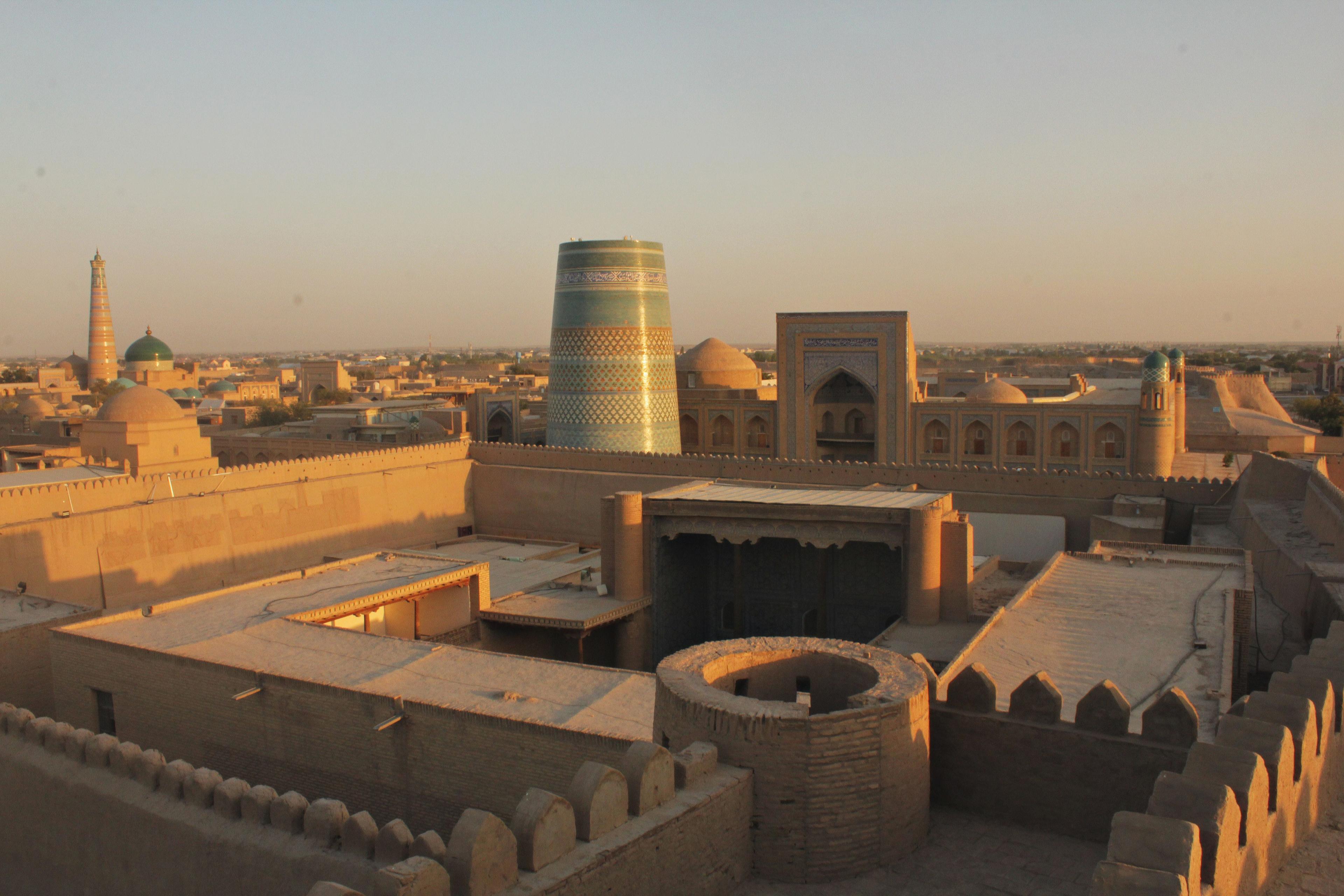
Bukhara was a walled city until the early 20th century. In its final form the wall ran for about 12 kilometres around the town and had 11 gates, from which roads left for Samarkand, Karshi, Khiva and the desert. Most of it was pulled down in the Soviet period as the city grew.
About 2 kilometres survive in fragments, mainly on the western and north-western edges of the old town, and two gates remain: Talipach in the north-west and Karakul in the south-west. The surviving sections date largely from the 16th century, when the Shaybanids rebuilt the defences, with repairs in later centuries. They are made of mud brick on a high earth bank, with rounded towers at intervals, and their weathered, sloping profile is much more atmospheric than tidy reconstruction.
The easiest place to see them is the edge of Samanid Park, where a stretch of the wall has been partly rebuilt and you can walk alongside it. The Talipach gate, with its two towers and arched passage, is a short taxi ride or a 15 to 20 minute walk north. Access is free, there is no ticket office, and late afternoon light on the clay walls is lovely for photographs. Wear proper shoes; the ground is uneven and there are no railings.
Bolo-Hauz Mosque: the emir's Friday mosque
Opposite the main gate of the Ark, across the open square, stands the Bolo-Hauz Mosque. It was completed in 1712 and became the official Friday mosque of the emirs, who crossed from the fortress on a carpet laid over the square to pray here.
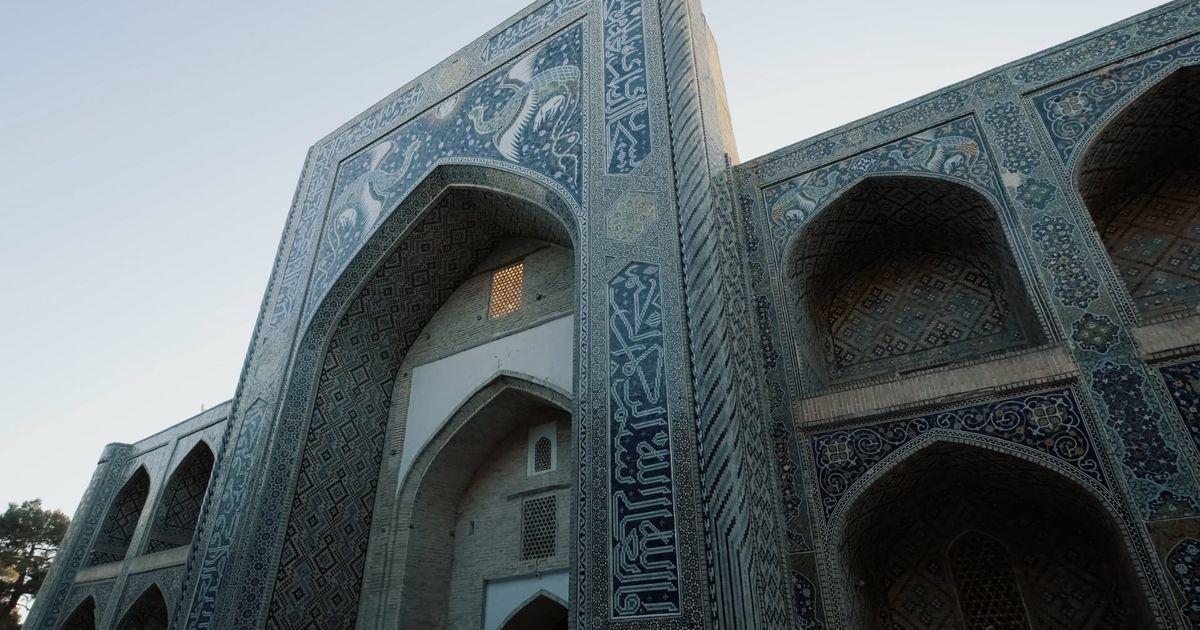
The mosque is famous for its iwan, the deep open porch along the front. The iwan rises about 12 metres, and twenty slender wooden columns hold up its flat, coffered ceiling painted in red, green and gold, and the column capitals are carved with stalactite-like muqarnas. The tall columns and the painted ceiling were added in 1917, in the very last years of the emirate, as was the short brick and tile minaret beside the pool. That is why the mosque looks lighter and more graceful than most buildings of its age in Bukhara.
In front is the hauz, the pool that gives the mosque its name ("pool of the children" is one popular translation, though the meaning is debated). The reflection of the columns in the water, especially at sunset, is one of the best photographs in the city.
Bolo-Hauz is a working mosque. You can admire and photograph the iwan from outside at any time, free of charge. Visitors are usually welcome to look inside outside prayer times if dressed modestly: shoulders and knees covered, women with a scarf, shoes off on the carpets. Avoid Friday midday prayers.
Samanid Mausoleum entrance fee and opening hours in 2026
These sites are not covered by a single combined ticket. Each has its own small fee paid in cash at the door. As of November 2026:
- Samanid Mausoleum: about 20,000 som per adult (roughly US$1.50 to 2); children under seven usually free.
- Chashma-Ayub water museum: a small separate fee, typically 15,000 to 30,000 som.
- Bolo-Hauz Mosque: free; donations welcome.
- City walls and Talipach gate: free.
- Samanid Park: free entry; rides and attractions are paid separately.
Opening hours: the mausoleum is generally open daily from about 08:00 or 09:00 to 18:00, slightly longer in summer and shorter in winter. The park itself is open all day. Fees in Uzbekistan have risen in recent years and can change without notice, so treat these as typical 2026 figures and check at the ticket window. Some museums charge extra for photography with a professional camera.
Bring small notes in som. Card payment at small ticket desks is unreliable; our money guide explains cards, cash and exchange.
How to get there and a walking route
The Samanid Park is on the western edge of the old town, about 600 metres west of the Ark: an easy 10-minute walk. From Lyabi-Hauz it takes about 20 to 25 minutes on foot, past the trading domes and Po-i-Kalyan; a taxi through Yandex Go takes five minutes and costs very little.
A relaxed morning loop, about three hours including visits:
- Start at the Bolo-Hauz Mosque at around 08:30, while the light is soft and the square in front of the Ark is quiet.
- Walk west along the road beside the park to the Samanid Mausoleum, before the tour groups arrive.
- Continue through the park to Chashma-Ayub and the water museum.
- Finish along the reconstructed city wall, then either walk or take a taxi to the Talipach gate.
- Back towards the centre, visit the Ark when it is still not too hot, or stop for tea and samsa near the trading domes.
In the afternoon you can reverse it: the Ark first, then the Samanid Park in the last two hours of daylight, and Bolo-Hauz at sunset.
Is the Samanid Mausoleum worth it? Tips for your visit
Yes, even if you are not an architecture enthusiast. It is small and quick to see, but it shows what Bukhara looked like before the Mongols, and it costs almost nothing. For many visitors it is the building they remember most clearly from Bukhara.
A few practical tips:
- Best light: early morning or the last two hours before sunset. At midday the brick looks flat.
- Time needed: 20 to 30 minutes for the mausoleum, 1.5 to 2.5 hours for the whole area including Chashma-Ayub, the walls and Bolo-Hauz.
- Best seasons: April to early June and September to October. In July and August, go before 10:00.
- Accessibility: the park paths are flat and paved; the mausoleum has a low step at each entrance; the walls are on rough ground.
- With children: the park playground and rides make this an easy stop for families, and our guide to Uzbekistan with kids has more ideas.
- A guide helps: the meaning of the patterns, the Samanid story and the legends are what bring a plain brick cube to life.
Visiting the Samanid Mausoleum with TourEast
The Samanid Mausoleum, Chashma-Ayub and Bolo-Hauz fit easily into a Bukhara morning, when the light is best. If you would like more time here, or a slower Bukhara itinerary with a local guide, we can build it into a custom tour of Uzbekistan.