Bukhara in two days, hour by hour: the Ark and Samanid Mausoleum in morning light, Po-i-Kalyan at sunset, Lyabi-Hauz and the trading domes, a one-day version and a third day at Sitorai Mohi-Hosa, Bahauddin Naqshband, Chor-Bakr and Gijduvan.
Facts, prices and schedules checked on November 4, 2026
Two days in Bukhara is the right amount for a first visit. The old town is compact and almost entirely walkable, so this Bukhara itinerary is about order and timing rather than distance: the Samanid Mausoleum and the Ark in the morning light, Po-i-Kalyan at sunset, the trading domes when the craftsmen are at work, and Lyabi-Hauz after dark.
Below you will find the two days hour by hour, a one-day version for travellers passing through, and a third day outside the city at Sitorai Mohi-Hosa, the Bahauddin Naqshband complex, the Chor-Bakr necropolis and the potters of Gijduvan.
This page is the schedule. For the stories behind the buildings, see our Bukhara travel guide, our guide to the Ark Fortress and Po-i-Kalyan, and our guide to Lyabi-Hauz and the trading domes. Times assume spring or autumn; the section on seasons explains how to adjust them.
How many days do you need in Bukhara?
- One day: enough to walk the old town from Lyabi-Hauz to the Ark and the Samanid Mausoleum. You will see most interiors only briefly.
- Two days: our recommendation. Day one covers the western half of the old town, with the citadel and Po-i-Kalyan; day two the eastern half, with Lyabi-Hauz, the trading domes, Chor Minor and the craft workshops.
- Three days: add the countryside, with the emir's summer palace, the shrine of Bahauddin Naqshband, Chor-Bakr and a ceramics workshop in Gijduvan.
Two days in Bukhara usually means three nights, or two nights with an early arrival. Bukhara's railway station is in Kagan, 20 to 30 minutes by car from the old town, while the airport is only 10 to 15 minutes away. Trains from Samarkand take under two hours, and since 2026 the high-speed line also links Bukhara with Khiva. Our guides to Samarkand to Bukhara and Bukhara to Khiva have the details.
How Bukhara's old town is laid out
The historic centre runs roughly east to west along one line, about 20 minutes' walk from end to end:
- East: Lyabi-Hauz, the pool square, with Chor Minor 10 minutes north-east in the residential lanes.
- Centre: the 16th-century trading domes, Toki Sarrafon, Toki Telpak Furushon and Toki Zargaron, with the Magoki-Attori Mosque and the Tim of Abdullakhan along the way.
- West: the Ulugbek and Abdulaziz Khan madrasahs, then the Po-i-Kalyan square with the Kalyan Minaret, the Kalyan Mosque and the Mir-i-Arab Madrasah.
- Far west: the Ark Fortress and the Bolo-Hauz Mosque facing it, then the Samanid park with the Samanid Mausoleum and Chashma-Ayub.
Three rules for timing:
- The Samanid Mausoleum's brick patterns need low sun: early morning or late afternoon.
- Po-i-Kalyan belongs to the late afternoon and dusk, when the brick turns gold and then the minaret is floodlit.
- From June to August Bukhara can pass 40°C. See the monuments before 12:00 and after 16:00, and spend the middle of the day under the shaded trading domes or at your hotel.
Day 1 morning: Samanid Mausoleum, Bolo-Hauz and the Ark
- 08:00 Breakfast in your guesthouse courtyard.
- 08:30 Walk or take a short taxi to the Samanid park. See the Samanid Mausoleum while the low sun picks out the basket-weave brickwork. Walk around all four sides; each changes with the light. Allow 30 minutes.
- 09:00 The Chashma-Ayub next door, the 12th-century shrine over a spring, now a small museum of water. Allow 20 to 30 minutes.
- 09:45 Walk 10 minutes to the Bolo-Hauz Mosque, opposite the Ark. Its tall wooden columns reflect in the pool, and it is free to view from outside.
- 10:00 The Ark Fortress. Climb the ramp through the western gate, then see the Juma Mosque, the coronation courtyard, the museum halls and the view from the upper terraces. Allow one to one and a half hours.
- 11:30 Optional: the Zindan, the emir's prison, a short walk behind the Ark.
- 12:30 Lunch. Choose a family-run place in the lanes rather than the busiest terraces.
The Ark is best in the morning, when it is cooler and the sun falls on the main gate. If you arrive on day one by train and miss the morning, swap days and start with the eastern half.
Day 1 afternoon and evening: Po-i-Kalyan at sunset
- 13:30 Rest at your hotel, or in hot weather until 16:00.
- 15:30 Walk to the Ulugbek Madrasah, built in 1417 by Timur's astronomer grandson, and the Abdulaziz Khan Madrasah facing it. A quick look at both takes 30 minutes.
- 16:15 The Po-i-Kalyan square. Enter the Kalyan Mosque for its huge arcaded courtyard and the view of the minaret from inside, then step into the vestibule of the Mir-i-Arab Madrasah, which is still a working religious school. Allow an hour. The mosque is active, so avoid Friday midday prayers and dress modestly.
- 17:30 Find a rooftop café near the square and order tea. From here you watch the Kalyan Minaret and the twin domes of Mir-i-Arab turn gold as the sun drops.
- After sunset: walk back into the square once the floodlights are on. It is quiet, relaxed and one of the great night views in Central Asia.
- 19:30 Walk east under the trading domes, closed and peaceful after hours, to Lyabi-Hauz for dinner by the pool.
The Kalyan Minaret cannot normally be climbed, so the rooftop terraces are the way to see it from above.
Day 2 morning: Chor Minor, Lyabi-Hauz and the trading domes
- 08:00 Walk 10 minutes north-east from Lyabi-Hauz to Chor Minor, through quiet residential lanes. Early morning is the best time: soft light, an empty little square and the four turquoise domes to yourself. For a small fee, paid to the shop on the ground floor, you can usually climb to the roof.
- 08:45 Return through the old Jewish quarter, where a historic synagogue still welcomes respectful visitors.
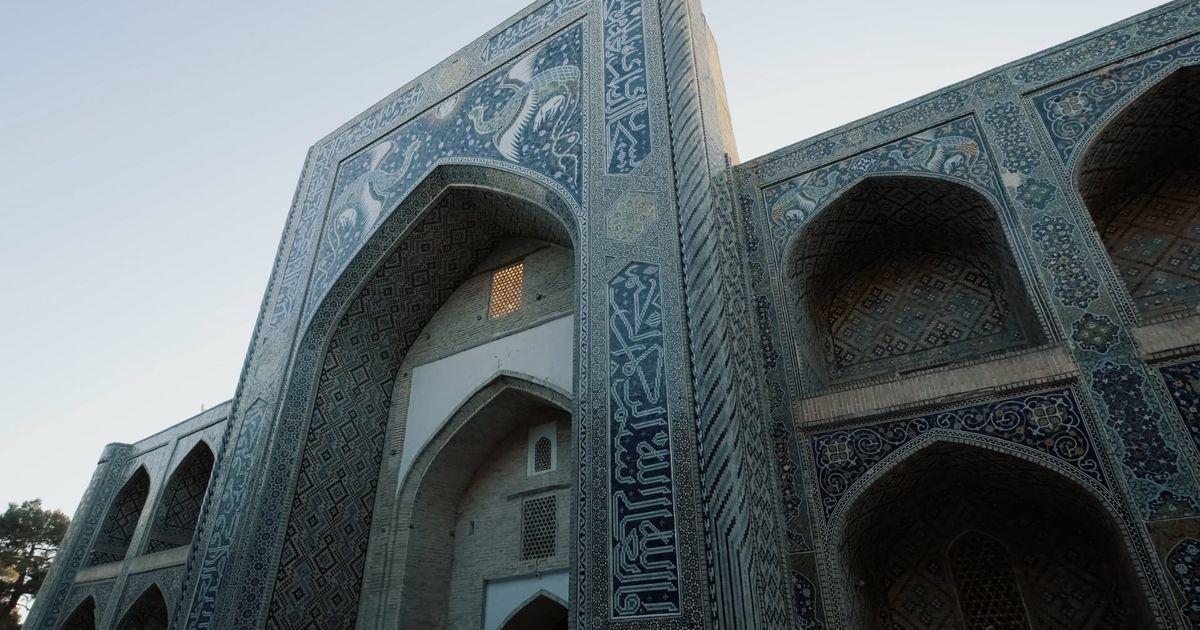
- 09:15 Lyabi-Hauz in the morning, when the portal of the Nadir Divan-Begi Khanaka is reflected in the pool. Then the Nadir Divan-Begi Madrasah, with its mosaic of birds flying towards a human-faced sun, and the Kukeldash Madrasah on the north side.
- 10:00 Walk west along the bazaar lane: Toki Sarrafon, the money changers' dome, then the Magoki-Attori Mosque, set several metres below today's street.
- 10:45 Toki Telpak Furushon, then the Tim of Abdullakhan, the covered silk market, and finally Toki Zargaron, the jewellers' dome. The shops open from about 9:00, and with time to browse this stretch fills the rest of the morning.
- 12:30 Lunch. Samsa from a tandoor near the domes makes an easy option.
The trading domes are public streets, free to walk through. Bargaining is normal and polite; our crafts and souvenirs guide explains what to check before you buy.
Day 2 afternoon and evening: workshops and the folklore show
- 14:00 Rest, or stay under the domes, which keep cool in summer.
- 15:30 Visit the workshops around the domes: blacksmiths making knives and the stork-shaped scissors that have become a Bukhara symbol, suzani embroiderers, carpet weavers and miniature painters. Most are happy for you to watch without buying.
- 17:00 Lyabi-Hauz again. In the late afternoon the sun falls on the madrasah portal, and families come out to sit by the water.
- 17:30 or 19:30 The folklore and fashion show in the courtyard of the Nadir Divan-Begi Madrasah, in the tourist season, roughly April to June and August to October. Published times are about 17:30 without dinner and 19:30 with dinner, which must be ordered in advance. Book a day ahead and check that it is running.
- After dark: tea by the pool, then a last walk to the lit Kalyan Minaret if you did not see it last night.
If you are not a shopper, use the afternoon of day two instead for Sitorai Mohi-Hosa, 15 minutes by taxi, and keep the rest of the countryside for a third day.
One day in Bukhara: the short version
If you only have one day, for example between Samarkand and Khiva, walk the old town from east to west and end at Po-i-Kalyan.
- 08:00 Lyabi-Hauz and the Nadir Divan-Begi Madrasah.
- 08:45 Chor Minor, 10 minutes away, then back.
- 09:45 The trading domes and the Magoki-Attori Mosque.
- 11:00 The Ulugbek and Abdulaziz Khan madrasahs, then a first look at Po-i-Kalyan.
- 12:00 The Ark Fortress and Bolo-Hauz.
- 13:30 Lunch, then a rest.
- 16:00 The Samanid Mausoleum in the late afternoon light.
- 17:30 Back to Po-i-Kalyan: the Kalyan Mosque, then sunset from a rooftop café.
- Evening: dinner at Lyabi-Hauz.
If you arrive by train, the morning Afrosiyob from Samarkand reaches Kagan station before lunch, which leaves you the afternoon and evening. In that case begin at the Ark, do the domes on the way back east, and see Chor Minor early the next morning before you leave.
Day 3: Sitorai Mohi-Hosa, Bahauddin Naqshband, Chor-Bakr and Gijduvan
A third day takes you outside the old town. You need a car with a driver, since the sites are spread out; Yandex Go works for single legs, but a driver for the day is simpler. A typical 2026 range for a car and driver for a full day around Bukhara is about US$40 to 80.
- Sitorai Mohi-Hosa: the summer palace of the last emirs, on the northern edge of the city, about 15 minutes from the centre. Built between 1912 and 1918 for Emir Alim Khan, it mixes European façades with Bukharan interiors, including the mirrored White Hall, and houses a museum of decorative arts. Allow about an hour and a half.
- Bahauddin Naqshband: the shrine of the 14th-century Sufi master (1318 to 1389) whose order spread across the Islamic world, about 12 km from the centre. It is an active pilgrimage site with mosques, a courtyard and the open-air grave enclosure. Cover shoulders and knees, women should bring a scarf, and keep your voice low. Allow an hour.
- Chor-Bakr: a necropolis in the village of Sumitan, about 5 km west of the city, around the 10th-century grave of Abu Bakr Said, one of the "four Bakrs" who gave the place its name. The complex was laid out from 1559 under Abdullah Khan II and grew into a walled "city of the dead" of courtyards, family tombs, a mosque and a khanaka, largely for the Juybari sheikhs. Quiet and little visited. Allow 45 minutes.
- Gijduvan: a small town about 45 km north-east of Bukhara, 40 minutes to an hour by car. The Narzullaev family's house museum and workshop show the town's warm yellow, brown and green ceramics, with master classes on request. Gijduvan also has a small Ulugbek madrasah and the shrine of Abdulkhaliq Gijduvani, first of the Seven Pirs, and is known for its kebab.
A full day that covers all four:
- 08:30 Chor-Bakr, in the cool of the morning.
- 10:00 Sitorai Mohi-Hosa.
- 11:45 Bahauddin Naqshband.
- 13:00 Drive to Gijduvan for a kebab lunch.
- 14:30 The ceramics workshop.
- 16:30 Back in Bukhara for sunset at Lyabi-Hauz.
For a half day, keep Sitorai, Bahauddin Naqshband and Chor-Bakr and return for lunch. Travelling on to Samarkand by road? Gijduvan sits on the way, so you can visit it on the transfer instead. Our ziyarat guide covers the Seven Pirs for travellers on a pilgrimage route.
Adjusting for the season, Fridays and Ramadan
- Summer (June to August): start at 07:30 and see the outdoor monuments by 11:00. Spend 12:00 to 16:00 under the domes, in a museum or at your hotel. Sunset is around 20:00 in June and July.
- Spring and autumn: the plan works as written, with sunset roughly between 18:15 and 19:45.
- Winter (November to March): fewer visitors and low prices, but short days. Sunset is around 17:15 in December, sites tend to close by 17:00, some craft shops shut early and the folklore show usually pauses. Bring warm layers; some old guesthouses are cold.
- Fridays: the Kalyan Mosque and the Bahauddin Naqshband complex are busiest around midday prayers. Visit in the morning or late afternoon.
- Ramadan: some teahouses open only after sunset, and shrines are busier in the evenings.
Our weather by month guide and the seasonal guides to Uzbekistan in spring, summer, autumn and winter help you choose.
Bukhara entrance fees for a two-day visit in 2026
There is no combined city ticket; you pay at each site, in cash in som. Typical prices for foreign adults as of November 2026:
- Ark Fortress: about 50,000 to 60,000 som
- Kalyan Mosque: about 15,000 to 25,000 som
- Samanid Mausoleum, Chashma-Ayub, Magoki-Attori and other small museums: about 10,000 to 40,000 som each
- Chor Minor roof: about 5,000 to 15,000 som, paid to the shop
- Sitorai Mohi-Hosa: a separate ticket, in a similar range to the Ark
- Lyabi-Hauz, the trading domes, Bolo-Hauz from outside and the Po-i-Kalyan square: free
Allow roughly 250,000 to 350,000 som per person, about US$20 to 30, for two full days, plus the folklore show and the third-day sites if you add them. Prices change often, so check at the ticket office. Our money guide explains cash, cards and ATMs.
Planning Bukhara with TourEast
Bukhara is one of our home cities, and this plan follows the light, the heat and the quiet hours. We can include it in a small-group tour, or build a private itinerary with a third day in the countryside and a ceramics class in Gijduvan.