Marble halls, chandeliers and a UNESCO-listed cosmonaut station a few metres underground. The 2026 fare, QR tickets and the ATTO card, hours, the four lines, photo rules and a two-hour station-hopping route.
Facts, prices and schedules checked on November 4, 2026
The Tashkent Metro is the cheapest art museum in the city: one ticket costs 2,500 soum. Opened in 1977 as the first metro in Central Asia, it hides marble halls, crystal chandeliers, ceramic cosmonauts and blue domes a few metres below the street. In July 2026 its most famous station, Kosmonavtlar, became part of a UNESCO World Heritage property, and that has brought a new wave of travellers asking the same questions: how to pay, which stations to see, whether photos are allowed and how to see the best of it in an afternoon.
This Tashkent Metro guide answers all of them with the figures in force as of November 2026: the new fares from 1 October 2026, QR tickets and the ATTO card, opening hours, the four lines including the overground Circle Line, and a station-hopping route for first-time visitors.
Tashkent Metro at a glance
The system was planned after the earthquake of 1966 destroyed much of the old centre, and it was built for a seismic city. Tunnels run shallow, mostly between 8 and 25 metres down, and the structures were designed to withstand strong earthquakes. The first section of the Chilonzor line opened on 6 November 1977.
- Lines: four. Chilonzor (red), O'zbekiston (blue), Yunusobod (green) and the Circle Line, called Halqa in Uzbek, which runs mostly above ground.
- Size: about 50 stations and roughly 70 km of route in 2026, after the extensions of 2020 to 2025.
- Hours: about 05:00 to midnight every day, with longer hours on some holidays such as New Year's Eve.
- Frequency: a train every few minutes on the central lines; about every 7 minutes on the Circle Line.
- Signs: station names are in Uzbek (Latin script) on signs and in announcements, with some English on newer maps. Download an offline map or take a screenshot of the line plan before you go underground.
Each station was decorated around a theme: a poet, a profession, a historical event or, in one famous case, the conquest of space. Many artists who worked on them were among the best known in Soviet Uzbekistan, and their ceramics, carved alabaster and marble are why people now ride the metro for pleasure.
Tashkent Metro lines, including the new Circle Line
The Chilonzor line, the oldest, runs from the south-western residential districts through the centre to Buyuk Ipak Yo'li in the east. In December 2020 it was extended south on an elevated section beyond Olmazor towards Sergeli and Qipchoq. This is the line for Mustaqillik Maydoni, Paxtakor, Amir Temur Xiyoboni, Hamid Olimjon and Pushkin.
The O'zbekiston line opened in 1984 and crosses the city from Beruniy in the north-west to Do'stlik in the east. It carries the most photographed stations: Alisher Navoiy, Kosmonavtlar and Toshkent, as well as Chorsu for the bazaar of the same name.
The Yunusobod line opened in 2001, the first built after independence, and runs north from Mingo'rik through Yunus Rajabiy and Bodomzor. Two stations, Turkiston and Yunusobod, were added at the northern end in August 2020.
The Circle Line is the newest. Its first seven elevated stations opened in August 2020, a second phase followed in April 2023 and a short underground link towards Qipchoq was added later. The overground section was closed in stages for maintenance in the summer of 2025 and reopened fully on 1 November 2025. Since 1 May 2026 it starts at 05:00, like the rest of the network. For a visitor it is less about art and more about views: you ride above the low-rise suburbs, which is a good way to see how most of the city actually lives.
What is not open yet: a new line to the planned New Tashkent district has been under construction, with a first section of three stations announced for the end of 2026, and a much larger expansion plan to 2035 was approved in May 2026. Check tashmetro.uz for the current map before relying on any station that is not listed above.
Tashkent Metro fare in 2026
Fares in Tashkent changed on 1 October 2026, so many older blogs are out of date. As of November 2026:
- One ride with electronic payment (transport card, bank card, QR from an app or kiosk): 2,500 soum.
- One ride paid in cash: 3,000 soum.
- A metro ride as part of a transfer chain that began on a bus within the past hour: 1,500 soum.
- Unlimited bus and metro travel on a transport card: 13,500 soum for one day, 73,000 soum for one week, 345,000 soum for one month.
- Trip packages on a transport card: 10 trips for 19,000 soum, 20 trips for 38,500 soum.
At about 20 US cents a ride, the metro is one of the cheapest in the world. One fare covers your whole journey, including changes between lines, for as long as you stay inside the gates. That is the key to station-hopping: you can get off, photograph a platform, take the next train and transfer as often as you like on a single ride. Leave the system and you pay again.
Note the one-hour rule: under the time-based tariff, a fare allows one entry into the metro. If you go out to the street and come back in, a new trip starts. Prices are set by the city and can change again, so check the current figures on tashmetro.uz or atto.uz before a long stay.

How to pay: QR ticket, ATTO card or bank card
Tokens disappeared in 2020 and paper tickets are now QR codes. You have three practical options.
QR ticket. The simplest choice for a visitor making a few rides. Ticket offices at many stations have been replaced by self-service kiosks that issue a QR ticket, which you scan at the turnstile. In December 2025 the cash desks at all fourteen overground Circle Line stations and at Paxtakor and Alisher Navoiy were closed and replaced by these kiosks. A QR ticket is valid for a short time after purchase, so buy it when you are ready to ride.
ATTO card. This is Tashkent's transport card, used on both the metro and city buses. It is sold and topped up at metro ticket offices and Uzbek post offices, and can also be topped up through the ATTO app, local banking apps and payment terminals. If you are in the city for three days or more, or plan to use buses, an ATTO card with a day or week pass is the best value. Tap it on the validator: a green light means you are through.
Bank card or phone. Contactless payment works at the turnstiles with local Uzcard and Humo cards and with some co-branded cards. Reports from travellers using foreign Visa and Mastercard cards are mixed, so do not count on it. Local payment apps such as Payme and Click can generate a QR ticket if you have a local card linked.
Our advice for a short visit: buy a QR ticket for your first ride, and if you like the system, pick up an ATTO card at a station with a staffed ticket office. Keep a few 5,000 soum notes in case a kiosk refuses your card.
Can you take photos in the Tashkent Metro?
Yes. For more than forty years the Tashkent Metro was also a civil-defence shelter, and photography was strictly forbidden; police would stop anyone with a camera. The ban ended on 1 June 2018, and since then you can photograph the stations freely.
A few rules of thumb still apply:
- Expect a short security check at the entrance. Police officers may look into bags or wave a scanner; it is routine and quick.
- Do not photograph police officers, security staff or control rooms, and ask before taking a close portrait of a passenger.
- Keep platforms clear. A tripod in rush hour will get you moved on, and you will not need one: most stations are well lit.
- Stand back from the platform edge. Trains arrive quickly and the platforms are not screened.
- Flash is unnecessary and annoys commuters; the chandeliers do the work.
The best time for photos is between about 10:00 and 16:00 on weekdays, or early on a weekend morning. Rush hours, roughly 08:00 to 09:30 and 17:30 to 19:00, are crowded on the central stations.

The most beautiful Tashkent Metro stations
There is no official ranking, but these are the stations we would show a friend first, with what to look for.
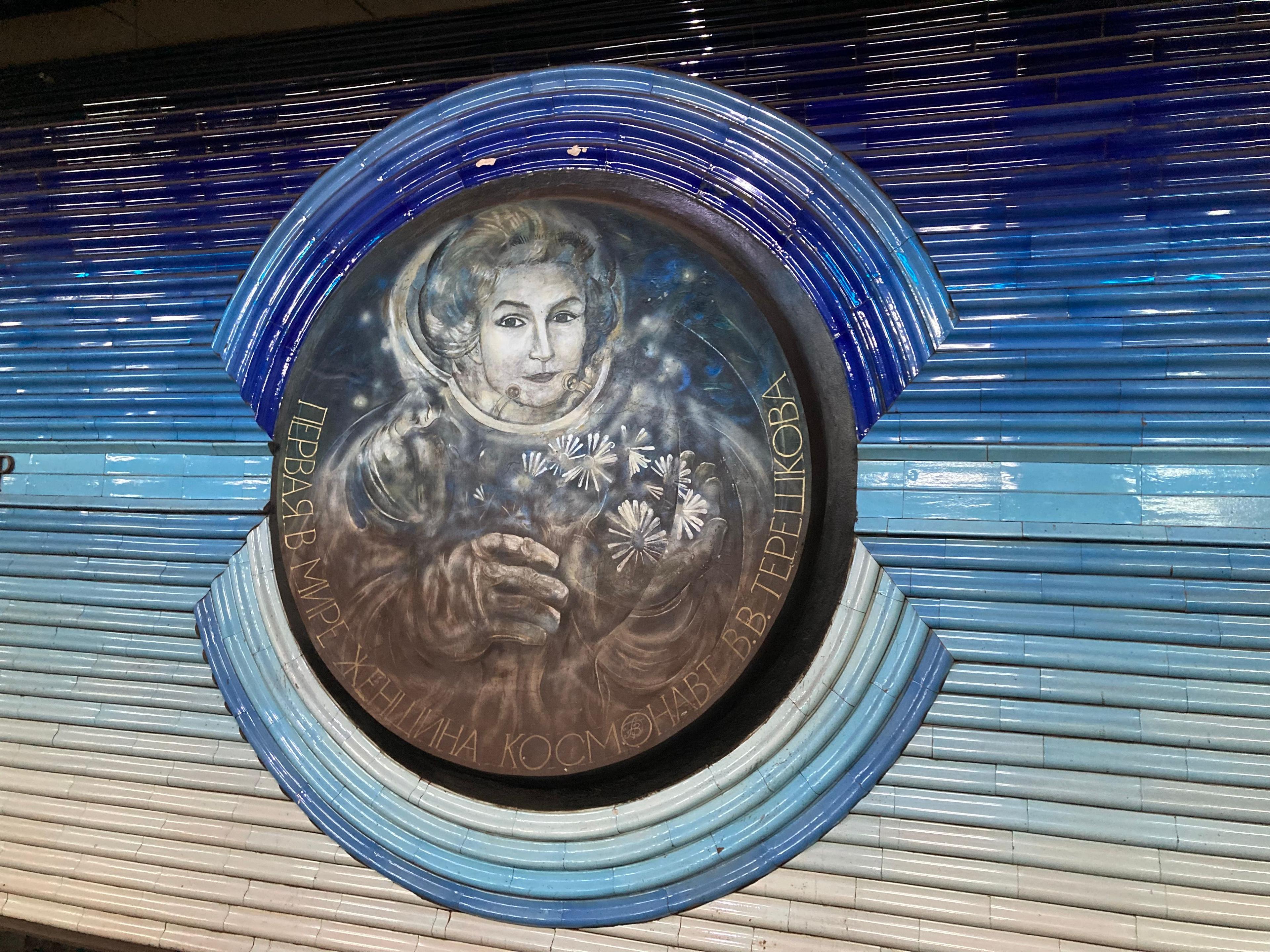
Kosmonavtlar (O'zbekiston line, 1984). The star. Architects Sergo Sutyagin and Sergey Sokolov built a hall that seems to float: blue ceramic walls darken from pale sky to deep space, glass-clad columns glow, and the ceiling is a line of light with glass stars. Twelve round ceramic medallions line the walls, among them Ulugbek, the astronomer-king of Samarkand, Yuri Gagarin, Valentina Tereshkova and Vladimir Dzhanibekov, the Tashkent-region cosmonaut. In July 2026 the station was inscribed on the UNESCO World Heritage List as one of ten buildings of Tashkent Modernist Architecture.
Alisher Navoiy (O'zbekiston line, 1984). Named after the 15th-century poet, it is often called the most beautiful of all. A row of shallow domes in white and blue, carved and gilded, recalls the madrasas of Samarkand and Bukhara, and the walls carry ceramic panels with scenes from Navoi's poems. It is the interchange with Paxtakor on the red line.
Mustaqillik Maydoni (Chilonzor line, 1977). Under Independence Square, and called Lenin Square until 1991. Three aisles of white marble columns, pink marble walls and crystal chandeliers hanging in small domes make it the most formal hall in the network, and one of the few with a palace atmosphere rather than a theme.
Toshkent (O'zbekiston line, 1984). Under the forecourt of the main railway station, so it is the first station many travellers see when arriving on the Afrosiyob train. Ceramic artist Saparniyaz Sultanmuratov designed ornaments that resemble carved column capitals, and stair panels mark the city's 2,200th anniversary.
Paxtakor (Chilonzor line, 1977). The name means cotton grower, and the mosaics turn cotton bolls into abstract patterns. One of the original 1977 stations, and a good contrast with the domes of Alisher Navoiy next door.
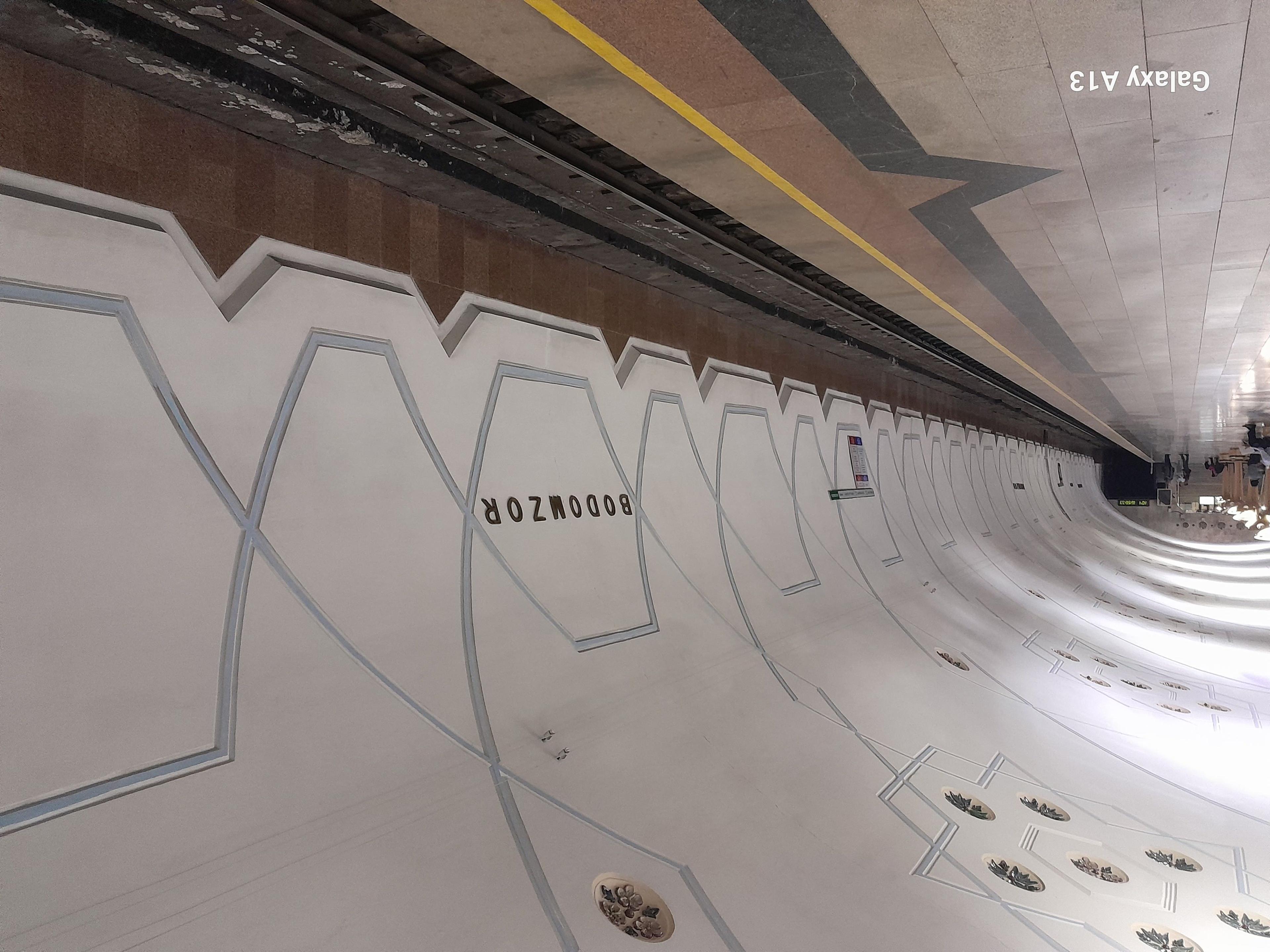
Bodomzor (Yunusobod line, 2001). Almond Grove: a white ceiling with blue geometric patterns and almond-shaped lamps. A lighter, more modern style than the Soviet stations.
Also worth a stop: Hamid Olimjon and Pushkin on the red line, both from 1980, with glazed tiles, dark marble and bronze lamps; Chorsu, which brings you up next to Chorsu Bazaar; and any overground Circle Line station if you want views rather than decoration.
A station-hopping route: the best stations in about two hours
This route covers the highlights on a single fare, because you never leave the gates. Allow about two hours with photo stops; it works in either direction.
- Start at Toshkent (blue line). Convenient if you arrive by train or stay near the station.
- Ride two stops west to Kosmonavtlar. Spend 15 to 20 minutes on the platform.
- Continue two stops west to Alisher Navoiy. Walk the length of the hall under the domes.
- Follow the transfer signs to Paxtakor on the red line. Look at the cotton mosaics.
- Ride one stop to Mustaqillik Maydoni for the chandeliers.
- Continue to Amir Temur Xiyoboni, then on to Hamid Olimjon and Pushkin if you have time.
- Optional: from Amir Temur Xiyoboni transfer to Yunus Rajabiy on the green line and ride north to Bodomzor.
- Finish by riding back to Alisher Navoiy and two stops west to Chorsu, and come up for lunch at Chorsu Bazaar and a walk to the Kukeldash Madrasah.
If you only have 45 minutes, do Kosmonavtlar, Alisher Navoiy and Mustaqillik Maydoni. Line maps inside the trains show the station order; check it as you go, because some interchange stations have different names on each line.

Practical tips for riding the metro
- Station entrances are often modest pavilions or stairways from an underpass. Look for the blue M sign.
- Announcements are in Uzbek, with some stations also announced in English on newer trains. Count the stops.
- Give up seats to older passengers and to women with children; locals do, and it is expected.
- Eating on the platforms and in trains is frowned upon. Drinking water is fine.
- Mobile data works in most stations and tunnels.
- Lifts are still rare on the older lines, so travellers with heavy luggage or reduced mobility should plan for stairs. The newer Circle Line and southern stations have lifts.
- Taxis via the Yandex Go app are cheap, so combine the metro with a short ride when stations are far apart.
Is the Tashkent Metro worth it?
Yes, even if you are only in Tashkent for a day. It is fast, safe, clean and very cheap, and it is the easiest way to see Soviet-era Uzbek decorative art of a quality you will not find above ground. It also takes you between the main areas of the city: the Amir Temur square and Broadway, the old town around Chorsu and Khast Imam, and the railway station for trains to Samarkand and Bukhara.
Combine it with our Tashkent travel guide for what to see above ground, and with our article on getting around Uzbekistan's cities for taxis and buses.
Seeing the metro with TourEast
We can include a guided metro ride with the stories behind each station in a private or small-group itinerary on request. If you are planning a longer trip, we can design a custom itinerary that starts in Tashkent and continues to Samarkand, Bukhara and Khiva.
Frequently asked questions
Watch
Photo gallery