
Mausoleum · 1403–1404, later additions under Ulugbek
Gur-e-Amir Mausoleum
The tomb of Amir Timur and his descendants: a fluted turquoise dome over a gilded burial chamber, and the model for the great Mughal tombs of India.
About
Gur-e-Amir, “the tomb of the ruler”, was not built for Timur at all. In 1403 his favourite grandson and chosen heir, Muhammad Sultan, died on campaign in Anatolia, and Timur ordered a mausoleum for him beside the madrasah the young prince had founded. Two years later Timur himself died in Otrar, on his way to invade China, and with the passes snowed in he was brought back to Samarkand and laid here rather than in the tomb he had prepared at Shakhrisabz.
A dynastic tomb
Ulugbek turned the building into the family mausoleum of the Timurids. Beneath the dome lie, among others, Timur, his sons Shahrukh and Miran Shah, his grandsons Muhammad Sultan and Ulugbek, and his spiritual teacher Sayyid Baraka, at whose feet Timur asked to be buried. The carved stones in the hall are cenotaphs; the actual graves are in the crypt directly below. Timur’s cenotaph is a block of dark green nephrite, brought from Central Asia under Ulugbek. It is cracked in two: the Persian ruler Nadir Shah carried it off to Mashhad in 1740 and, the story goes, returned it after a string of misfortunes.
Architecture
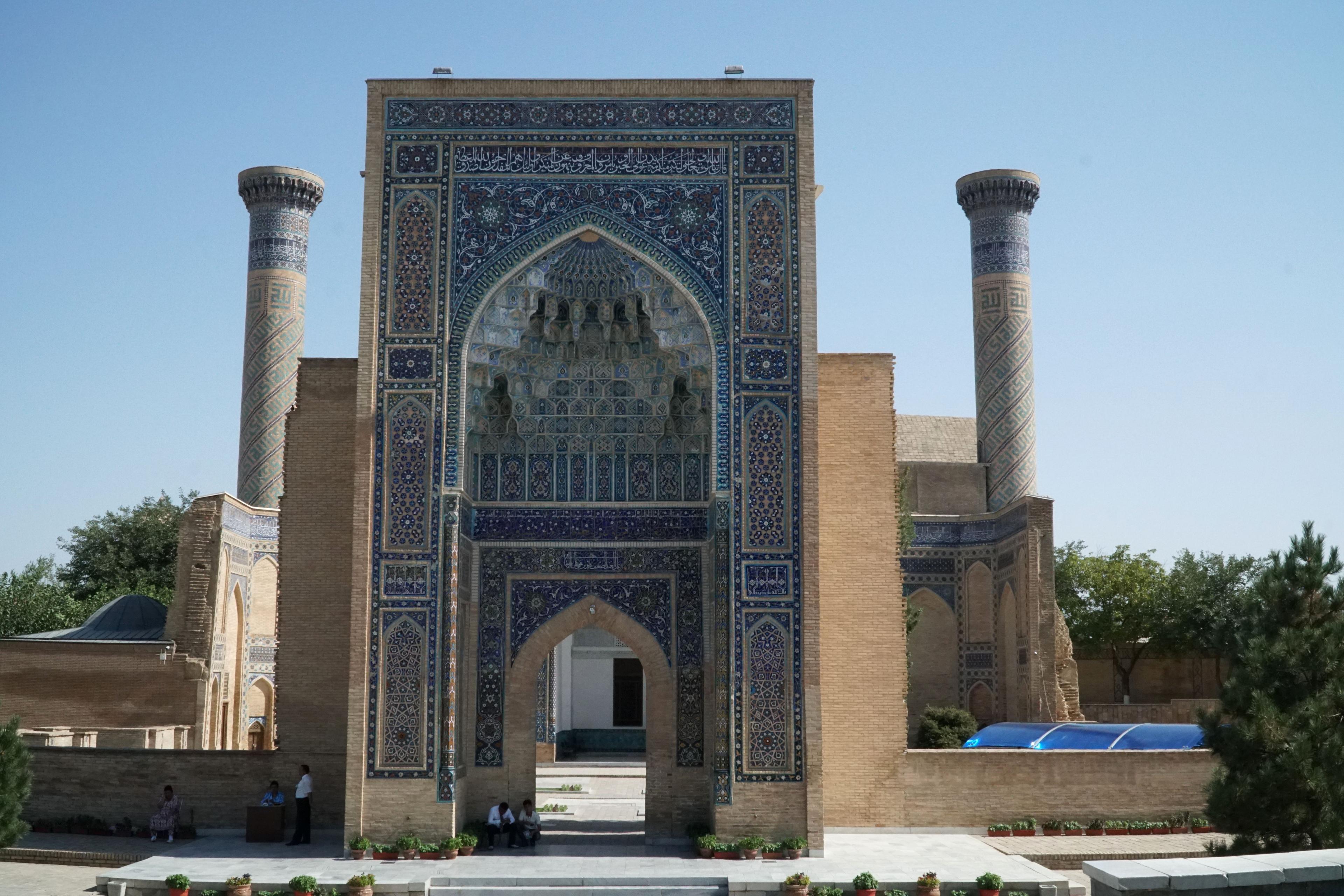
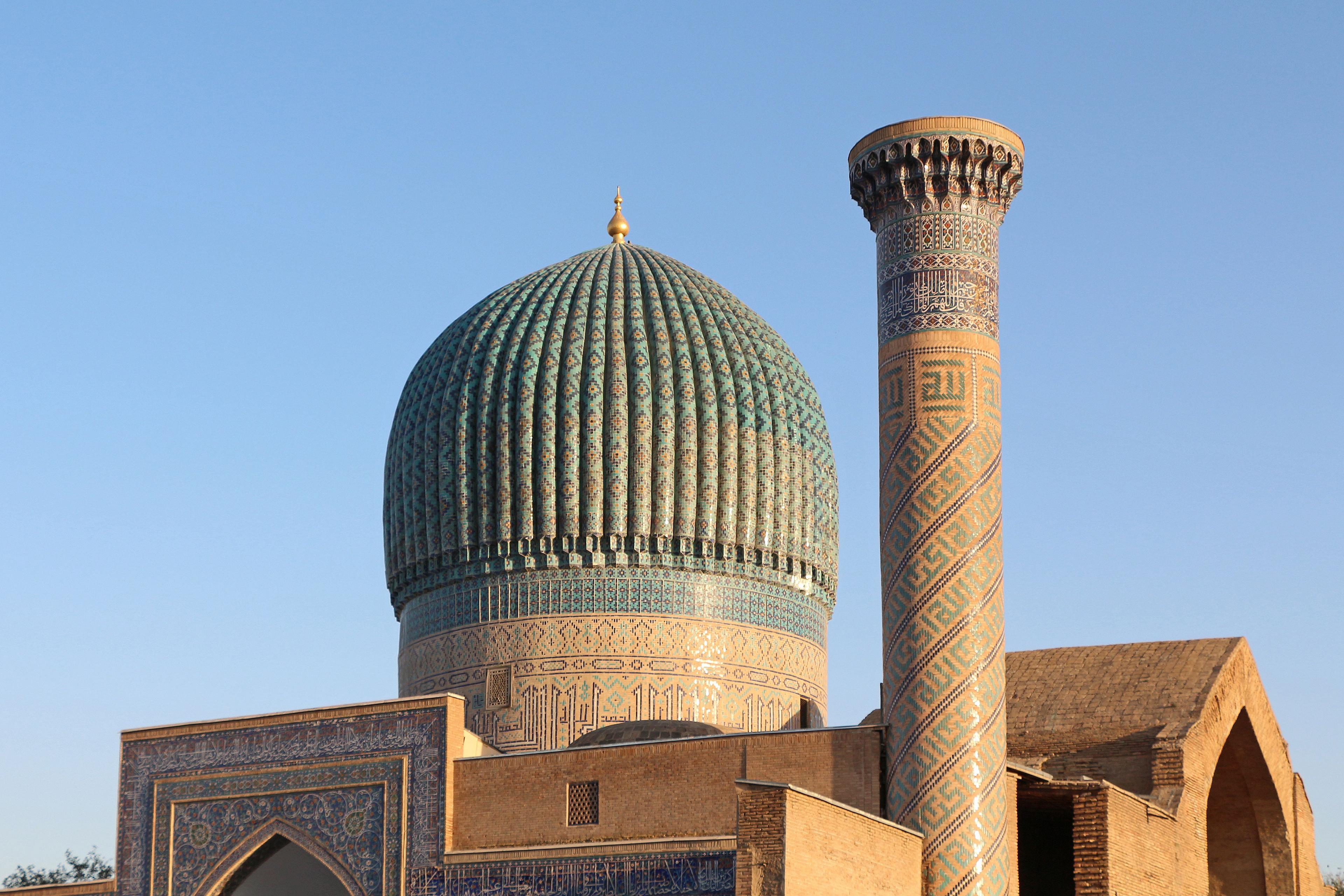
The outer dome rises on a tall drum and is ribbed with deep flutes, faced in turquoise and blue tile. The portal bears the name of its master builder, Muhammad ibn Mahmud of Isfahan. Inside, the walls have an onyx dado, and above it relief work in gilded papier-mâché (the kundal technique) and painted decoration, restored with a great deal of gold in the 1990s. The double-dome profile and the arrangement of a family tomb within a garden complex were carried to India by Timur’s descendant Babur, and echo through Humayun’s Tomb and, ultimately, the Taj Mahal.
The legend of the curse
In June 1941 a Soviet team led by the anthropologist Mikhail Gerasimov opened Timur’s grave. Local tradition says an inscription warned that whoever disturbed the tomb would unleash a war worse than Timur’s own; Germany invaded the Soviet Union days later. The remains were reburied with Islamic rites in late 1942, shortly before the Soviet victory at Stalingrad. The tale is legend, but it is told at the graveside to this day.
Visiting
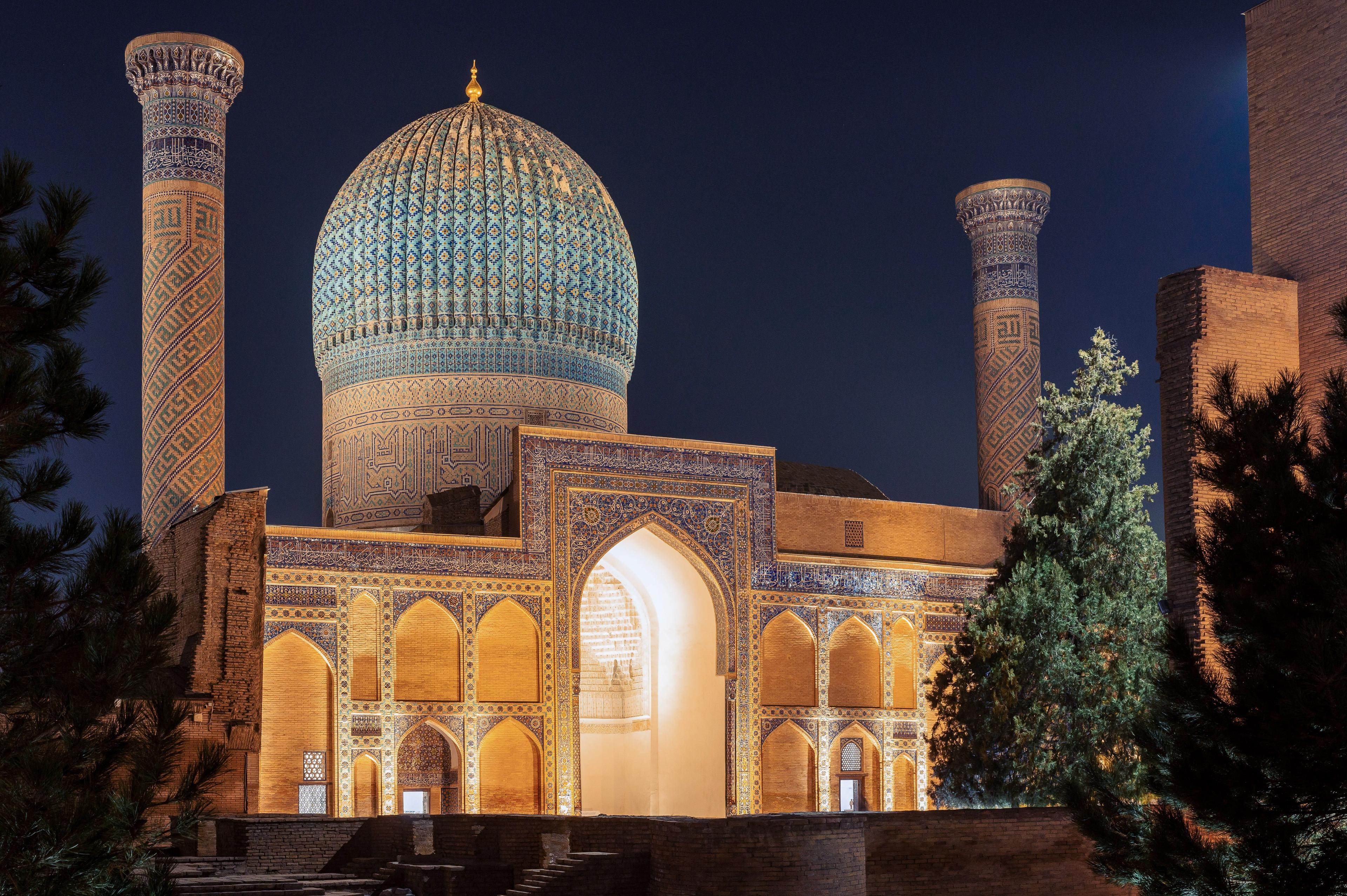
Come in the evening, when the dome is floodlit and the ensemble is far quieter than the Registan, or first thing in the morning. Modest dress is appropriate.
What to see
- The fluted turquoise dome on its tall drum
- Timur’s dark-green nephrite cenotaph
- The gilded interior of the burial hall
- The tiled entrance portal of the complex
- The mausoleum floodlit after dark
- Ruins of Muhammad Sultan’s madrasah and khanaka in the courtyard
Gallery


Tours that visit Gur-e-Amir Mausoleum
More sights in Samarkand
All of Samarkand

See Gur-e-Amir Mausoleum with a local guide
We build private and small-group trips around the places you want to see — with guides who grew up here.