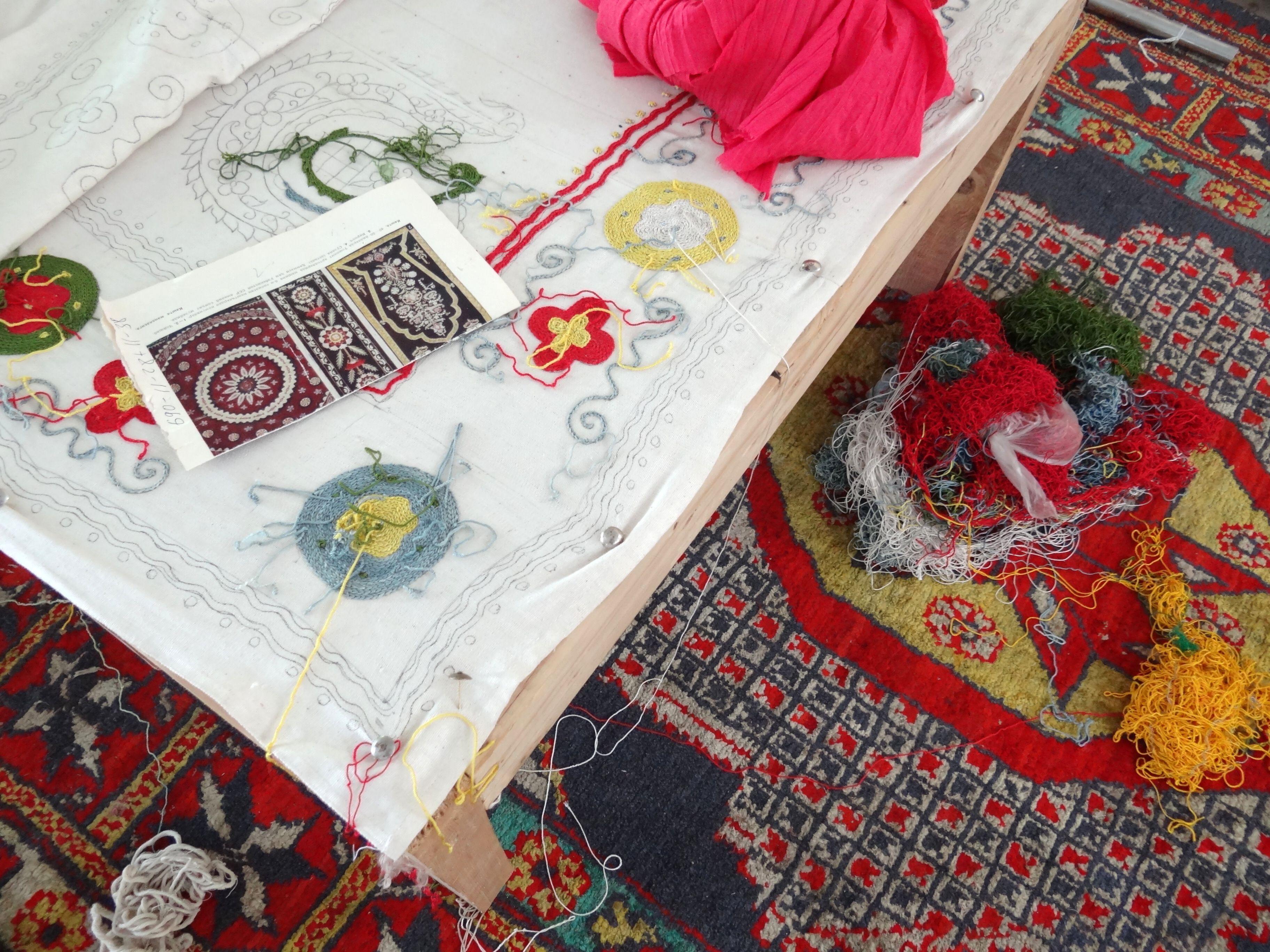
Margilan is the silk capital of Uzbekistan. How ikat (abrband) is made from cocoon to cloth, what you see at the Yodgorlik factory, the difference between adras and atlas, and how to tell hand-woven ikat from printed copies.
Facts, prices and schedules checked on November 4, 2026
Margilan silk is the reason the blurred, flame-like patterns of Uzbek ikat are recognised from Paris runways to Istanbul bazaars. This small town in the Fergana Valley has woven silk for centuries, and it is still the place where the whole chain, from silkworm cocoon to finished cloth, happens by hand within a few streets.
Our crafts and souvenirs guide gives a quick overview of ikat, and our Fergana Valley travel guide explains how to get to Margilan and plan the day. This article goes deeper into the fabric itself: how ikat is made step by step, what you actually see at the Yodgorlik silk factory and in master weavers' homes, the difference between adras, atlas and the other Margilan cloths, what to pay in 2026, and how to make sure the ikat you buy is the real thing.
What is ikat? Abrband, the "tied cloud"
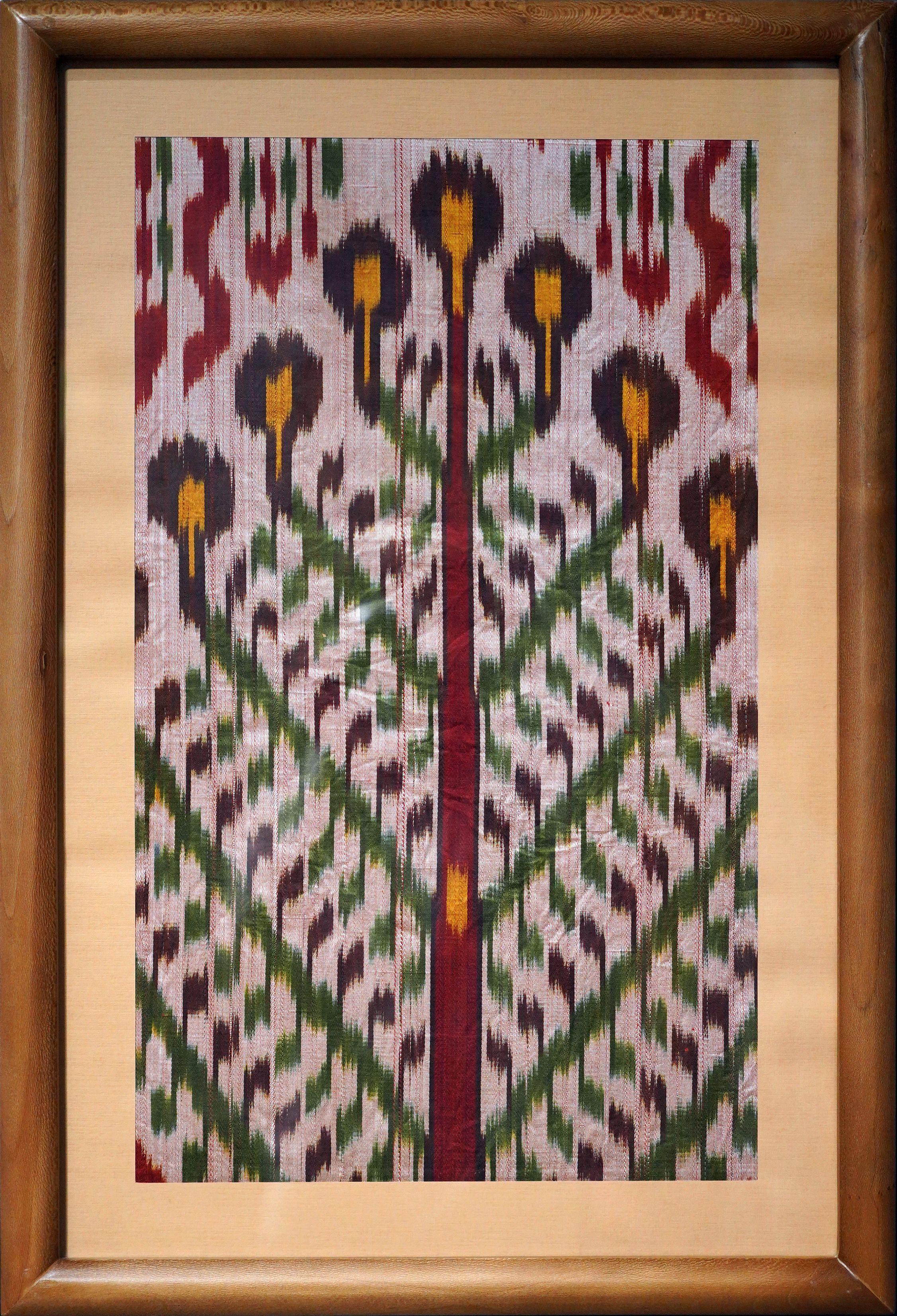
Ikat is a resist-dyeing technique in which the threads are tied and dyed before the cloth is woven. The pattern exists in the yarn first and only appears as the weaver works. Because the dyed threads shift slightly on the loom, the edges of every motif are soft and feathered, which is the signature look of the cloth.
The word ikat is Malay-Indonesian and is used worldwide, but in Uzbekistan the technique is called abrband, from abr (cloud) and band (tie). The craftsman who ties the patterns is the abrbandchi, and in the old system dyeing, tying and weaving were separate trades handed down in separate families.
Uzbek ikat is warp ikat: only the lengthwise threads (the warp) are patterned. The crosswise weft is a single colour. This is why the design runs along the length of the cloth, and why a good weaver can keep the pattern crisp enough to read from across a room.
In 2017 UNESCO added the Margilan Crafts Development Centre's work safeguarding atlas and adras weaving to its Register of Good Safeguarding Practices, recognition of how close the technique came to disappearing in the twentieth century and how deliberately it has been revived.

From cocoon to cloth: how Margilan ikat is made
A full ikat cycle takes weeks and passes through many hands. In Margilan you can see most of it in one morning.
- Cocoons. Silkworms are raised in late spring on mulberry leaves, mostly by village families, and the cocoons are sold to workshops in early summer. Each cocoon is wound from a single continuous filament that can be hundreds of metres long.
- Reeling. Cocoons are softened in hot water, and the reeler catches the loose ends of several cocoons at once and draws them onto a wheel as one thread. The smell of the boiling vats is the first thing you notice at Yodgorlik.
- Twisting and preparing the warp. Threads are twisted, washed, and laid out in long bundles the length of the future cloth.
- Marking and tying. The abrbandchi marks the pattern on the stretched warp and ties off the sections that must resist the first colour, binding them tightly with thread.
- Dyeing. The bundles go into the vat, lightest colour first. Then some ties are cut, others added, and the warp is dyed again. A design with five or six colours means five or six rounds of tying and dyeing, and overlapping colours create new ones: yellow over blue gives green.
- Weaving. The dyed warp is threaded onto the loom in exact order and woven, a few centimetres an hour for the finest pieces.
- Finishing. Atlas is traditionally beaten or pressed to bring up its shine.
Natural dyes were largely replaced by synthetic ones in the twentieth century. Since the 1990s several Margilan families, notably the Mirzaakhmedovs, have revived plant dyes such as madder (red), indigo (blue), pomegranate rind and onion skin (yellows and golds) and walnut husk (browns). Many workshops now use both.
The Yodgorlik silk factory: what to expect
Yodgorlik (the name means "souvenir" or "memorial") opened in 1972 and is now a private enterprise. It is described by Uzbekistan's national tourism site as the only factory in the country where the entire silk cycle is done by hand, and it is the easiest place for a visitor to see every stage in one place.
A typical visit, around an hour with an English-speaking staff guide:
- The reeling room, with cocoons simmering in vats and women drawing thread onto wooden wheels.
- The tying and dyeing yard, where you see warps bound in patterned sections and hanging to dry after the dye bath.
- The loom halls, where weavers work adras and atlas on hand looms, and sometimes a room where silk carpets are being knotted.
- The showroom, selling cloth by the metre, scarves, cushion covers and ready-made clothes at fixed prices.
Practical points as of November 2026: a modest entrance fee is usually charged, reported by visitors at around 30,000 som; it is generally open Monday to Saturday, with conflicting reports about Sundays. Photography is normally allowed but always ask before photographing individual weavers. Plan Yodgorlik for a Thursday or Sunday morning if you also want the Kumtepa Bazaar nearby at its busiest.

Beyond Yodgorlik: master weavers and craft centres
Yodgorlik shows the process; Margilan's master workshops show the art.
- The Crafts Development Centre, opened in 2007, is the community initiative behind the UNESCO listing. It trains young weavers and dyers and organises exhibitions and textile festivals.
- Rasuljon Mirzaakhmedov, who comes from a long line of weavers, is the best-known name in Uzbek ikat. His father Turgunbai began reviving natural dyes in the 1990s, and in 2005 Rasuljon received a UNESCO crafts award for reviving silk velvet ikat. His family workshop also offers guest rooms, so you can stay with the weavers.
- The Margilan Handicraft Centre, opened in 2020 as a public-private partnership, combines weaving workshops with a showroom of atlas, adras and silk carpets.
Visits to private workshops need to be arranged in advance. This is where a guide pays for themselves: the masters often speak only Uzbek or Russian, and much of what makes a visit memorable is the conversation about patterns, dyes and family history.
In May Margilan also hosts the Atlas Bayrami textile festival; see our festivals calendar for dates.
Adras vs atlas: which fabric is which?
These two words cover most of what you will be offered in Margilan, and they are easy to confuse.
Atlas (also khan-atlas):
- Pure silk in both warp and weft.
- A warp-faced satin weave: the silk warp floats on the surface, giving a smooth, high-gloss, almost liquid finish.
- Lightweight and fluid, the classic fabric for women's dresses.
- Khan-atlas, "the khan's satin", is the name for the finest, most elaborate patterns. A popular legend says a weaver created it after seeing clouds reflected in water.
Adras:
- A silk warp with a cotton weft.
- A ribbed, slightly matt surface with a soft sheen rather than a gloss.
- Heavier, stronger and easier to care for than atlas. It is used for robes (chapan), cushions, upholstery, bags and modern clothing.
Other names you may hear:
- Bekasab: a striped silk-and-cotton cloth, traditionally used for men's robes.
- Shoyi: plain or simply patterned silk.
- Baxmal (bakhmal): silk velvet ikat, the most demanding and most expensive of all, once reserved for the robes of the wealthy.
Which should you buy? For a garment or scarf, atlas. For anything that will be used, sat on or washed, adras.

Reading ikat patterns and colours
Every ikat pattern has a name, and asking a weaver what a design is called is the quickest way into a good conversation. Patterns are usually named after everyday or protective objects rather than abstract ideas. Names you will hear include the tree of life, the silkworm cocoon, the snail trail, the ear of corn, the lance, the amulet and doiragul (a round, drum-like flower). On old velvet robes, a stylised scorpion was believed to protect the wearer from the evil eye.
Colour carries meaning too. Strong reds, yellows and greens were traditionally associated with youth and celebration, and a bride's trousseau would include bright atlas. Older women wore darker, quieter ikats. Today designers in Tashkent and abroad use ikat in muted indigo and grey palettes, and Margilan weavers produce both, so do not assume that a subtle colourway is less traditional.
If you are buying for a particular use, tell the weaver: some patterns read best hung as a panel, others only make sense as a garment cut along the length.
Margilan silk and ikat prices in 2026
Prices vary with the fabric, the number of colours, natural or synthetic dyes and where you buy. These are typical prices in Margilan as of November 2026:
- Hand-woven adras: roughly US$8 to 25 per metre.
- Hand-woven silk atlas: from roughly US$15 to 40 per metre, more for complex patterns.
- Ikat scarves: about US$15 to 60.
- Natural-dye pieces from master workshops and silk velvet ikat: considerably more, often priced per piece.
- Machine-printed "ikat" cotton or polyester: a few dollars a metre, sold in every bazaar.
Standard widths are narrow, traditionally around 35 to 50 centimetres, so ask how many metres you need for a dress, cushion or curtain before you buy. The same cloth costs noticeably more in Tashkent, Samarkand or Bukhara shops, and several times more abroad.
Bargaining: fixed or near-fixed at Yodgorlik and master workshops, normal at the Kumtepa Bazaar and the central Margilan bazaar. Ask your guide what a fair price for a metre of adras is that week before you start.

Real vs printed ikat: how to tell
Printed copies are everywhere, from cheap scarves to upholstery fabric. They are not bad in themselves, but you should know what you are paying for.
- Turn it over. Because hand ikat is dyed in the thread, the pattern goes right through the cloth and the back looks almost the same as the front. A printed fabric is visibly paler or blank on the reverse.
- Look at the edges of the motifs. Real ikat has soft, slightly irregular, feathered edges where the dyed threads shift. Printed imitations either have razor-sharp edges or a uniform, too-regular blur.
- Check the repeat. In hand ikat no two repeats are exactly identical. A perfectly mechanical repeat suggests printing.
- Pull a thread at a cut edge, if the seller allows. In ikat the individual warp thread changes colour along its length.
- Feel it. Real silk warms quickly in the hand and has a dry, slightly crisp handle; polyester stays slippery and cool. A shop that sells real silk will usually let you do a burn test on a loose thread: silk smells like burnt hair and crumbles to ash, synthetics melt into a hard bead.
- Look at the price. Hand-woven silk ikat at a few dollars a metre does not exist.
There is also a middle ground: machine-woven fabric made from hand-dyed ikat threads, and power-loom adras. These are honest products at fair prices as long as they are sold as such. Simply ask: "Is this hand-woven?"
Caring for ikat and taking it home
- Hand-wash cool in mild soap or dry-clean. Natural and older synthetic dyes can bleed, so wash ikat separately the first time.
- Dry flat, out of direct sun. Iron on the reverse at low heat.
- Atlas creases easily; roll rather than fold for packing.
- Fabric is light, so carrying it home is easy. New textiles have no export restrictions; keep the receipt.
Many Margilan workshops and Tashkent tailors can make a garment from your fabric in a day or two, which is a good reason to buy on the first day of your valley stay rather than the last.
Is Margilan worth visiting for silk?
If textiles interest you at all, Margilan is one of the most rewarding stops in Uzbekistan. In Bukhara, Samarkand and Tashkent you can buy ikat; only here do you see the whole process and meet the people who design the patterns.
Combine it with the Rishtan pottery workshops and Kokand's Khudayar Khan Palace for a full Fergana Valley day, and allow two or three days in the valley in total. Spring and early summer are the time to see the cocoon harvest and reeling at full speed, but weaving continues year round.
Margilan silk with TourEast
We can arrange Yodgorlik and private workshop visits, dyeing or weaving master classes and a Kumtepa market morning as part of a private Fergana Valley itinerary or our Crafts of the Fergana Valley tour. A guide who knows the weavers makes all the difference to what you see and what you pay.