An hour-by-hour Fergana Valley itinerary: the train through the Kamchik tunnel to Kokand, the Khudayar Khan Palace and Jami Mosque, Rishtan's ceramic workshops, Margilan silk and the Kumtepa bazaar on a Thursday or Sunday, Andijan and Babur, then on to Osh or back to Tashkent. With 2-day and 4-day versions.
Facts, prices and schedules checked on November 4, 2026
Our Fergana Valley travel guide explains what the region is and why it is worth the detour from the Silk Road cities. This article is the plan: a three-day Fergana Valley itinerary with times, the order that avoids backtracking, and the two fixed points that decide everything, the morning train from Tashkent and the Kumtepa bazaar, which only trades properly on Thursdays and Sundays.
The route runs east: Tashkent to Kokand by train through the Kamchik tunnel, the Khudayar Khan Palace and the Jami Mosque, then Rishtan's ceramic workshops, Margilan's silk and bazaar, Fergana city as a base, Andijan and Babur's birthplace, and finally either the Dostuk border to Osh or the train back to Tashkent. A compressed two-day version and a four-day version with Shakhimardan follow.
Times and prices are as of November 2026. Train timetables in the valley changed in September 2026 with a new high-speed service, so check the live times on the Uzbekistan Railways app before you fix hotels.
Before you go: the two things that fix the plan
Start with the calendar. Kumtepa bazaar, outside Margilan, is the reason most travellers come, and it is a Thursday and Sunday market. Other days a skeleton of stalls opens, but the silk rows, the livestock corner and the crowds are not there. Build the itinerary so that Day 2 is a Thursday or Sunday, and everything else falls into place.
Then the train. Since 10 September 2026 a Chinese-built high-speed set runs Tashkent to Andijan via Angren, Pap, Kokand and Margilan, leaving Tashkent at 09:20 and reaching Kokand at 12:28, Margilan at 13:00 and Andijan at 13:35. It returns from Andijan at 15:38, Margilan 16:11, Kokand 16:43, arriving in Tashkent at 19:53. The older daytime trains still run on a similar pattern, leaving Tashkent around 08:00 and taking four to four and a half hours to Kokand. Either way, you cannot be in Kokand before late morning by rail.
The alternative is the road over the Kamchik Pass, about 2,200 metres, four and a half to five hours from Tashkent to Kokand with a private car. It leaves earlier, stops where you like and shows you the pass rather than 19 km of tunnel. Many of our guests take the train in and the road out, or the reverse.
Book the train 45 to 60 days ahead if you can; see our guide to booking Uzbekistan train tickets. Seats on the valley trains sell out on Fridays and before holidays.

Day 1: Tashkent to Kokand, the palace and the old city
07:30. Leave your Tashkent hotel for the station, or earlier for the road.
09:20–12:28. The train. The first hour crosses the Tashkent oasis, then the line climbs past Angren into the Chatkal foothills and dives into the Kamchik tunnel, which takes about 16 minutes. You come out at Pap in the valley, with the Fergana plain opening ahead.
12:30. Driver meets you at Kokand station. Lunch in town: Kokand is known for its samsa and for a dense, nutty halva that you will see sold in blocks at the bazaar.
14:00. Khudayar Khan Palace. Built in the late 1860s and early 1870s for the last ruling khan, only a few years before the Russian Empire absorbed the khanate, it is a long tiled facade in front of a fraction of the original courtyards. Inside are the regional museum and some rooms with their painted ceilings. Allow an hour; the complex is open daily, roughly 09:00 to 18:00, with a modest entrance fee for foreigners.
15:30. The old city on foot or with short drives: the Jami Mosque, with its 98-column wooden iwan and the painted ceiling that is the finest in the valley, now housing craft workshops around the courtyard; the Narbutabey madrasah, still a working religious school; and the Dakhma-i-Shakhon, the khans' necropolis with its carved tombstones. If you have energy, the Kokand bazaar at the end of the afternoon is at its liveliest.
18:00. Drive east to Fergana city, about 90 km and an hour and a half via Rishtan, or stay in Kokand if you prefer a quiet evening. Fergana has the better hotels and is the base for Days 2 and 3.
If you came by road instead of train, you reach Kokand by noon and can add the Modari Khan mausoleum and a halva workshop before the palace.
Day 2: Rishtan ceramics, Margilan silk and the Kumtepa bazaar
This day must be a Thursday or Sunday. If it cannot be, swap Day 2 and Day 3 so that it is.
07:30. Early breakfast and drive to Kumtepa, about 10 km from Fergana city towards Margilan. The bazaar peaks between 08:00 and 11:00.
08:00–10:00. Kumtepa bazaar. Rows of khan-atlas and adras ikat sold by the metre, beshik cradles, knives from Chust, skullcaps, dried apricots by the sack, and the livestock market at the far end. Bargain gently, carry small notes, and keep your bag in front of you; it is crowded rather than unsafe. This is the best place in Uzbekistan to buy ikat at local prices, though the dyes are often synthetic; the silk-and-silk ikat comes from the workshops you will see next.
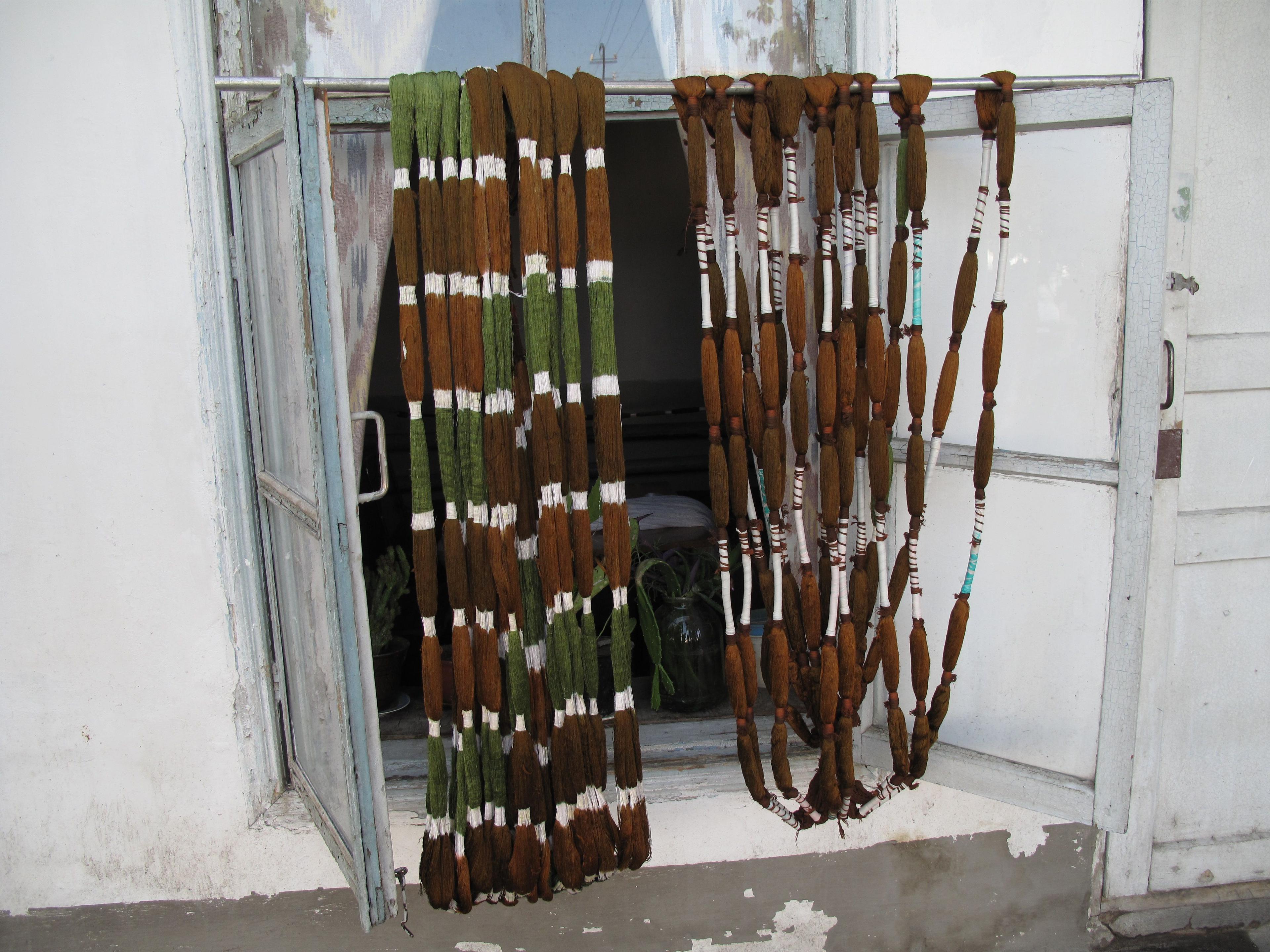
10:30. Yodgorlik silk factory, Margilan. The hand-production cooperative shows the whole process: cocoons, reeling, the tying and dyeing of the warp that creates the ikat pattern, and the looms. A guided visit takes about an hour and costs around 30,000 som. The showroom sells finished fabric and scarves at fixed prices. Our Margilan silk and ikat guide goes deeper.
12:00. Lunch in Margilan, then a short visit to the Pir Siddiq complex and the Said Ahmad Khoja madrasah, whose cells house weavers and block-printers you can watch at work.
14:00. Drive west to Rishtan, about 50 km, 45 minutes to an hour.
15:00–17:00. Rishtan ceramics workshops. The town has been making blue-and-green glazed pottery for centuries, and the master workshops open their courtyards to visitors: you see the wheel, the painting, the ishkor glaze made from plant ash, and the kiln, then buy from the shelves. Prices run from a few dollars for a small bowl to several hundred for a signed lyagan. Carry cash in som. Our Rishtan ceramics guide lists what to look for.
18:00. Back to Fergana city, 45 minutes. Dinner at a chaikhana on the Russian-planned boulevards of the old garrison town.
Tip: if you buy a large ceramic, have the workshop pack it in a box with padding; it will survive the train, and ceramics do not need an export certificate unless they are antiques.

Day 3: Andijan and Babur, then Osh or Tashkent
08:00. Drive east from Fergana to Andijan, about 75 km, an hour and a quarter.
09:30. Andijan is the valley's largest city and the birthplace, in 1483, of Zahiriddin Muhammad Babur, the Timurid prince who lost Samarkand, wrote one of the great memoirs of the medieval world and founded the Mughal dynasty in India. Start at the Babur park (Bogishamol) on a hill on the edge of town, with his literary museum and a symbolic tomb; it is the place where Andijanis come on Sundays, and the view over the valley to the Alay mountains is the best in the region.
11:00. The Jami madrasah and mosque complex in the centre, a late 19th-century ensemble on a huge scale, and the covered bazaar beside it. Andijan's bazaar is less touristic than Kumtepa and good for knives, embroidered caps and the valley's fruit.
12:30. Lunch. Andijan claims the best plov in the valley, cooked in a lighter, drier style than Tashkent's.
Then choose your exit:
- To Osh and Kyrgyzstan: the Dostuk (Dustlik) border is about 45 km from Andijan via Khanabad, 45 minutes by car. Cross on foot, taxi to Osh in half an hour. Most nationalities enter Kyrgyzstan visa-free. Our Osh guide covers the border and the city.
- To Tashkent by train: the high-speed service leaves Andijan at 15:38 and reaches Tashkent at 19:53. Your driver drops you at the station after lunch.
- To Tashkent by road: five to six hours via Kokand and the Kamchik Pass. Leave by 13:00 to cross the pass in daylight.
- To Namangan: 70 km north, for the Mullah Kyrgyz madrasah and a quieter city, then the train or road back to Tashkent the next day.
The ring railway that opened in 2026 links Kokand, Namangan, Andijan and Margilan on a single electric service at a flat fare, useful if you want to travel between the valley cities without a driver.
The 2-day compressed version
Two days work if the train and the bazaar cooperate, and if you are willing to skip Andijan.
Day 1 (Wednesday or Saturday): early private car from Tashkent over the Kamchik Pass, reaching Kokand by 11:30. Palace and Jami Mosque, lunch, then Rishtan workshops in the afternoon and on to Fergana or Margilan for the night. About 320 km of driving.
Day 2 (Thursday or Sunday): Kumtepa bazaar at 08:00, Yodgorlik silk factory at 10:30, lunch in Margilan, then the 13:00 high-speed train from Margilan to Tashkent, arriving at 16:11, or the 16:11 departure if you want the afternoon in Margilan's workshops. Check the current times: Margilan has one or two departures a day.
This version loses Andijan and the slower pleasures of the valley, but it fits a nine- or ten-day Uzbekistan trip and gives you the three things most people come for: a khan's palace, ikat and ceramics.
The 4-day version with Shakhimardan
With a fourth day, most travellers want mountains. Shakhimardan is the obvious choice, with one serious caveat.
Shakhimardan (Shohimardon) is a small Uzbek exclave inside Kyrgyzstan, about 55 km south of Fergana city at 1,550 metres in the Alay foothills, with a 19th-century shrine to Hazrat Ali, a cable car up to the Blue Lake (Kurbankul) and the cold rivers that made it a Soviet resort. The road from Fergana passes through Kyrgyz territory, and the checkpoint at the entrance to the exclave is a bilateral one intended for citizens of the two countries. Foreign passport holders are sometimes allowed through and sometimes not, and the rule has shifted several times since 2017. Before you plan on it, ask us or your driver for the current position that week; if the answer is no, the alternatives are a day in the Chatkal foothills above Fergana or the Chimyon foothill villages near Fergana city.
The four-day plan:
- Day 1: Tashkent to Kokand as above, night in Fergana.
- Day 2: Kumtepa, Margilan and Rishtan on a Thursday or Sunday.
- Day 3: Shakhimardan or the mountains, with a picnic lunch, back to Fergana by evening.
- Day 4: Andijan, then the border to Osh or the train to Tashkent.
If Shakhimardan is off, a different fourth day is a cooking session with a family in Margilan, a visit to the knife-makers of Chust north of Namangan, or simply a slow morning in Fergana city, whose tree-lined streets and 1900s Russian buildings are easy company.
Where to base yourself in the Fergana Valley
Fergana city is the practical base: central between Kokand, Margilan and Andijan, with the widest choice of hotels, from Soviet-era three-stars to a few newer four-star properties, and restaurants that stay open past 21:00. Margilan is 10 km away and has guesthouses close to the silk workshops, which suits travellers who want to be at Kumtepa before dawn. Kokand has a handful of mid-range hotels and is the right stop if you arrive by road late in the day. Andijan has modern business hotels but little reason to linger overnight unless you are crossing to Osh in the morning.
All bookings should be in licensed accommodation so that your registration is handled automatically; our guide to the registration of foreigners explains why that matters.

Costs and logistics for three days in Fergana
Typical 2026 costs, excluding hotels:
- Train Tashkent to Kokand or Margilan: economy seats on the valley trains are cheap by any standard, from the equivalent of a few dollars after the 2026 fare cuts; check the live price when booking.
- Private car with driver inside the valley: US$60 to 100 a day depending on the vehicle and distance, more for the Tashkent transfer over the pass.
- Entrance fees: Khudayar Khan Palace, Jami Mosque and Yodgorlik each charge a modest fee, in the range of 25,000 to 40,000 som for foreigners as of 2026.
- Workshop visits in Rishtan and Margilan: usually free if you buy something, otherwise a small tip is appropriate.
- Meals: generous lunches at chaikhanas for US$5 to 10 a head.
What to bring: cash in som (cards work in hotels, not in bazaars or workshops), a soft bag for textiles, bubble wrap or a spare towel for ceramics, and modest clothing for the madrasahs and the shrine at Shakhimardan. The valley is conservative; long trousers and covered shoulders are the norm for both sexes outside Fergana city.
Season: April to June and September to October are best. July and August are hot but workable with an early start; winter brings fog and occasional snow on the Kamchik Pass, and the road closes briefly after heavy falls.
Fergana Valley itineraries with TourEast
We run the valley as a three- or four-day extension to our Uzbekistan group tours and as a private trip timed to the Kumtepa bazaar days, with the train in one direction and a car over the Kamchik Pass in the other. Our crafts-focused itinerary adds workshop sessions with the Rishtan potters and the Margilan weavers, and we can finish the route in Osh for travellers continuing into Kyrgyzstan.
Frequently asked questions
Photo gallery