Every Uzbekistan land border that matters to travellers, as of November 2026: Kazakhstan, Kyrgyzstan, Tajikistan, Turkmenistan and Afghanistan. Which posts are open, typical hours, how to get there, customs and cash rules, and what to expect.
Facts, prices and schedules checked on November 4, 2026
Uzbekistan borders every other Central Asian country, plus Afghanistan, and many of our guests arrive or leave by land: from Almaty or Shymkent, from Osh through the Fergana Valley, from Penjikent and the Fann Mountains, or from Turkmenistan after the Darvaza crater. This guide covers the Uzbekistan border crossings that matter to travellers, as of November 2026: which are open, roughly when, how to reach them and what happens on the day.
Two things to keep in mind. First, border hours and status change, sometimes overnight, and crossings close for reconstruction or for political reasons. Second, the hours below are typical published hours, not guarantees. Check shortly before you travel, or ask us: our drivers do these runs every week.
Visa rules are the same at land borders as at airports. Visa-free nationals show their passport; e-visa holders show the printed e-visa. For the rules of each neighbouring country, see our Central Asia visa guide.
What to expect at an Uzbek land border
The routine is similar at most crossings:
- You usually walk across. Taxis and minibuses drop you at the first gate, and another driver picks you up on the far side. Buses and private cars can cross at the main posts, but passengers still go through passport control on foot.
- Uzbek exit or entry: passport check, a stamp, and a customs check with bags through an X-ray. Officers may ask what medicines you carry.
- Between the posts there is often a walk of a few hundred metres to a couple of kilometres. Some crossings have a shuttle for a small fee.
- Then the same again on the other side.
Allow 30 minutes to an hour on a quiet day, and two to four hours at busy times. Queues build up at weekends, around public holidays such as Navruz and the Eid holidays, and on summer evenings when locals cross for trade and family visits.
Other practical points:
- There are rarely ATMs or reliable exchange booths at the border itself. Carry some local cash for both countries, or US dollars in clean notes.
- Do not photograph border posts, soldiers or the buildings around them.
- Drones are prohibited in Uzbekistan without prior permission. Leave them at home.
- Keep hotel confirmations or registration slips for your stay in Uzbekistan in case they are asked for on exit.

Uzbekistan customs and currency declaration rules
Customs at land borders tends to be more thorough than at Tashkent airport, so it helps to know the rules.
- Cash: you can bring any amount of foreign currency, but amounts above the equivalent of 100 million som (roughly 8,400 USD in November 2026) must be declared in writing on arrival. Keep the stamped declaration: non-residents cannot take out more cash than they declared when they came in.
- A presidential decree of August 2026 proposes raising the threshold to 10,000 USD, but as of November 2026 the change has not come into force.
- Medicines: keep them in original packaging with a copy of the prescription. Products containing codeine, some sleeping pills and strong painkillers are controlled in Uzbekistan.
- Antiques: old carpets, suzani, coins and other items that look historic may need an export certificate when you leave. Reputable shops provide it.
- Goods allowances for duty-free personal items are lower when you arrive by land than by air, so declare anything valuable you are bringing in to sell or give.
If you are travelling below the cash threshold with ordinary luggage, use the green channel and you will rarely be stopped for more than a quick X-ray.
Uzbekistan to Kazakhstan: Gisht-Kuprik, Navoi and the Tashkent–Almaty train
Tashkent lies only a few kilometres from the Kazakh border, which makes Shymkent, Turkestan and Almaty easy to combine with Uzbekistan.
Gisht-Kuprik (Zhibek Zholy on the Kazakh side). Historically the busiest crossing in Central Asia, just north of Tashkent on the road to Shymkent. It has been closed for reconstruction since 5 February 2025. In late October 2026 the Uzbek and Kazakh customs services said construction was complete on both sides and they were agreeing a date to reopen at the same time, with the reopening expected by the end of 2026. Until it reopens, use Navoi.
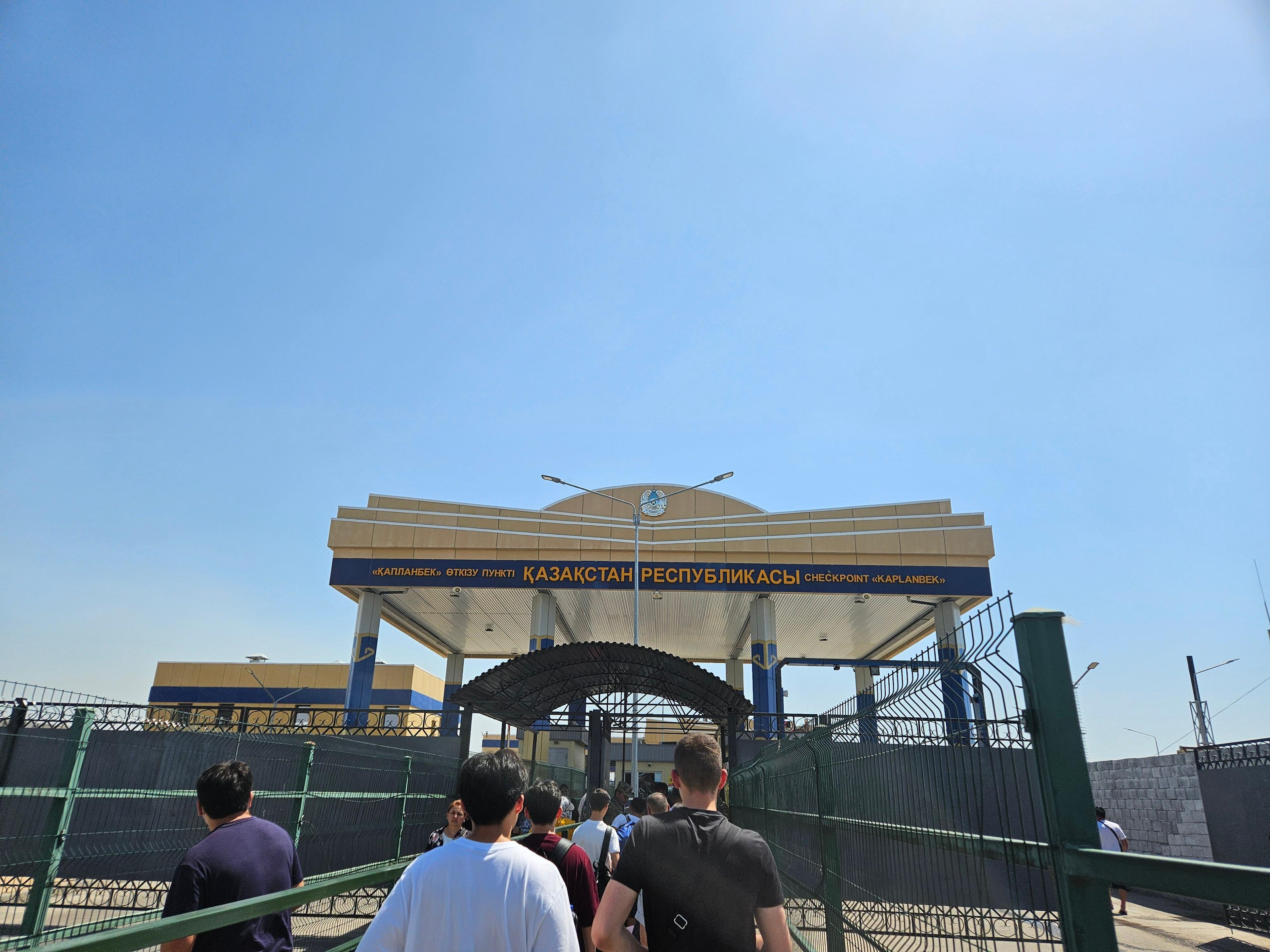
Navoi (Kaplanbek on the Kazakh side). The main alternative, around 20 km from central Tashkent in the Zangiota district. It is modernised, open around the clock and handles pedestrians, cars and buses. Expect long queues on holiday weekends: in May 2026 travellers waited for hours here while Gisht-Kuprik was closed. From Tashkent, a taxi (Yandex Go works well) takes 30 to 45 minutes to the post. Shymkent is around two hours beyond it.
Yallama (Konysbaev on the Kazakh side). About 60 km south-west of Tashkent, open 24 hours, and useful if you are driving towards Turkestan and the Syr Darya. Arrange transport in advance on both sides.
By train. The simplest option for many travellers is the daily Talgo sleeper between Tashkent and Almaty, around 18 hours, with border formalities carried out on board. We cover it in our guide to travel between Tashkent, Almaty, Bishkek and Dushanbe.
Far north-west. The Daut-Ota (Tazhen) crossing links Karakalpakstan with Beyneu and the Caspian region of Kazakhstan. It is remote, has been closed or restricted at times, and is only worth considering if you are travelling overland to or from the Caspian. Check its status locally.
Uzbekistan to Kyrgyzstan: the Dostuk crossing
The main crossing for travellers is Dustlik on the Uzbek side, called Dostuk (Dostyk) on the Kyrgyz side. It sits on the edge of Osh, the Kyrgyz city a few kilometres away, and about an hour by car from Andijan in the Uzbek part of the Fergana Valley.
- Hours: open 24 hours.
- Transport: on the Uzbek side, taxis run from Andijan to the post. On the Kyrgyz side, taxis and minibuses wait just beyond passport control for the short ride into Osh.
- What to expect: a busy, sometimes chaotic crossing used heavily by local traders, with bags X-rayed and sometimes checked twice. Weekends are busiest, especially from Kyrgyzstan into Uzbekistan.
- Getting to Andijan from Tashkent: by train in around five to six hours, by road over the Kamchik Pass in a similar time, or by a short domestic flight.
This is the natural route if you are combining the Fergana Valley, with its silk and ceramic workshops in Margilan and Rishtan, with Osh, the Pamir Highway or the lakes of Kyrgyzstan.
Uzbekistan and Kyrgyzstan have agreed to expand the number of crossings and have given international status to several smaller posts in the Fergana Valley, but most of these mainly serve local residents. Unless you have a specific reason, use Dostuk.
Uzbekistan to Tajikistan: Oybek, Jartepa and the Termez–Dushanbe route
Relations between Uzbekistan and Tajikistan have improved enormously since 2018, and there are now several crossings open to foreigners. Three matter most.
Oybek (Fotehobod on the Tajik side), for Tashkent to Khujand.
- About 100 to 120 km south of Tashkent, roughly 1.5 to 2 hours by car.
- Open 24 hours. Khujand is about an hour beyond the border.
- From Khujand, the road to Dushanbe crosses two high passes and tunnels; allow five to six hours.
Jartepa (Sarazm on the Tajik side), for Samarkand to Penjikent.
- About 45 to 50 km east of Samarkand, roughly 45 minutes to an hour by car.
- Open 24 hours.
- Penjikent is about 20 minutes beyond the border. From there you can reach the Seven Lakes (Haft Kul) and the Fann Mountains, and continue to Dushanbe.
- Usually one of the smoother crossings, though the Uzbek computer system occasionally slows things down.
Sariosiyo (Tursunzoda on the Tajik side), for Termez to Dushanbe.
- In the south, near Denau, about 120 km north-east of Termez.
- Open 24 hours. Dushanbe is about 70 km beyond the border.
- Termez to Dushanbe by road takes around four to six hours, including the crossing.
Also open to foreigners: Gulbakhor (Ayvaj on the Tajik side), about 60 km from Termez, for southern Tajikistan; and, since August 2025, Bekobod Avto and Xovosobod in the Tashkent region, which opened to third-country nationals and passenger cars.
If you are planning to continue to the Pamirs, remember that the GBAO permit is required in addition to your Tajik visa or visa-free entry.

Uzbekistan to Turkmenistan: Shavat, Alat and Khojeli
Turkmenistan is different from the other neighbours. You need a visa, normally arranged through a letter of invitation from a licensed Turkmen agency, and the LOI names the crossings you will use. You cannot change your mind at the border. Turkmen border formalities are slow and thorough, and visa and border fees are paid in US dollars at a bank window on the Turkmen side.
Shavat (Dashoguz on the Turkmen side), from Khiva.
- About 60 km from Khiva, around an hour by car.
- Daytime only, roughly 9:00 to 18:00; aim to arrive in the morning.
- A strip of about 1.5 km between the two posts.
- The usual route to Konye-Urgench and the Darvaza gas crater.
Alat (Farap on the Turkmen side), from Bukhara.
- About 100 km south-west of Bukhara, around 1.5 to 2 hours by car.
- Daytime hours in practice, roughly 8:30 or 9:00 to 18:00, with a lunch break on the Turkmen side. Sources disagree, so confirm with your Turkmen agency.
- The busiest Uzbek–Turkmen crossing, and the one for Turkmenabat, Merv and Ashgabat.
- Recent visitor reports describe two hours or more on the Turkmen side alone.
- Drivers with their own vehicles pay a separate fee for the Amu Darya bridge, plus other Turkmen vehicle charges.
Khojeli (Konye-Urgench on the Turkmen side), from Nukus.
- About 40 km from Nukus; Konye-Urgench is about 20 km beyond the border.
- Daytime hours, few travellers and thorough checks.
- Some sources say it works only for entry into Uzbekistan, so check with your Turkmen agency before planning to leave Uzbekistan this way.
We arrange the Uzbek side of these crossings for our guests, timing the transfer to meet the Turkmen agency on the other side. See our guide to Turkmenistan and the Darvaza gas crater for the full picture.
Uzbekistan to Afghanistan: Termez–Hairatan
The only crossing between the two countries is on the Friendship Bridge over the Amu Darya, near Termez. It was closed to passengers for four years and reopened in late November 2025, with official reports describing it as open to citizens of Uzbekistan and Afghanistan holding visas. It is a pedestrian crossing for travellers, with daytime hours.
We do not recommend this crossing for tourists and we do not arrange transfers to it. The UK, US and most other governments advise against all travel to Afghanistan, travel insurance is normally invalid there, and it is not clear that third-country nationals can use the crossing at all.
Termez itself is a fascinating and safe city to visit, with Buddhist ruins at Fayaz Tepa and Kara Tepa, the Sultan Saodat ensemble and the Termez Archaeological Museum, and you can look across the river from the Uzbek side.

Tips for a smooth crossing
- Start early. Most crossings are quieter in the morning, and daytime-only posts such as Shavat close in the evening.
- Avoid weekends and holiday eves at Navoi, Dostuk and Oybek if you can.
- Carry your passport, printed e-visas, any LOI for Turkmenistan, and hotel bookings for the next country.
- Keep your bags simple. Liquids, medicines and electronics in one easy-to-reach bag speed up X-ray checks.
- Agree fares before you get in a taxi near any border, and agree whether the price is per car or per seat.
- Do not carry parcels or bags for strangers.
- If you are driving your own car, check vehicle import rules, insurance and fuel charges for the next country, especially Turkmenistan.
- Have a little local currency for both sides. Exchanging at the border is usually poor value or impossible.
Crossing with TourEast
We can arrange transfers from Tashkent, Samarkand, Bukhara, Khiva, Nukus, Andijan and Termez to the Uzbek side of the border, timed to meet your next driver or agency. If you are combining Uzbekistan with its neighbours, we can plan a private or small-group Uzbekistan itinerary around your crossing points and dates.