A 12-day Uzbekistan and Turkmenistan itinerary built as a loop: Tashkent, Samarkand and Bukhara, across the border to Merv, Ashgabat and Darvaza, then Kunya-Urgench, Khiva and a flight home. Timings, visa lead times and who runs which leg.
Facts, prices and schedules checked on November 4, 2026
Uzbekistan and Turkmenistan share the same deserts, the same river and, for a thousand years, the same trade roads. Most itineraries treat them as separate trips. Done as a single loop, they make one of the most coherent journeys in Central Asia: the great Uzbek cities, then the ruins of Merv, the white marble of Ashgabat, the Darvaza gas crater and the old Khorezm capital of Kunya-Urgench, then back to Khiva and a flight home.
This guide sets out a 12-day Uzbekistan and Turkmenistan itinerary with a shorter 10-day cut, explains why the loop beats an out-and-back, and is plain about who does what. TourEast is an Uzbekistan operator. We run every Uzbek leg and the transfers to the border. The days inside Turkmenistan, including your visa support, guide, driver and hotels, must be organised by a travel agency licensed in Turkmenistan. Figures and rules are as of November 2026 and the border rules in particular change often.
Why a loop beats an out-and-back
Turkmenistan lets most tourists in on a fixed itinerary with a licensed agency, and the letter of invitation names your entry and exit points. That makes the geometry of the trip unusually important.
An out-and-back, for example Bukhara to Ashgabat and back to Bukhara, spends two days on the same Karakum road and uses one crossing twice. A loop uses each crossing once:
- Enter Turkmenistan at Farap, south-west of Bukhara, where the road leads straight to Merv and Ashgabat.
- Leave at Dashoguz via the Shavat crossing, an hour from Khiva, after Darvaza and Kunya-Urgench in the north.
- Fly or take the train onwards from Khiva's region, with no backtracking.
The loop also fits the sights in historical order. Merv and Nisa cover the Parthian, Seljuk and Islamic worlds of the south; Kunya-Urgench is the Khorezm capital destroyed by the Mongols in 1221, which sets up Khiva perfectly. You can run it in reverse, but the clockwise direction leaves the strongest Uzbek city, Khiva, for the end, and Khiva has a convenient airport at Urgench.
One caveat. Direct flights between Tashkent and Ashgabat exist but are infrequent, so they are a useful backup rather than the plan. Check current schedules before relying on them.
The 12-day Uzbekistan and Turkmenistan itinerary
This is the plan we would draw up for a first visit, with the Uzbek legs in the first and last days.
- Day 1, Tashkent: arrival, a first evening walk and dinner. The Old City, Chorsu Bazaar and the metro fit into a short half day later if you wish.
- Day 2, Tashkent to Samarkand: the Afrosiyob high-speed train takes roughly two hours. Afternoon at Shah-i-Zinda and Gur-e-Amir.
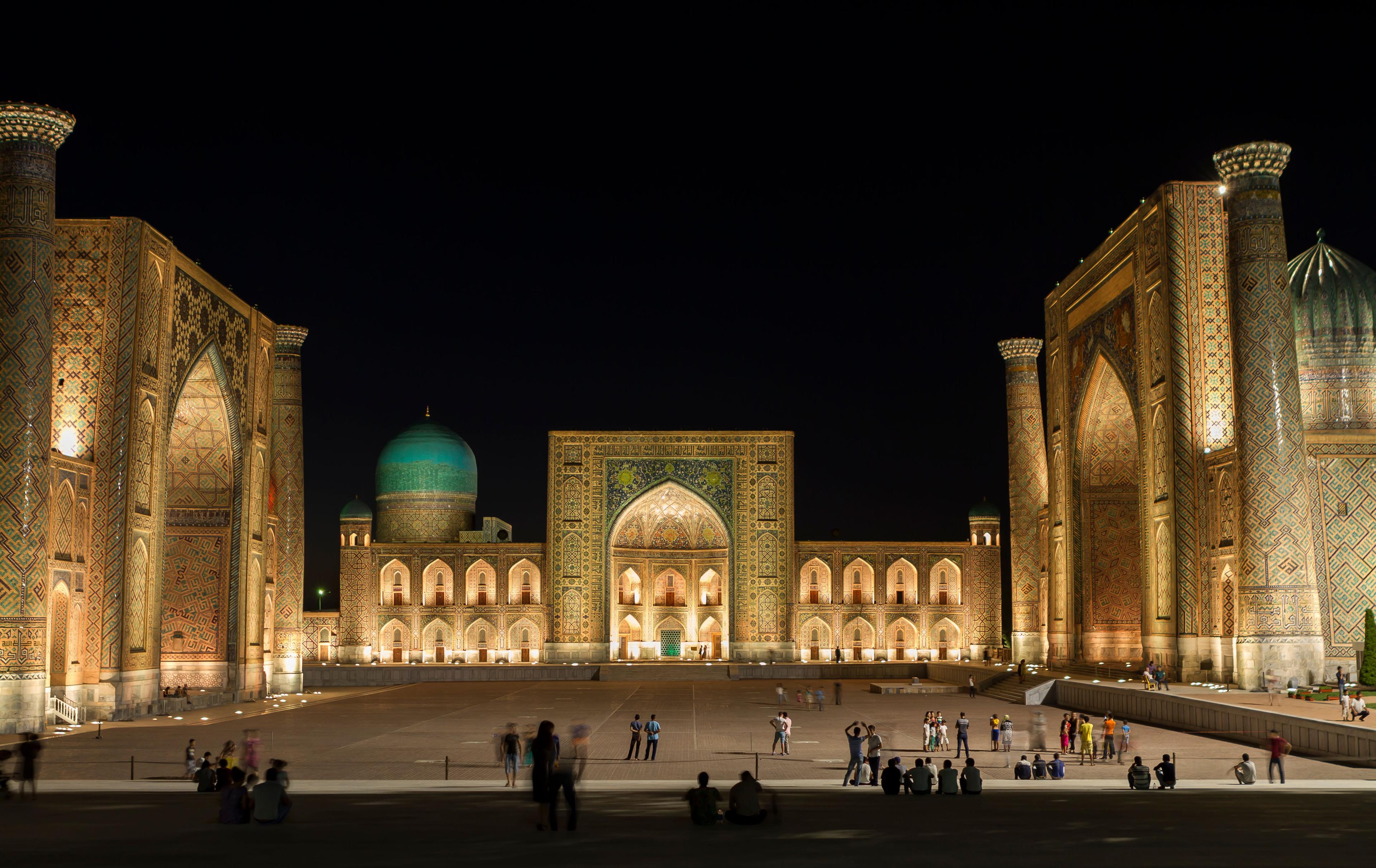
- Day 3, Samarkand: Registan in the morning light, Bibi-Khanym and the bazaar, then a free evening.
- Day 4, Samarkand to Bukhara: the train takes around an hour and a half. Afternoon in the old town around Lyabi-Hauz and the trading domes.
- Day 5, Bukhara: Ark Fortress, Po-i-Kalyan, the Samanid Mausoleum and a slow evening.
- Day 6, Bukhara to Mary: roughly 100 km to the Alat border post, the crossing at Farap, then a long drive through the Karakum to Mary. Allow the whole day.
- Day 7, Merv and Ashgabat: the ruins of ancient Merv in the morning, including the Sultan Sanjar Mausoleum, then the road to Ashgabat.
- Day 8, Ashgabat: Nisa, the early Parthian royal fortress outside the city, then the marble avenues of the capital.
- Day 9, Ashgabat to Darvaza: roughly 260 km and four to five hours north through the desert. Evening and, if your agency offers it, a night at a camp near the crater.
- Day 10, Darvaza to Dashoguz: a long day on the road to Dashoguz, with a stop at Kunya-Urgench if time allows.
- Day 11, Kunya-Urgench, Shavat and Khiva: the Turkmen exit, the Shavat crossing and the short drive into Khiva. Evening on the walls of Ichan-Kala.
- Day 12, Khiva and departure: morning in Ichan-Kala, then a transfer to Urgench airport for the flight to Tashkent and your connection.
Days 10 and 11 are the weak point. If Kunya-Urgench is a priority, give it a full morning and treat Darvaza as a quick evening and dawn visit rather than a camp night. We can add a second night in Khiva and push departure to day 13.
A 10-day version
To save two days, drop the second Samarkand night and the first Tashkent evening. Land in Tashkent in the morning, take the Afrosiyob straight to Samarkand, and do the Registan, Shah-i-Zinda and Gur-e-Amir in one long day and one half day. Everything from Bukhara onwards stays the same.
Cutting further is false economy. Turkmenistan's distances are real, and the Karakum road tires travellers who have already flown long-haul. Under nine days, we would recommend a single crossing, Bukhara to Merv and back, instead of the full loop. See our guide to the Bukhara to Turkmenistan crossing for that shorter option.
What you see in Turkmenistan
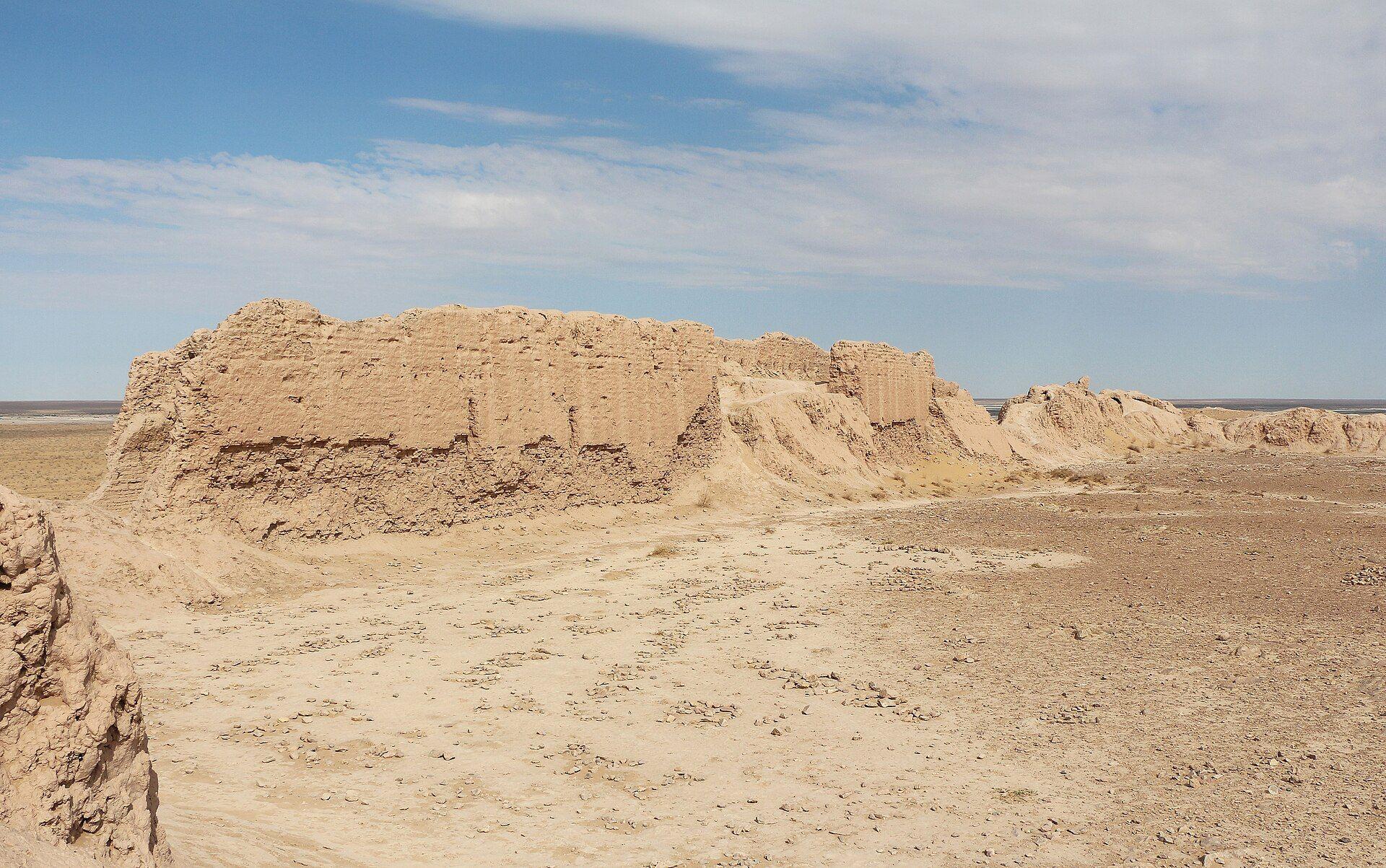
Merv is the reason to go. For several centuries it rivalled Baghdad and Nishapur, and the Seljuk sultan Sanjar made it his capital in the twelfth century. Today it is a field of ruined walls, domes and earthen citadels, with the restored mausoleum of Sultan Sanjar as its anchor. It is one of the great archaeological landscapes of Asia and often nearly empty.
Nisa, just outside Ashgabat, was a royal Parthian centre from the third century BC. The excavated halls are modest to look at but significant in the history of the region, and both Nisa and Merv are on the UNESCO World Heritage list.
Ashgabat is a different kind of attraction, a capital rebuilt in white marble with monuments, fountains and wide empty avenues. Photography around government buildings is restricted, and your guide will tell you where cameras must stay in the bag.
The Darvaza gas crater, the Door to Hell, is a burning pit in the Karakum. Reports in 2025 and 2026 say that the flame has weakened and that authorities have been working to reduce it, so check the latest news before building the trip around it. Our separate guide to the Darvaza gas crater covers its current state.
Kunya-Urgench, also written Konye-Urgench, was the capital of the Khorezmshahs before the Mongols destroyed it. Its tall Kutlug-Timur minaret and tiled mausoleums have World Heritage status and are well worth the detour from Dashoguz.
Visas and lead times
Plan the Turkmen paperwork first, because it sets the dates for everything else.
- Uzbekistan: most visitors from Europe, North America, East Asia and many other countries enter visa-free; others use the e-visa. Our Uzbekistan visa guide has the current list. If you enter Uzbekistan again after Turkmenistan, check whether your status gives you a new period of stay.
- Turkmenistan: the standard route is a tourist visa backed by a letter of invitation from a licensed Turkmen agency. Sources in 2026 quote two to six weeks for approval; we advise allowing six to eight weeks before arrival.
- E-visa: Turkmenistan announced an e-visa system, and early reports said it might remove the need for the letter. At the time of writing we could not confirm that it works for ordinary tourist itineraries, so plan on the letter and re-check the official portal.
- Both crossings must appear on the letter: Farap in, Dashoguz out. A last-minute change of crossing is not realistic.
- Fees are paid at the Turkmen border in US dollars. Reported 2025 figures were around US$100 in total, but this is not an official figure. Bring clean, undamaged notes.
Tell your Turkmen agency your exact Uzbek dates early. We ask for the same in reverse, so that our Bukhara nights, the Alat transfer and the Khiva departure all line up.
Who handles what
Because the trip crosses two jurisdictions, it helps to separate the responsibilities.
- Our side, in Uzbekistan: hotels, guides, trains and flights between Tashkent, Samarkand, Bukhara and Khiva, private transfers to the Alat gate and the Shavat gate, a driver waiting when you return, and the final Urgench flight.
- The Turkmen agency: your letter of invitation, the guide and driver on the Turkmen side, the hotels and any camp at Darvaza, and permits for restricted districts.
- You: your passport with at least six months of validity, the dollar cash, and travel insurance that covers all the countries involved.
We do not operate in Turkmenistan, and we do not issue its invitations. We are glad to coordinate with the agency you choose, or to suggest how an Uzbek-side plan can fit around dates you have already agreed.
Costs, seasons and practical points
Spring (April and May) and autumn (late September to October) are the comfortable seasons. Summer in the Karakum regularly passes 40 degrees, and the Darvaza camp is cold in winter. Turkmen hotels, guides and drivers are bundled into your agency's price, and in 2026 reports of packages for this kind of route ranged widely, so ask for a written breakdown.
Practical points that save trouble:
- Carry cash. Cards are of limited use in Turkmenistan, and your Uzbek som cannot be changed there. Spend or exchange them in Khiva before you cross.
- Expect slow internet and no reliable roaming. Tell your family before you cross.
- Pack medicines in original packaging with a note, as Turkmen customs look closely at them.
- Border posts work in daylight. Aim to arrive in the morning and never leave an exit for late afternoon.
- Keep Uzbek hotel registration slips until you leave the country.
How TourEast can help
We design the Uzbek legs of this loop as a private or small-group programme, time the border transfers around your Turkmen dates and arrange the Khiva departure. If you are still deciding whether the second country is worth it, our Silk Road grand tour and the 12-day extended group tour show how much the Uzbek side alone can hold.