What zardozi is, how Bukhara became the centre of gold embroidery for the emirs, what the craft produced, how it differs from suzani, where visitors can see and buy it, and what to ask before paying for a piece.
Facts, prices and schedules checked on November 4, 2026
In the museums of Bukhara there are robes so heavily embroidered with gold thread that they stand up on their own. The craft is called zardozi (also zarduzi or zardo'zlik), from the Persian words for gold and sewing, and it was for centuries the most prestigious textile art of the Emirate of Bukhara. Today it survives in workshops, a few museums and the better shops of the old town, and it is among the most distinctive things a visitor can see and buy in Bukhara.
This guide explains what zardozi is, where it came from, how it differs from suzani, where you can watch or buy it, and what to look for. It covers gold embroidery specifically; our separate guide to suzani covers the silk-on-cotton hangings.
What is zardozi?
Zardozi is embroidery worked in metallic thread, traditionally gold or gilded, on a base of velvet, silk or other rich cloth. The thread is laid on the surface in dense patterns of leaves, flowers, arabesques and medallions, and often fastened with fine stitches. The result is stiff, heavy and brilliant, which is why it was used for ceremonial objects rather than everyday clothes.
In Uzbekistan, gold embroidery is most closely associated with Bukhara, although the craft is known across the region and beyond, including in India and Iran. The name zardozi is also used in Indian and Pakistani traditions, which have their own styles and are distinct from the Bukhara tradition.
History: gold embroidery at the court of the emirs
Sources trace court gold embroidery in Central Asia back centuries. One account links it to the Sassanid court and notes that the Spanish envoy Ruy Gonzalez de Clavijo described the craft at the court of Amir Timur in Samarkand in his diary of 1403 to 1406. In the sixteenth century, under the Shaybanids, the craft concentrated in Bukhara, which was then the capital, and became an official court art.
It reached its height in the Emirate of Bukhara (1785 to 1920). According to published accounts, hundreds of hereditary embroiderers worked for the court. Some workshops were located inside the Ark fortress, and nearly all the output went to the palace, with only a small part reaching the market. Sources differ about the exact number of workshops at different times, and about the role of women, but they agree that gold embroidery was a court art until the emirate fell.
What the workshops produced
Court embroiderers made men's and women's robes, caps and scarves, shoes and belts, and horse blankets, saddles and other objects for the emir's household and state ceremonies. Robes covered in gold embroidery, sometimes called zarchapan, were reserved for the ruler and for people the ruler wanted to honour. A gift of such a robe was a political act. In the same spirit, a chapan with gold embroidery is still associated with status and weddings today; see our guide to chapan and doppi.
Gold embroidery also appears on decorative panels, bags, footwear and the covers of books and Qur'ans, and a modern revival has brought it onto jackets, handbags, wall panels and wedding accessories.
Zardozi versus suzani
The two are often confused because both come from Bukhara and both are embroidered, but they are different arts.
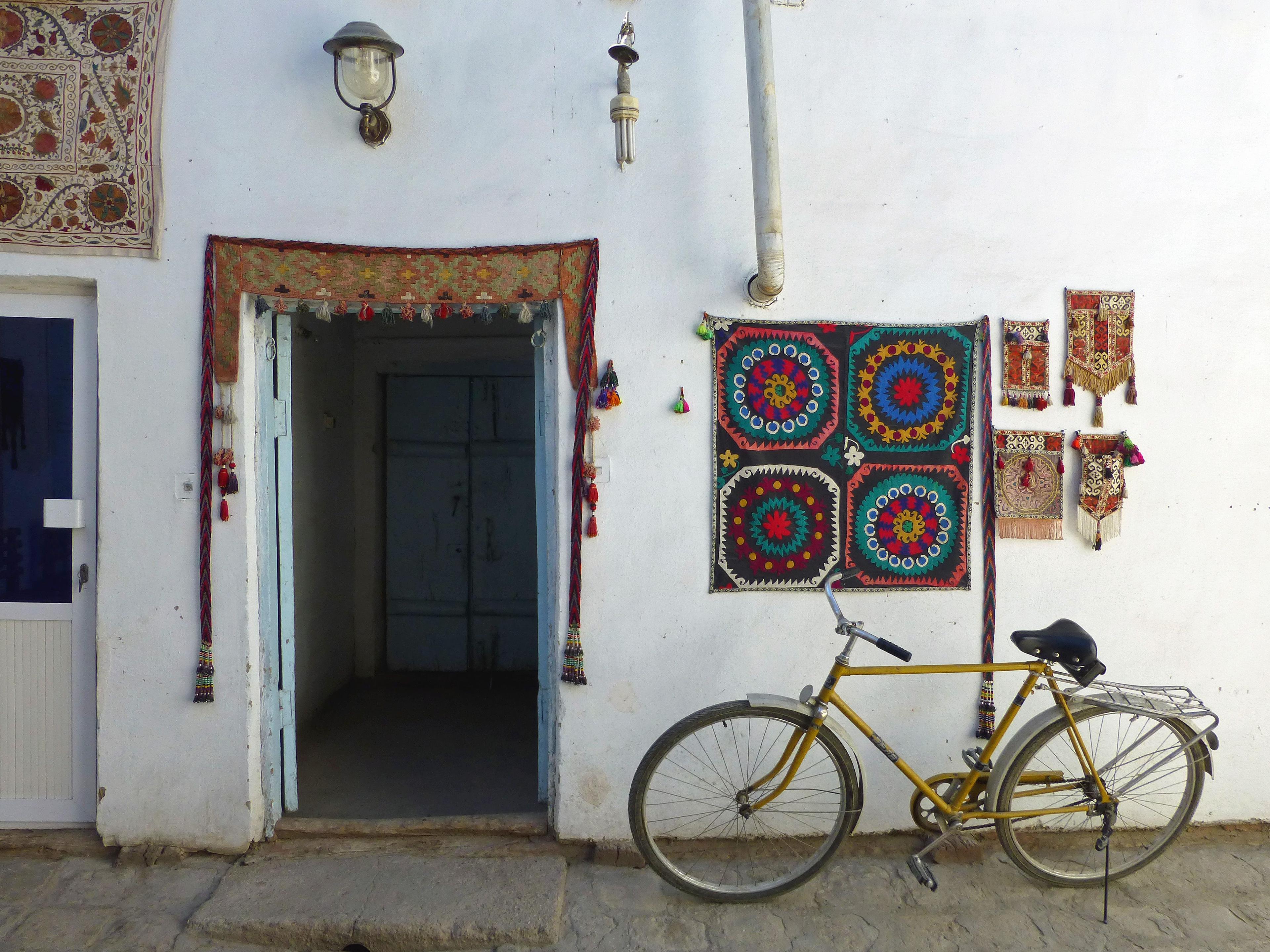
- Suzani is a large hanging or bedcover, embroidered in coloured silk thread on cotton, with big floral medallions; it was made by women for the home and dowry.
- Zardozi is metallic thread on velvet or silk, made in professional workshops for rulers and the wealthy.
If you want a bold, colourful object for a wall, suzani is the usual choice; if you want something small, opulent and ceremonial, zardozi is. Some modern pieces combine both.
How zardozi is made
Making a piece takes many hours. The design is drawn or printed on the fabric, which is stretched on a frame. The embroiderer then stitches metallic thread, often in raised or padded areas to give relief, working outwards from the main motifs. Fine pieces take weeks and use thread of consistent quality; cheaper pieces use thinner threads or machine work.
Traditionally the work was done by men in professional workshops, and some accounts say women were kept away. Today the craft includes many women, and visitors will see both men and women at work. The exact techniques differ between workshops, and we recommend asking the embroiderer to show you what they do.
Where to see zardozi in Bukhara
You can see antique and historic gold embroidery in museums, and watch modern work in workshops.
- The Bukhara State Museum of Art and Architecture and the museums in the Ark fortress hold goldwork items, alongside displays of the emirs' court. Our guide to the Ark and Po-i-Kalyan describes the fortress.
- The State Museum of Applied Art and Handicrafts in Tashkent has fine examples of Bukhara robes.
- Private workshops and shops in the old town and around the trading domes let visitors watch embroiderers at work. Several work in family studios, and some run short demonstrations for guests.
- Larger producers, including a state gold embroidery enterprise in Bukhara, make pieces on a bigger scale.
Opening hours and demonstrations change, so ask your hotel or guide to arrange a visit. Our Bukhara travel guide has more on the old town.
Visiting a workshop: what to expect
A workshop visit is usually informal. You are shown into a courtyard or a small room where embroiderers sit at frames, a guide or the owner explains the stages, and you may be invited to look closely at work in progress. It is polite to ask before taking photographs of people at their frames, to keep your hands off unfinished work and to say thank you whether or not you buy. Many workshops sell directly and will take custom orders for a robe, a cap or a wall panel, which can take weeks, so allow time if you want a commission posted to you.
Combine a workshop visit with a walk through the trading domes, the Ark and the quiet lanes of the old town. Bukhara also has traditions of ceramics, knife-making, silk weaving and miniature painting, which you can combine in a single day; our guide to Uzbek crafts and souvenirs describes them.
Zardozi today
Gold embroidery declined with the end of the emirate and the Soviet decades, when the court patrons vanished and mass production replaced much hand work. Since independence in 1991 the craft has been revived by state support, private studios and growing interest from tourists and designers. Modern workshops now produce wedding accessories, evening jackets, bags, framed panels and home décor alongside traditional robes. The best studios train apprentices, which is a hopeful sign for a craft that depends on years of practice. If you value this, buy directly from a maker and ask about their training.
How to buy zardozi: what to look for
Zardozi is one of the more expensive Uzbek crafts, because the thread and the hours of labour cost money. A few simple checks will help you choose well:
- Ask what the thread is made of and who made the piece. Most modern souvenir pieces use metallic thread rather than pure gold; the price should match the materials.
- Look at the back. The stitching should be neat and the pattern symmetrical, with no loose threads.
- Compare shops. A piece from a workshop where you can see embroiderers working is likelier to be handmade.
- Feel the weight and the stiffness of the fabric. Heavy, dense embroidery on velvet is a sign of effort.
- Ask for a receipt. For antique or very old pieces, an export permit may be required; read our guide to buying antiques and export rules before you buy anything old.
- Keep small items, such as caps, cases or framed panels, in your hand luggage if they are delicate.
Prices vary widely, from modest souvenirs to museum-class robes costing thousands of dollars. Set a budget before you go and do not feel pressure to buy on the first visit.
Caring for gold embroidery
Keep the piece flat or rolled with acid-free tissue, away from damp and direct sunlight. Do not wash it; if it needs cleaning, take it to a textile specialist. Metallic thread can tarnish with humidity, so store it in a breathable cloth rather than plastic.
Seeing zardozi with TourEast
Our Bukhara guides can arrange visits to the museums and to workshops where you can watch embroiderers, and can add suzani, ceramics and miniature painting for a day of crafts. Our Bukhara in Depth tour and the luxury Silk Road programme leave time for these visits. Tell us what you are interested in through WhatsApp or the trip builder at /trip-builder.