
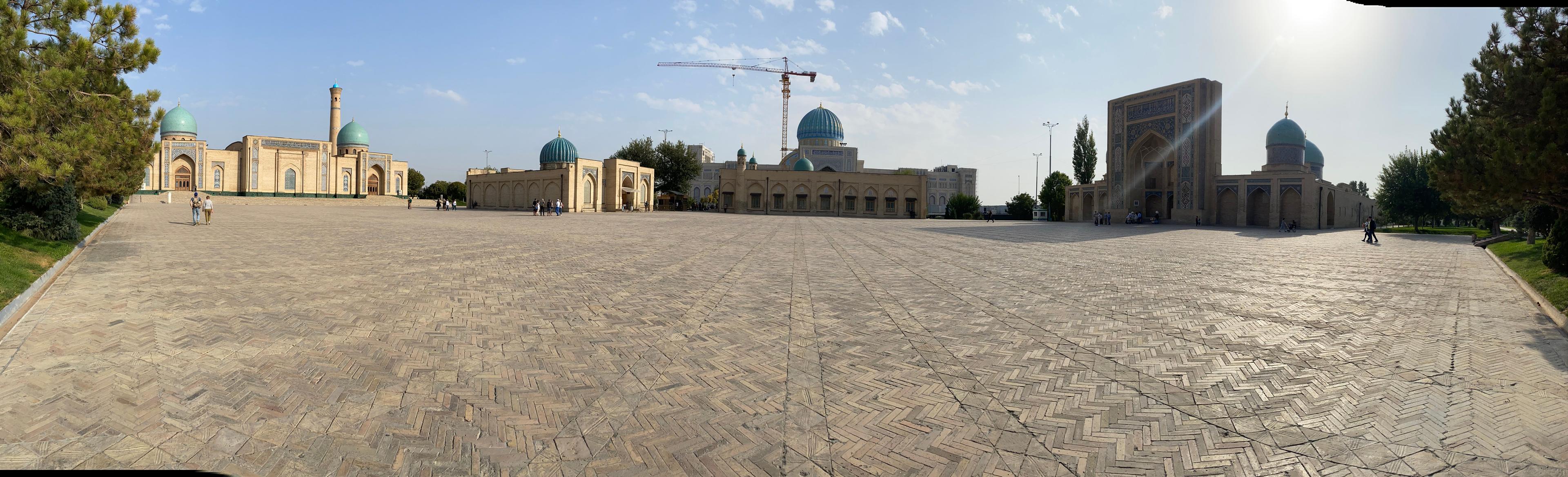
Architectural ensemble · 16th–21st centuries (Kaffal Shashi Mausoleum 1541–1542)
Khast-Imam Complex and the Uthman Quran
Tashkent's religious heart: a broad square framed by the 16th-century Barakhan Madrasah, the shrine of the city's patron saint and the new Center for Islamic Civilization, where the 8th–10th-century Uthman Quran is now displayed.
About
Khast-Imam, also written Hast Imam or Hazrati Imam, is the oldest continuously revered corner of Tashkent and the one place in the capital where the medieval city still sets the scale. The name is a shortened form of Hazrati Imam, "the holy imam", and refers to Abu Bakr al-Kaffal al-Shashi, a 10th-century scholar of law, hadith and Arabic whose grave became the nucleus of the quarter. Shash was the old name of Tashkent, so the city's patron saint is, quite literally, the Kaffal of Tashkent.
What stands around the square
- The Barakhan Madrasah, built in the 1530s for the Shaybanid governor Navruz Ahmad Khan, known as Barak Khan. Its long tiled façade with two blue domes is the oldest surviving madrasah front in the city, and its former student cells now hold craft shops.
- The Kaffal Shashi Mausoleum of 1541–1542, attributed to the architect Ghulam Husayn, set a little apart behind the square: a tall portal, a dome on a high drum and rooms for pilgrims around the burial chamber.
- The Tilla Sheikh Mosque (1890–1902) and the small Muyi Muborak Madrasah of the 1850s, named after a hair of the Prophet that is kept there as a relic.
- The Hazrati Imam Friday Mosque, completed in 2007, with twin minarets of about 53 metres and an iwan of carved wooden columns.
Much of what you see is recent. The square was cleared, paved and rebuilt as a national religious centre in 2007, and the restoration has smoothed some of the patina away. What it lost in age it gained in space: this is the calmest open square in Tashkent, and on an ordinary weekday morning you share it with students of the Imam al-Bukhari Institute, families and a few pigeons.
The Uthman Quran and its new home
For decades visitors came here above all to see the Uthman Quran, also called the Samarkand Kufic Quran: a huge parchment codex in Kufic script, one of the oldest surviving Qurans in the world and on UNESCO's Memory of the World Register since 1997. Tradition links it to the third caliph, Uthman, in the 7th century; radiocarbon dating places the parchment between the late 8th and late 10th centuries. Its journey alone is worth the visit: kept for centuries in Samarkand, taken to St Petersburg in 1868, returned to Tashkent in 1923 and shown at Khast-Imam from 1989.
In November 2025 the manuscript moved a few hundred metres to the Center for Islamic Civilization, a vast domed museum on the edge of the square that opened on 17 March 2026. It now lies in its own Holy Quran Hall, beneath a great chandelier, at the end of an exhibition that traces the region from pre-Islamic times through the age of al-Khwarizmi, al-Biruni and Ibn Sina to the Timurids. Older guidebooks that send you to the Muyi Muborak library for the Quran are out of date; a copy is shown there now.
How to see it
Come in the morning, after Chorsu Bazaar, by walking north for 15 to 20 minutes through the old mahalla lanes. The square, the mosques, the Barakhan shops and the mausoleum are free; the Center for Islamic Civilization has its own ticket and deserves at least two hours. Avoid Friday midday, when the main mosque and the square fill for prayers. Dress modestly: shoulders and knees covered, and a headscarf for women entering mosques and the shrine.
What to see
- The Uthman Quran in the Holy Quran Hall of the Center for Islamic Civilization
- Tiled portal and twin blue domes of the 16th-century Barakhan Madrasah
- Kaffal Shashi Mausoleum (1541–1542), the shrine of Tashkent's patron saint
- Craft workshops in the old student cells of the Barakhan Madrasah
- Twin minarets and carved wooden iwan of the Hazrati Imam Friday Mosque
- Muyi Muborak Madrasah and its library of rare manuscripts
- The walk through the old mahalla lanes from Chorsu Bazaar
Gallery

Tours that visit Khast-Imam Complex and the Uthman Quran
 Best SellerTashkent · Samarkand · Bukhara · Khiva
Four Crowns: Tashkent, Samarkand, Bukhara, Khiva
From
$1,270
 PremiumTashkent · Fergana Valley · Samarkand · Nurata · Bukhara · Khiva
Twelve Gates of the Silk Road
From
$1,750
 Tashkent · Samarkand · Lake Aydarkul · Nurata · Bukhara
Plov, Camels and Castles: Uzbekistan for Families
From
$1,305
More sights in Tashkent
All of Tashkent


See Khast-Imam Complex and the Uthman Quran with a local guide
We build private and small-group trips around the places you want to see — with guides who grew up here.