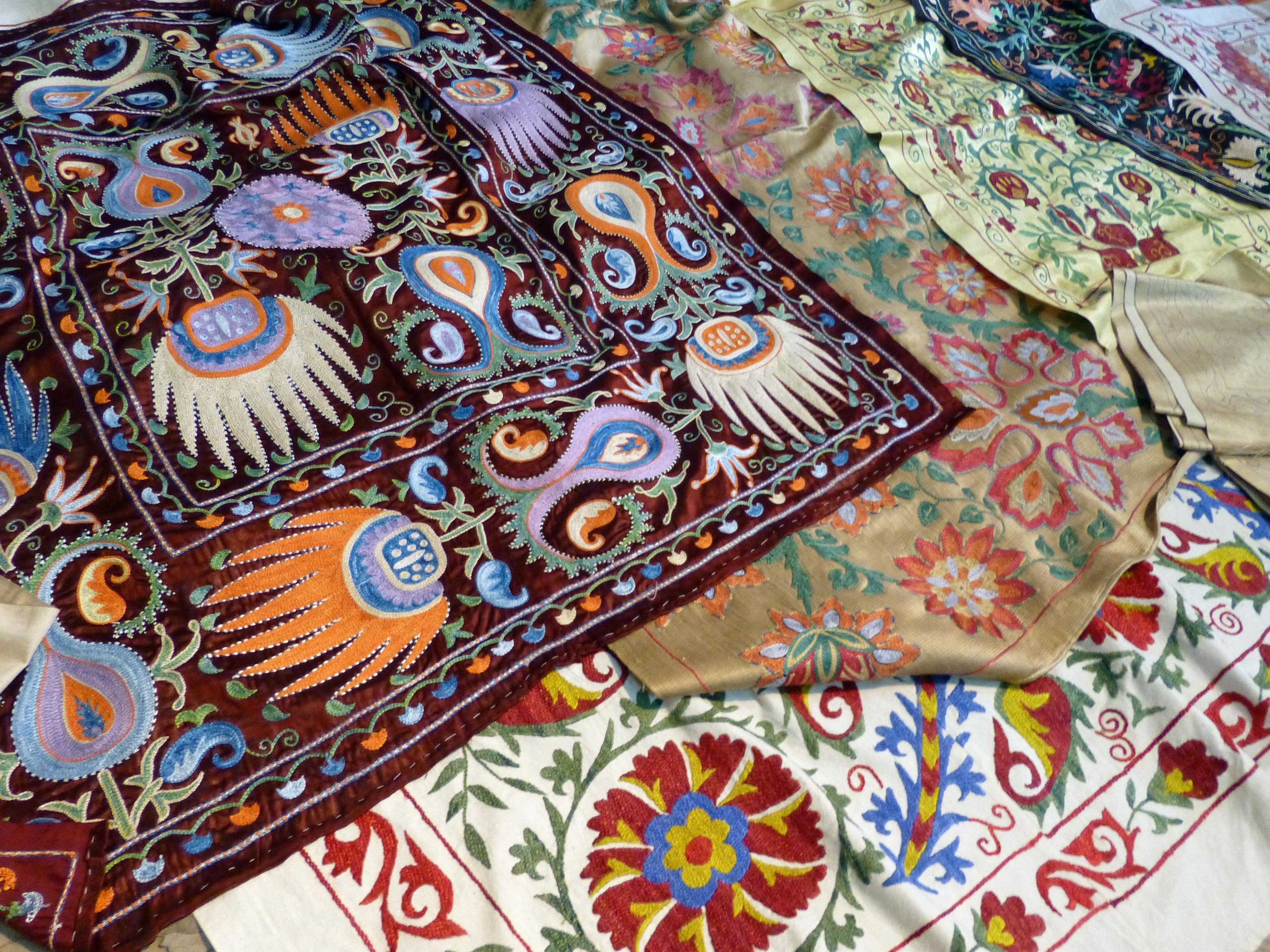
How to read an Uzbek suzani: the Bukhara, Nurata, Samarkand, Shakhrisabz and Urgut styles, how to judge age and hand work, realistic 2026 prices from bazaar cushion covers to antiques, and the export rules for anything old.
Facts, prices and schedules checked on November 4, 2026
A suzani is a large embroidered textile, traditionally sewn by a bride, her mother and female relatives for her dowry, and hung on walls, spread over beds or laid out at weddings. The word comes from the Persian suzan, needle. Suzani embroidery is the most personal of Uzbekistan's crafts: every piece was made for a particular family and a particular day, and the best ones took years.
Our crafts and souvenirs guide covers the basics of buying one. This guide is for travellers who want to go further: how to recognise the main regional styles, how to tell new from vintage and antique, what separates a good piece from a tourist one, realistic 2026 prices, and the export rules you must know before you buy anything old.
How a suzani is made
Understanding the process makes it much easier to judge a piece.
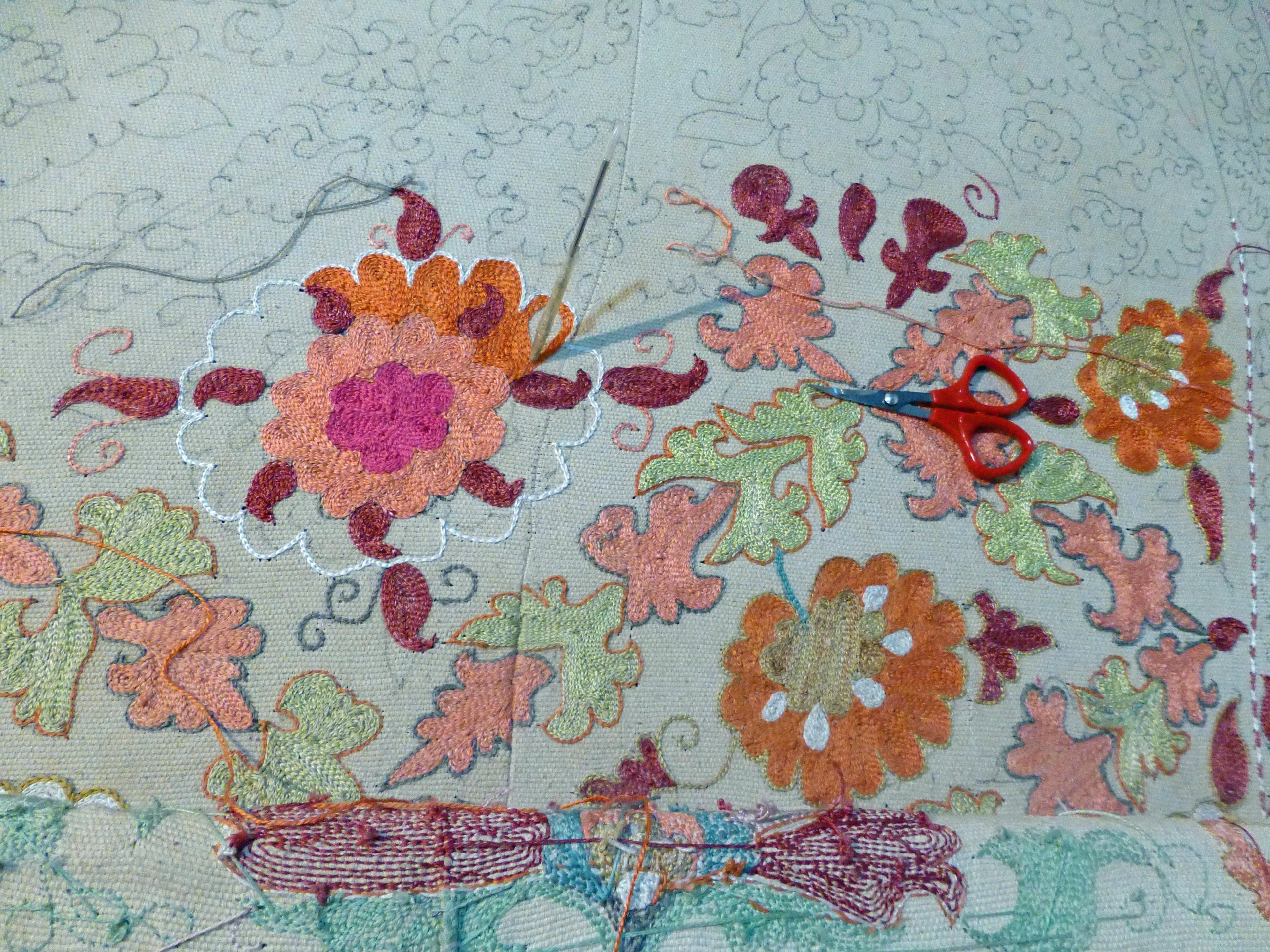
- The ground. Traditionally hand-woven cotton (karbos) or silk, often in narrow strips that were embroidered separately and sewn together at the end. Slight misalignment of the pattern across the seams is a classic sign of hand work.
- The drawing. A specialist designer, the kalamkash or chizmakash, drew the pattern on the cloth in ink. In each community only a few women had this role, and pattern books of sewn fabric samples were handed down.
- The stitches. The main ones are basma (a couching stitch, laid threads tied down with small stitches), kanda khayol (a closely related laid-and-couched stitch), yurma (chain stitch, worked with a needle or with a hooked awl), and iroki (cross or tent stitch, used for denser small pieces). Which stitch dominates is one of the regional clues.
- The thread and dyes. Floss silk dyed with madder, indigo, larkspur, pomegranate rind, onion skin and other plants until synthetic dyes arrived in the late nineteenth century.
A large suzani could take a master several years, and if a bride's dowry was not finished in time, relatives and neighbours helped. That is why you sometimes see a change of hand or colour halfway across an old piece.
Suzani types and what they were for
The word suzani is used for any large embroidered panel, but the pieces had specific names and functions:
- Suzani proper: a large hanging or bedcover, often two metres or more long.
- Nim-suzani: "half suzani", a smaller version, now a popular size for walls.
- Ruijo: a bed sheet embroidered on three sides for the wedding night.
- Bolinpush: a cover for the pile of quilts and pillows stacked in the niche of a traditional room.
- Joynamoz: a prayer mat, with a niche-shaped mihrab design.
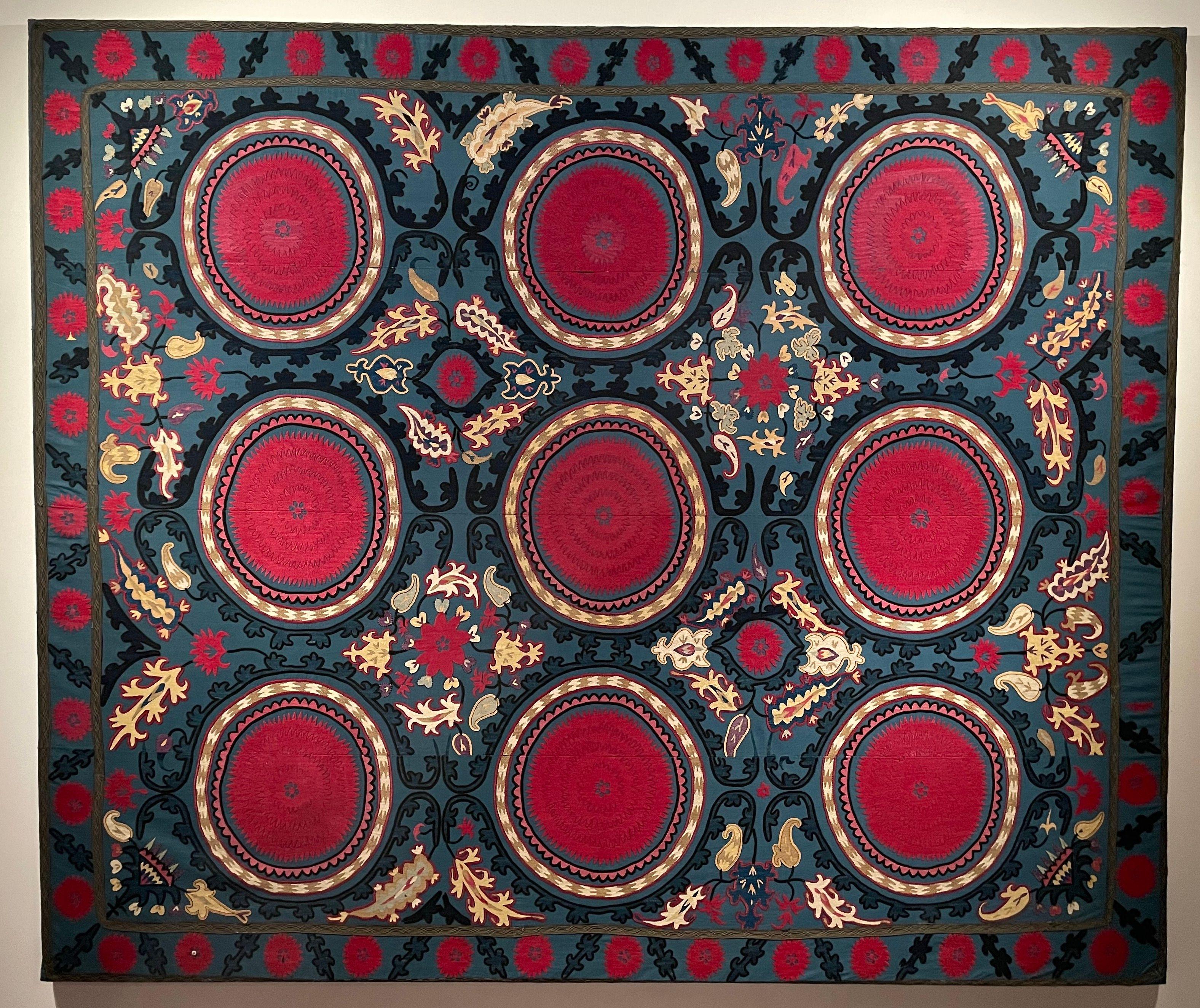
- Palak: "sky", the Tashkent-area design of large red circles symbolising the sun, moon and stars.
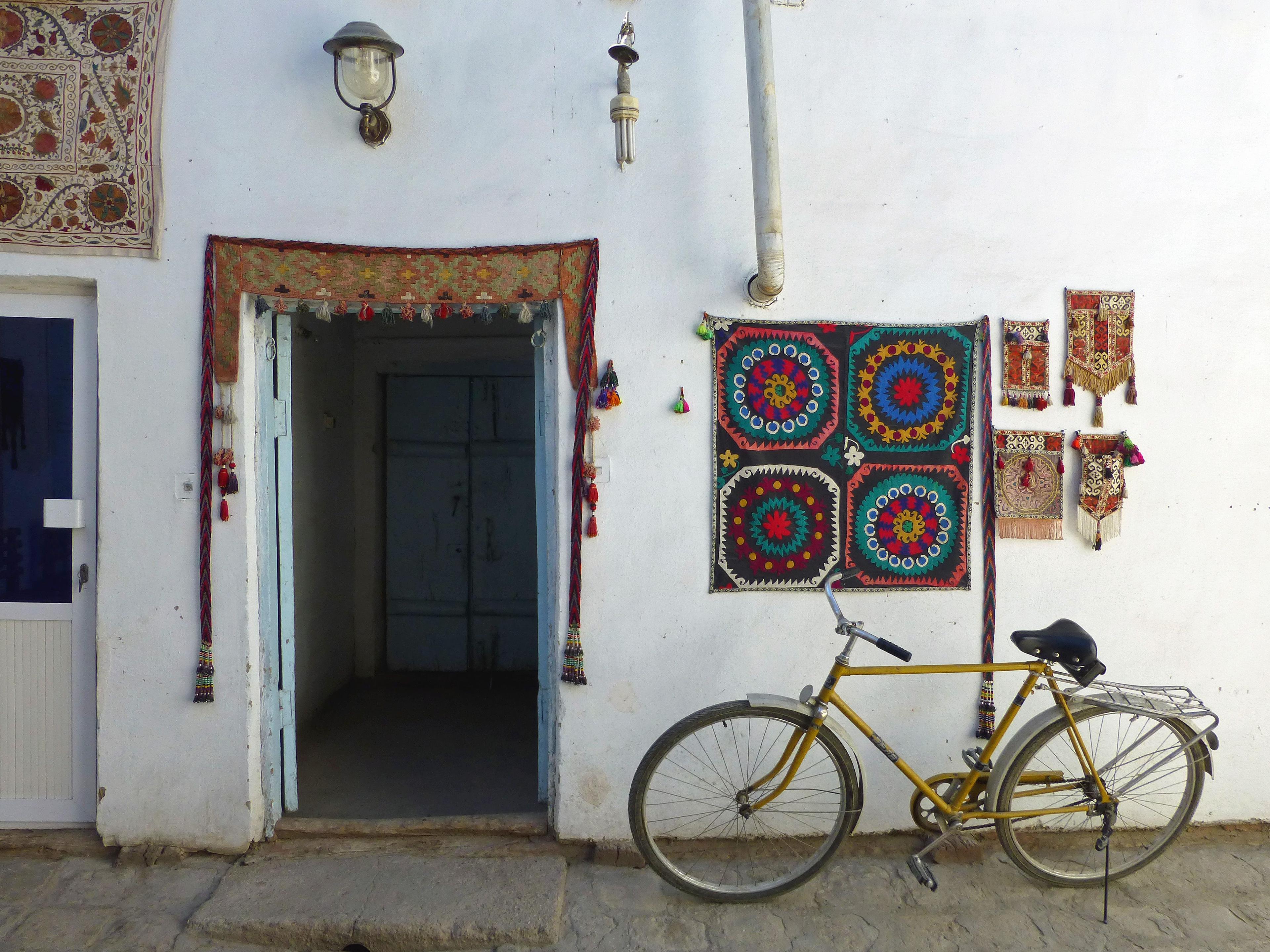
Smaller embroidered pieces such as bags, cushion covers, tea cosies and table runners are modern adaptations made for the market. They are a good way to own hand work at a modest price.
Regional suzani styles: Bukhara, Nurata, Samarkand, Shakhrisabz, Urgut
Before the twentieth century every town and many villages had their own recognisable style. The labels below are a guide, not hard rules; styles influenced one another, and dealers use place names loosely.
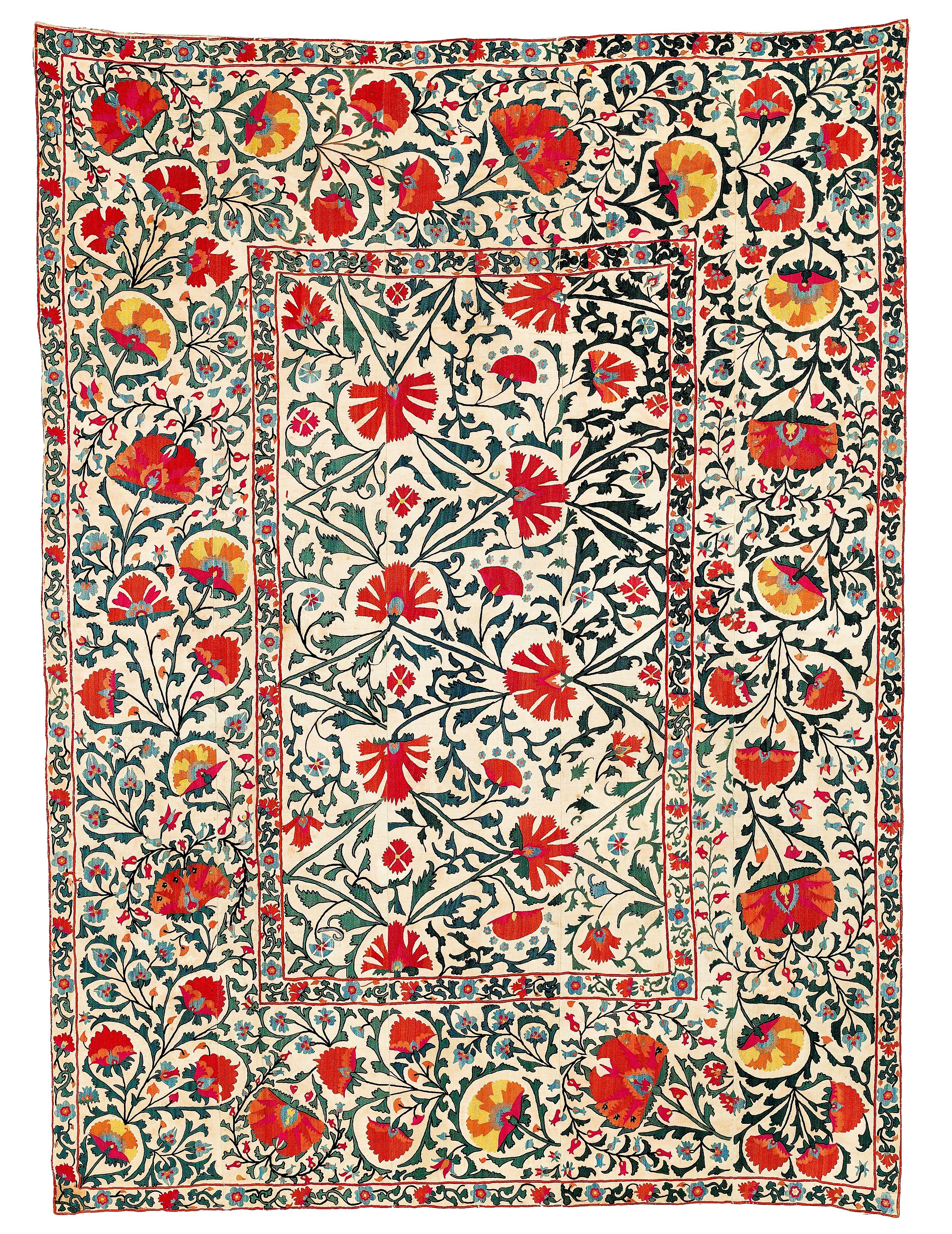
- Light ground, red and green the dominant colours, with many smaller accent shades.
- Delicate floral vines and the curling islimi scroll, often arranged around central medallions or in a lattice of diamonds that covers most of the ground.
- Fine chain stitch (yurma) is characteristic.
- Light, open ground and calm, subdued colours.
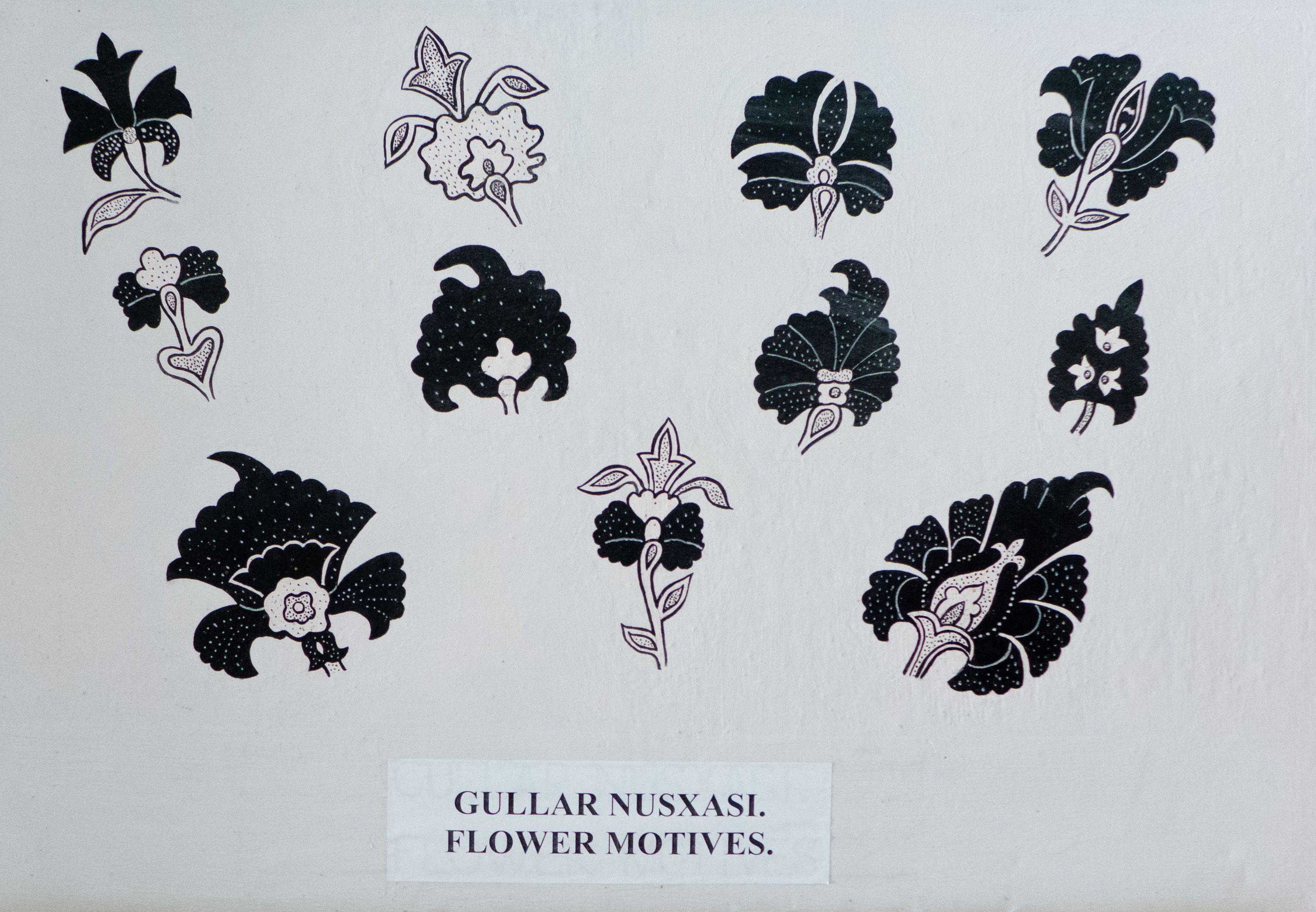
- Unusually realistic flowers, carnations, irises, cotton bolls and cherries, set as sprays and bouquets, sometimes with small birds or animals.
- Often a central eight-pointed star.
- Embroiderers sometimes added a deliberate "mistake" such as a green flower or a red leaf, so that the work would not be perfect.
- Bold and graphic: large crimson rosettes framed by rings of serrated leaves.
- From the late nineteenth century a striking red-and-black on white palette replaced the older raspberry and green.
- Basma couching is common.
- Close to Bukhara in design but far denser, with almost no ground left showing.
- Grounds in purple, yellow or green, rich multicoloured flowers, and sometimes the stylised oil lamps also seen in nearby Kitab.
- Old Shakhrisabz pieces are among the most sought after at international auctions.
Urgut
- From the town near Samarkand, famous for its weekend market.
- Heavy, dense embroidery that covers almost the whole surface, with large red rosettes and strong contrasts.
- Basma stitch dominates. Many of the mid-twentieth-century suzani you see for sale are Urgut-style.
Two other names you will meet in shops: Tashkent (the palak and the gulkurpa, a central star with flowering branches) and Fergana (fine branches and rosettes on dark silk with plenty of open ground).
How to tell a vintage suzani from a new one
Most suzani for sale in Uzbekistan are new, made in the last twenty years. A smaller share are vintage, usually Soviet-era pieces from the 1950s to the 1980s. Genuinely antique pieces, from the nineteenth century, are rare and mostly in museums or with specialist dealers. Clues to age:
- Ground fabric. Old pieces are on hand-woven cotton or silk, often in sewn strips. Soviet-era pieces often use factory cotton, satin or rayon in one width. New pieces may use any of these, including machine-woven "handloom-look" cloth.
- Thread. Antique floss silk is soft and matt, and it wears unevenly. Vintage pieces often use mercerised cotton or rayon floss with a hard shine. Modern synthetic thread is glossy and uniform.
- Colour. Natural dyes fade gently and unevenly, and the back is usually brighter than the front. Very bright, flat, evenly matched colours suggest synthetic dyes. Strong fluorescent pinks and purples belong to the twentieth century.
- Wear. Genuine age shows as soft fading along fold lines, small repairs in different thread, and occasionally stains. Artificial ageing, washing in tea or bleaching, gives uniform, overall dullness.
- Dealer's story. Ask where and when it was made and by whom. A good dealer will say "probably 1970s, from a family in Urgut" rather than "very old, two hundred years".
Be sceptical of "antique" at bazaar prices. A real nineteenth-century suzani sells for thousands to tens of thousands at auction abroad, and it cannot legally leave Uzbekistan anyway (see export rules below).
How to judge quality: handmade vs machine suzani
Whatever the age, these checks separate hand embroidery from machine copies:
- Turn it over. Hand work shows knots, thread ends and slight irregularity on the back. Machine embroidery shows a regular grid of stitches and often a backing fabric or interfacing.
- Look for variation. No two hand-drawn rosettes are exactly the same size, and the circles are never perfectly round.
- Check stitch density. On good basma and kanda khayol work the laid threads are close and even, with no ground showing through. Loose, long stitches that snag easily mean hurried work.
- Check the edges and seams. Panels joined by hand, binding stitched by hand and a pattern that does not quite match across a seam are all good signs.
- Printed suzani. Some cheap pieces are simply printed on cotton. Rub the surface: if there is no raised thread, it is print.
Quality also means design. The best new suzani are drawn by experienced designers and stitched by skilled embroiderers using natural dyes, and they are as fine as many old pieces. Buying one supports exactly the people who keep the tradition alive.
Suzani prices in 2026
Prices vary enormously with size, age, stitch density, materials and the seller. These are typical prices in Uzbekistan as of November 2026, intended only as a starting point:
- Machine-made or printed suzani and small souvenirs: roughly US$10 to 50.
- Hand-embroidered cushion covers, bags and small panels: roughly US$25 to 150.
- Hand-embroidered nim-suzani (about 1 to 1.5 metres): roughly US$150 to 500.
- Large new hand-embroidered suzani: from about US$400 to 2,000 or more, at the top end for silk on silk with natural dyes from a known workshop.
- Soviet-era vintage pieces: very variable, often a few hundred US dollars for a large piece in good condition.
- Nineteenth-century antiques: international auction prices, from thousands to tens of thousands of pounds for exceptional Shakhrisabz or Bukhara pieces.
Bargaining is expected in bazaars and most shops. The first price in the Bukhara trading domes or around Lyabi-Hauz is usually higher than in a workshop. Pay in som for the best price, and if you buy a big piece, ask for a receipt stating what it is, what it is made of and when it was made.
Where to buy suzani in Uzbekistan
- Bukhara. The largest choice of new hand-embroidered work, from the trading domes and madrasah shops to embroidery workshops in the old town where you can watch suzani being stitched on the frame. Also the best place to see museum pieces, at the Sitorai Mohi-Hosa palace, the summer residence of the last emirs, which has a fine suzani collection.
- Urgut. The bazaar town about 45 minutes from Samarkand, known for vintage and second-hand suzani as well as new ones. Go on a weekend morning, when trading is at its peak, and expect to bargain hard. Our Chorsu and Uzbek bazaars guide has more on Urgut.
- Samarkand. Shops in the Registan madrasahs and near Siab Bazaar.
- Tashkent. Chorsu Bazaar and craft shops in the city, plus the Museum of Applied Arts for a sense of top-quality historic work.
- Nurata. A small town on the way to the Aydarkul yurt camps, where a handful of embroiderers keep the local style alive.
If you want to understand before you buy, spend an hour in a museum first. Ten minutes in front of a fine Shakhrisabz or Nurata piece will train your eye better than any guide.
Can you export a suzani from Uzbekistan?
This is the most important section if you are buying anything that is, or looks, old.
- New suzani: you can take them home. Keep the receipt, ideally stating that the piece is new.
- Uzbekistan's law on the export and import of cultural values prohibits the export of cultural values created 50 or more years ago. The limit moves every year: in 2026 it covers anything made before about 1976, which includes most Soviet-era "vintage" suzani.
- Recent pieces of artistic value, including good suzani and carpets, may need an export certificate. The certificate is issued after an expert examination through the Ministry of Culture; the owner applies in writing, presents the item, and the examination can take up to ten days and involves a fee.
- Reputable shops and workshops in Bukhara and Samarkand are used to this and can provide the paperwork or a document confirming that a piece is new. Ask before you pay, not at the airport.
- Without documents, customs can confiscate an item at the airport or land border.
Rules and the responsible body have changed several times, so check current requirements with the State Customs Committee or ask the seller to confirm in writing. If you live in the United States, note that since May 2025 the US also restricts the import of ethnological material from Uzbekistan dating from about 600 to 1917, including textiles, carpets and embroidery. A genuinely antique suzani needs Uzbek export documentation to enter the US legally.
Caring for a suzani at home
- Hang it out of direct sunlight. Silk and natural dyes fade in strong light.
- Hang large pieces from a fabric sleeve sewn along the top, or from Velcro on a batten, so the weight spreads evenly. Avoid nails through the cloth.
- Vacuum gently through a mesh screen, or shake out carefully.
- Do not wash old or natural-dye pieces at home. Colours can run badly; use a textile conservator for anything valuable.
- Roll rather than fold for storage, with acid-free tissue.

Discovering suzani with TourEast
We can include embroidery workshop visits in Bukhara, a weekend morning at Urgut bazaar and time in the best textile museums in a private or small-group itinerary, with a guide who can explain what you are looking at and help with receipts and export paperwork.