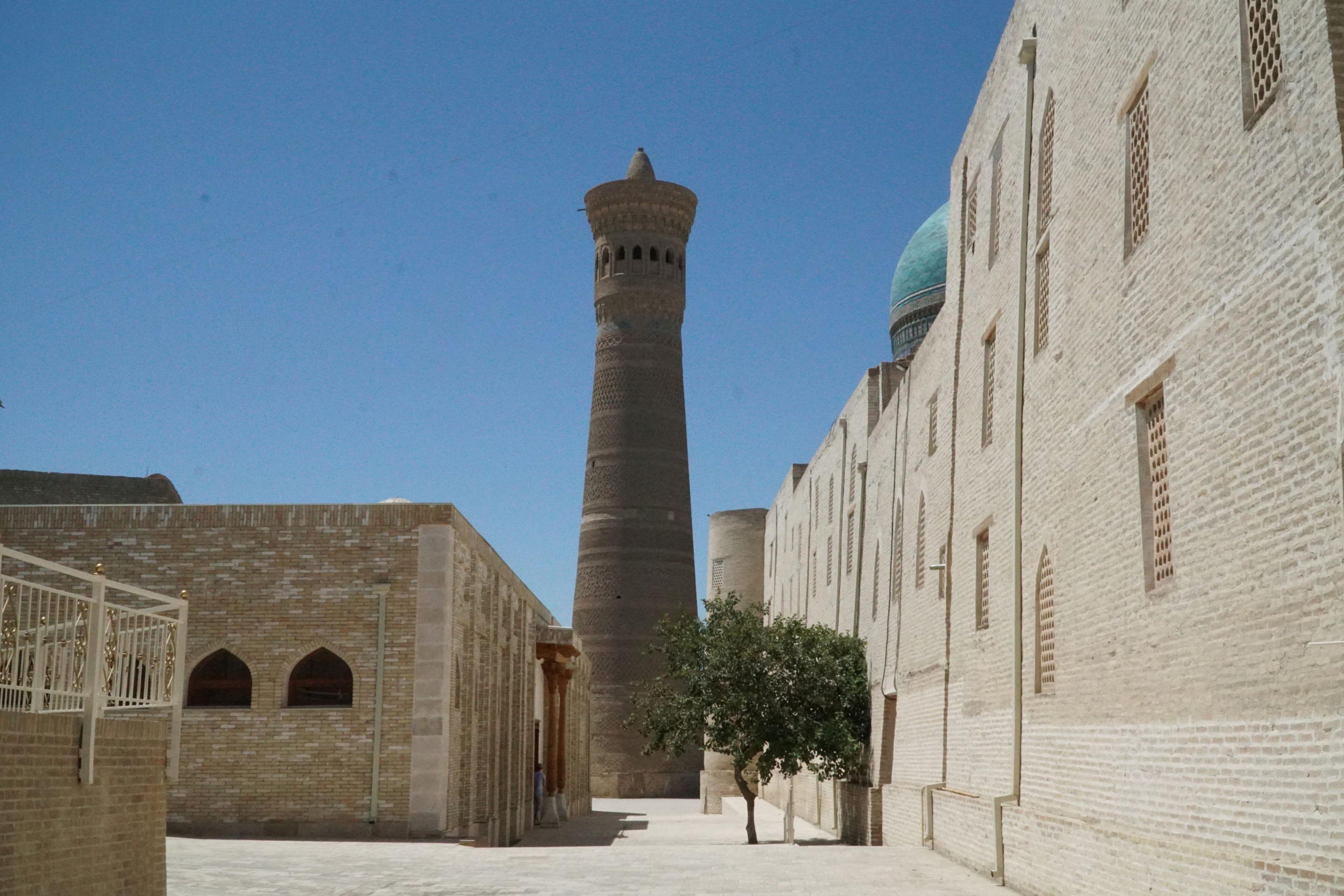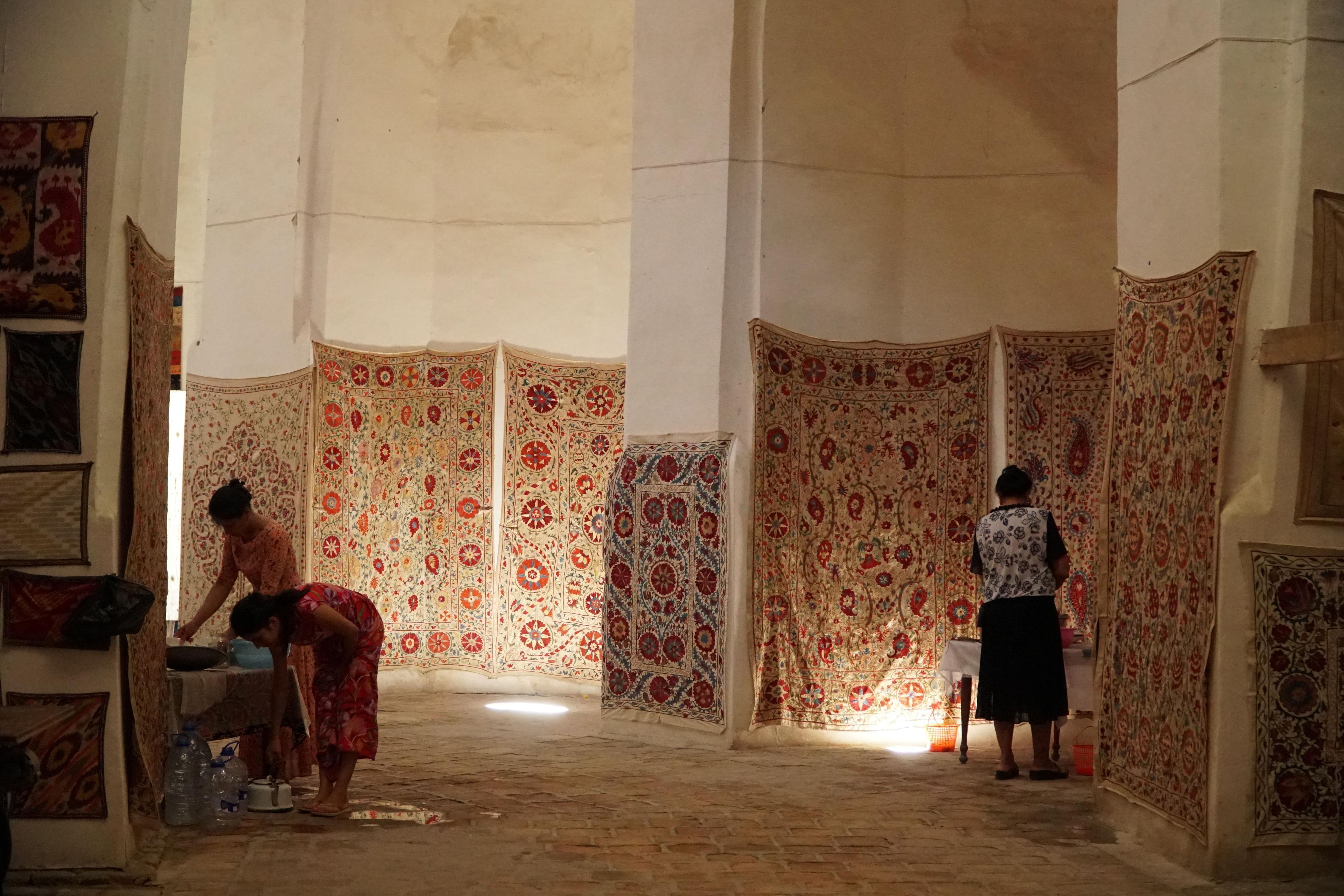
Buying a carpet in Uzbekistan: the Khiva Silk Carpet Workshop and the Samarkand silk carpet factory, regional rugs from Karakalpak to Kashkadarya, knot counts explained, 2026 prices, export paperwork and how to avoid fakes.
Facts, prices and schedules checked on November 4, 2026
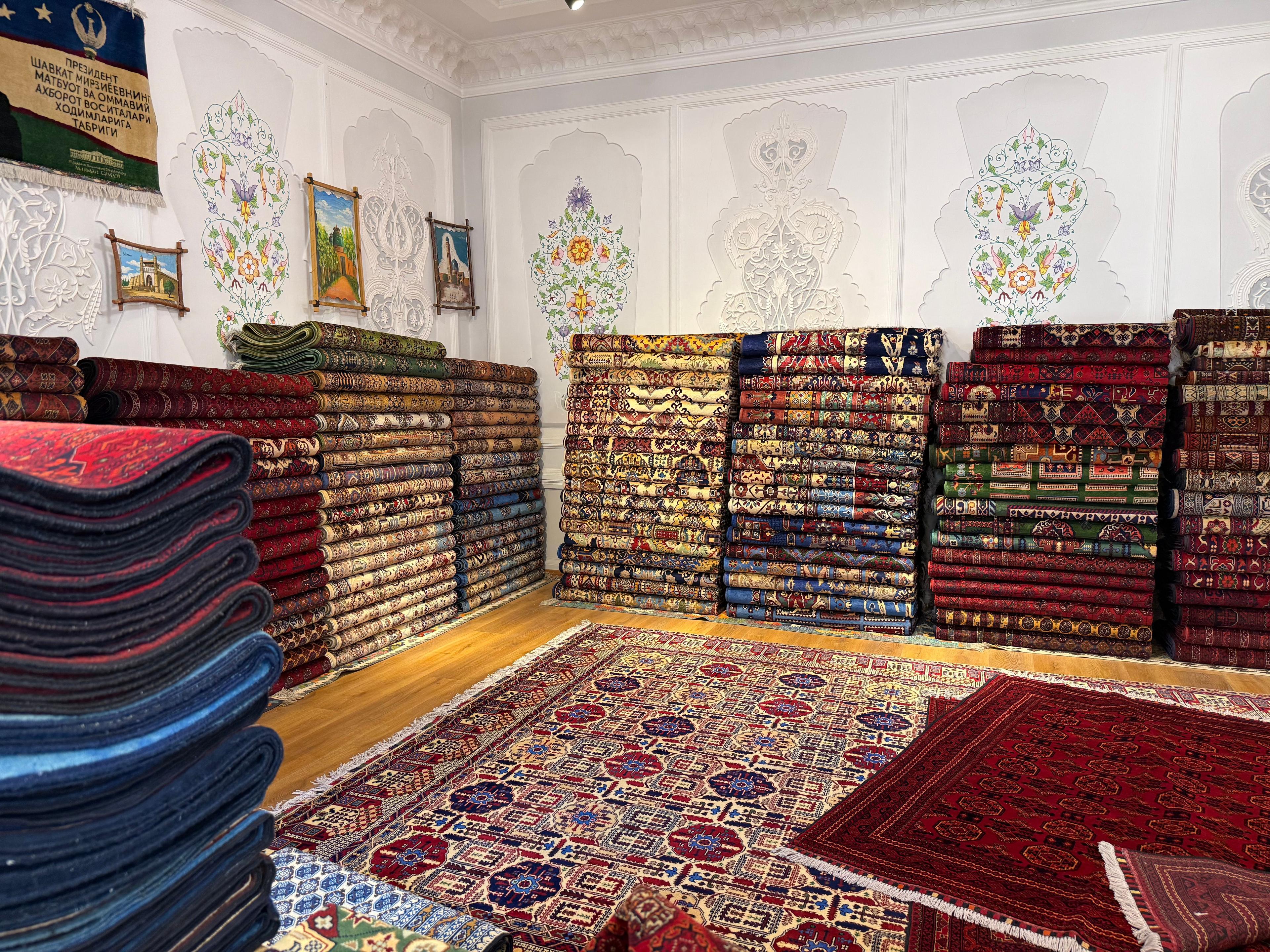
Uzbek carpets are the biggest purchase most travellers make in Uzbekistan, and the one most likely to go wrong. A carpet shop in a madrasah courtyard is a beautiful place to spend an afternoon, but it is also where machine-made rugs, artificial silk and imported pieces sit next to genuine hand-knotted work.
Our crafts and souvenirs guide gives a quick overview. This guide is for anyone seriously thinking about buying: the two workshops worth planning around (the Khiva Silk Carpet Workshop and the Samarkand silk carpet factory), the regional rug traditions, how knot counts work, realistic prices as of November 2026, the export certificate, and the tricks to watch for.
Carpets in Uzbekistan: a quick background
Carpet weaving in what is now Uzbekistan belonged mostly to the semi-nomadic peoples of the steppes and foothills: Uzbek tribal groups such as the Lakai and Kungrat, Karakalpaks, Turkmen and the Arab communities of Kashkadarya. City dwellers bought their carpets in the bazaars of Bukhara, Samarkand and Khiva.
The Soviet period industrialised production, and by independence hand-knotting with natural dyes had nearly disappeared. The revival since the 1990s has come from two directions: workshops founded to recreate historic designs with natural dyes, and private family weavers in villages and towns.
The main types you will meet:
- Gilam: a knotted pile carpet, wool or silk.
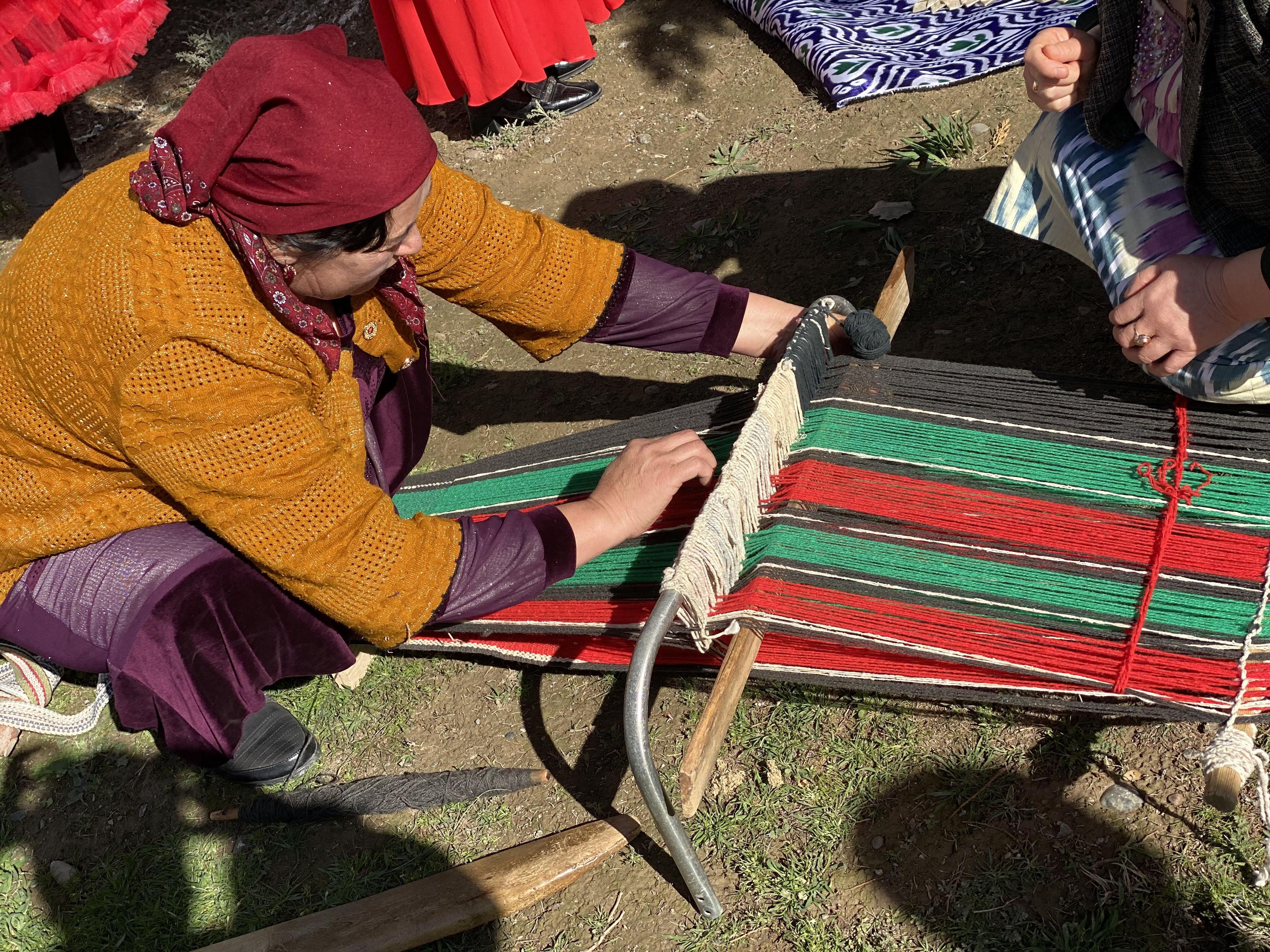
- Julkhyr (julkhir): a long, shaggy pile rug of the semi-nomadic Uzbeks, warm and loosely knotted.
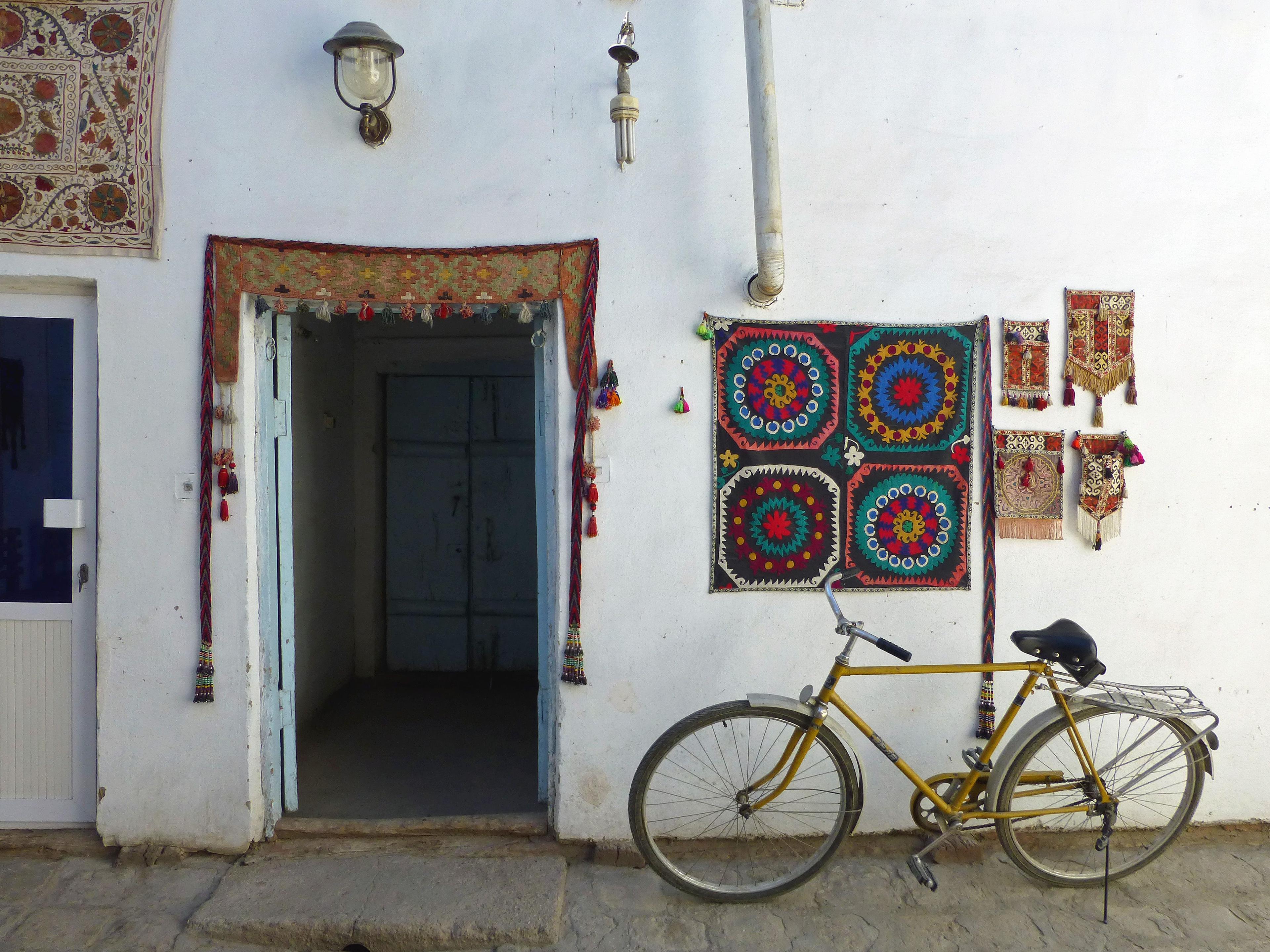
- Kilim and palas: flat-woven rugs with no pile, often in bold stripes or geometric patterns.
- Joynamoz: a small prayer rug.
Khiva has celebrated its carpets with an international festival, Splendour of Carpets (Gilamlar Jilosi), held most recently in October 2025.

The Khiva Silk Carpet Workshop
The Khiva Silk Carpet Workshop was founded in 2001 as a joint initiative of UNESCO and the development organisation Operation Mercy, to revive silk carpet weaving with natural dyes. It works inside Ichan-Kala, in the Yakubbai Khoja madrasah, a nineteenth-century religious school whose cells now hold looms. The story of its founding is told in Chris Aslan Alexander's memoir A Carpet Ride to Khiva.
What makes it special:
- Designs come from Khiva itself: the tile panels of its mosques and mausoleums, carved wooden doors and columns, and Timurid miniature painting. You can often match a carpet to the tilework you saw that morning.
- All colours are natural: madder root for reds, imported indigo for blue, pomegranate rind, onion skin and vine and quince leaves for yellows, walnut husks for browns, with green made by overdyeing yellow with blue.
- Weavers are local women, and the workshop has deliberately employed people who would otherwise struggle to find work.
- A medium carpet occupies several weavers for months.
Visitors can walk through the dye room and watch weaving, and there is a shop. A neighbouring suzani workshop uses the same naturally dyed silk. Prices are fixed and reflect silk and natural dyes: one guidebook quotes around US$2,300 for a carpet of 1.3 by 2 metres. Check current prices on the spot.
Combine it with the rest of Ichan-Kala; our Khiva travel guide has the full picture.
The Samarkand silk carpet factory (Samarkand Bukhara Silk Carpets)
In Samarkand the name to know is Samarkand Bukhara Silk Carpets, usually called the Hujum (Khujum) factory after the street it stands on, a short drive from the Registan. It is run by the Badghisi family, hereditary weavers of Afghan origin, and is one of the largest hand-knotted silk carpet workshops in Central Asia.
What you see on a visit:
- Raw silk being boiled, spun and dyed with natural materials such as onion skins, walnut shells and pomegranate peel.
- Rows of women at the looms, knotting silk on silk at remarkable speed, with set breaks to rest their eyes and hands.
- A showroom of finished carpets, from small panels to room-sized pieces, many in classic Persian and Central Asian designs.
Tours are usually free and conducted in English, and there is no pressure to buy, though the showroom is the logical end of the route. The factory also employs women who weave at home with materials it supplies.
Fine silk-on-silk carpets take a single weaver many months, and a large piece can take more than a year. Prices reflect that: from several hundred US dollars for a small panel to many thousands for a room-sized carpet. Ask for the knot count, size and material on the invoice.

Regional rugs: what you will find around the country
Away from the two big workshops, Uzbekistan's carpet traditions are regional and largely tribal. Shops in Bukhara, Samarkand and Tashkent sell many of these:
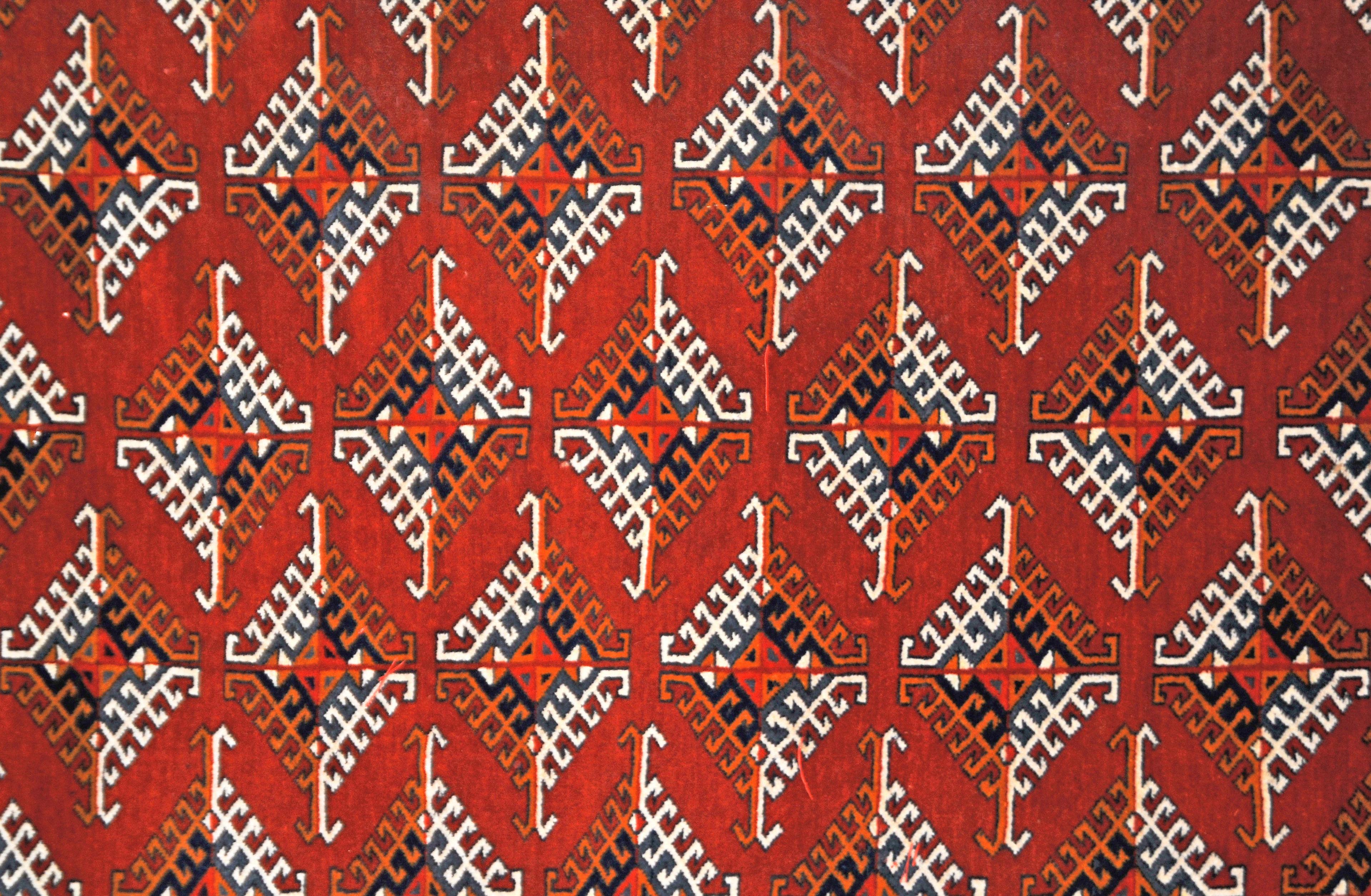
- Karakalpak and Khorezm rugs: from the lower Amu Darya, closely related to Turkmen weaving, with deep reds and repeating geometric medallions.
- Kashkadarya and Surkhandarya: the heartland of Uzbek semi-nomadic weaving. Look for julkhyr long-pile rugs, bold kilims, and the rugs of the Arab villages of Kashkadarya. Baysun, in Surkhandarya, preserves some of the oldest weaving traditions, including striped textiles.
- Nurata: rugs that show clear Turkmen influence, as well as the region's famous embroidery.
- Bukhara: historically a trading centre rather than a weaving region. Many "Bukhara carpets" were woven elsewhere and sold in its bazaars.
A note on the word "Bukhara": in Western rug shops, "Bukhara rug" is a trade name for carpets in the Turkmen style, with rows of octagonal gul medallions on a red ground, and most of them are made in Pakistan or Afghanistan. In Uzbekistan, too, many carpets on sale come from Afghanistan, Turkmenistan or Iran. There is nothing wrong with that, but you should know the origin of what you buy.
Knot counts explained
Knot density is the single number that best describes the fineness of a hand-knotted carpet. It is usually quoted per square metre in Uzbekistan and per square inch in the US and UK.
How to count it yourself:
- Turn the carpet over. On a hand-knotted carpet each knot is visible as a small bump on the back.
- With a ruler, count the knots along 1 centimetre horizontally and 1 centimetre vertically.
- Multiply the two numbers. That is knots per square centimetre; multiply by 10,000 for knots per square metre.
- To convert to knots per square inch, multiply knots per square centimetre by about 6.45.
As a rough guide:
- Tribal and village wool rugs, julkhyr and similar: often under 20 knots per square centimetre, and that is fine. Their charm lies in bold design and wool, not fineness.
- Good-quality wool carpets: commonly 20 to 40 knots per square centimetre.
- Silk carpets: from around 40 to over 100 knots per square centimetre for the finest workshop pieces.
Sellers quote very different numbers, and some exaggerate. Count a sample yourself, and get the figure written on the invoice. Higher density is not automatically better: a well-designed, naturally dyed wool rug at 25 knots can be a better carpet than a garish silk one at 100.
How to avoid fakes: hand-knotted vs machine-made, silk vs art silk
Most problems fall into three categories.
Machine-made carpets sold as handmade:
- On the back of a machine-made carpet the pattern is blurred and perfectly regular, and there is often a stiff mesh or a glued backing.
- On a hand-knotted carpet the fringe is the end of the warp threads, part of the carpet itself. A fringe sewn or glued on afterwards is a warning sign.
- Hand-knotted carpets have small irregularities: slightly uneven edges, a motif a few millimetres off, an abrash (gentle colour change across a dyed batch).
Artificial silk sold as silk:
- "Art silk" made from viscose, mercerised cotton or so-called bamboo silk shines like silk at a fraction of the price.
- Real silk feels cool, dry and slightly crisp, and the pile springs back. Art silk feels slippery and can crush and stay flattened.
- A burn test on a loose thread from the fringe is the most reliable test: silk smells like burnt hair and leaves a crumbly ash; viscose and cotton burn quickly, smell like paper and leave a soft grey ash. Reputable sellers will not object.
- Price is the giveaway. A "silk" carpet of a square metre for a hundred or two hundred dollars is not silk.
Synthetic dyes sold as natural:
- Natural dyes give slightly varied, harmonious colours with abrash. Synthetic dyes can be very even and occasionally harsh.
- Ask what was used for each colour. A weaver who uses natural dyes will tell you with pleasure.
Uzbek carpet prices in 2026
Prices depend on material, knot density, size, dyes and where you buy. These ranges are indicative for new hand-knotted pieces in Uzbekistan as of November 2026:
- Small kilims and palas (flat-weave): from roughly US$100 to 400.
- Small hand-knotted wool rugs (about 1 by 1.5 metres): roughly US$200 to 700.
- Medium wool carpets (about 2 by 3 metres): roughly US$800 to 3,000.
- Small silk carpets and panels (under 1 square metre): roughly US$500 to 2,000.
- Silk carpets of 2 to 3 square metres from top workshops: several thousand US dollars, and well into five figures for very fine knotting.
Think in price per square metre and compare like with like: same material, similar knot count, natural or synthetic dyes. Workshops quote near-fixed prices; shops and bazaars expect bargaining, and the first figure in a busy tourist area can be well above the final one.
Most workshops and larger shops accept cards, and many can ship. Ask for an itemised invoice giving size, material, knot count, origin and the fact that the carpet is new.
Exporting a carpet: the certificate and customs
Carpets are the item customs officers check most often at Tashkent, Samarkand and Urgench airports.
- Uzbekistan's law on the export and import of cultural values bans the export of cultural values created 50 or more years ago. In 2026 that means anything made before about 1976.
- New carpets of artistic value can be subject to an export certificate, issued after an expert examination through the Ministry of Culture. The owner applies in writing and presents the carpet; the examination can take up to ten days and carries a fee.
- In practice, reputable workshops and shops supply the paperwork that confirms a carpet is new and may be exported, or arrange the certificate for you. Ask for it at the time of purchase and do not leave it until your last day.
- Keep the invoice together with the certificate in your hand luggage.
- A carpet bought without documents can be held or confiscated at the border.
If you live in the United States, note that since May 2025 US import rules restrict ethnological material from Uzbekistan dating from about 600 to 1917, explicitly including carpets. An antique carpet needs Uzbek export documentation to be imported legally.
Rules and responsible agencies change, so check the current requirements with the State Customs Committee of Uzbekistan before buying anything valuable.
Getting your carpet home
- Small rugs fold or roll into a suitcase. Shops will tie them into a compact bundle with a handle.
- Medium carpets usually go as checked baggage. Check your airline's weight allowance first; a 2 by 3 metre wool carpet can weigh well over 15 kilograms.
- Larger pieces can be shipped by the workshop or by courier. Get the cost, insurance and delivery time in writing, and keep photographs of the carpet, including the back, before it leaves.
- Your home country may charge import duty or VAT on arrival. Check the limits before you buy.
Roll a pile carpet with the pile facing outwards for transport, never fold a silk carpet sharply, and unroll it as soon as you get home.
Buying a carpet with TourEast
We can build the Khiva Silk Carpet Workshop, the Samarkand silk carpet factory and smaller family weavers into a private or small-group itinerary, with a guide who will translate, explain what you are looking at and step back while you decide. If you buy, we can help you check the paperwork before you reach the airport.