How to visit and pray in Uzbekistan's mosques: what to wear, shoes and scarves, women's access, Friday prayer, where to find prayer times and prayer rooms, and how to calibrate your prayer app for Hanafi timings.
Facts, prices and schedules checked on November 4, 2026
Uzbekistan is a secular state with a Muslim heritage, and the two facts shape every visit to a mosque. Some of the country's finest mosques are museums or protected monuments that visitors tour with a ticket and a guide. Others are working places of worship where the call to prayer still sounds five times a day. Knowing which is which, and how to behave in each, is most of what mosque etiquette in Uzbekistan comes down to.
This guide is for two kinds of reader: visitors who want to enter mosques and shrines respectfully, and Muslim travellers who want to pray on the road. It covers dress, shoes, women's access, Friday prayer, prayer times, prayer-app settings and where prayer rooms exist, as of November 2026. Rules vary by mosque and change over time, so treat what follows as a practical guide and confirm locally with your guide or the mosque's staff.
Can tourists enter mosques in Uzbekistan?
In most cases, yes. A good way to think about it is in three groups.
- Monuments that were mosques and are now museums or visited sites: the Bibi-Khanym Mosque in Samarkand, the Tilla-Kari mosque in the Registan, the Juma Mosque in Khiva. You buy a ticket or pass through the complex freely and can walk in with modest dress.
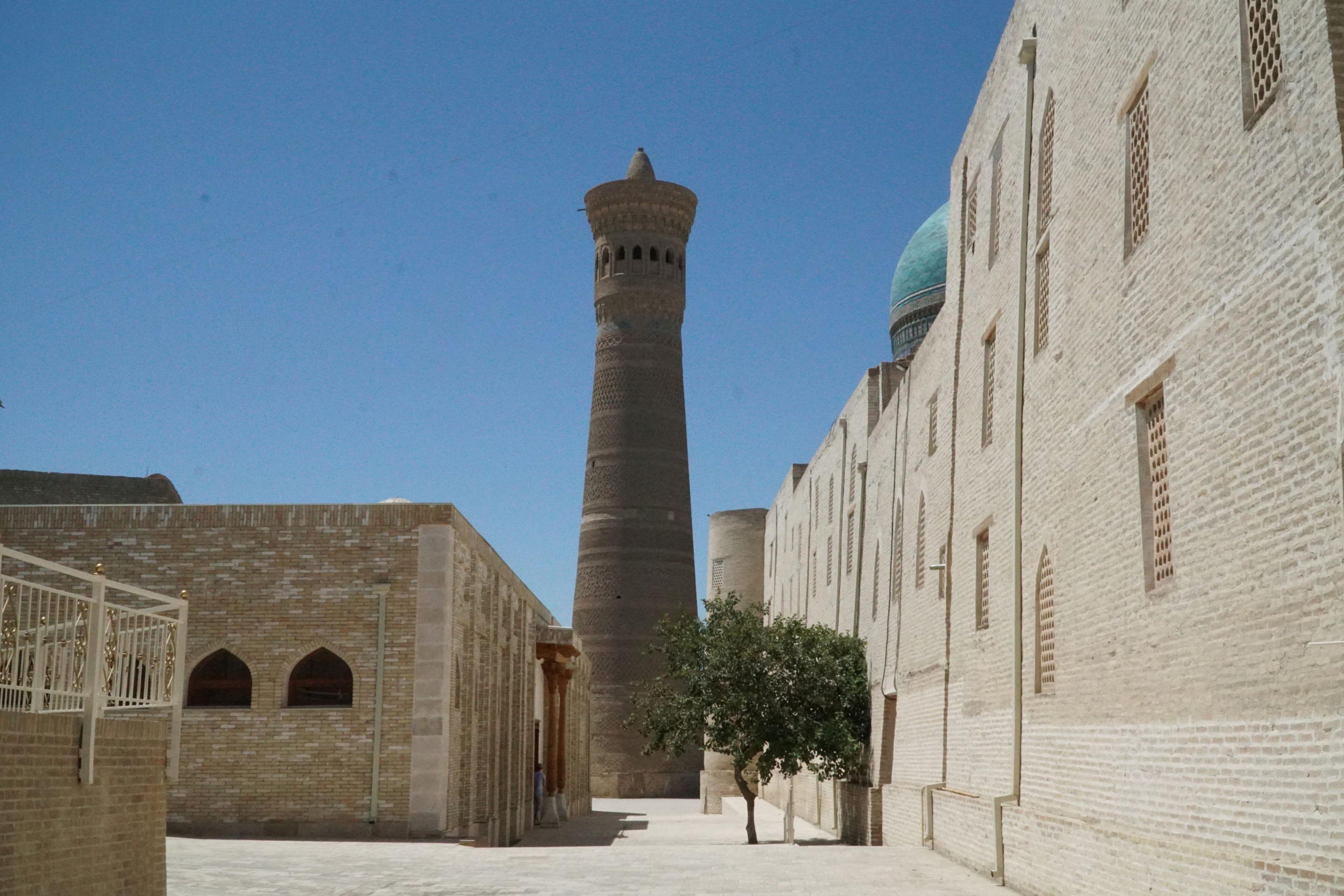
- Working congregational mosques that also welcome visitors: the Kalyan Mosque beside the Po-i-Kalyan minaret in Bukhara, the Bolo-Hauz mosque, the Hazrati Imam Mosque in Tashkent. Visitors are generally accepted between prayers.
- Neighbourhood mosques: small mosques in residential districts. These are for worshippers first. Ask before you enter, and do not go in during prayers unless you are praying.
At the largest pilgrimage complexes, such as the Bahauddin Naqshband complex outside Bukhara and the Imam al-Bukhari complex near Samarkand, visitors of every background come, and locals treat the shrine as a place of quiet and respect. Entry procedures and opening hours vary and are sometimes tightened around religious holidays, so ask on the day.
What to wear in a mosque in Uzbekistan
There is no law that dictates what a visitor wears, but there is a clear custom. The Uzbek embassy's guidance for holy places in Uzbekistan advises covering shoulders and legs, and that is the minimum for everyone.
- Women: loose clothing that covers shoulders, arms and legs to the ankle or below the knee at the very least. A headscarf is expected inside active mosques and at shrines. Carry a light scarf in your daypack so you can put it on when you reach the door.
- Men: long trousers and a shirt with sleeves. Shorts and sleeveless tops are inappropriate at holy sites, even in summer heat.
- Both: nothing see-through or tight, no hats worn inside prayer halls, no sunglasses perched on the head, no strong perfume.
Footwear matters as much as clothing. Shoes come off at the door of every prayer hall, and often at the entrance to the courtyard. Slip-on shoes save time. Cotton socks are kinder than bare feet on tiled or marble floors, which can be very hot in summer and cold in winter. Our packing list explains what to wear in each season.
Behaviour: what to do and not to do
The same short rules apply at mosques, mausoleums and pilgrimage complexes.
- Speak quietly. Loud talk, laughing and shouting are out of place.
- Do not eat, drink, smoke, listen to music or rest on the premises of a shrine. Official guidance for visitors to holy sites lists cooking, eating, smoking and alcohol as forbidden.
- Do not step on or sit on tombs. Walk around them in the direction other visitors take.
- If you wish to give charity, use the donation box. Do not leave money on tombs.
- Do not photograph worshippers at prayer or pilgrims at a tomb up close. Ask before photographing anyone, and ask your guide whether photography is permitted inside a prayer hall.
- Switch your phone to silent, and never answer it inside.
- At a shrine, men and women often move through the complex separately, especially near the tomb itself. Follow the order of the line.
None of this is complicated, and a visitor who follows it will find that doors open easily. People are glad when a foreigner takes the trouble.
Women in mosques in Uzbekistan
This is the question we hear most from women travellers, including from Malaysia and Indonesia, where women attend the mosque as a matter of course. The honest answer is that practice varies.
- At historic mosques that function mainly as monuments, women are welcome as visitors in the courtyard and often in the hall.
- In many neighbourhood mosques there is no women's section, and local women usually pray at home.
- The largest mosques and pilgrimage complexes in Tashkent, Bukhara and Samarkand often have separate arrangements, including a separate entrance or room for women. If you want to pray in a mosque, ask your guide to check in advance which one welcomes women and where they pray.
- Friday prayer arrangements for women differ by mosque. Do not assume that the courtyard will be open to everyone at midday on Friday.
Women travelling alone or in women-only groups find Uzbekistan safe and respectful. See our solo female travel guide for general advice.
Friday prayer: when to visit and when to stay away
Juma namozi, the midday Friday prayer, is the busiest hour in the week. Mosques fill early, the congregation spills into courtyards and nearby streets, and there is no room for sightseeing. A few practical points:
- Plan your sightseeing around it. Visit the Kalyan Mosque or the Hazrati Imam Mosque in the morning, and avoid the hour before and during the prayer.
- If you wish to pray with the congregation, arrive 30 to 45 minutes early. When the halls are full, mats are laid out in the courtyard. The sermon is usually in Uzbek.
- Dress as you would for any mosque, and keep your bag small.
- Expect heavy traffic and crowds around the large mosques at that time.
When we plan a tour, we schedule Friday mornings around the prayer, so that a group is not travelling at the wrong hour.
Prayer times in Uzbekistan and how to set your app
The Muslim Board of Uzbekistan publishes official daily prayer times for each region on its portal (muslim.uz), and local mosques follow them. The local names are bomdod (Fajr), peshin (Zuhr), asr, shom (Maghrib) and xufton (Isha).
The key point for travellers is the calculation method. Uzbek Muslims are overwhelmingly of the Hanafi school, and the Hanafi time for Asr begins later than the Shafi'i time used in Malaysia and Indonesia. If you use an app such as Muslim Pro, you can usually choose either setting. Many travellers keep the method they follow at home. If you want to pray with the local congregation, the Hanafi setting will match the mosque's call.
Other practical points:
- Times shift by season. In summer the days are long and Isha comes late; in winter the day is short. Set your app to your current city, since the times differ slightly between Tashkent, Samarkand, Bukhara and Khiva.
- The qibla points roughly south-west from Uzbekistan. A compass app works well, and many hotel rooms have a marker, though not all.
- Local timetables may differ from an app by a few minutes, so keep a margin when planning around a prayer.
Prayer rooms: where to find them
Official policy has moved in the direction of providing prayer rooms. Tashkent International Airport has had a prayer room since 2017, and a 2019 decision requires prayer rooms at international airports and railway stations. In practice:
- Airports: ask staff for the namozxona (prayer room). Its location inside a terminal can change with renovations, so check on the day.
- Railway stations: the main stations are covered by the same rule, but the Afrosiyob and other trains have no dedicated prayer space. Pray before departure, or on arrival.
- Hotels: some provide a prayer mat and a qibla sign, but this is not universal. Ask at check-in, and bring your own mat if you prefer.
- Sightseeing: many monuments are working mosques or stand beside one, so a place to pray during the day is rarely far away. Your guide can lead you to the nearest mosque at prayer time.
For wudu, mosques have ablution areas, and many public toilets have a tap or a small water jug. Bring a small travel mat and a bottle if you are in doubt.
If you are planning a trip that centres on prayer, pilgrimage and halal food, our guides to halal travel and to ziyarat in Uzbekistan give the wider picture, and the guide to the Seven Pirs of Bukhara covers a route of shrines.
A short checklist for your day bag
- A light scarf or shawl for women, and a long-sleeved shirt for everyone.
- Slip-on shoes and clean socks.
- A small prayer mat, if you pray on the road.
- A compass or qibla app set to Hanafi or your preferred method.
- Small notes for the donation box.
- A bottle of water for the heat, to be drunk outside the shrine, not in it.
If you have questions about a specific mosque, ask your guide or the person at the door. Asking first is always appreciated, and it is the simplest way to learn what is and is not permitted.
Doing it with TourEast
If you would like a route that respects prayer times, with mosque and shrine visits scheduled around them, we can plan private tours and small-group journeys with guides who know the local mosques. Tell us your prayer needs on WhatsApp or in our trip builder at /trip-builder, and we will plan the days around them. Guides in Arabic, Indonesian or Malay are available on request.