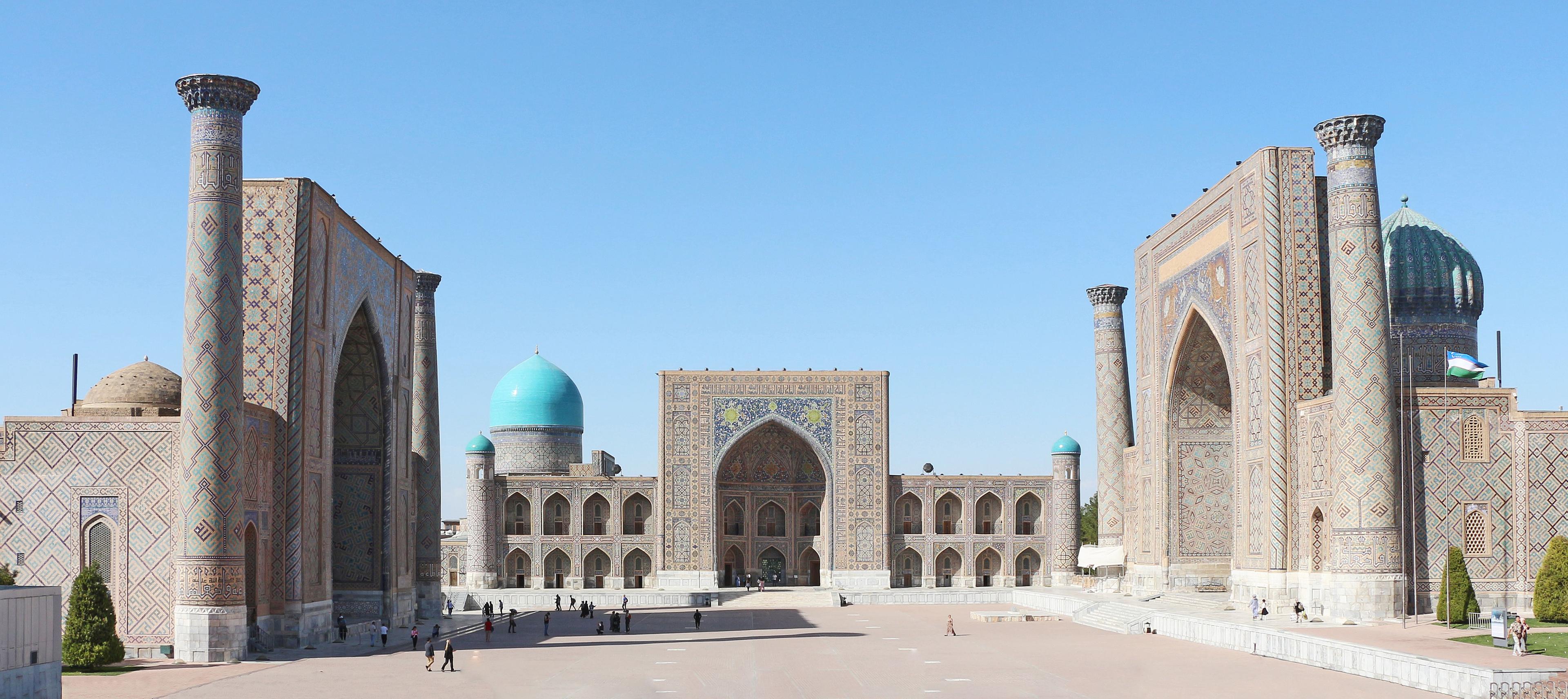
Russian Orthodox cathedrals in Tashkent and Samarkand, a monastery with Athonite icons, the Tomb of the Prophet Daniel and Job's spring in Bukhara: a guide to Orthodox Uzbekistan, with feast days and tips for attending the Liturgy.
Facts, prices and schedules checked on November 4, 2026
Orthodox churches in Uzbekistan surprise most visitors. In a country best known for turquoise domes and madrasahs, the bells of a Russian cathedral ring over Tashkent every Sunday morning, and in Samarkand a red-brick garrison church stands a short drive from the Registan. Most of these churches were built between the 1870s and the First World War, when Turkestan became part of the Russian Empire. Many were closed in the 1920s and 1930s, and some were demolished. The survivors returned to their parishes during and after the Second World War, or after independence in 1991.
This guide is written for pilgrims and for any traveller curious about Christian Uzbekistan. It covers every Orthodox church of real historical or pilgrimage interest: where it is, what to see and venerate, when its feast day falls, and how to attend the Divine Liturgy as a visitor. We have also added the Tomb of the Prophet Daniel in Samarkand and the spring linked to the righteous Job in Bukhara. Both are revered by Christians as well as Muslims.
Is there an Orthodox Church in Uzbekistan?
Yes. All the Orthodox parishes in the country belong to one diocese of the Russian Orthodox Church (Moscow Patriarchate), the Tashkent and Uzbekistan Diocese. It was founded in 1871 as the diocese of Turkestan, with its see in Verny (today's Almaty), and moved to Tashkent in 1916. Since 2011 it has headed the Central Asian Metropolitan District, which also includes the dioceses of Bishkek and Dushanbe and the parishes of Turkmenistan. The ruling hierarch is Metropolitan Vikenty of Tashkent and Uzbekistan, who is also the rector of the cathedral.
The diocese has around three dozen parishes and prayer houses, two convents, a men's monastery and a theological seminary in Tashkent, which opened in 1998. Services are in Church Slavonic, with sermons in Russian. Parishioners are mostly Russian-speaking families, but there are also Uzbek, Korean, Tatar and Armenian Orthodox believers. The Russian community has shrunk since the 1990s, yet the great feasts still fill the churches: at Pascha the Tashkent cathedral welcomes several thousand people.
Patriarch Alexy II of Moscow visited Uzbekistan in November 1996. He celebrated the Divine Liturgy in the Tashkent cathedral, re-consecrated the cathedral in Samarkand and visited the convent in Tashkent. For local Orthodox believers his visit marked the end of the long Soviet winter.
Holy Dormition Cathedral in Tashkent
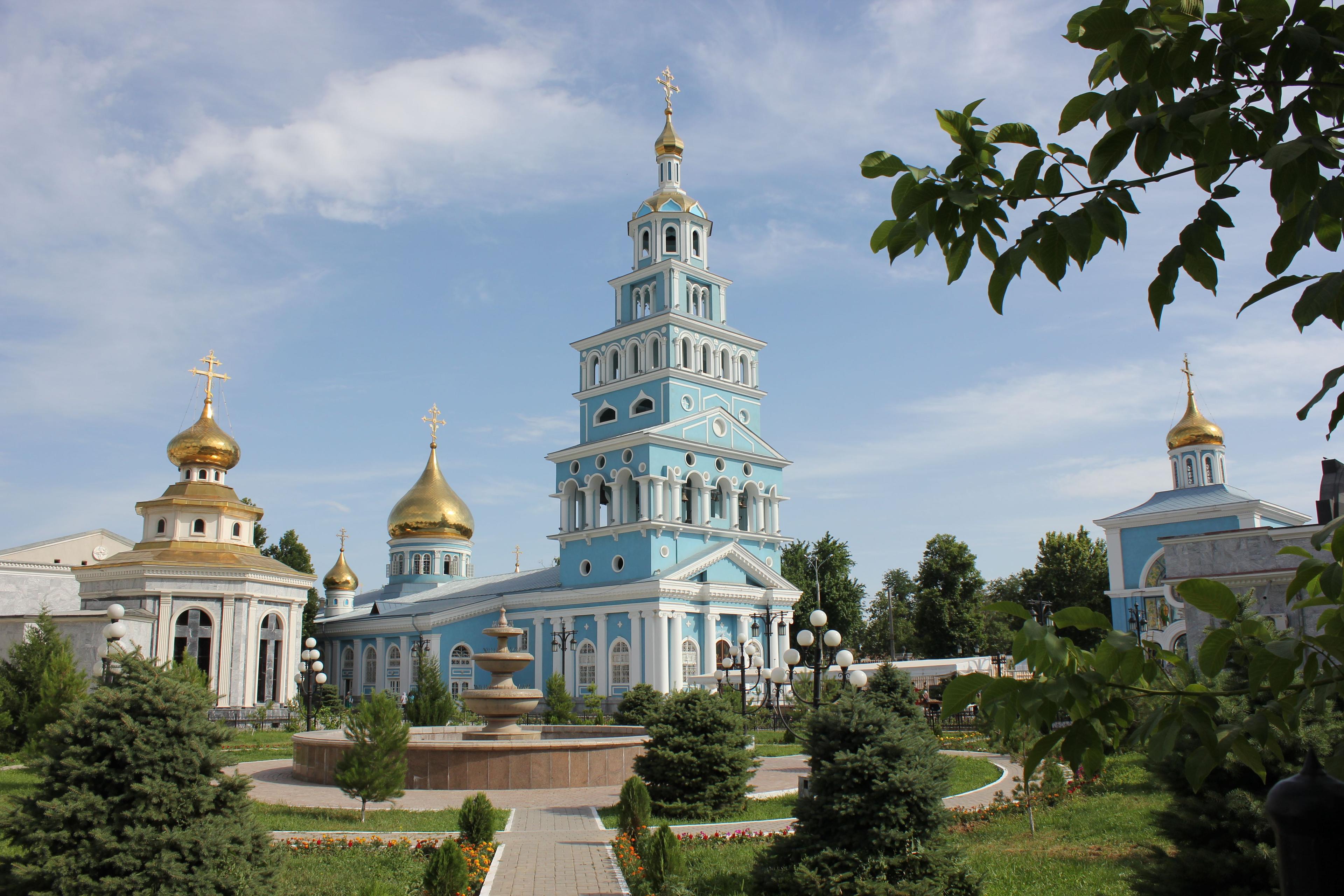
The Holy Dormition Cathedral (Uspensky Sobor) is the main Orthodox church of Uzbekistan and the place every pilgrim should start. It stands at 91 Avliyo-Ota Street, formerly Gospitalnaya (Hospital) Street, a few minutes from Tashkent Central railway station.
Its history explains its unusual dedication. It began in 1877–79 as the hospital church of the Great-Martyr and Healer Panteleimon, beside the military hospital and its cemetery. Among the donors were the Governor-General Konstantin von Kaufman and the merchant Dmitry Zakho, who gave the largest sum and served as church warden for fifteen years. The church was closed in 1933 and used as a medical warehouse. In December 1945 it was returned to the faithful, re-consecrated in honour of the Dormition of the Theotokos and made the cathedral of the diocese. Bishop Ermogen (Golubev) rebuilt and enlarged it in 1958–60, and further work followed in 1978 and in the 1990s.
What you see today:
- A white-and-blue church with gilded and blue domes, in the Russian Revival style
- A separate multi-tiered bell tower, consecrated in 2009 and described by the diocese as the tallest in Uzbekistan
- A chapel for the blessing of water in the cathedral grounds
- A monument to St Luke (Voyno-Yasenetsky) on the cathedral square
St Luke is the saint most closely tied to Tashkent. He was a surgeon and scholar who came to the city in 1917 as chief physician of the city hospital. At a time of open persecution he was ordained a priest here, and in 1923 he was consecrated a bishop. He later spent years in prison and exile and was canonised by the Russian Orthodox Church in 2000. His relics rest in Simferopol in Crimea, not in Tashkent, but many Russian visitors come to the cathedral specifically to pray before his image.
The cathedral's patronal feast is the Dormition, on 28 August. On that day the Metropolitan celebrates the festal Liturgy, and it is the best single date for a pilgrimage to Tashkent.
Other Orthodox churches in Tashkent
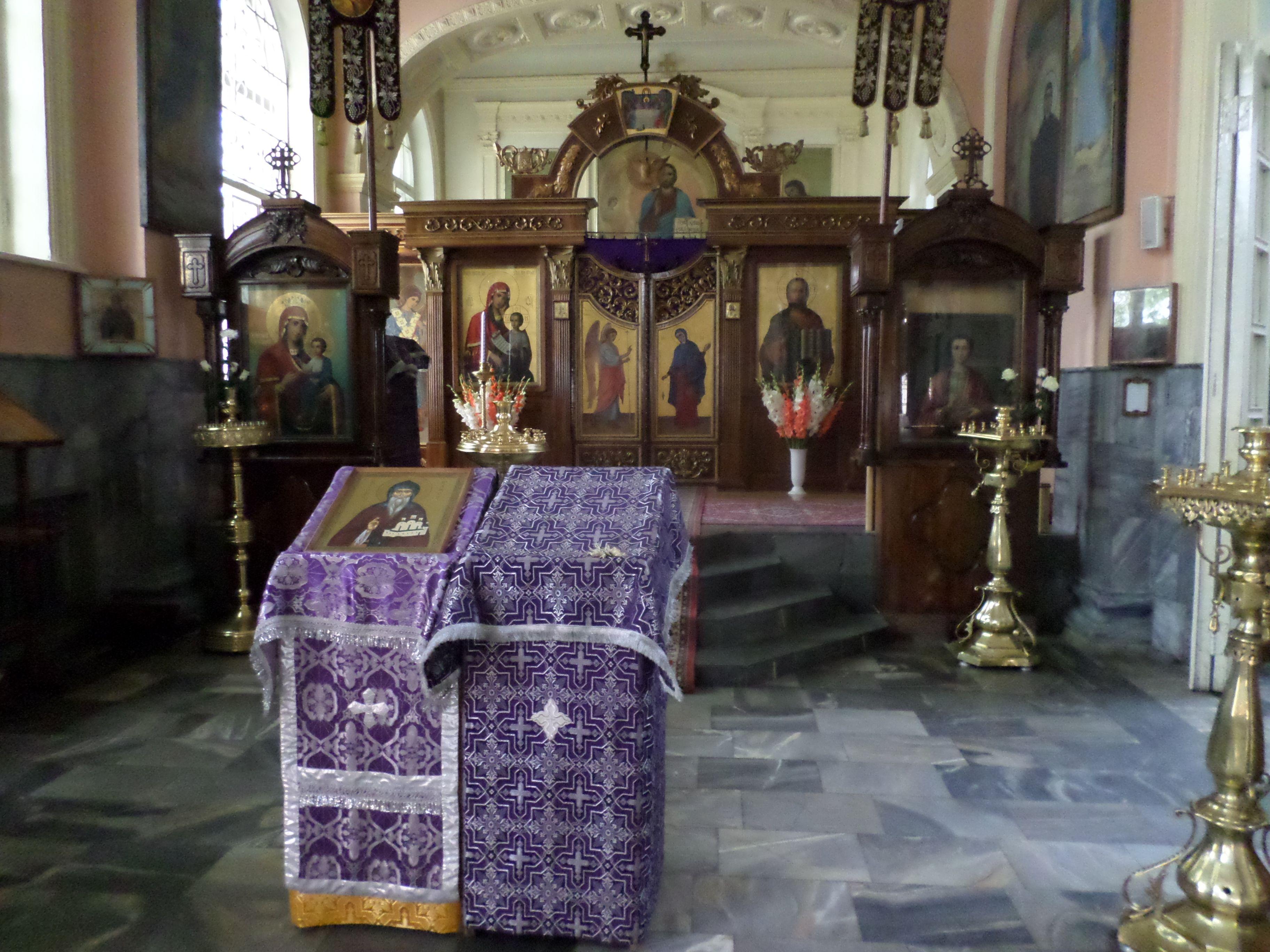
St Alexander Nevsky church stands on a small rise inside the old Christian cemetery on Botkin Street (No. 106). It was built in 1903–04 with funds from the military department, and the commercial counsellor Nikolai Ivanov donated its gilded, finely carved wooden iconostasis. According to the diocese's history it was never closed during the Soviet period, although Renovationists held it from 1922 to 1945. In 1994 the grave of Abbess Lidia (Nagornova) was found near the church. She was the last abbess of the pre-revolutionary St Nicholas convent, survived the Solovki camp and died in Tashkent in 1936. The patronal feast is 6 December.
The Holy Trinity–St Nicholas Convent, at 7, 8-Marta Street, is the only monastery in the city. A women's community formed here in 1893, became the Tashkent St Nicholas convent in 1901 and grew to about a hundred sisters before it was closed in 1922. Its old buildings were lost: the site became a prison. In 1991 the Holy Synod restored the convent on the site of the Holy Trinity parish church, which is why it now carries both names. The sisters hold daily services, and the patronal feast is St Nicholas, on 19 December.
Two more working parishes complete the picture:
- St Vladimir church, at the Domrabad cemetery on Katartal Street, occupies a 1970 building that was given to the Church in 1991; patronal feast 28 July
- St Hermogenes church, in a lane off Oyshakhonim Street, consecrated in 1956; patronal feasts 2 March and 25 May
Several great churches of old Tashkent did not survive. The military Transfiguration Cathedral was blown up in 1935, and the Joseph-St George Cathedral was demolished in the 1990s. Your guide can show you where they stood in the city centre.
The Holy Trinity–St George Monastery in Chirchik
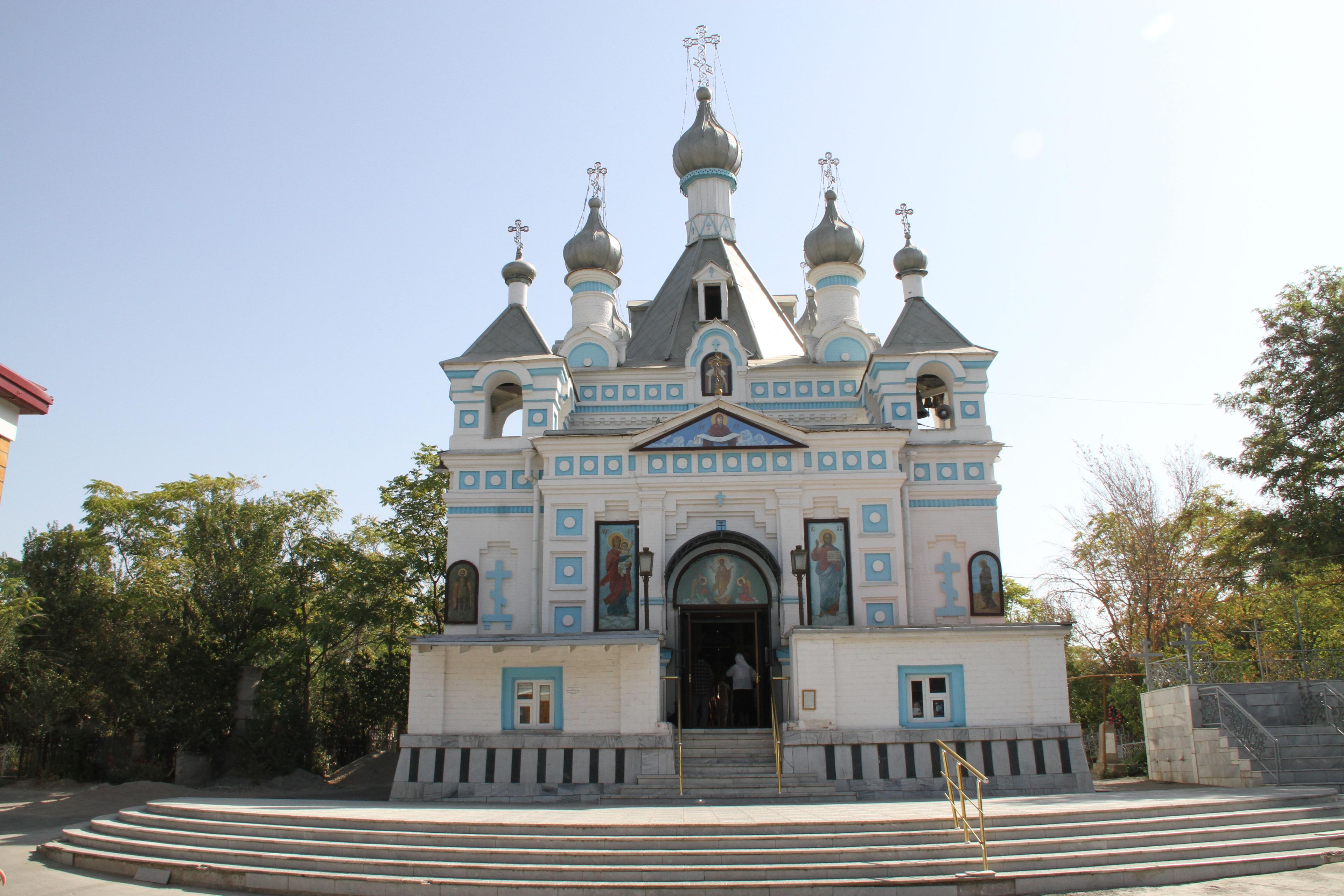
About 35 km north-east of Tashkent, in the industrial town of Chirchik, stands the country's men's monastery. It grew from the parish of the Russian village of Troitskoye. There a prayer house was consecrated in 1897 and a brick church of St George the Great-Martyr was built in 1898–1900; the local Muslim community helped to pay for it. The church was closed in 1931 and used as a stable, then returned in 1945. In 1996 it became a monastery, and after a major restoration it was re-consecrated in March 2020.
The monastery keeps two icons of the Mother of God painted on Mount Athos: "It Is Truly Meet" (1908) and "Economissa" (1896). It also keeps particles of the relics of saints. Services have been held daily since 2012. The patronal feast is 9 December, the autumn feast of St George. The drive from Tashkent takes about 45 minutes, so the monastery fits easily into a day of Tashkent churches.
Orthodox churches in Samarkand
Samarkand has three working Orthodox parishes, all a short drive apart in the 19th-century "Russian" part of the city.
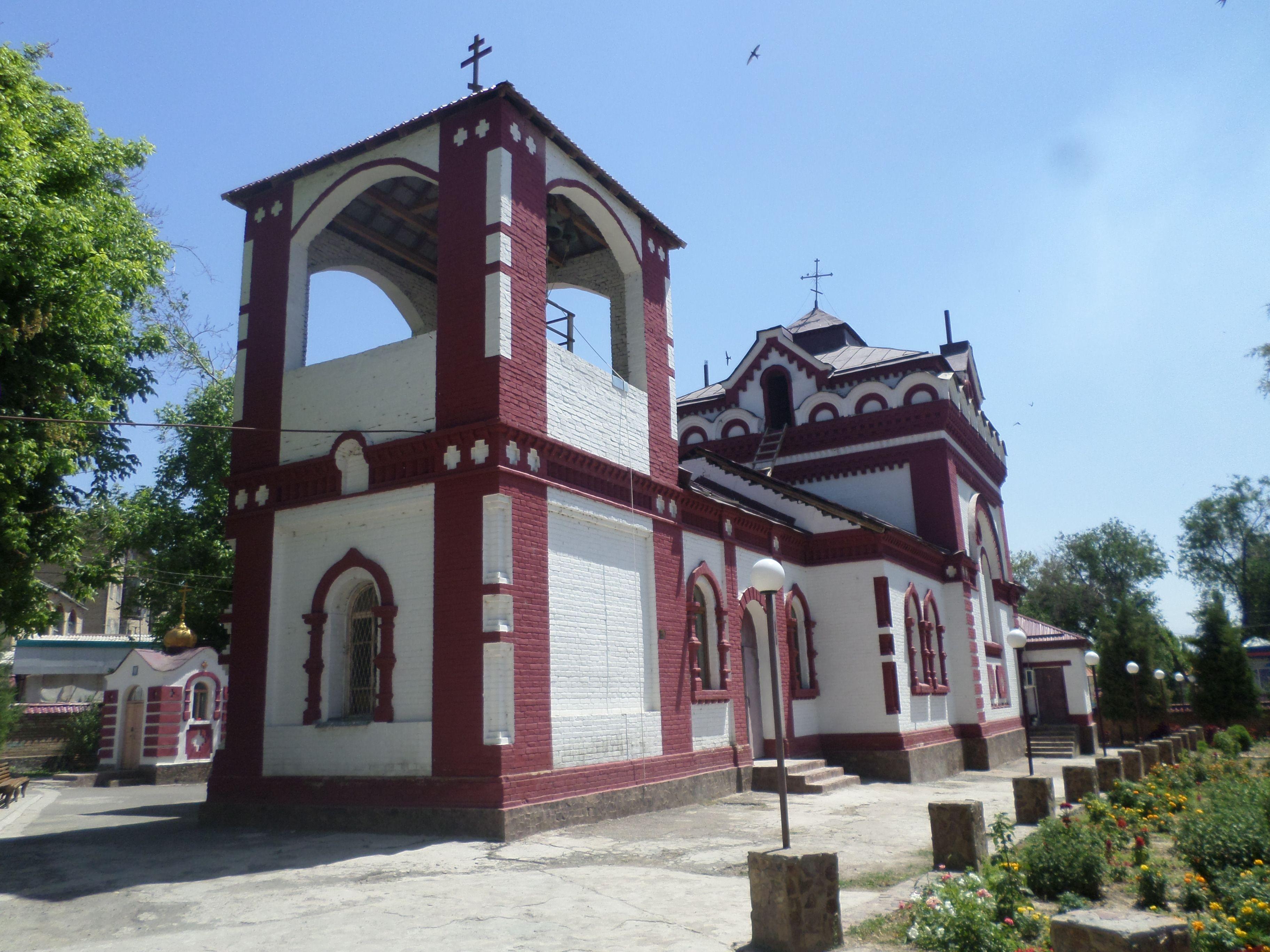
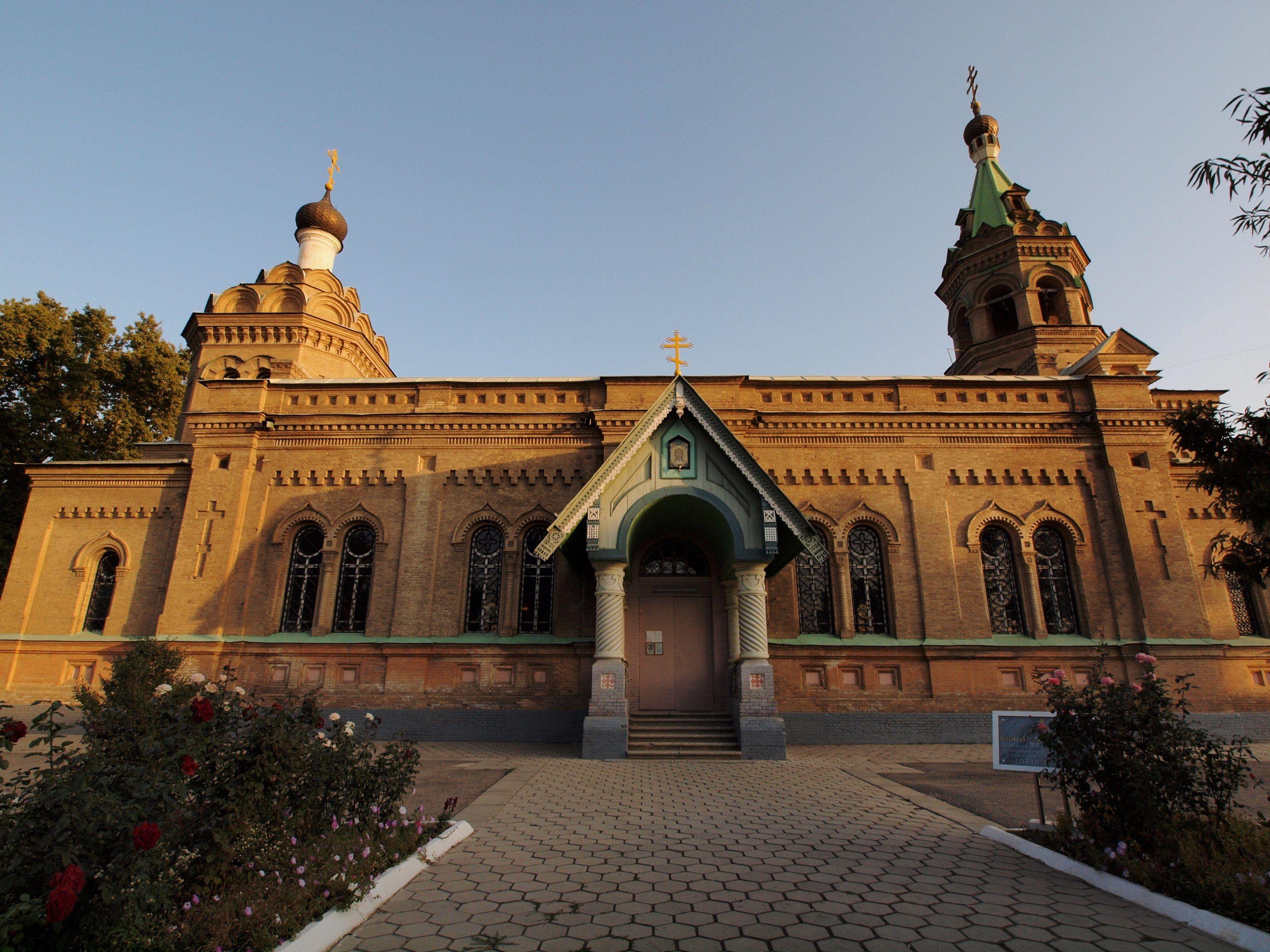
The Cathedral of St Alexis of Moscow, at 1 Bobur Mirzo Street, is the most striking. It was built in 1909–12 for the garrison, to a standard design for military churches in Turkestan by the architect Fyodor Verzhbitsky and the military engineer Fyodor Smirnov. Inside is a single bright hall without columns, about 24 by 16 metres, under a high dome, with a bell tower over the entrance. After the revolution it was closed, and its dome and bell tower were taken down. It served a military unit and then a museum. It returned to the Church in 1996 and was re-consecrated by Patriarch Alexy II on 13 November that year. The patronal feast is St Alexis of Moscow, on 25 February.
The Church of the Protection of the Theotokos (Pokrov), at 24 Husayn Boyqaro Street, was built in 1903 as a regimental church, originally dedicated to the Ascension. Look for its tall bell tower with a mosaic icon of the Mother of God. It is the church of the Samarkand dean, and its patronal feast falls on 14 October.
The parish of St George the Victorious, at 66 Birlik Street, has worshipped since 1937 in a converted private house near the old Orthodox cemetery. It is modest, but parishioners kept many old icons safe here through the Soviet years. The patronal feast is 6 May.
The Tomb of the Prophet Daniel in Samarkand
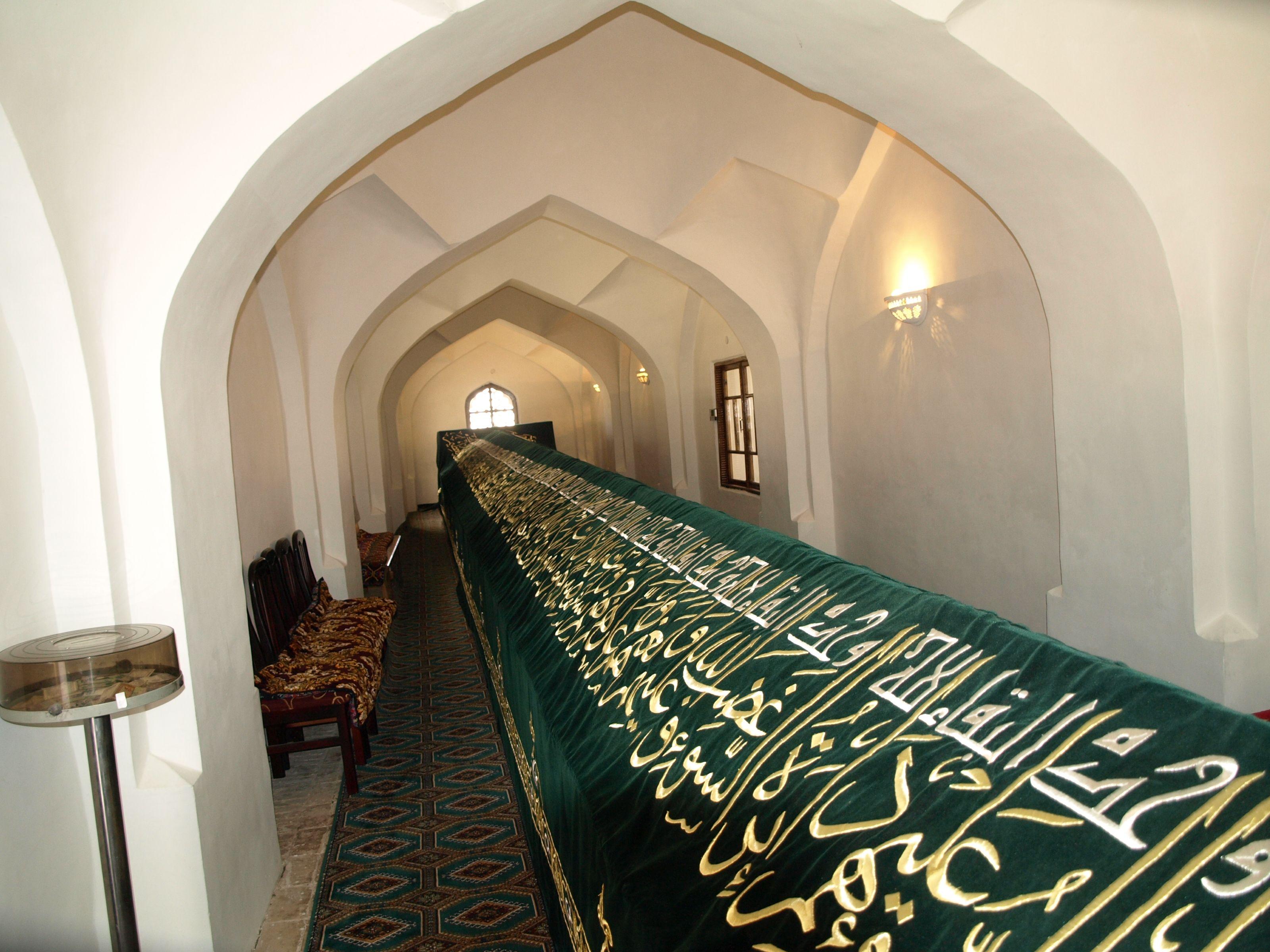
On the Afrosiyob hill, above the little Siab river, a long mausoleum with five domes covers an 18-metre sarcophagus. Local tradition holds that it is the tomb of the Prophet Daniel, and that Amir Timur brought his relics here from Susa in Persia. Historians treat the identification as a tradition rather than established fact. Muslims know the place as Khoja Doniyor, and Jews and Christians come here too. When Patriarch Alexy II visited in the 1990s he prayed at the tomb, and local people still tell of the old pistachio tree beside it that came back to life after his blessing.
For Orthodox pilgrims this is a moving stop, especially around 30 December (17 December Old Style), when the Church commemorates the Prophet Daniel and the Three Holy Youths. Remember that it is a working Muslim shrine. Pray quietly and personally, dress modestly, and women should cover their heads. There is also a spring below the mausoleum.
Bukhara, Kagan and the spring of Job
Bukhara has one Orthodox parish, the Church of the Archangel Michael, at 4 Karshi Darvoza Street. Its story is a small history of Russian Bukhara. Settlers built a wooden church here in 1860, and a brick church followed in 1875 to a sketch by the architect Alexander Benois; the authorities closed it in 1929. In 1994 the city gave the parish the former railway station building of "Old Bukhara", and it was consecrated as a church the following year. Some icons of the old iconostasis, saved by parishioners, are back in place. It is a small community, and its patronal feast is the Synaxis of the Archangel Michael, on 21 November.
Bukhara's railway station is actually in Kagan, the Russian railway town built in the 1880s, about 15 km away. Kagan has its own working Orthodox parish of St Nicholas, which you can visit on the way to or from the train.
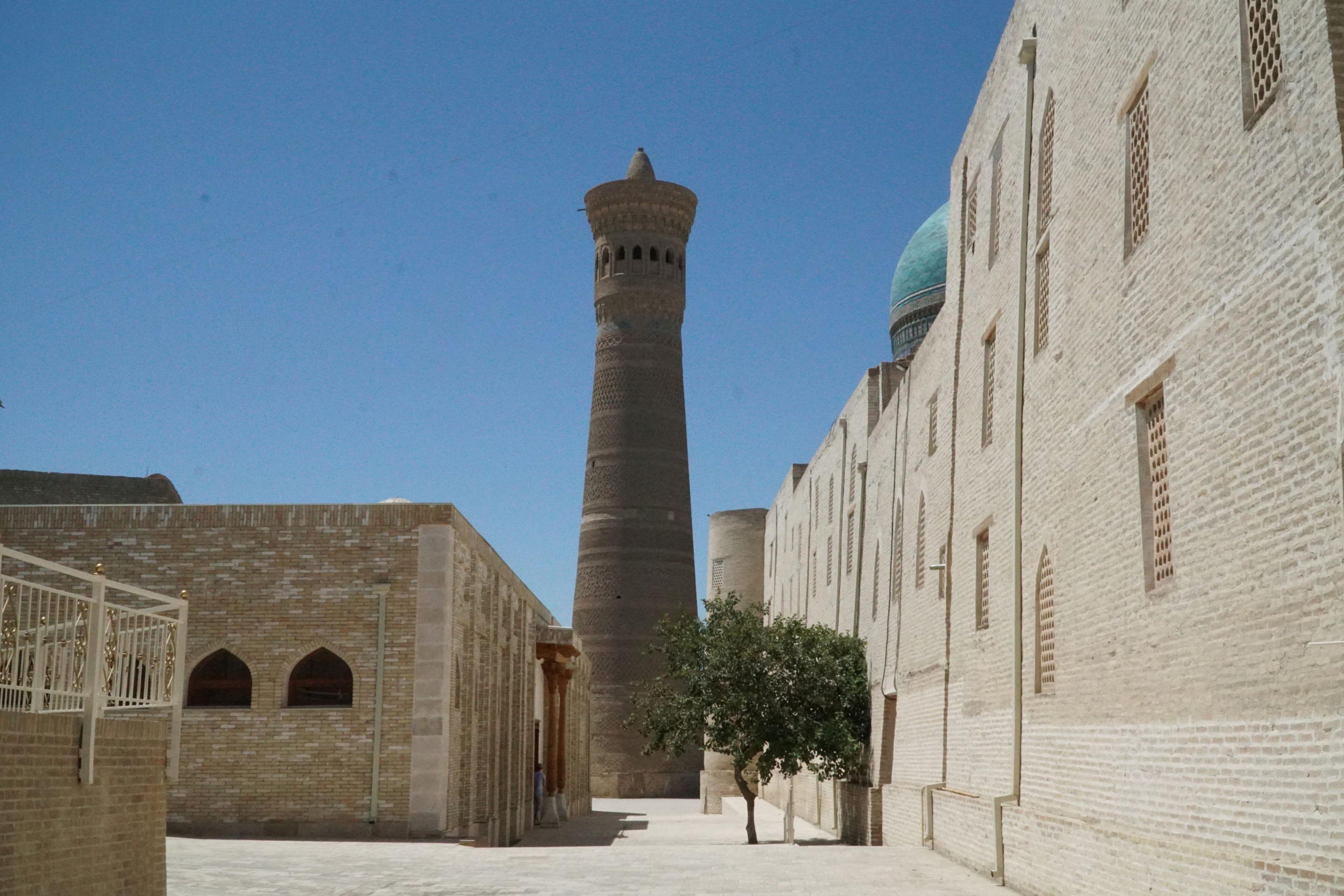
In the centre of Bukhara, near the Samanid Mausoleum, stands Chashma-Ayub, "Job's Spring". Legend says that the righteous Job struck the ground here with his staff and water appeared. The building, from the 12th to 14th centuries, now houses a small water museum. Christian visitors often stop here, as it fits naturally into a walk between the Samanid Mausoleum and the Ark.
Orthodox churches elsewhere in Uzbekistan
Outside the three main cities, Orthodox parishes are mostly modest post-war buildings. Most of the pre-revolutionary churches of the Fergana Valley, for example, were demolished in the 1930s. A few are still worth knowing about:
- Termez: St Alexander Nevsky, a garrison church built to the same standard design as the Samarkand cathedral
- Urgench, near Khiva: a church dedicated to the righteous Job the Long-Suffering, a rare dedication, with its feast on 19 May
- Fergana: the church of St Sergius of Radonezh; Kokand: the church of the Kazan Icon of the Mother of God
- Nukus: the church of St Panteleimon
- Dustabad, south of Tashkent: the Holy Protection Convent, restored and re-consecrated in 2020
If you are travelling through these regions, we can include a visit or help you find the service times.
Orthodox feast days in Uzbekistan: when to go
Every church has its patronal feast, when the community celebrates with a festal Liturgy and often a procession. These are the dates to plan around:
- Pascha: 2 May in 2027 and 16 April in 2028, with the night service at the Tashkent cathedral
- 25 February: St Alexis of Moscow, cathedral in Samarkand
- 6 May: St George, Samarkand parish
- 28 July: St Vladimir, Tashkent
- 28 August: Dormition of the Theotokos, cathedral in Tashkent
- 14 October: Protection of the Theotokos, Samarkand
- 21 November: Archangel Michael, Bukhara
- 6 December: St Alexander Nevsky, Tashkent
- 9 December: St George, Chirchik monastery
- 19 December: St Nicholas, Tashkent convent and Kagan
For weather, spring (April to early June) and autumn (mid-September to early November) are the most comfortable seasons. Pascha in spring and the feast of the Protection in October fit them well. The Dormition falls in the hot season, when Tashkent can reach 35 °C, but the festal service with the Metropolitan makes up for the heat. Our guides to the best time to visit and the weather by month have more detail.
Attending the Divine Liturgy: tips for pilgrims
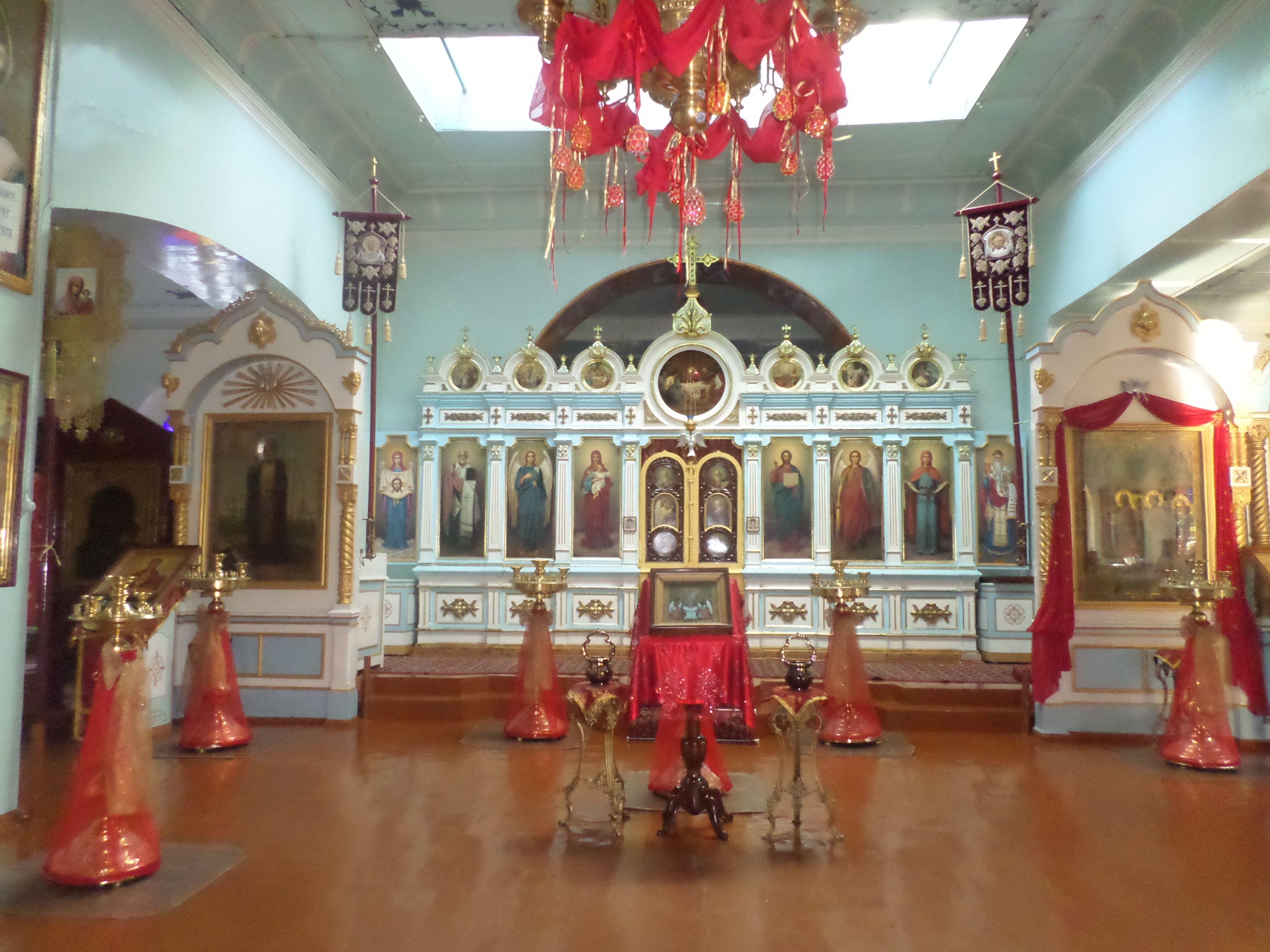
Visitors are welcome at services in every church listed here. You do not need permission to attend the Liturgy, light a candle or venerate an icon. A few practical points:
- Service times are not published reliably online. The Sunday Liturgy usually begins in the morning, typically around 8:00–9:00, and the All-Night Vigil on Saturday evening. Check locally the day before, or ask us to check.
- Dress as in any Russian church: women in a skirt or dress below the knee with a headscarf; men without hats, in long trousers and with covered shoulders.
- Candles and small icons are sold at the church shop (svechnaya lavka), usually in Uzbek som. Bring some cash.
- To order a moleben or a panikhida, or to submit names for commemoration, go to the church shop. A donation is customary.
- If you wish to receive Holy Communion, prepare as you would at home and speak to the priest at confession beforehand. Confession is heard in Russian.
- Do not take photographs during the service, and always ask before photographing inside a church.
- If a priest is travelling with your group and wishes to concelebrate, he needs the blessing of the ruling bishop, requested through the diocese in advance.
The same courtesy applies when you visit mosques and shrines on the same day. Our articles on culture and etiquette and on what to wear in Uzbekistan cover this in more detail.
A pilgrimage with TourEast
We have drafted a seven-day Orthodox pilgrimage through Tashkent, Samarkand and Bukhara, with the Sunday Liturgy at the Dormition Cathedral, the monastery in Chirchik, the Tomb of Daniel and the great Silk Road monuments. There are also one-day church excursions in Tashkent and in Samarkand. Our guides speak Russian or English, a meeting with a priest can be arranged on request, and we plan every visit around the service times.