One day in Khiva, hour by hour inside Ichan-Kala: empty streets at dawn, the Kunya-Ark, Juma Mosque and Tash-Hauli in the right light, how the combined ticket works, where to be at sunset and what to add with a second day.
Facts, prices and schedules checked on November 4, 2026
One day in Khiva is enough to see every major monument of Ichan-Kala, the walled inner town, because the whole place measures only about 26 hectares and you can cross it on foot in ten minutes. What one day cannot give you is a second chance at the light, so the order matters more here than anywhere else in Uzbekistan. This Khiva itinerary is the schedule we would suggest, hour by hour, with a ticket strategy and the best places to be at sunset.
It is the practical companion to two other guides. Our Ichan-Kala guide explains each monument in depth, and our Khiva travel guide covers getting there, the outer town of Dishan-Kala, Khorezm food and the desert fortresses. Here we tell you what to do when, and how to stretch it to two days.
Times below assume spring or autumn. See the section on seasons for summer and winter.
Is one day enough in Khiva?
- One day: enough for Ichan-Kala's main sights at a steady pace, with sunset from the walls or a watchtower. It works best if you sleep inside or just outside the walls, so that you have the early morning and the evening.
- Two days: our recommendation. Ichan-Kala without rushing, sunset and sunrise, plus Dishan-Kala, the Nurullabay Palace, the bazaar and the craft workshops.
- Three days: add the desert fortresses of Ayaz-Kala and Toprak-Kala in Karakalpakstan, a full day out by car.
The key word is overnight. A day trip that arrives at noon and leaves at five misses Khiva's two best moments: the empty streets at dawn and the walls glowing at sunset. Since the high-speed Jaloliddin Manguberdi train started running in May 2026, most travellers arrive by rail in the afternoon, which makes a two-night stay the natural shape. Our guide to Bukhara to Khiva compares the train, the road and flights via Urgench.
Getting your bearings in Ichan-Kala
Ichan-Kala is an oblong town inside clay walls, with four gates:
- Ota Darvoza, the west gate: the main entrance, with the ticket office and the statue of al-Khwarizmi outside. Kalta Minor and the Kunya-Ark are just inside.
- Palvan Darvoza, the east gate: next to the Tash-Hauli Palace, with the bazaar outside.
- Bakhcha Darvoza, the north gate: near the stretch of wall most often climbed at sunset.
- Tash Darvoza, the south gate: the quietest.
A single main street runs from the west gate to the east gate, past the Juma Mosque in the middle. Almost everything you will want to see lies within two or three minutes of that street. The Islam Khoja minaret, at about 57 metres the tallest structure in town, is visible from almost everywhere, so it is hard to get lost.
Two things to know before you start. The streets are public and you can walk them without a ticket, at any hour. And the monuments open later than the town wakes up: the streets are lovely from about 07:00, while ticket desks and museums typically open around 09:00. Use that gap.
The Ichan-Kala ticket: how it works and when to buy it
Ichan-Kala uses a combined ticket, sold at the ticket office by Ota Darvoza and usually at the other gates. As of November 2026:
- Price for foreign adults: recent reports range from 200,000 to 250,000 som, about US$16 to 20. The figure most often reported in 2025 and 2026 is 250,000 som.
- Included: most madrasahs and museums, among them the Kunya-Ark interior, the Juma Mosque, the Muhammad Rahim Khan Madrasah, Tash-Hauli and the small museums in the madrasah cells.
- Not included, paid on the spot: climbing the Islam Khoja minaret (reported at 100,000 to 150,000 som), the Ak-Sheikh Bobo watchtower in the Kunya-Ark (around 100,000 som), sections of the city wall, and a few rooms such as the inner chamber of the Pakhlavan Makhmud mausoleum.
- Validity: reports conflict. Some say the day of purchase, others two days or 48 hours from issue. Ask at the desk when you buy.
Our ticket strategy:
- If the ticket is valid for two days and you arrive in the afternoon, buy it on arrival and use it for an hour or two before sunset, then for the full day after.
- If it is valid for one day only, walk the streets on your arrival evening without a ticket and buy it the next morning.
- Choose one paid viewpoint, not all of them. The Ak-Sheikh Bobo watchtower gives the classic view over Kalta Minor; the Islam Khoja minaret is higher but dark, steep and narrow inside; the walls near the north gate are cheapest and best at sunset.
- Carry cash in som for the extras, in small notes. Card terminals exist but are not reliable at every door.
One day in Khiva: the morning, hour by hour
- 07:00 Walk in through Ota Darvoza while the streets are empty. Photograph Kalta Minor, the stubby tiled minaret, and the façade of the Muhammad Amin Khan Madrasah beside it, then walk the main street to the east gate and back. No ticket is needed yet.
- 08:00 Breakfast at your hotel or a café inside the walls.
- 09:00 Buy your ticket at the west gate as the desk opens. Go straight into the Kunya-Ark, the khans' fortress: the summer mosque lined with blue and white majolica, the old mint and the throne court with its round platform for the khan's yurt. Allow an hour.
- 10:00 Cross to the Muhammad Rahim Khan Madrasah, opposite the Ark gate, for its small museum of the last khans. Allow 20 to 30 minutes.
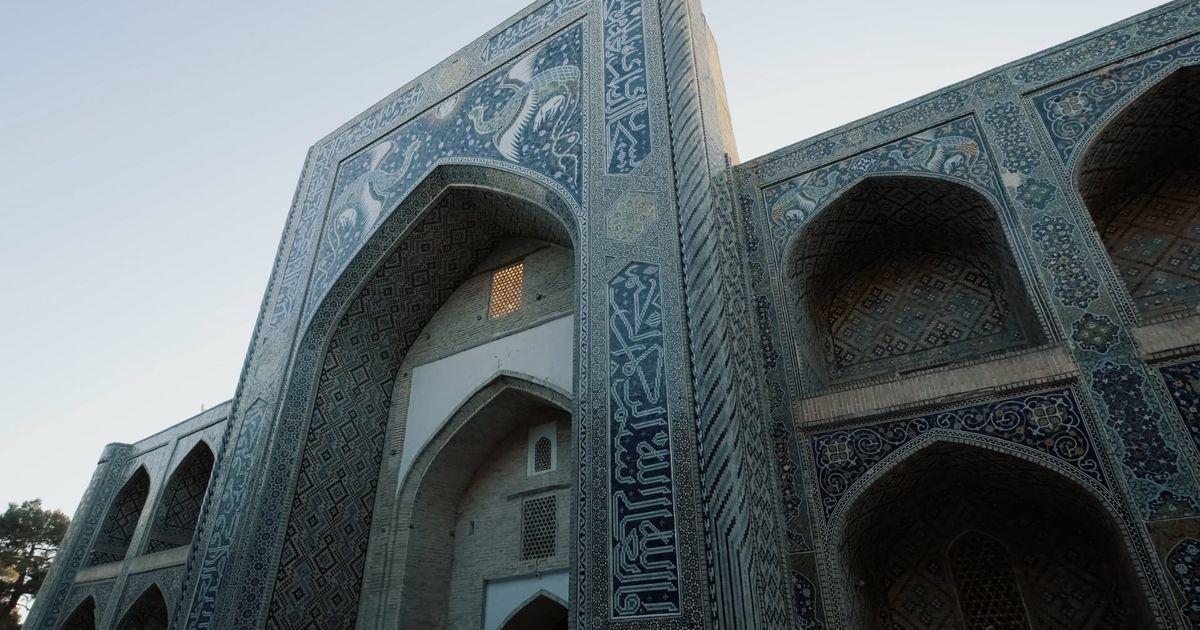
- 10:30 The Juma Mosque, halfway along the main street. Its forest of more than 200 carved wooden columns is cool even in summer, and the shafts of light from the roof openings are at their best in the late morning. Allow 30 to 45 minutes.
- 11:15 Tash-Hauli, the palace of Allakuli Khan near the east gate. Go now, because the light in the harem courtyard is best in the morning. Allow 45 minutes.
- 12:00 The Pakhlavan Makhmud mausoleum, Khiva's most revered shrine, with some of the finest tilework in the town. It is an active pilgrimage site, so dress modestly, take your shoes off where asked and keep your voice low.
- 13:00 Lunch on a terrace. Order shivit oshi, the green dill noodles, and tukhum barak, egg-filled dumplings found almost only in Khorezm.
One day in Khiva: afternoon, sunset and evening
- 14:00 Rest, especially from May to September. Khiva's afternoons are the hottest part of the day, and the clay walls hold the heat.
- 15:30 The Islam Khoja madrasah and its museum of applied arts. If you have chosen the minaret as your viewpoint, climb it now, while you have the energy; the stairs are steep and unlit.
- 16:15 Wander the lanes south of the main street, where families live in courtyard houses. Look into the workshops for carpets, suzani embroidery and wood carving, the craft that made Khiva's columns and doors.
- 17:00 Walk out of Palvan Darvoza to see the domed passage of the east gate, the Allakuli Khan Madrasah and the bazaar outside, which is livelier in the morning but still trading.
- Sunset minus 45 minutes: head to your chosen viewpoint (see the next section).
- After sunset: walk the main street from east to west. The monuments are floodlit, the day groups have gone and the town returns to its residents.
- 20:00 Dinner inside the walls, then a last look at Kalta Minor lit against the night sky from outside Ota Darvoza.
If you are leaving on the morning train the next day, you still have time for one more walk at 06:30 before checking out. The northbound high-speed train leaves Khiva at about 07:10, and the station is only about 1.5 km from the walls.
Where to be at sunset in Khiva
Sunset is the defining moment of a Khiva day. The mud-brick walls turn gold, then rose, and the turquoise minarets glow against a darkening sky. Your options:
- The city walls near Bakhcha Darvoza, the north gate: a stretch of wall can be climbed for a small fee, giving a long view along the crenellations with the minarets behind. This is the classic sunset spot. In high season, arrive 30 to 45 minutes before sunset to find space.
- The Ak-Sheikh Bobo watchtower in the Kunya-Ark: the best panorama over Kalta Minor and the domes. In summer it often closes before sunset, so check the closing time in the morning; if it shuts early, go in the late afternoon instead, when the light is already warm.
- A rooftop terrace: several cafés and hotels along the main street face Kalta Minor or the Islam Khoja minaret. Buy tea or dinner and stay for the light. Easiest with older travellers or children.
- Outside the west gate: from the ground, the walls lit from the side by the setting sun make the best photograph of Khiva at eye level.
Roughly when is sunset? Khiva sits far west in Uzbekistan's single time zone, so the sun sets later than in Tashkent: around 20:20 to 20:30 in June and July, about 19:00 in late September and March, and around 17:30 to 17:40 in December. Check a sunset app on the day.
Khiva in two days: what to add
The most common two-day pattern now is arrival by the high-speed train in the afternoon, a full day, and departure on the following morning. That gives you two sunsets and two dawns.
Arrival day:
- Mid-afternoon: arrive at Khiva station, check in and drop your bags.
- Late afternoon: walk Ichan-Kala without a ticket, or buy one if it is valid for two days, and see the Kunya-Ark.
- Sunset: the north walls or a rooftop terrace.
- Evening: dinner and the floodlit main street.
Full day: the one-day plan above at a gentler pace, with time to add:
- Dishan-Kala, the outer town, enclosed by its own wall in 1842: family houses, small mosques and workshops, where Khiva lives.
- The Nurullabay Palace, a few minutes' walk north of Ichan-Kala, built in the early 20th century for Isfandiyar Khan, with Khivan carving alongside European stoves and chandeliers. Ask whether entry is included in your Ichan-Kala ticket.
- The bazaar by the east gate in the morning, for bread, dried fruit and local life.
- A long Khorezm lunch, or a cooking session if you can arrange one.
With a third day, drive to the desert fortresses of Ayaz-Kala and Toprak-Kala, about one and a half to two hours away, or stay overnight in the yurt camp below Ayaz-Kala. Our guide to the Khorezm desert fortresses explains the route.
Fitting the day around trains and flights
- From Tashkent, Samarkand or Bukhara by high-speed train: the Jaloliddin Manguberdi train leaves Tashkent at about 07:00 and reaches Khiva in the mid-afternoon, about seven and a half hours later; from Bukhara the ride takes about three and a half hours. Frequency has been changing since the line opened, so check the live timetable on the Uzbekistan Railways site and book early.
- By overnight train: slower trains to Khiva and Urgench arrive in the early morning, which gives you a full day, though you may be tired.
- By air via Urgench: flights from Tashkent take about an hour and a half, and Urgench airport is 35 to 40 km away, a 40 to 50 minute drive. An early flight puts you in Ichan-Kala by mid-morning.
- By road from Bukhara: six to seven hours across the Kyzylkum, so you arrive late in the day.
Leaving the same day? If you have only the hours between a morning arrival and an evening departure, follow the morning plan, skip the afternoon rest and settle for a late-afternoon view from the Ak-Sheikh Bobo watchtower rather than sunset.
Adjusting for summer, winter and Ramadan
- Summer (June to August): temperatures in Khorezm regularly pass 40°C. Start at 07:00, finish the outdoor monuments by 12:00, rest until 16:30, and save the walls for the last hour of light. Carry water and a hat.
- Spring (April to early June) and autumn (September to October): the best seasons, and the plan works as written.
- Winter (November to March): cold, sometimes below freezing, but sunny and almost empty of visitors. Museums typically close earlier, sunset comes at about 17:30, and some rooftop cafés close for the season. Start at 09:00 and move the sunset viewpoint to about 16:45.
- Ramadan and Fridays: the Juma Mosque and the Pakhlavan Makhmud mausoleum are religious sites; avoid Friday midday prayers. During Ramadan some cafés open only after sunset.
Our weather by month guide has temperatures for every region.
What a day in Khiva costs
Typical costs per person as of November 2026:
- Ichan-Kala combined ticket: 200,000 to 250,000 som
- One paid viewpoint: about 100,000 to 150,000 som for the watchtower or the minaret, less for the walls
- Small extras such as the Pakhlavan Makhmud inner chamber: tens of thousands of som
- Lunch and dinner in Ichan-Kala's terrace restaurants: from about 100,000 to 250,000 som each, more for tasting menus
In total, allow about 400,000 to 700,000 som, roughly US$35 to 60, for a full day, excluding your room. Prices have risen quickly in the last two years and are rarely published officially, so check at the ticket office. Our money guide explains cash, cards and ATMs, and our Uzbekistan travel cost guide puts these figures in context.
Planning Khiva with TourEast
Khiva rewards good timing, and our local guides know when each courtyard is quiet and which viewpoint is open at sunset. We can arrange train tickets, transfers and a guide for Ichan-Kala, add the desert fortresses, and fit Khiva into a small-group tour or a private itinerary across Uzbekistan.