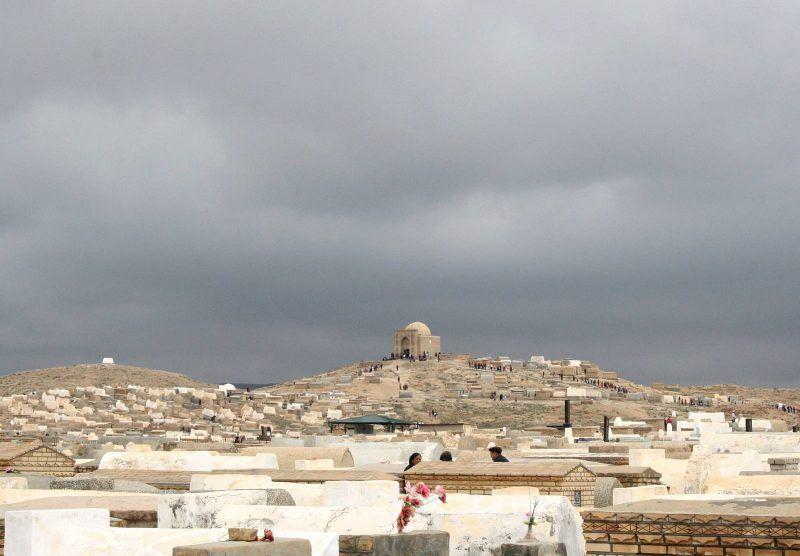
On the dark Sultan Uvays ridge above the Amu Darya, between Nukus and Khiva, stands the most visited shrine of Khorezm: a symbolic tomb of Uwais al-Qarani, a 7th-century Yemeni ascetic, with a sacred fish pond, a hilltop grave visited first, and a cemetery that fills on Thursdays. Legends, buildings, etiquette and how to fit it between the fortresses and the deer forest.
Facts, prices and schedules checked on November 11, 2026
The road from Nukus to Khiva is mostly flat and pale, cotton and desert, until the Sultan Uvays range rises on the left: a low ridge of dark, bare rock, almost black against the sky, running for 60 km along the right bank of the Amu Darya. On its southern slope, about 35 km from the town of Beruniy, is the shrine of Sultan Uvays-bobo, the most visited holy place in Khorezm and Karakalpakstan and one of the great pilgrimage sites of Central Asia that almost no foreign itinerary includes.
It is worth including. The shrine is a symbolic tomb of Uwais al-Qarani, a Yemeni of the Prophet's own generation, built and rebuilt from the 17th century to the present; it has a sacred pond where pilgrims feed fish they will never eat, a hilltop grave that custom says must be visited first, and a hillside cemetery of thousands of graves. On a Thursday it has the atmosphere of a fair. The same stretch of mountain holds Khorezm's most elegant unrestored fortress and the last stronghold of the Bukhara deer, so a day here does three things at once.
Who Uwais al-Qarani was, and why his tomb is here
Uwais ibn Amir al-Qarani was born in the village of Qaran in Yemen around 594 and died in 657, a contemporary of the Prophet Muhammad who, in the tradition, never met him: he stayed in Yemen to care for his blind mother. A hadith has the Prophet speak of him as the best of the generation after the Companions, and later Sufis made him the model of devotion at a distance, the disciple who follows a master he has never seen. He was killed at the battle of Siffin, and his accepted grave is in Syria.
So the mountain in Karakalpakstan holds no body. It holds a memory. Local tradition says Uwais's followers brought his veneration to Khorezm, and that the first monument stood here under the Khorezmshahs before the Mongol invasion destroyed it. A symbolic tomb was raised in the 17th century; in the 19th the Khiva khans Eltuzar and Allakuli built a large mosque and cells for pilgrims. The entrance was renovated in 2002 and the whole complex has been restored again in recent years. Khorezm, remember, is the land of al-Biruni and al-Khwarizmi; Beruniy town, 25 km away, is named after the scientist. The region has always built shrines to people who mattered to it whether or not they were buried in its soil.
The legend of the teeth and the black stones
Every pilgrim will tell you the story, and it should be told as a legend. When Uwais heard that the Prophet had lost a tooth at the battle of Uhud, he did not know which tooth it was, and so, in solidarity, he knocked out all of his own. The teeth fell on the mountain, and the black stones of the Sultan Uvays ridge are those teeth. A second version says he fasted here for forty days and prayed for the Muslims, and that is when the teeth were lost. The mountain 2 to 3 km from the shrine is pointed out as the place.
The geology is older than Islam by some hundreds of millions of years, but the story explains why the whole ridge is considered sacred, why pilgrims pick up small dark stones as keepsakes, and why the name has settled on the mountains themselves: the range is called Sultanuizdag, the mountain of Sultan Uvays, on every map.
What you see on the hillside
The complex is a rectangle of burnt brick about 21 by 53 metres in the Khorezm style, oriented north to south, with the entrance from the west. The symbolic tomb, behind a wooden screen, stands on the north side of the courtyard; the mosque, a veranda and the pilgrims' rooms are on the south. Around it, over the centuries, have grown domed tombs of later sheikhs, kitchens for the sacrificial meals, a hotel, canteens and stalls selling prayer beads, incense and bread. At the entrance is the pool: a large rectangular basin fed by underground springs, full of fish that are never eaten. Dead fish are buried with a small ceremony. Pilgrims drink from the pool, feed the fish and wash their faces, and this, more than the tomb itself, is the ritual heart of the visit.
On the hilltop above is the tomb of Chinor-bobo, described variously as Uwais's mentor, his muezzin or his barber; the ethnographer Gleb Snesarev, who studied Khorezm's shrines in the Soviet period, considered him a mythical figure. Custom says you climb to Chinor-bobo first, then come down to Sultan Uvays. From the hilltop the view runs across the cemetery, with its rows of tombstones on the slopes, to the river and the green line of the tugai forest beyond.
A dry channel once carried spring water down from a point where, tradition says, it flowed from beneath the foot of a buried saint; along it pilgrims have built little cairns of stones, obo, as prayers for children.
Pilgrims, Thursdays and etiquette
People come from across Karakalpakstan, Khorezm and the Turkmen side of the river, and in growing numbers from Kazakhstan. Most come to ask for something, usually a child or a cure, and many bring a sheep to sacrifice and share; the kitchens by the entrance cook for anyone present. Thursday afternoon and Friday are the busy days, as at every shrine in Uzbekistan, and the days around Eid and Navruz turn the hillside into a festival with mats on the ground, tea and plov. If you want to see ziyarat as a living practice, come on a Thursday; if you want the mountain to yourself, come on a Tuesday morning.
The rules are the usual ones. Dress modestly; women cover their hair at the tomb and mosque. Remove shoes where carpets begin. Walk clockwise if you join the circuit of the tomb. Do not photograph people praying, and ask before photographing anyone; the elderly pilgrims here are not used to cameras. Accept tea or bread if it is offered, and leave a donation in the box; 10,000 to 20,000 som is normal, more if you have eaten. Non-Muslim visitors are welcome and will be treated with curiosity rather than suspicion; a guide who speaks Karakalpak or Uzbek makes the visit far richer.
Jampyk-kala and Badai-Tugai: the rest of the mountain
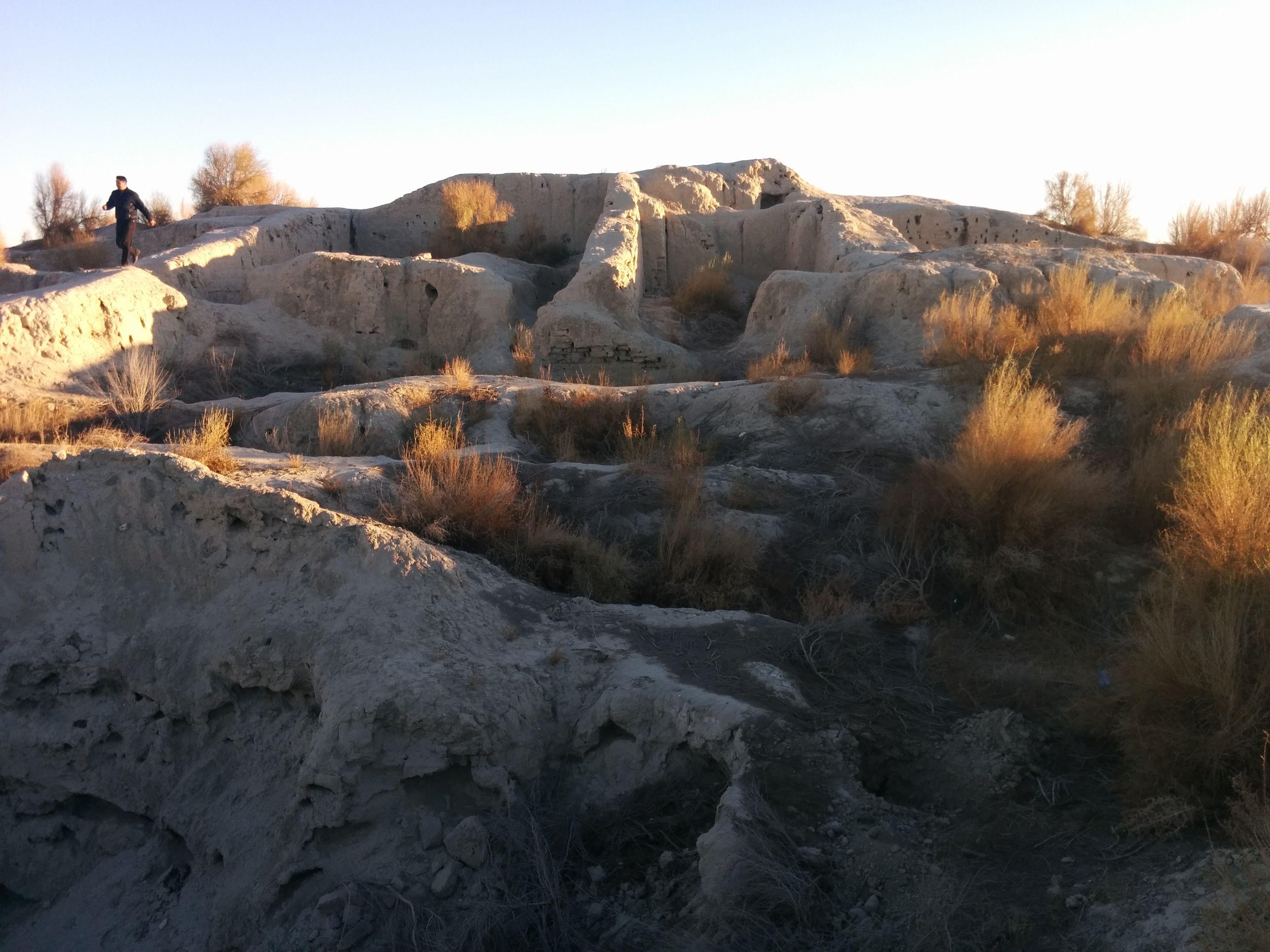
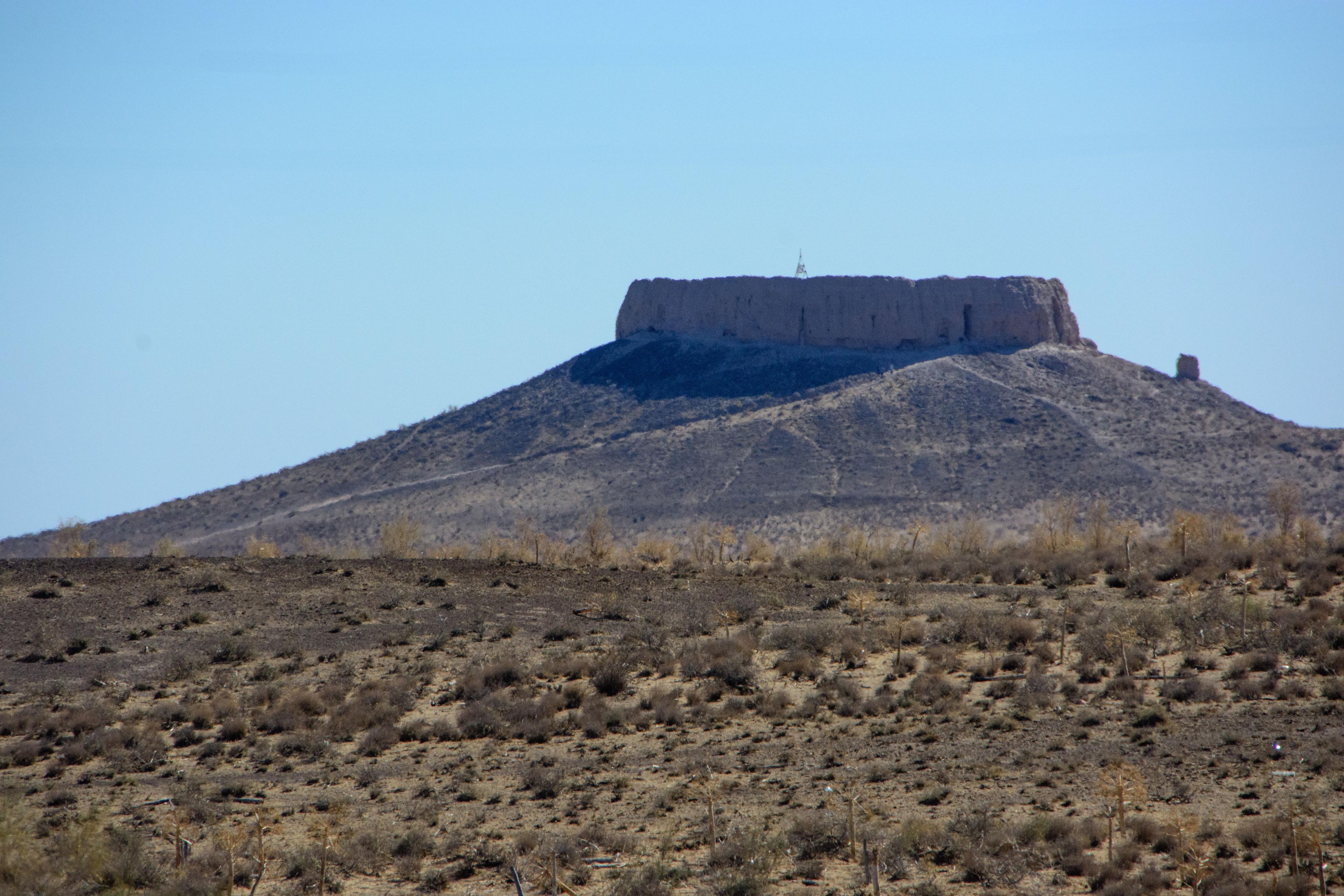
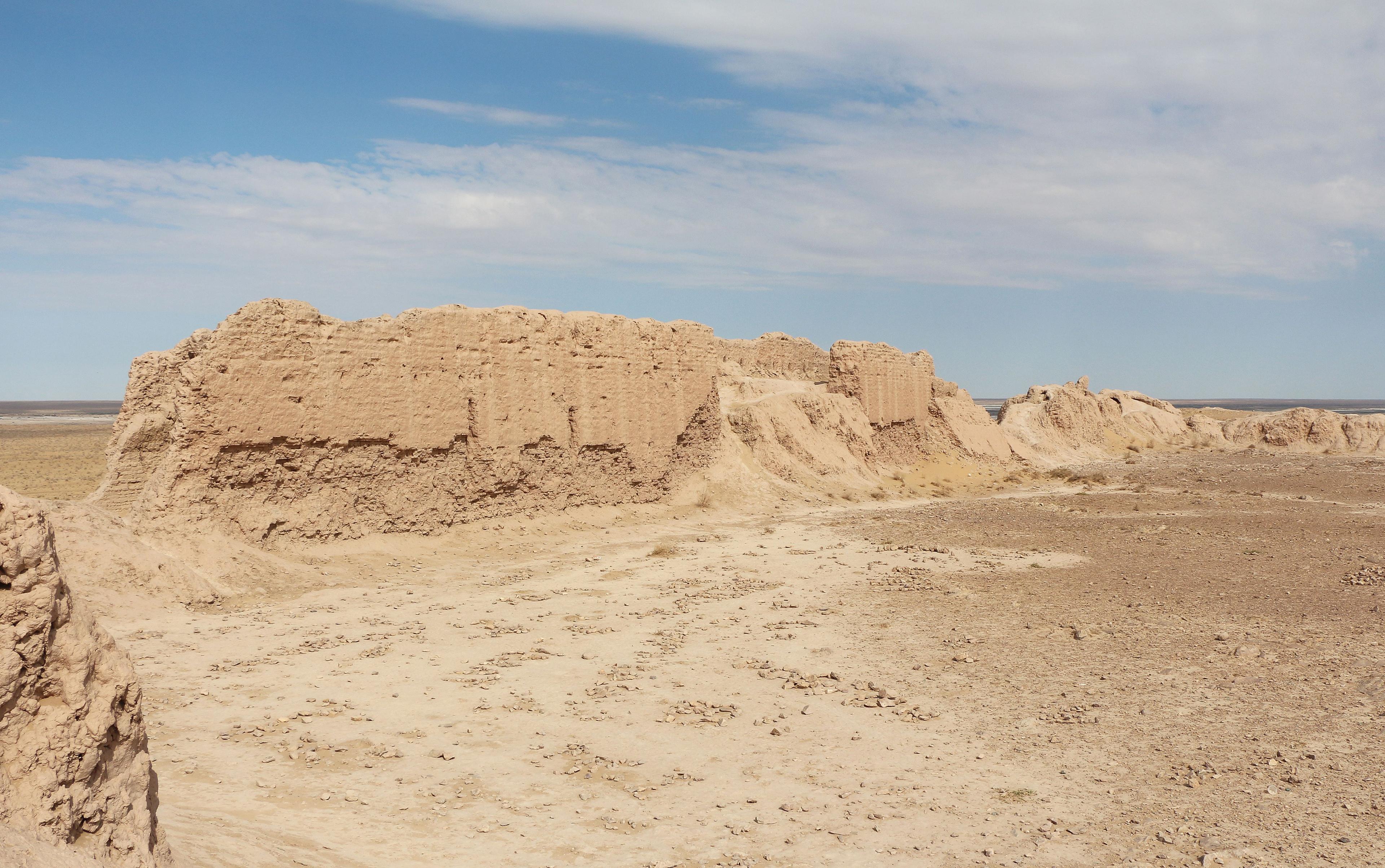
Along the foot of the same ridge, towards the river and about 50 km from Nukus, stands Jampyk-kala, the fortress that the archaeologist Sergei Tolstov called the most beautiful in Khorezm. A settlement existed here from the 4th century BC, but the walls you see, with closely set towers and corrugated faces, belong to the 9th to 13th centuries, when it was a river port trading with the Volga and the Caucasus. It has never been restored, which is its charm: at sunset the clay turns orange against the black hills, and you will almost certainly be alone.
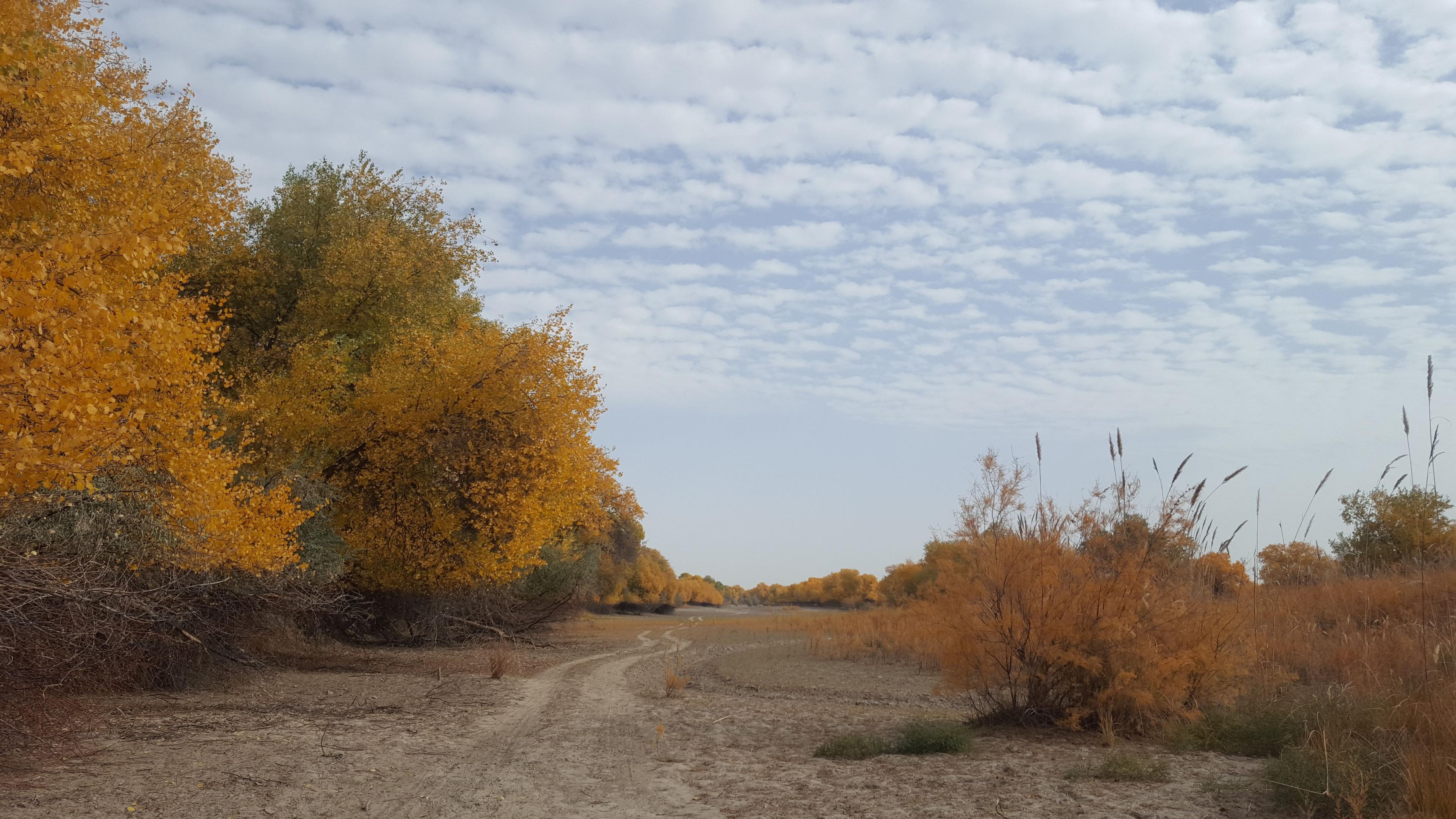
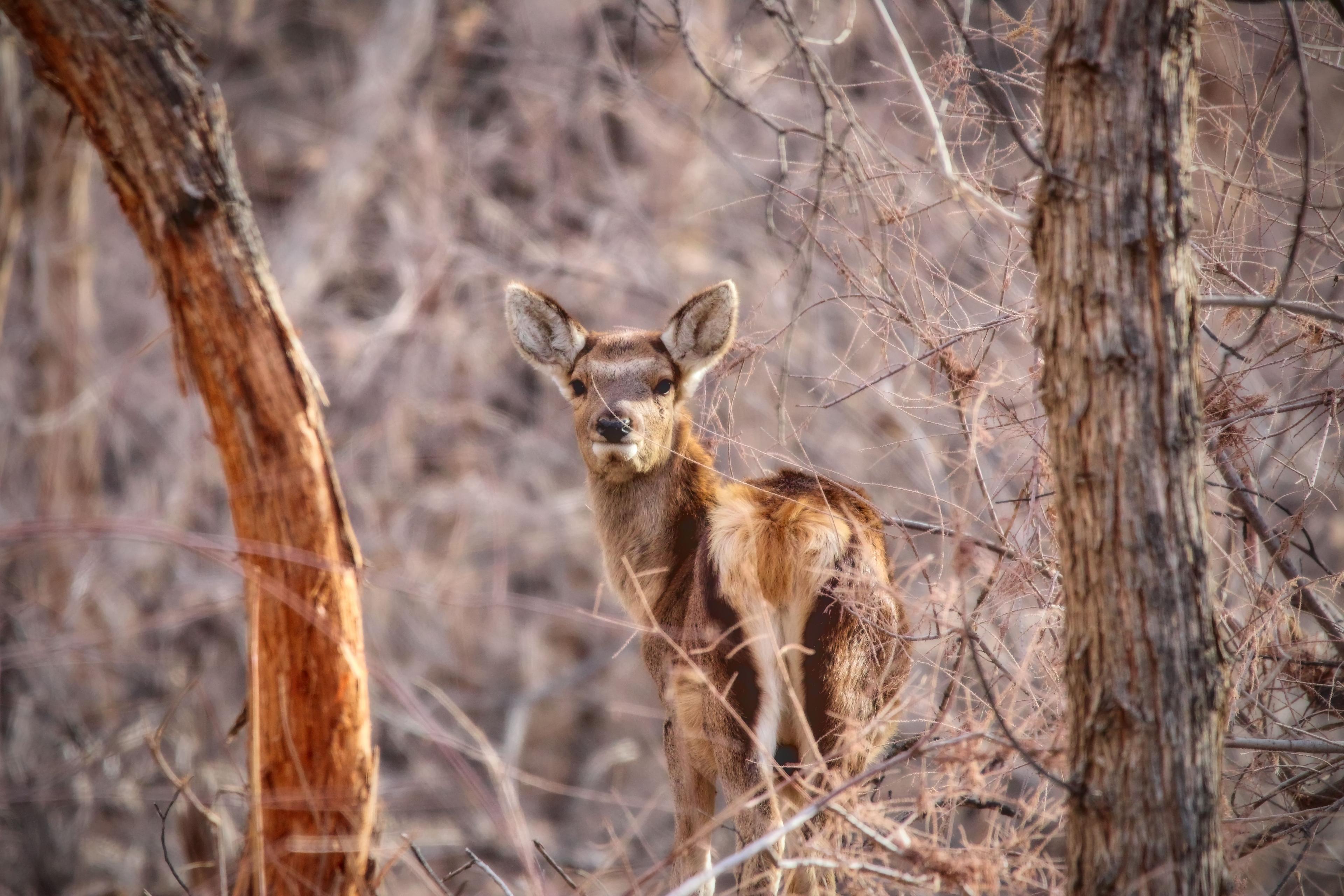
Beside the fortress, on the river, is Badai-Tugai, a reserve founded in 1971 to protect about 6,400 hectares of tugai, the dense poplar, tamarisk and reed forest that once lined the whole Amu Darya. Since 2011 it has been the core of the Lower Amu Darya Biosphere Reserve. Bukhara deer, reintroduced in the 1970s, now number around two thousand here, the largest population anywhere, and the forest shelters jungle cat, pheasant and wild boar. Entry is with a permit and a ranger; there is a small museum and a short walking route, and dawn or dusk give the best chance of deer at the forest edge. Ask us to arrange the permit in advance, since the reserve office keeps working hours.
How to get there, when and what it costs
The shrine lies in the Beruniy district of Karakalpakstan on the southern side of the Sultan Uvays range: about 60 to 70 km from Nukus (1 to 1.5 hours by car), about 60 km from Khiva and Urgench (1.5 hours), and 25 to 35 km from Beruniy town. There is no public transport to the gate; a taxi from Beruniy is possible, but a car with driver for the day from Nukus or Khiva is the practical answer and costs roughly US$50 to 80 in 2026 depending on the vehicle and stops. The last kilometres to Jampyk-kala and the reserve are dirt tracks; a 4x4 is not essential in dry weather.
The shrine is open from early morning to evening every day; entry is free. The reserve charges a permit and guide fee, payable on site; ask for the current figure. March to May and September to November are the pleasant months; July and August exceed 40°C on the bare hillside and the walk to Chinor-bobo is best done before 09:00.
A sensible day from Nukus: Chilpik, the Zoroastrian tower of silence, at sunrise; Badai-Tugai and Jampyk-kala in the morning; Sultan Uvays-bobo around midday with lunch at the pilgrims' canteen; then on to Ayaz-Kala and Toprak-Kala or straight to Khiva. From a Khiva base run it in reverse and keep Jampyk-kala for the sunset light.
Visiting with TourEast
Sultan Uvays-bobo sits on the one road every Karakalpakstan trip has to drive, between the Savitsky Museum in Nukus and the walls of Khiva, and although it is not a fixed stop on our programmes, we can add it on request to Edge of the Map, our seven-day desert fortresses and Aral Sea route, with Jampyk-kala and the deer forest on the same day, or to any private route between Nukus and Khiva. For Muslim travellers we can build it into a private ziyarat itinerary that pairs Khorezm with the Seven Pirs of Bukhara, timed for a Thursday if you want the full pilgrimage atmosphere. Tell us which way you are travelling and we will set the order.
Frequently asked questions
Photo gallery
Photo: My cardio / Wikimedia Commons, CC BY-SA 4.0; Givte / Wikimedia Commons, CC BY-SA 4.0; Bruce Allardice / Wikimedia Commons, CC BY-SA 2.0; Bernard Gagnon (Bgag) / Wikimedia Commons, CC0; Ymblanter / Wikimedia Commons, CC BY-SA 4.0