Hundreds of mosaic panels by the Zharsky brothers and others, the cosmonaut medallions of Kosmonavtlar station, and the 375-metre TV Tower with the Japanese Garden beside it: who made Tashkent's monumental art, how it was saved and how to see it in half a day.
Facts, prices and schedules checked on November 11, 2026
Tashkent's best art gallery has no doors. It runs along the end walls of nine-storey apartment blocks, over the entrances of institutes and sports halls, and down the platforms of the metro: hundreds of mosaic panels laid between the late 1960s and the 1990s, when a city flattened by the 1966 earthquake was rebuilt at speed and its builders decided that concrete alone was not enough. Above it all, at the northern end of Amir Temur Avenue, rises the 375-metre steel needle of the TV Tower, the last great monument of that rebuilding.
Here is that layer of the city: who made the mosaics, what they show, how they nearly disappeared and how to find them, followed by a practical half day at the TV Tower and the Japanese Garden beside it. It is deliberately not about the buildings themselves; for the ten structures inscribed by UNESCO in 2026 see our Tashkent modernism guide, and for fares and station-hopping see the Tashkent Metro guide.
Why a city of concrete got its mosaics
After the earthquake of 26 April 1966, Tashkent was rebuilt with prefabricated housing blocks raised by construction brigades from across the Soviet Union. Prefabrication was fast and earthquake-safe, and also relentlessly identical. Monumental art was the official answer: a share of a building's budget could go to decoration, and blank gable walls were ideal canvases. As the city's own mosaic project puts it, the aim was to give people something more than just new buildings.
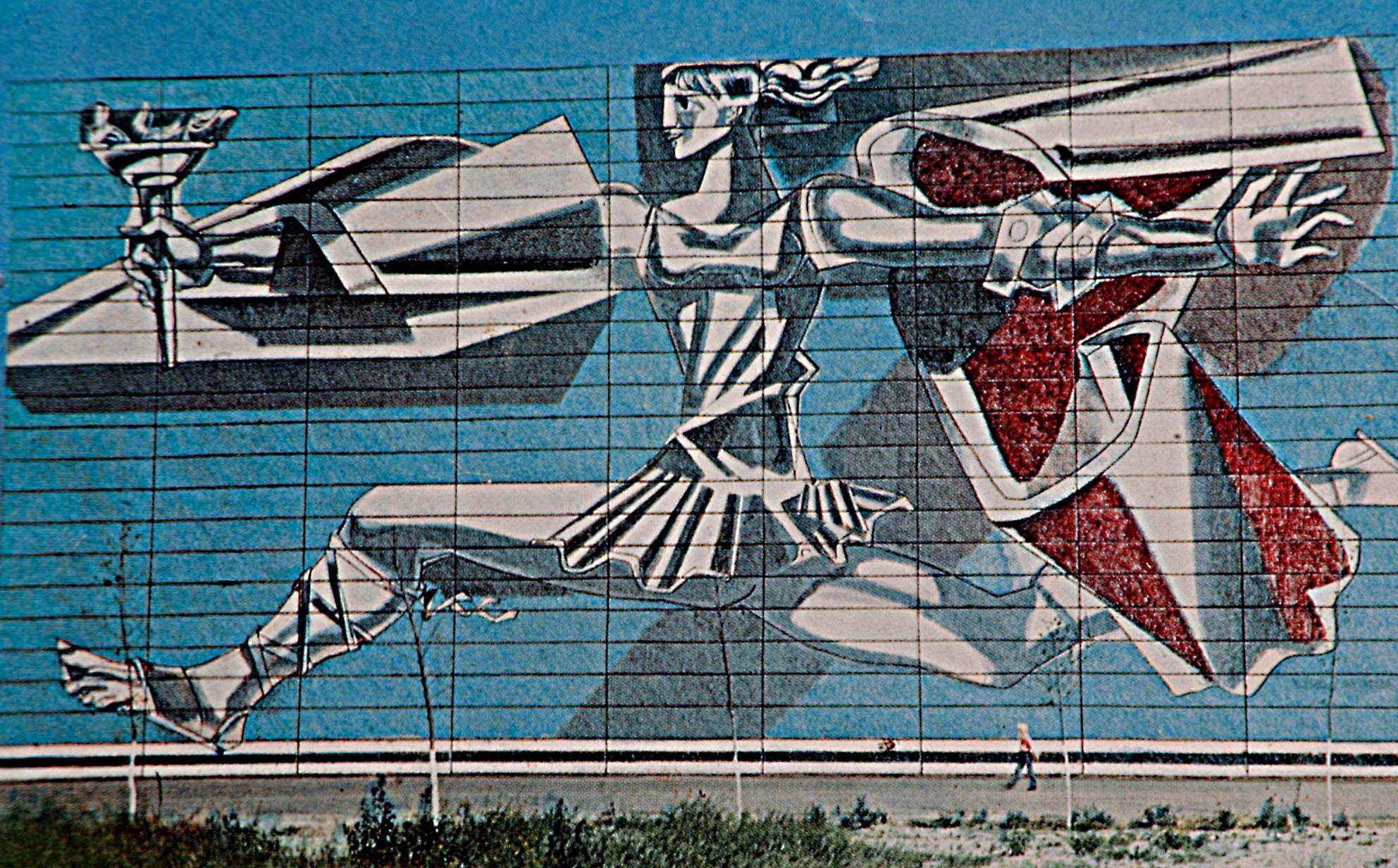
The artists came from Uzbekistan and from all over the Union, many of them from Ukraine. The subjects range from the expected (cotton, wheat, a young couple, a woman irrigation engineer, workers and cosmonauts) to the much more interesting: scenes from Persian and Uzbek poetry, medieval scholars, fairy tales, Navruz, and a great deal of pure pattern drawn from Central Asian ornament. That last point explains why so many survived independence when Soviet statues did not. A geometric panel or a portrait of a poet offends no one.
The Zharsky brothers: the hand behind Tashkent's walls
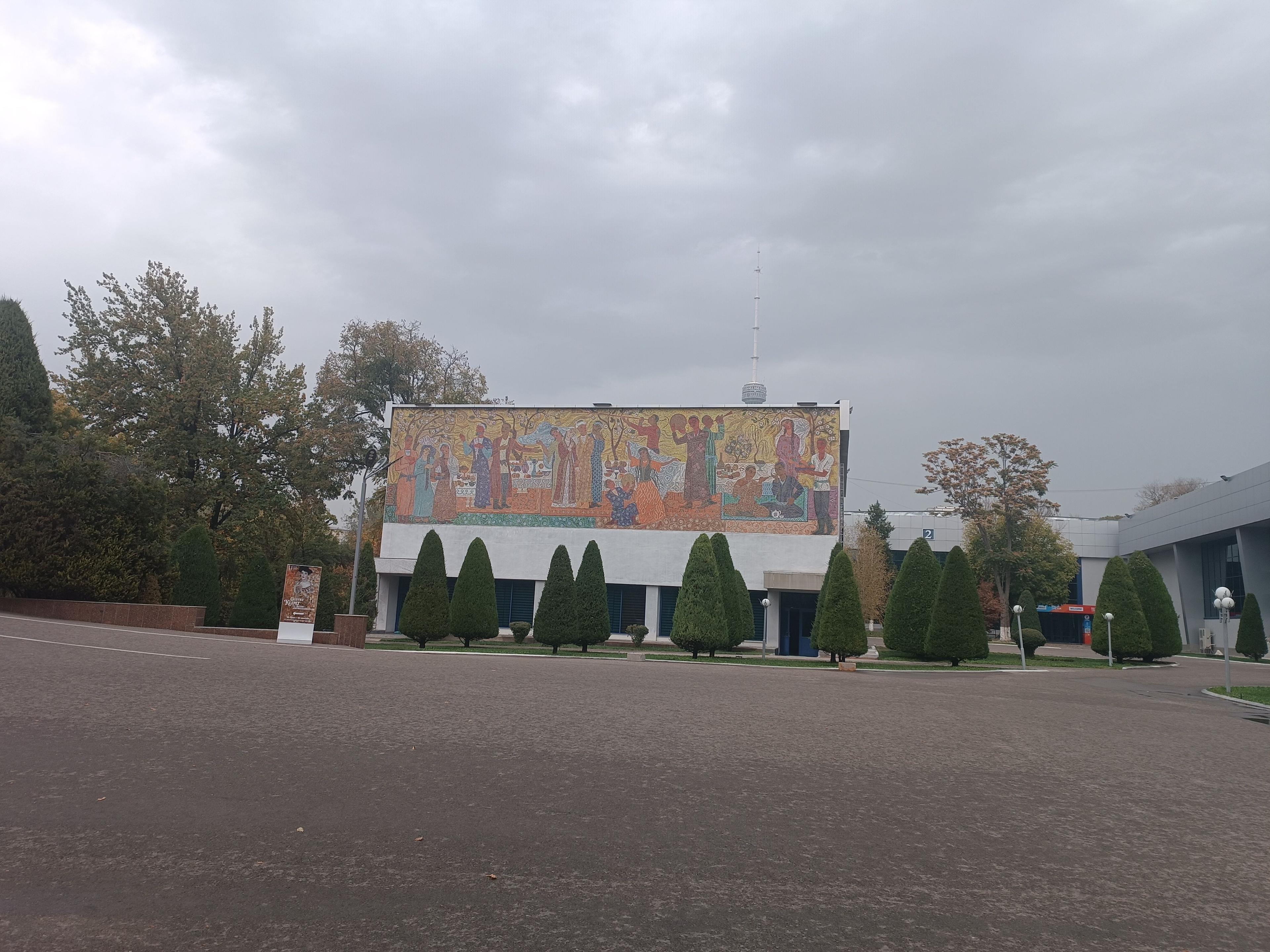
The names to know are Pyotr, Nikolai and Alexander Zharsky (also spelled Jarsky). Working in Tashkent from the end of the 1960s until the end of the 1990s, the brothers designed and laid hundreds of panels, most of them on residential buildings; counts range from about 240 to more than 400 depending on how they are attributed. Their method began with small sketches scaled up to full size; in one technique, coloured tiles were pressed by hand into soft concrete poured into a steel mould, producing panels that could be mounted like any other prefabricated element.
A good example stands on Babur Street in Yakkasaray: a 1974 apartment block by the architects Andrey Kosinsky, Yury Miroshnichenko and Alexander Dizik, whose end wall carries a Zharsky portrait of a medieval scholar holding the tree of life, with a planet overhead and water flowing below. Nobody quite agrees whether it is Ulugh Beg or al-Biruni, which is itself a good conversation with your guide. The German architect and publisher Philipp Meuser has documented the family's work in a book published in English as *Patterned Panels: Mosaic Façades by the Jarsky Brothers in Soviet and Uzbek Tashkent 1969–1999*, the first serious record of their lives and panels.
They were not alone. Leonid Polishchuk and Svetlana Shcherbinina, a Moscow pair who worked across the Soviet Union, made a large work titled *The History of Human Culture* for Tashkent's House of Knowledge in 1968, and further panels in the city are credited to them.
Nearly lost, now protected
For thirty years after independence the mosaics were nobody's responsibility. Some were painted over during facade repairs, some demolished with their buildings, and many disappeared behind advertising banners. The turn came in 2021, when a public campaign, backed by the Uzbekistan Art and Culture Development Foundation and city officials, began uncovering them.
On 25 March 2024 the Cabinet of Ministers added 157 mosaic panels to the national list of monumental art, 117 of them in Tashkent, mostly in the Olmazor and Shaykhontokhur districts. Over the following months the banners came down from some 70 apartment buildings. In April 2024 the city's Department for Digital Development launched the Mosaics of Tashkent website, mosaic.tashkent.uz, with photographs and information on about 390 mosaics, including 15 already lost. In May 2025 three panels by Nikolai Zharsky, painted over in 2021, were cleaned and returned to view. Protection is not universal: in August 2026 the Cultural Heritage Agency announced that mosaics on a 1972 former tuberculosis dispensary in Yunusabad would be dismantled and moved before the building's demolition.
How to hunt mosaics: a few rules
There is no single mosaic district, which is part of the pleasure. A few practical notes:
- Use the map. The Mosaics of Tashkent site lets you browse by area; pick three or four panels close together and take a Yandex Go taxi between clusters.
- Look at the gables. Most panels sit on the narrow end walls of housing blocks, best seen from across the street or from the courtyard.
- Go early or late. Glazed tiles flare in midday sun; morning and late-afternoon light brings out the colour.
- These are homes. Residents are used to photographers but not to drones; flying one in the city needs a permit, so do not.
- Combine with the metro. Several stations continue the same tradition underground.
A private guide who knows the panels can turn an hour of driving into a coherent story, and will know which ones have recently been cleaned or are under scaffolding.
Underground: Kosmonavtlar and the metro panels
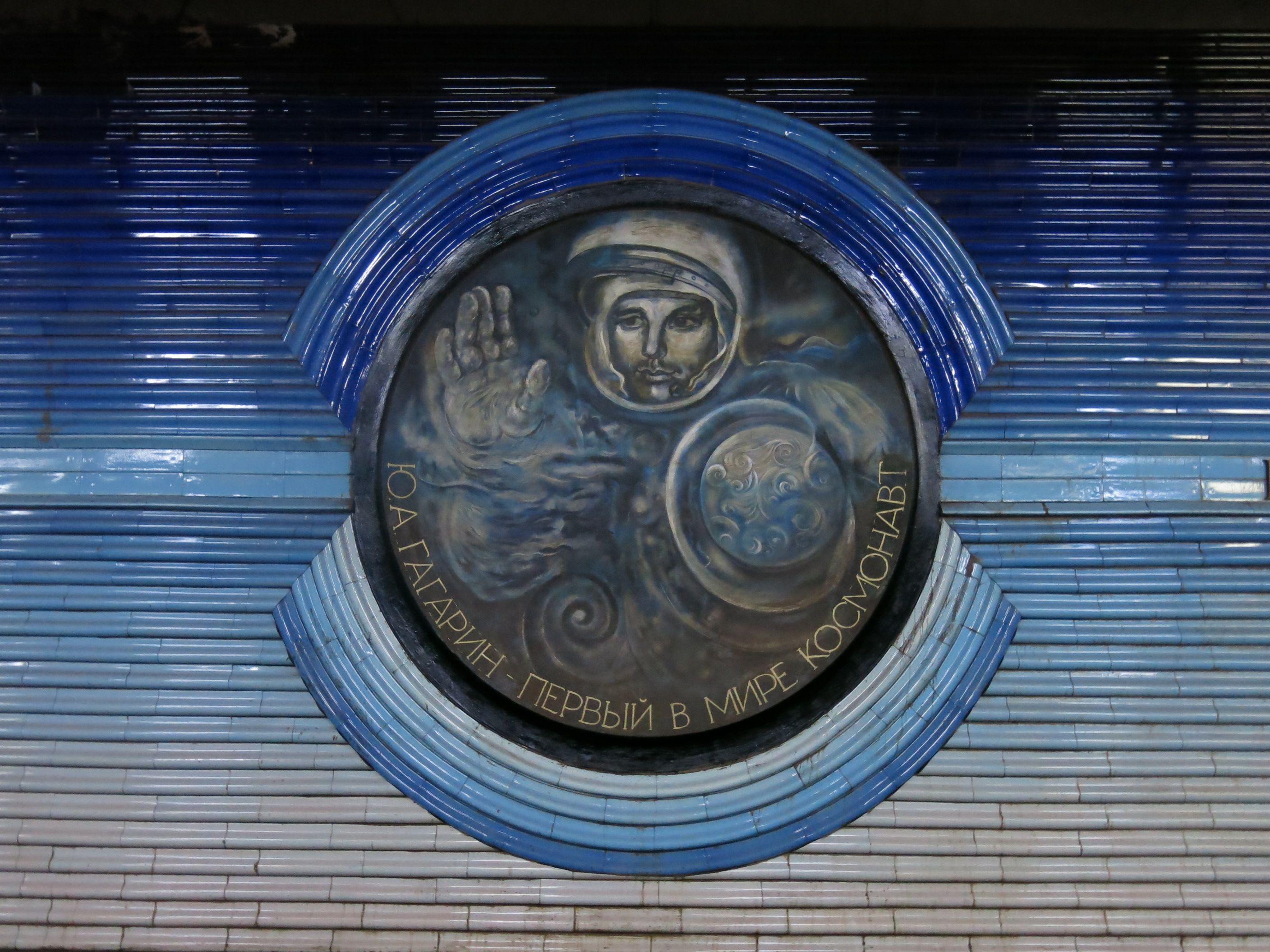
The metro is where monumental art was given the biggest budget, and our Tashkent Metro page covers the network as a sight. For mosaic hunters one station matters above all. Kosmonavtlar, designed by Sergo Sutyagin and Sergey Sokolov and opened on 8 December 1984, is a tribute to space flight in graduated blue ceramic, anodised aluminium and glass-clad columns, under a ceiling read as the Milky Way. Along the platform walls, twelve round ceramic medallions run from the astronomer Ulugh Beg, Galileo and Icarus to Sergei Korolev, Yuri Gagarin, Valentina Tereshkova, Vladislav Volkov and Vladimir Dzhanibekov, the cosmonaut born in the Tashkent region. It is now one of the components of the UNESCO listing. Alisher Navoi station, with ceramic panels of scenes from Navoi's poetry, makes the natural second stop. Photography in the metro is permitted; tripods and blocking passengers are not.

The TV Tower: 375 metres of late-Soviet steel
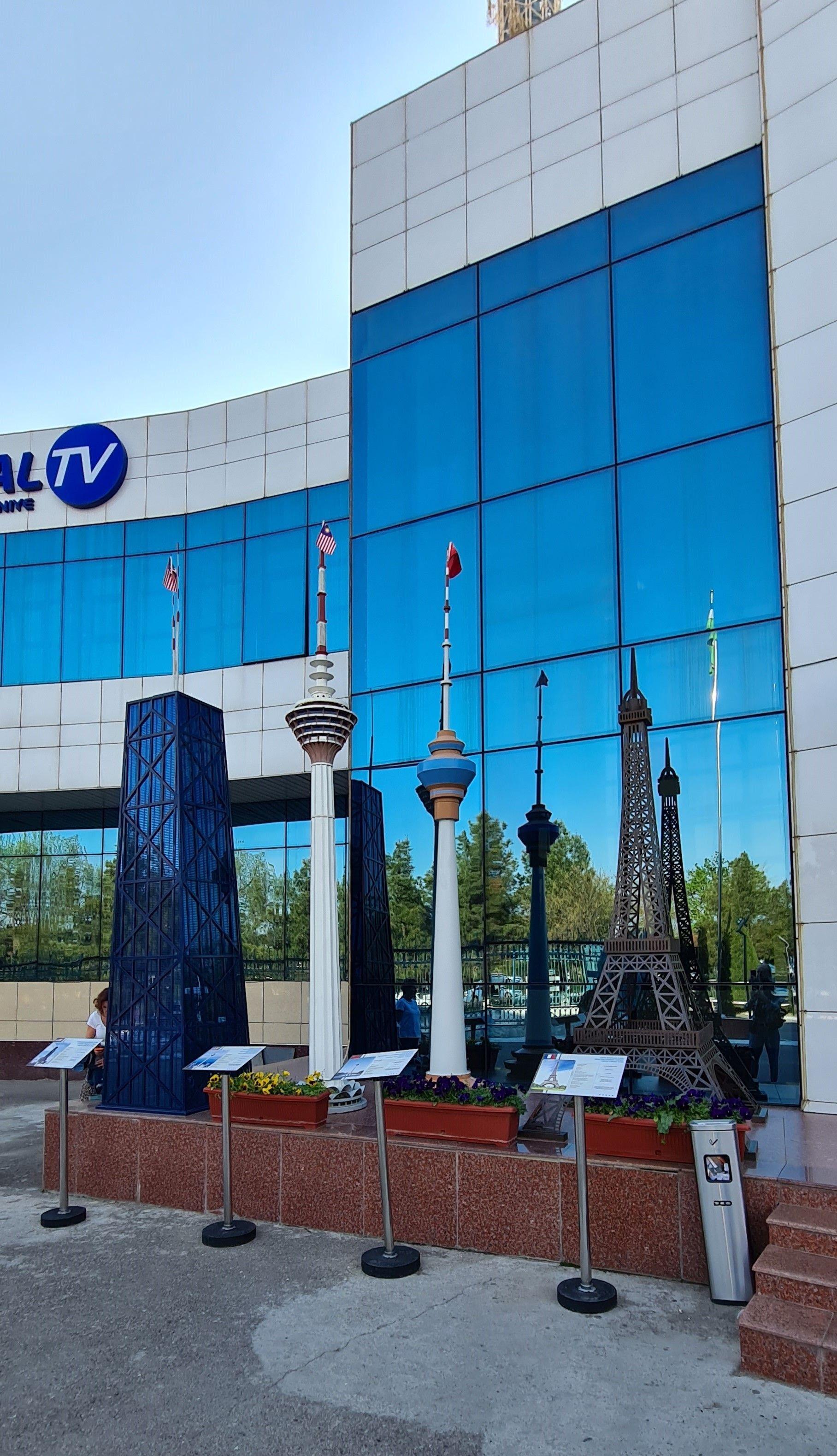
The Tashkent TV Tower is the full stop at the end of the rebuilding era. The decision to build it was taken in 1971; construction ran from 1978 to 1984, and it began broadcasting on 15 January 1985. At 375 metres it was the fourth-tallest tower in the world until 1991 and remains among the tallest structures in Central Asia. The architects Yury Semashko and I. N. Terziev-Tsarukov gave it three splayed steel legs and a tapered lattice shaft, a profile designed for a seismic city that still dominates the flat northern skyline.
Lifts take visitors to the observation deck at 97 metres, from which, on a clear day, the city runs out to the Chimgan range. A couple of floors above is the Koinot restaurant, which revolves slowly, with Uzbek food in one hall and European in another. Expect airport-style security and bring your passport. Reported 2025–2026 prices for foreign visitors on the observation deck range from about 40,000 to 60,000 som, and reported hours are 10:00 to 20:00 with last entry at 19:30; confirm on the day, since the tower occasionally closes on public holidays.
The Japanese Garden and the Uzexpo mosaic
Ten minutes' walk from the tower, the Japanese Garden opened in 2001 beside the Uzexpocentre with support from Japan: lawns, pines and maples around ponds with wooden bridges, a tea house, carp and a pier pavilion. It is a stroll garden rather than a botanical collection, busy with wedding photographers at weekends and quiet on weekday mornings. Aim for cherry blossom in early April or the maples in late October.
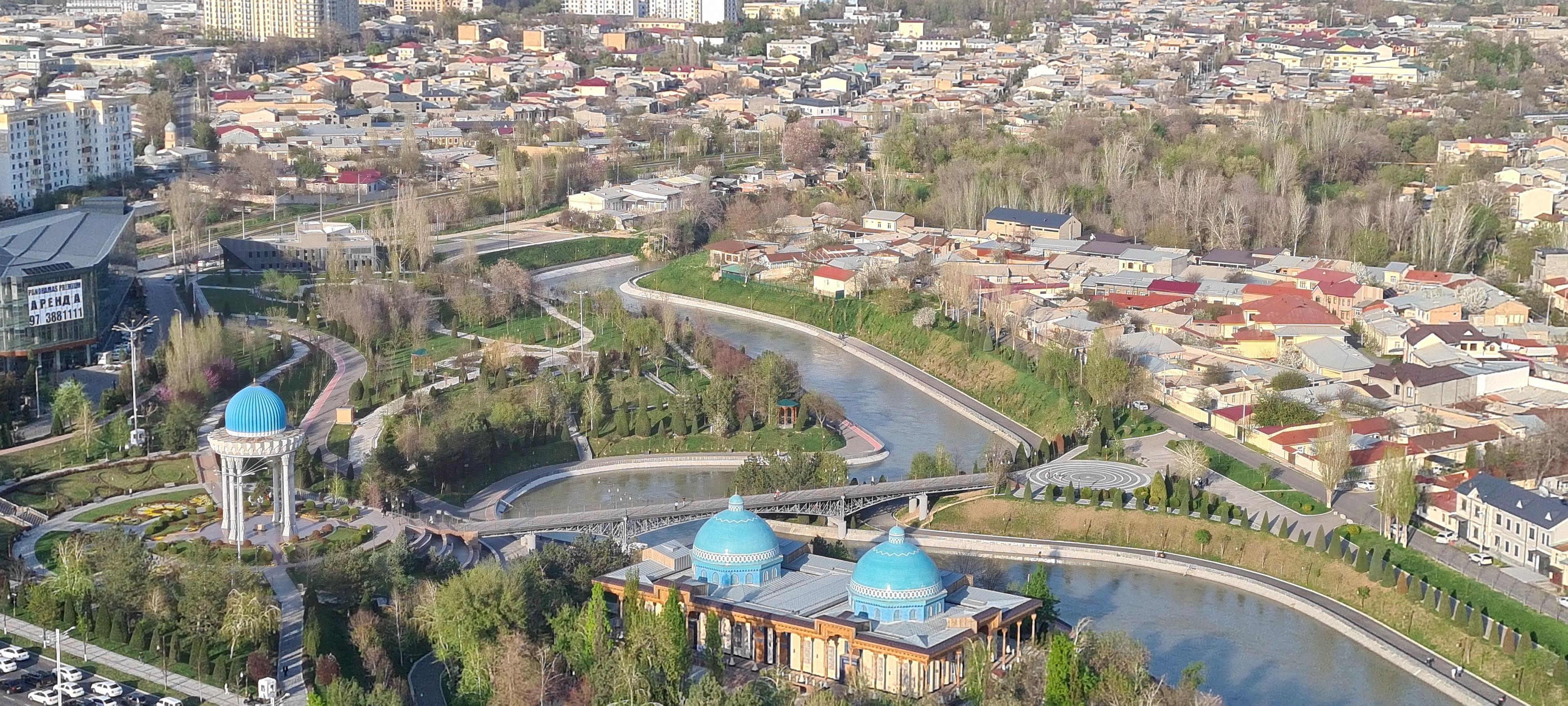
On the way, look up at Pavilion 4 of the Uzexpo exhibition centre on Amir Temur Avenue, whose portal carries a large mosaic panel; it is the easiest piece of monumental art to fold into a TV Tower visit. Across the avenue, the Museum of Victims of Repression and its domed rotunda complete the cluster with a very different, sober chapter of the Soviet century.
A half day: practical plan
A route that works, starting mid-morning:
- 10:00 Kosmonavtlar station, then two stops to Alisher Navoi for the poetry panels.
- 11:00 Taxi to two or three residential mosaics chosen from the city map, in Yakkasaray or Shaykhontokhur.
- 13:00 Lunch in the revolving restaurant of the TV Tower, or the deck alone if you prefer to eat in town.
- 14:30 Uzexpo Pavilion 4 mosaic, then an hour in the Japanese Garden.
- 16:00 Museum of Victims of Repression, about forty minutes, before it closes.
Taxis across the city cost little through Yandex Go; the Bodomzor metro station is closest to the garden. Spring and autumn are ideal; in July and August do the outdoor mosaics before 10:00 and keep the tower and museums for the afternoon heat.
Tashkent's modern layer with TourEast
Most of our Uzbekistan journeys begin or end in Tashkent, and we can turn the arrival day into a guided mosaic and metro morning followed by the TV Tower, with a guide who knows which panels have just been restored. It fits neatly into Four Crowns: Tashkent, Samarkand, Bukhara, Khiva or the longer Twelve Gates of the Silk Road. For travellers who want design, architecture and art as a theme across the whole trip, Silk Road in Silk: Private Uzbekistan is the programme we tailor: it has only an arrival afternoon in Tashkent, but on request we add a full day for the modernist buildings, the metro and the mosaics before the Silk Road cities. Tell us your arrival date and we will plan the day around the light.
Frequently asked questions
Photo gallery


Photo: Panpanchik / Wikimedia Commons, CC BY-SA 4.0; Naivvv / Wikimedia Commons, CC BY-SA 4.0; Adam Harangozó / Wikimedia Commons, CC BY-SA 4.0; Enric / Wikimedia Commons, CC BY 4.0; BeshevI / Wikimedia Commons, CC BY-SA 4.0; Nikolai Bulykin / Wikimedia Commons, CC BY-SA 4.0