Tashkent region calls its circuit of districts the Golden Ring: a pilgrimage shrine 15 km from the city, river fish on the Syr Darya at Chinaz, a Soviet solar furnace in the Parkent hills, a climbers' lodge at Yangiabad, a Timurid mausoleum in a coal town and the mountains and lake of Bostanlyk. Seven day trips for residents, repeat visitors and anyone with a spare day in the capital, with distances, timings and what to eat.
Facts, prices and schedules checked on November 11, 2026
Tashkent is a city of more than three million people in an oasis the size of a small country, and the region around it, which Uzbeks call Toshkent viloyati, is where the capital goes at the weekend. The regional tourism office markets its districts as a Golden Ring, a circuit of eight stops that starts at a Sufi shrine on the southern edge of the city and ends in the Chatkal mountains. The name is borrowed from the Russian tourist route and the comparison is generous, but the idea is sound: within 110 km of a Tashkent hotel there are a pilgrimage complex, a Syr Darya fish market, a solar furnace, a Timurid mausoleum, a climbers' town, a resort village, a lake and a national park.
These trips suit anyone with a spare day: residents and expatriates, diplomats showing visitors around, repeat travellers who have done the Silk Road cities, and anyone on a stopover with a car. Each stop gives the distance from the city centre, what you do there and what to eat. The eight can be grouped into three or four days or taken one at a time.
1. Zangi-ota: the pilgrimage 15 km south
The first stop is practically a suburb. Zangi-ota, 15 km south of the centre, is the main pilgrimage site of the region: the mausoleum of Sheikh Ai-Khoja, a 13th-century Sufi of the Yasawi line known as the dark-skinned father, with a tiled portal that local tradition credits to Amir Timur and Ulugbek, a mosque and madrasa added by the Kokand khans in 1832 and a carved minaret of 1870. Beside it, in the cemetery, is the small tomb of his wife Ambar-bibi, protector of women, where the rituals are practical: a young woman sweeps the floor around the grave with a broom kept for the purpose to ask for a husband, and married women circle the building three times for children.
Go on a Friday morning to see the complex working as a shrine rather than a monument, dress modestly and bring a headscarf. Allow an hour and a half. With a car you can continue 50 km south-west to Chinaz; without one, the Zangiota town centre is a short taxi ride from the Chilanzar metro stations.
2. Chinaz: fish on the Syr Darya, 64 km
Chinaz is where the Tashkent–Samarkand highway crosses the Syr Darya, and the reason to stop is lunch. Roadside cafés along the river keep live fish in tanks, catfish, carp, pike-perch and farmed trout and sturgeon, which you choose, have weighed and eat fried or grilled with bread, onion and tomato twenty minutes later; Tashkent families drive out for it on Sundays. The town itself was a river fortress in the 19th century, with a ferry across the Syr Darya that Russian photographers recorded in the 1870s, and the site of a battle against the Mongols in local telling. Nearby, the mound of Karshaul-tepa, a settlement of the 6th to 8th centuries, produced finds in 2014 that archaeologists read as a Zoroastrian community; there is little to see without a guide, but the river banks are a pleasant walk. Combine Chinaz with Zangi-ota for a half-day to the south-west, or with a drive on to the Buka district in spring, when the fields along the Syr Darya are sown and green and the villages are at their best; Buka's claim to fame is that Alexander's army is said to have passed through in 328 BC.
3. Parkent: the solar furnace and Kumushkan, 50 km
East of the city the road to Parkent climbs through vineyards into the foothills of the Chatkal range, and the most surprising object in the region appears on a hillside: the Big Solar Furnace of the Institute of Physics and the Sun, built in 1987, a field of 62 heliostats that focus sunlight onto a ten-storey concave mirror to reach temperatures above 3,000 °C for materials research. It is one of only two such furnaces in the world, the other being in the French Pyrenees, and it is a monument of late Soviet science as much as a working laboratory. Visits are by arrangement with the institute and we organise them for groups; even from the road the mirror wall is worth the detour.
Ten kilometres further into the hills, Kumushkan is a resort village of guesthouses and a sanatorium in a stone gorge, the region's first designated tourist village, with a yurt camp in summer, short walks to waterfalls and cold streams, and shashlik that the locals insist is the best in the region. A 2025 government plan lists 52 tourism projects for the Parkent district, including a large ski resort, so the valley will change; for now it is a quiet lunch and a walk. Parkent is 50 km and an hour from the centre.
4. Akhangaran: the city of blacksmiths, 62 km
Akhangaran, whose name means blacksmiths in Persian, is an industrial town on the Angren river and the stop on the ring that tourists skip. Its interest is the valley rather than the town: the Angren river comes down from the Kurama range through a reservoir and a gorge, with the mountains of the Chatkal reserve above, and the road along it leads to Angren and Yangiabad. The cement plant that supplied Tashkent's post-earthquake rebuilding offers industrial tours by arrangement, which is a niche taste. For most visitors Akhangaran is the lunch stop on the way up the valley, with a good bazaar for fruit and bread and a 19th-century Orthodox church. Count it as part of a day rather than a day in itself.
5. Angren: a mausoleum in a mining town, 105 km
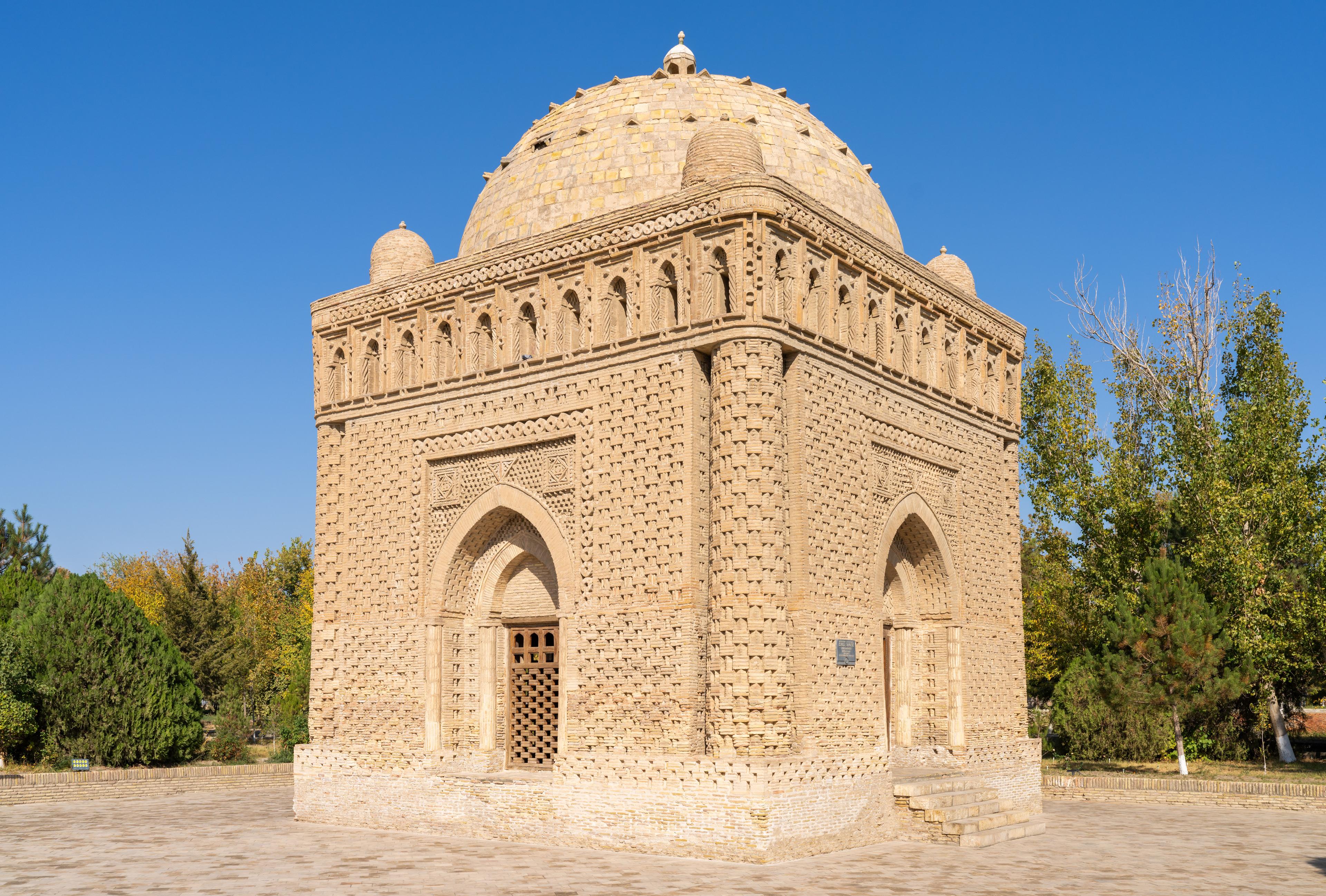
Angren grew in the 1940s around the largest coal field in Central Asia and still has the only plant in the country that gasifies coal underground. It is not a beautiful town, but the Geolog settlement on its edge keeps a surprise: the mausoleum of Gumbaz-bobo, a domed brick tomb of the Timurid period standing among the apartment blocks, with a cemetery around it and a mahalla that tends it. The contrast is the point. Angren is also the junction where the highway turns south over the Kamchik pass to the Fergana Valley, so it is a natural pause on that road rather than a destination; the regional museum has a small ethnographic hall. From Angren, Yangiabad is 20 minutes up the valley.
6. Yangiabad: climbing, a ski slope and a trout stream, 100 km
Yangiabad was built after the war as a uranium-mining town in the Chatkal foothills, closed to outsiders for decades, and has reinvented itself as a mountain resort with the atmosphere of a 1950s Soviet spa: stone houses, a music school, a tourist base with a restaurant and lodges, and silence. The rock walls above the town are the training ground of Uzbekistan's climbers, with routes of all grades and competitions in season; a 500 m beginners' ski slope with a button lift runs in winter; and in summer the walks follow the Chilten and Kattasay rivers upstream through pools and small waterfalls to Pigeon Gorge, or climb to the Babaytag ridge at 3,555 m for a long day. A clear reservoir below the town is used for swimming and fishing from spring. Yangiabad lies at 1,200 m, 100 km and two hours from Tashkent via Angren, and is the one stop on the ring that justifies an overnight: the Yangiabad Tourist Lodge is simple and the air at night is cold even in July.
7. Bostanlyk: the lake, the lifts and the national park, 80–110 km
The last and largest stop is the one most people already know. Bostanlyk district is the Chatkal mountain country north-east of the city: the Charvak reservoir, with its beaches and ring road; the Chimgan massif and the Amirsoy and Beldersay resorts, where gondolas run in summer for walkers and in winter for skiers; and the Ugam-Chatkal National Park beyond, with the Paltau waterfall, the Obi-Rakhmat grotto where Neanderthal remains were found, the jade-green Urungach lakes and the Pskem valley villages of Nanay, Bogiston and Burchmulla. The regional tourism office adds the Jilga-tepa fortress of the 6th to 12th centuries on the Pskem bank and a Zoroastrian cemetery near Sijak for the determined.
The practical split: Charvak and the lifts are an easy day on paved road, 80–90 km and under two hours each way; Paltau and the Pskem valley lie in a border zone and need a permit arranged through an operator, which turns them into a planned day or an overnight in a village guesthouse. Our separate Chimgan and Charvak guide has the beaches, prices and seasons.
How to plan it: transport, timing and costs
The ring is not a loop you drive in one go; it is a set of radials from the city. Reasonable groupings:
- South-west half-day: Zangi-ota and Chinaz for lunch, 130 km round trip, four to five hours.
- East day: Parkent's solar furnace (book ahead), Kumushkan for shashlik and a walk, back by evening, 120 km round trip.
- Angren valley day: Akhangaran, Angren's mausoleum and Yangiabad, with an optional night at the lodge, 220 km round trip.
- Mountain day or two: Charvak, Chimgan and the lifts; add Paltau or Urungach with a permit.
A private car with driver costs roughly US$60–100 for a day depending on distance; Yandex Go taxis will take you to Zangi-ota, Parkent or Chinaz but are unreliable for the return from the mountains. Shared taxis to Charvak leave from the Buyuk Ipak Yuli metro area, and suburban trains reach Angren in about two hours for the patient. Meals are the cheap part: a whole fried fish at Chinaz for two costs 80,000–150,000 som, shashlik at Kumushkan 20,000–30,000 som a skewer. Seasons: spring for Buka's fields, Zangi-ota's gardens and Kumushkan's streams; summer for the lake and Yangiabad; autumn for colour; winter for the lifts. Carry your passport on every trip; the Pskem and Ugam valleys are border zones and police checkpoints are routine.
Day trips with TourEast
We are based in Tashkent and run these roads every week for residents and for guests with a day to spare before or after a tour. Four Crowns, our classic eight-day route, and 48 Hours in Samarkand both begin in the capital, and either can be extended by a day on the ring: Zangi-ota and Chinaz for a taste of local life, Parkent for the furnace and lunch in the hills, or the mountains. Snow on the Domes, our winter departure, already includes Chimgan and Charvak. For the solar furnace, the Pskem permit or a night in Yangiabad, give us a few days' notice and we will arrange the car, the guide and the paperwork.
Frequently asked questions
Photo gallery

Photo: Bobyrr / Wikimedia Commons, CC BY-SA 4.0; Panpanchik / Wikimedia Commons, CC BY-SA 4.0; Sehrliolam / Wikimedia Commons, CC BY-SA 4.0; Галиев Ярослав / Wikimedia Commons, CC BY-SA 4.0; German Stimban / Wikimedia Commons, CC BY-SA 3.0; NasimbekNasimov / Wikimedia Commons, CC BY-SA 4.0; Stephanieadams99 / Wikimedia Commons, CC BY-SA 4.0