A half-day route through Islamic Tashkent: the Center of Islamic Civilization (opened March 2026) and the Uthman Quran, Muyi Muborak library, Barak-Khan Madrasah, Kaffal Shashi and Tilla Sheikh, with etiquette and timing.
Facts, prices and schedules checked on November 4, 2026
Tashkent is often treated as a gateway to Samarkand and Bukhara, yet it holds one of the most compact Islamic heritage areas in Central Asia. The old-town square of Hazrati Imam, also known as Khast-Imam, sits beside a new landmark, the Center of Islamic Civilization, which opened on 17 March 2026 and now houses the Uthman Quran. Within a short walk are a 16th-century madrasah, the tomb of the city's patron scholar, a library that keeps a relic of the Prophet, and working mosques.
This guide lays out a half-day route through Islamic Tashkent, in the order we would walk it: Chorsu Bazaar, the Kukeldash Madrasah, the Hazrati Imam square with Barak-Khan, Kaffal Shashi, Tilla Sheikh and Muyi Muborak, the Center of Islamic Civilization, and, if you have time, the Minor Mosque. It is written for Muslim travellers and for anyone interested in the history of Islam in Central Asia. Our separate guide to the Hazrati Imam complex goes deeper on each building; this one shows how they fit into a day.
The Center of Islamic Civilization: what it is and what opened in 2026
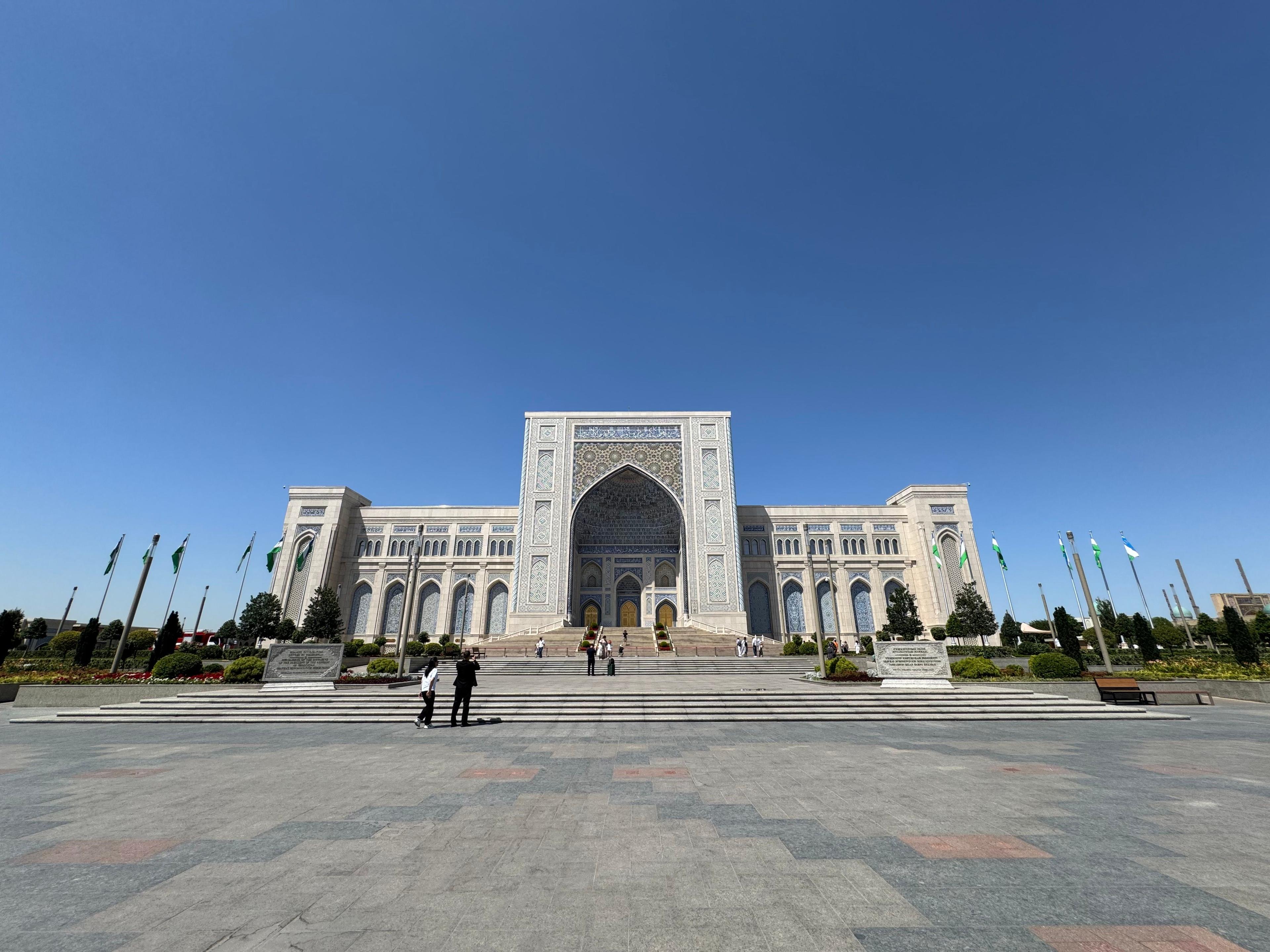
The Center of Islamic Civilization is a vast, domed museum and research complex beside the Hazrati Imam square, in the Old City district at 47 Karasaray Street. Construction took about eight years, and it opened on 17 March 2026 in the presence of the president. Reports describe a three-storey building about 161 metres long and 118 metres wide, under a dome that rises roughly 65 metres, in grounds of about 10 hectares. Figures differ slightly between sources, so treat them as approximate.
Inside, the exhibition covers more than 2,000 items across four main halls: Pre-Islamic Heritage, the First Renaissance, the Second Renaissance and New Uzbekistan. The First Renaissance hall covers the golden age of scholars from the region, such as al-Khwarizmi, al-Biruni, Ibn Sina and Imam al-Bukhari; the Second Renaissance corresponds to the Timurid era. Our guide to the great scholars of Uzbekistan is good background. The complex also includes a library, a manuscript restoration laboratory, conference halls, temporary exhibition spaces and a children's museum.
At the centre is the Holy Quran Hall. It displays the Uthman Quran, one of the oldest Qur'an manuscripts in the world, alongside other rare Qur'an manuscripts. A major Quran-related congress took place at the centre in mid-November 2025, shortly before the manuscript was moved from its old home. Visitors cannot get close to the manuscript, and flash photography is not allowed.
Allow two to three hours. Opening hours reported in guides differ, from about 09:00 to 18:00 in some to later evening in others, and the centre may close one day a week, so check the official site, iccu.uz, before you go. Foreign-visitor tickets were announced in March 2026 at around US$25 for adults, according to reports we have seen, with an audio guide in English or Russian included; please confirm the current price, because it may have changed.
The Uthman Quran: where it was and where it is now
For decades the Uthman Quran, also called the Samarkand Kufic Quran, was shown in the Muyi Muborak library in the Hazrati Imam complex. In November 2025 it was moved to the new centre. It is a huge parchment codex in early Kufic script, and UNESCO placed it on its Memory of the World Register in 1997. Tradition links it to the caliph Uthman in the 7th century; scholars date its script to a somewhat later period, and the debate does not change what it represents to visitors. It reached Tashkent in 1923 after a long journey through Samarkand, St Petersburg and Ufa. Our Hazrati Imam guide tells the whole story.
If you are following older guidebooks, note that the Muyi Muborak Madrasah no longer holds the manuscript. It still has its library, rare books and a revered reliquary of the Prophet's hair, which is why it is called the blessed hair. A copy is shown where the original used to be, but the original is now in the Quran Hall.
A half-day route through Islamic Tashkent
Start early and keep the route simple.
- 08:30, Chorsu Bazaar. The old-town bazaar under its green dome is a good place for breakfast: warm bread, samsa, tea, fruit and nuts. See our Chorsu guide.
- 09:30, Kukeldash Madrasah. This 16th-century madrasah is a short walk from the bazaar and a quiet introduction to Tashkent's older architecture.
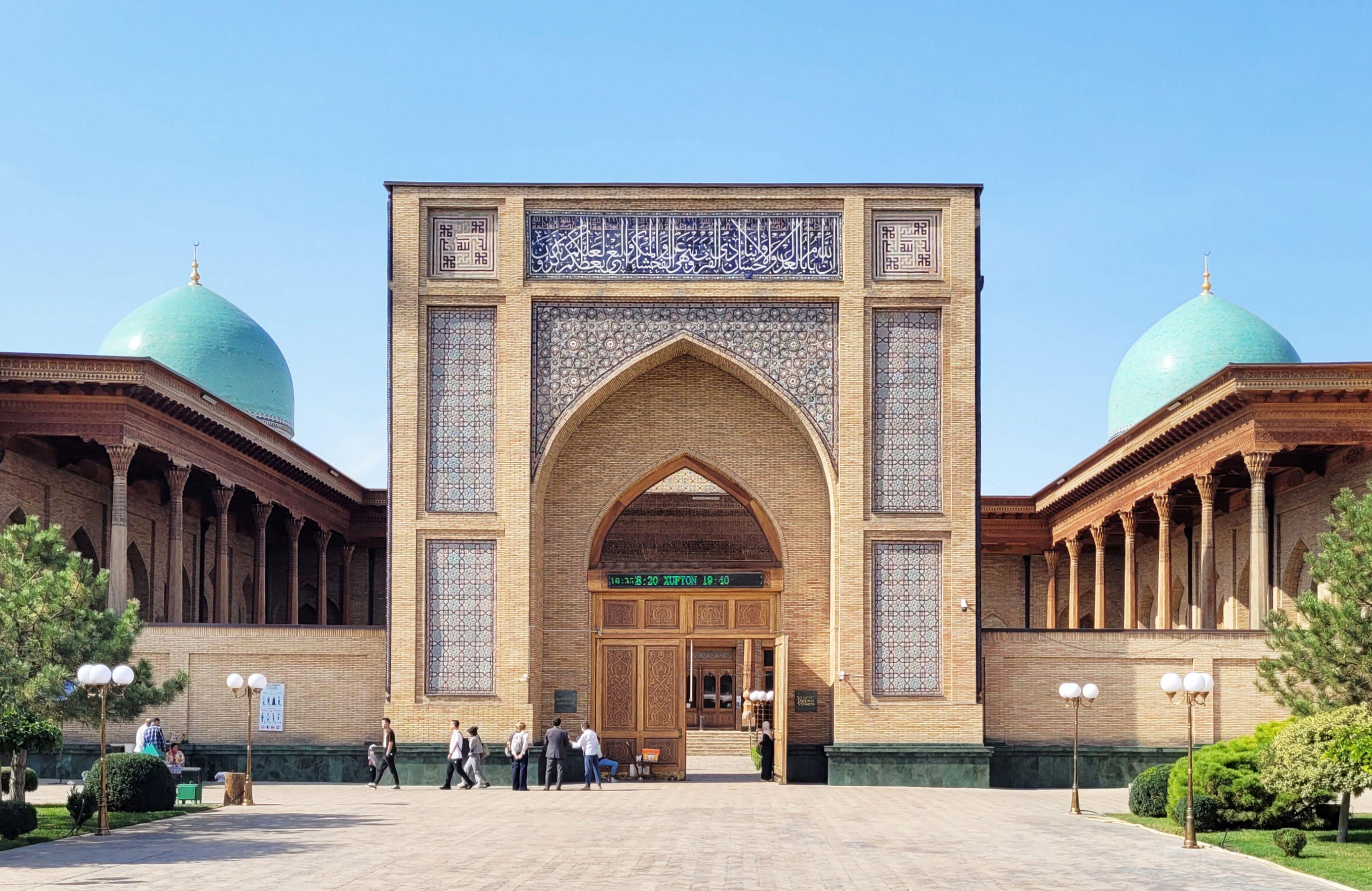
- 10:00, the Hazrati Imam square. Walk through the mahalla lanes, about 15 to 20 minutes, to the open square. Visit the Barak-Khan Madrasah, with its blue and turquoise tiled facade and craft shops in the cells, then the Kaffal Shashi mausoleum, the Tilla Sheikh Mosque, the Muyi Muborak library and the Hazrati Imam Mosque.
- 12:00, lunch near the square. Plov and shashlik are within reach; our halal food guide explains the choices.
- 13:30 to 14:30, Friday note. The main mosque fills for midday prayers on Fridays, so shift the route on that day and arrive after about 14:00.
- 14:30, the Center of Islamic Civilization. Two to three hours.
- Late afternoon, optionally the Minor Mosque. A white-marble mosque opened in 2014, with a blue dome and a waterside setting. Reports on whether non-Muslim visitors may enter conflict, so ask on arrival, avoid prayer times and dress modestly.
The distance from Chorsu to the square is walkable, and Yandex Go is the easy way to finish; fares between Chorsu and Hazrati Imam are typically 20,000 to 40,000 som in 2026.
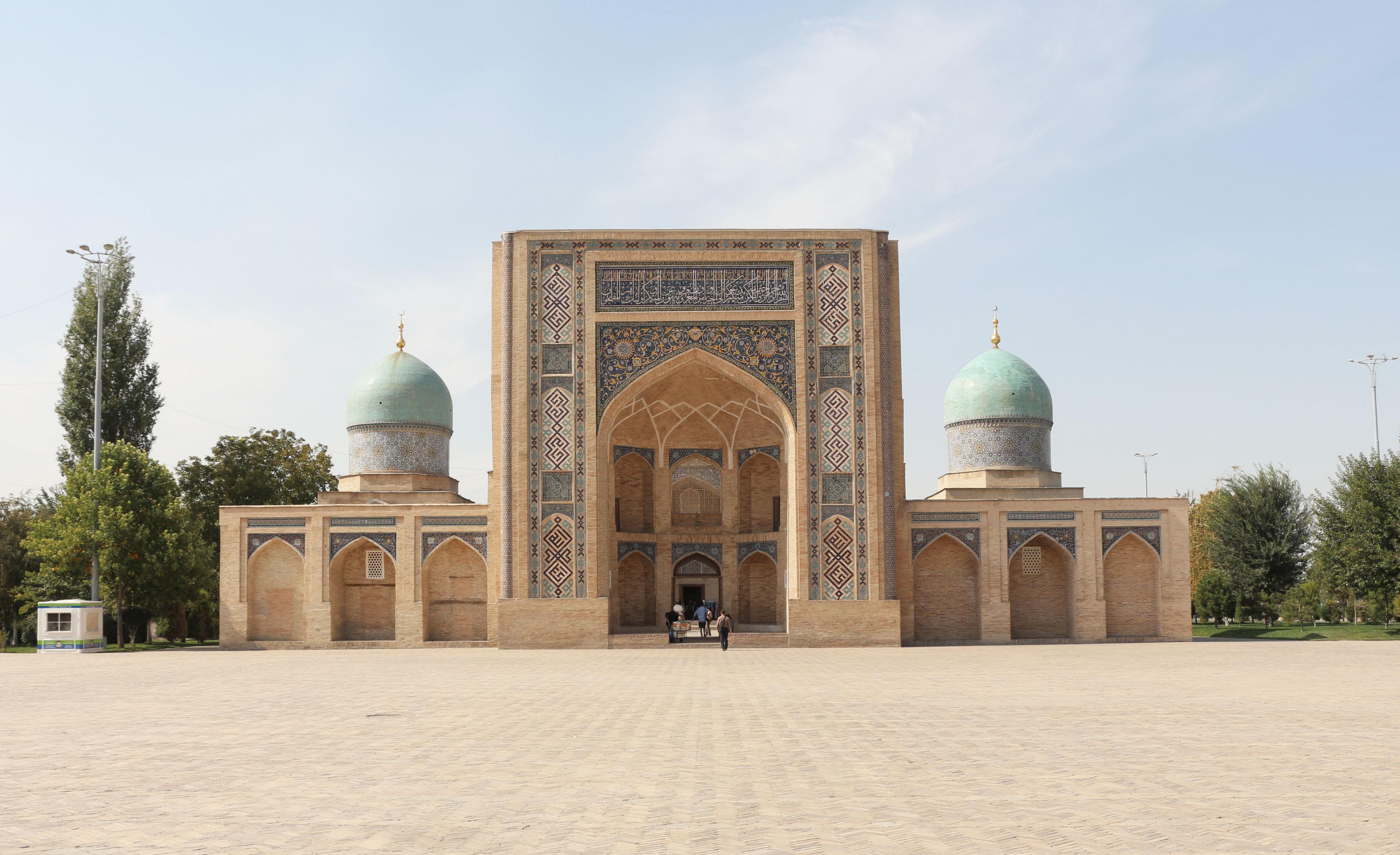
The Hazrati Imam square: Barak-Khan, Kaffal Shashi, Tilla Sheikh
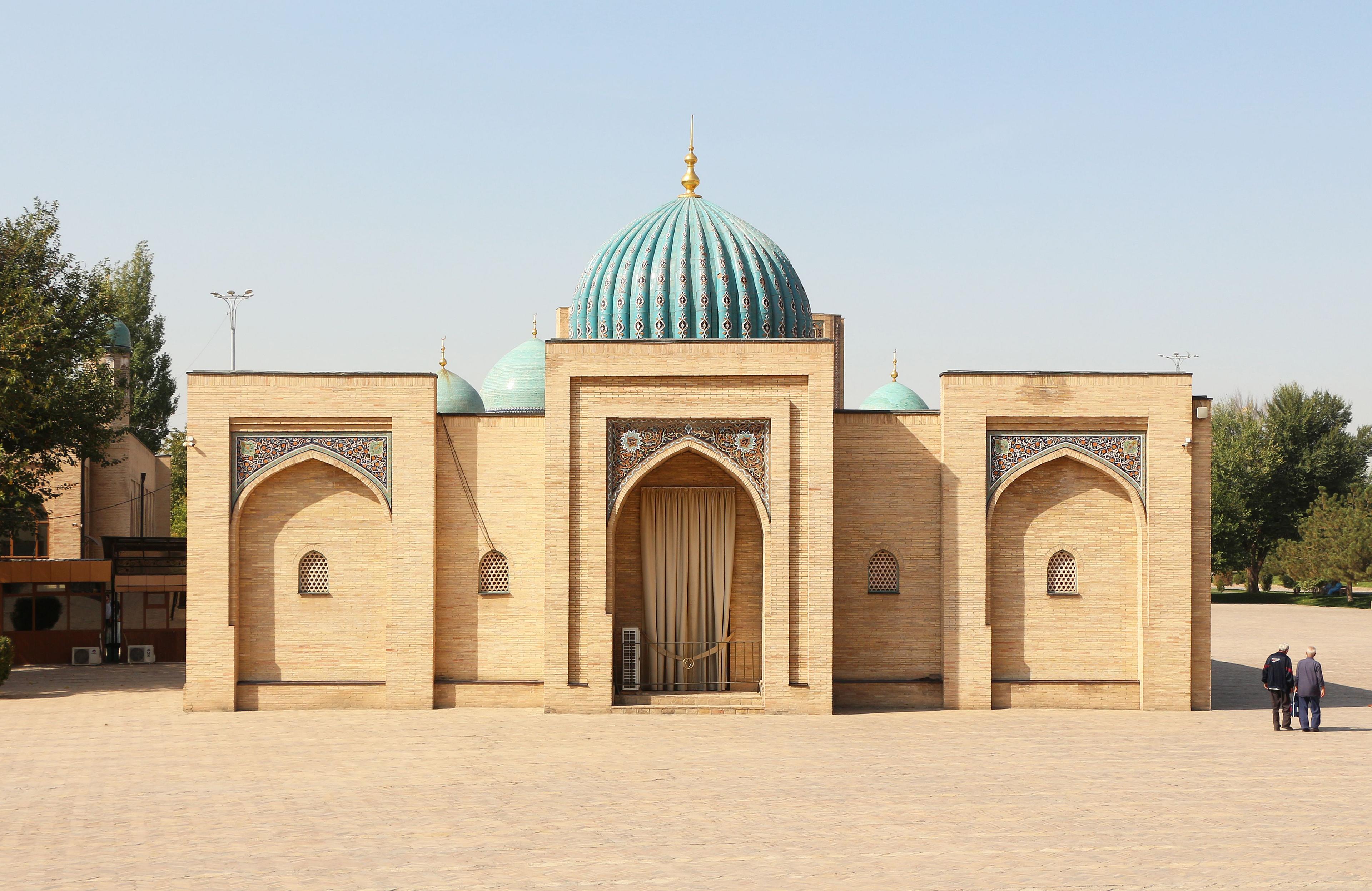
The Barak-Khan Madrasah was built in the 1530s for a Shaybanid ruler of Tashkent and is the oldest surviving madrasah in the city. Its tiled portal faces the square, and the student cells now hold craft shops selling ceramics, suzani, miniature paintings and carved wood. The mausoleum of Abu Bakr Kaffal Shashi, a scholar of the 10th century revered as Tashkent's patron, dates from the 16th century and is a place of prayer: walk quietly and do not photograph people praying. The Tilla Sheikh Mosque, built between 1890 and 1902, has carved wooden columns and a painted ceiling. The Hazrati Imam Mosque, completed in 2007, is the main Friday mosque, and the square itself was rebuilt as a national religious centre. The headquarters of the Muslim Board of Uzbekistan and the Imam al-Bukhari Islamic Institute are also in the area.
The square is open and free to enter. The mosques are active, so they close to visitors during prayer.
Practical details: getting there, tickets and timing
The nearest metro station is Chorsu on the Chilanzar line, and from there it is a 15 to 20 minute walk through old mahalla streets or a short taxi ride. Yandex Go works well; see our taxi apps guide. If you stay in the centre around Amir Timur Square, the ride to Hazrati Imam takes 15 to 25 minutes depending on traffic.
The square and the mosques are free to enter. The Barak-Khan craft shops keep normal daytime hours, roughly 09:00 to 18:00, and prices are fixed in some shops and negotiable in others; our crafts and souvenirs guide explains what to look for. The Muyi Muborak library sets its own hours, which can vary around Friday prayers and religious holidays, and a small fee or donation may be requested. The Center of Islamic Civilization has a separate ticket. Book a timed entry if the website offers one, particularly on weekends and holidays, when queues are likely.
Morning is the best time for the square, when the light falls on the tiles of Barak-Khan and the courtyards are calm. In summer, plan the Center of Islamic Civilization for the hot hours, because it is air-conditioned. In winter, the square is cold but clear, and the walk from Chorsu is pleasant with a warm drink.
Etiquette, dress and photography
These are working religious sites as well as museums, and a few rules make the day smoother.
- Dress modestly: shoulders and knees covered for everyone, and a headscarf for women entering mosques and shrines. Remove shoes before carpeted areas. See our guide to mosque etiquette and what to wear.
- Keep your voice low in the mausoleum and library, and do not photograph worshippers.
- Fridays are busy at midday, and religious holidays and Ramadan evenings are lively and crowded.
- Muslim visitors are welcome to pray in the mosques outside restricted areas; ask a staff member or your guide about arrangements for women.
- Photography of the buildings is fine in the square; inside the Quran Hall, follow staff instructions.
If you travel in Ramadan, the area is lively around iftar. Our Ramadan in Uzbekistan guide has more.
Where this fits on a longer trip
Islamic Tashkent works as a first day or a last day. It is a calm introduction after a night flight, with the metro, bazaar and mosques in a small area, and a good complement to Samarkand and Bukhara, where the older monuments stand. For a longer spiritual journey, the usual continuation is the Imam al-Bukhari complex near Samarkand and the shrine of Bahauddin Naqshband near Bukhara, covered in our ziyarat guides. Our overview of Islamic architecture explains pishtaqs, muqarnas and madrasahs, so you can read what you see.
Visiting with TourEast
We can build a guided half-day around prayer times, a timed visit to the Center of Islamic Civilization and a halal lunch, as part of a Tashkent city tour or a longer Uzbekistan itinerary. Guides in Indonesian, Malay or Arabic are available on request. Tell us your dates and what you would like to see through our trip builder or on WhatsApp.
Frequently asked questions
Photo gallery