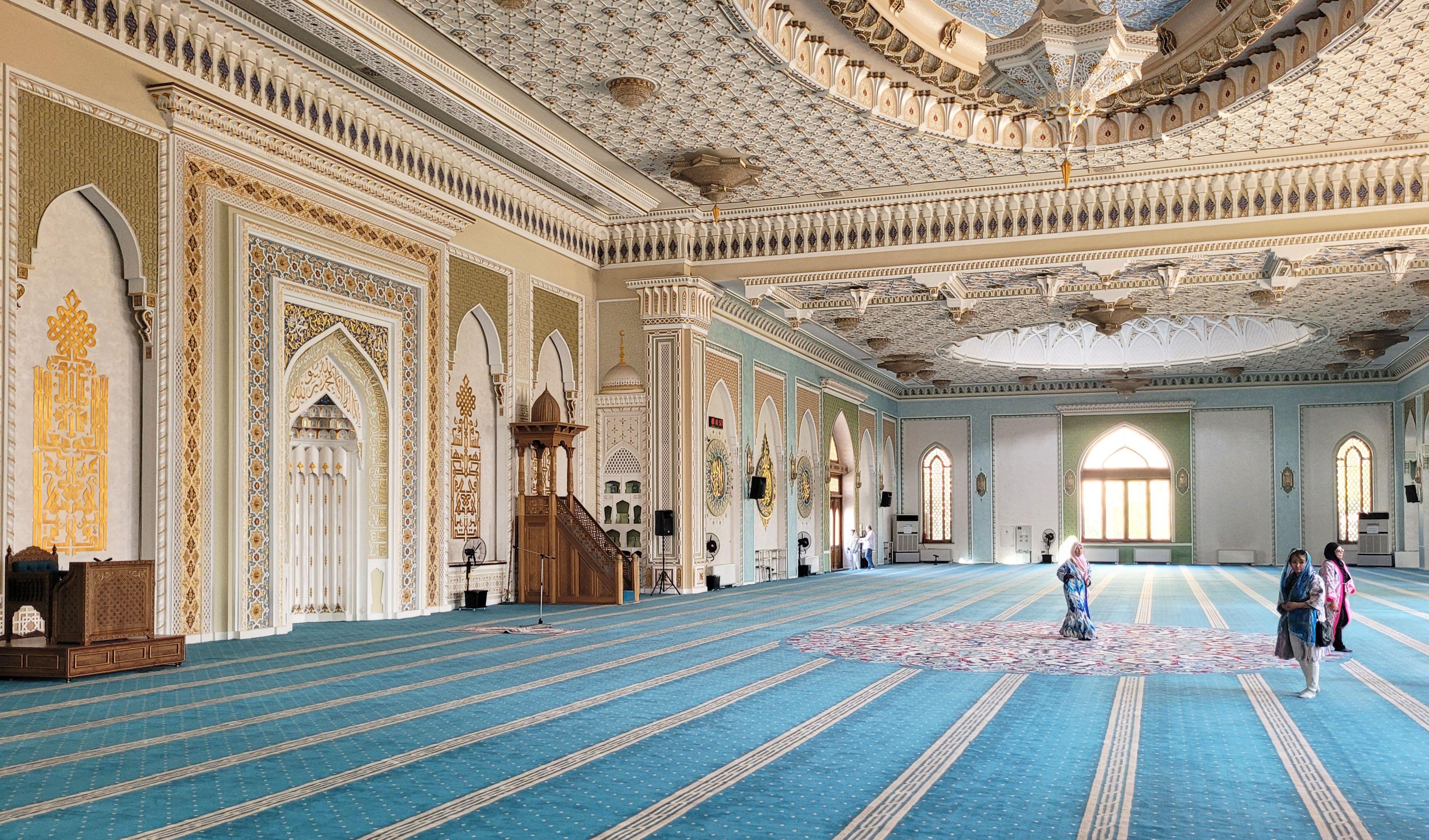
A candid guide to accessible travel in Uzbekistan for wheelchair users and slow walkers: what is step-free at the Registan, Shah-i-Zinda, Ichan-Kala and the Ark, the Afrosiyob train, Tashkent airport and metro, hotels, and what a private tour can and cannot change.
Facts, prices and schedules checked on November 4, 2026
Honest answers first. Uzbekistan is not an easy country for wheelchair users, and anyone who tells you otherwise has not pushed a chair across the cobbles of Ichan-Kala. Kerbs are high, dropped kerbs are rare, historic buildings were built for horses and feet, and the standards that exist on paper are patchy on the ground. And yet accessible travel in Uzbekistan is possible, and getting better: the Afrosiyob high-speed train has wheelchair spaces and an accessible toilet, Tashkent airport has invested in assistance, the main squares of Samarkand and Bukhara are flat, and a private tour with a van and a patient guide removes most of the remaining obstacles.
This guide is written for wheelchair users, slow walkers, travellers with a mobility-limited parent and anyone who avoids stairs. It goes site by site through what is step-free and what is not, as of November 2026, then covers trains, flights, the metro, hotels and what we can and cannot change on a tour. Where we have not been able to verify something, we say so.
Is Uzbekistan wheelchair accessible? The short version
- Fully accessible with a companion: the Registan's square and courtyards, Bibi-Khanym's courtyard, Lyabi-Hauz, Bukhara's trading domes, Po-i-Kalyan's square and mosque courtyard, most of the lanes of Ichan-Kala, the Afrosiyob train, Tashkent airport, major modern hotels.
- Partly accessible: Gur-e-Amir, Bukhara's Ark Fortress, Khiva's palaces, the Hazrati Imam complex, bazaars, most restaurants.
- Not accessible: Shah-i-Zinda's main staircase, all minarets and watchtowers, most older Tashkent Metro stations, the upper floors of madrasah cells, almost all public toilets.
Surfaces are the recurring problem: brick paving, stone slabs with gaps and cobbles. A chair with larger wheels, or a power-assist attachment, copes much better than a lightweight folding chair with small front castors. Bring your own equipment; nothing can be hired locally with any certainty.
Samarkand: the Registan, Shah-i-Zinda, Gur-e-Amir
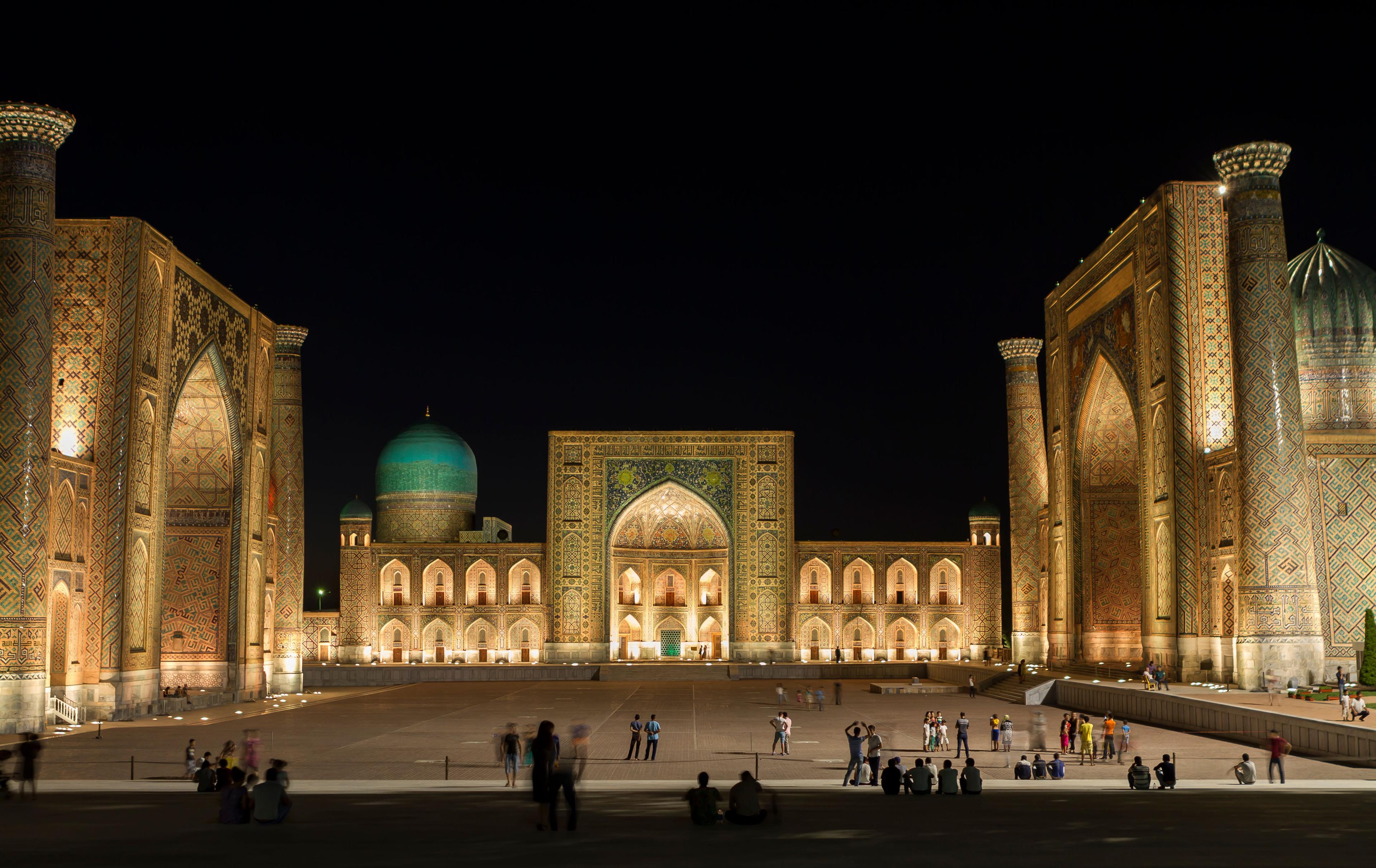
The Registan is the best news in the country. The square sits below the level of the surrounding streets, reached from the viewing terrace by broad steps and, to one side, a long sloping ramp. The ramp is steep in places and a companion should take the chair; once down, the square and the three madrasah courtyards are paved and almost level. The interiors of the Tilla-Kari mosque and the ground-floor cells have thresholds of a few centimetres and occasional single steps. There are no lifts to upper galleries, which matters little, since the glory of the place is at ground level. The evening light show can be watched from the terrace without going down at all.
Shah-i-Zinda is the hardest site. The necropolis climbs the hill through a staircase of about 36 steps near the entrance and continues upwards between the mausoleums. There is no ramp on the main route. Some visitors with mobility limits are driven to the upper gate on the cemetery side and see the top group of mausoleums with little climbing; ask your guide whether this is possible on the day. A slow walker with a stick can manage the stairs with rests; a wheelchair user cannot, short of being carried.
Gur-e-Amir, Amir Timur's mausoleum, has steps at the entrance portal and inside the chamber; a companion can usually manage a chair over them with help from staff. Bibi-Khanym has a vast flat courtyard but steps into the main portal. The Siab Bazaar beside it is flat and busy. The Afrosiab museum and the Ulugbek Observatory have steps; the observatory's sextant trench is viewed from a platform reached by stairs.
Bukhara: Lyabi-Hauz, the domes, Po-i-Kalyan and the Ark
Bukhara's old town is compact, mostly flat and largely pedestrian, which makes it the most accessible historic centre in the country, with the usual caveat about paving.
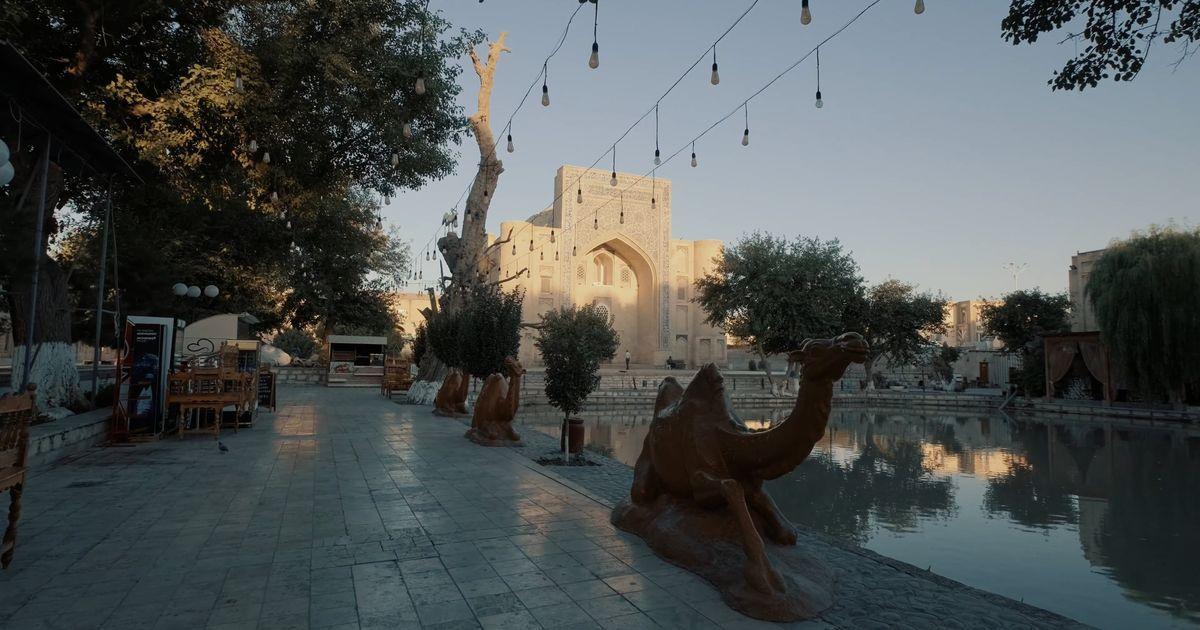
- Lyabi-Hauz: a level square around the pool, with restaurants that have outdoor seating at ground level.
- The trading domes and the lanes between them: flat, paved with brick and stone, uneven in places but passable. Shops inside the domes have a step or two.
- Po-i-Kalyan: the square between the Kalyan Mosque and the Mir-i-Arab Madrasah is level. The mosque courtyard is reached over a threshold and a couple of steps; the minaret cannot be climbed by anyone in normal circumstances, so nobody misses out.
- The Ark Fortress: the entrance is a long, steep cobbled ramp inside the gatehouse, then rooms at different levels joined by steps. A strong companion can get a chair up the ramp; most of the interior is awkward. Many travellers with limited mobility view the Ark's walls from the Registan square outside and visit the Bolo-Hauz mosque across the road, which is flat and open-sided, instead.
- The Samanid Mausoleum sits in a park with paved paths; the building has a step at the threshold. Sitorai Mohi-Hosa, the summer palace, has gardens with paths and a main hall reached by steps.
Bukhara's station is at Kagan, outside the city, and the drive is 25 to 30 minutes; a private van with the chair in the back is the practical answer.
Khiva: Ichan-Kala's lanes, palaces and minarets
Ichan-Kala, the walled inner town of Khiva, is flat and car-free, and its main lanes are paved with stone slabs that a chair can cross with effort. Expect gaps, patched sections and some soft sand near the walls. The West Gate entrance is level. Inside, most monuments are reached over a threshold and one or two steps: Kunya-Ark's courtyards, the Juma Mosque with its forest of wooden columns, the Tash-Hauli palace with its painted iwans. The watchtower of Kunya-Ark, the Islam Khoja Minaret and the city walls are stairs only, and the sunset view from them is the one part of Khiva a wheelchair user will not share.
Khiva's own railway station is about 1.5 km from the walls; Urgench airport is 35 to 40 km away. Both transfers are easy by van. Within the walls, distances are short, and a good plan is two slow half-days rather than one long one, with rests in the shaded tea gardens.
Tashkent: airport, metro, streets
Tashkent airport. In January 2026 the airport received 30 specialised wheelchairs for passengers with reduced mobility, and it has been fitting help-call buttons at terminal entrances to summon staff with wheelchairs. Uzbekistan Airways and most foreign airlines provide assistance from check-in to the aircraft, including lifts to the door, when it is requested at booking or at least 48 hours ahead. Request it; do not assume it will appear unasked. The domestic terminal is a separate building from the international one, so a connecting passenger needs a vehicle between them.
The Tashkent Metro is beautiful and, for a wheelchair user, mostly off limits. The older stations are reached by stairs and escalators only. A few of the newest stations on the above-ground lines, and a couple of rebuilt ones, have lifts for passengers with disabilities, but you cannot rely on a lift at both ends of a journey. Slow walkers who can manage escalators and some steps can enjoy two or three stations with a guide; wheelchair users should see the city by car.
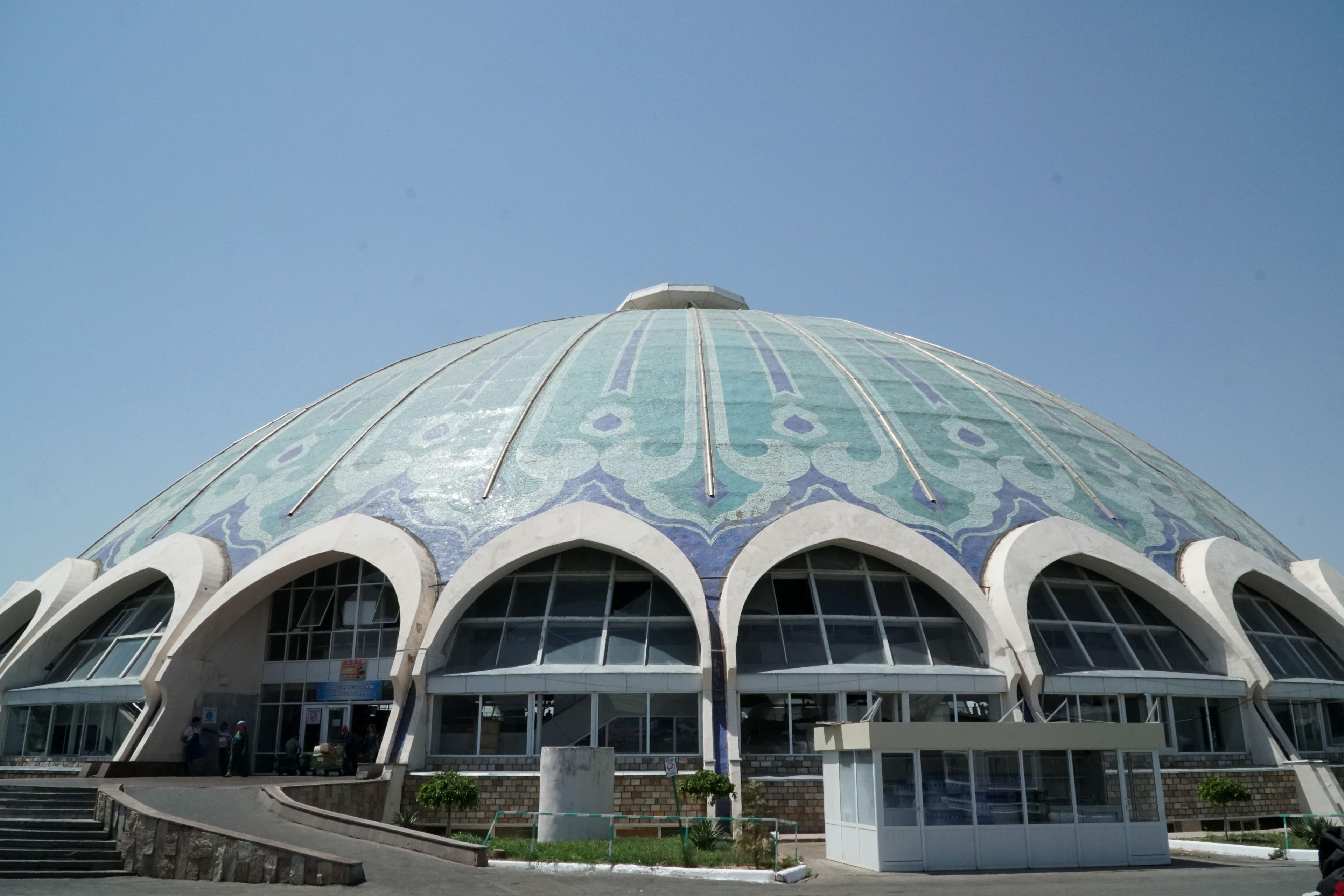
Streets. Tashkent's main avenues have wide pavements, but crossing them often means an underpass with stairs, and dropped kerbs are inconsistent. The Hazrati Imam complex is a flat open plaza with thresholds into the buildings. Chorsu Bazaar's domed hall is reached by ramps and stairs and is crowded; the outdoor market around it is flat. A January 2026 draft law on transport proposes mandatory accessibility standards for urban transport and its infrastructure, which tells you both that change is coming and that it has not arrived.
Trains: the Afrosiyob and the overnight sleepers
The Afrosiyob, the Spanish-built Talgo high-speed train on the Tashkent, Samarkand and Bukhara route, is the most accessible way to travel between the cities. Its floor is level through the train, there is a zone in one carriage with wheelchair spaces, securing straps and a call button for the conductor, and an accessible toilet. Ask for the wheelchair space when buying tickets through an agency or at the station; the online booking form does not make it obvious. Platforms in Uzbekistan are low, so boarding uses the train's steps or a portable ramp with staff help; arrive 40 minutes early and tell the platform staff.
The new Jaloliddin Manguberdi high-speed train to Khiva uses Korean-built Hyundai Rotem sets, which in service elsewhere have wheelchair spaces and accessible toilets, but we have not yet confirmed what is provided on the Uzbek trains; ask before you rely on it. Since a government resolution of December 2024, Uzbekistan Railways lists free use of wheelchairs at stations for passengers with disabilities, and some stations also have staff assistance to the platform if asked.
Overnight sleeper trains are not suitable for wheelchair users: narrow corridors, high steps and compartment toilets. Stations themselves have airport-style security at the entrance with a scanner, a step or ramp depending on the building, and long walks to platforms; Samarkand's and Bukhara's modern stations are better than the older ones.
Flights, cars and getting around cities
Domestic flights work well for the long western legs. Tashkent to Urgench (for Khiva) and Tashkent to Nukus take about an hour and a half; regional airports are small and single-level, with assistance available on request through the airline. Flying from Tashkent to Urgench, seeing Khiva, then taking the train east is the gentlest route around the whole country.
For cities and transfers, a private van is the tool that makes everything else possible. A minivan with a sliding door and space for a folded chair is standard; a vehicle with a lift or ramp for a powered chair is not, so travellers in power chairs should tell us the weight and dimensions well in advance. There is no wheelchair-accessible category in the Yandex Go taxi app in Uzbekistan as far as we know, and ordinary taxis are small saloon cars. Typical 2026 rates for a private car and driver are about US$50 to 100 a day, more for a large van.
Mobility scooters: they can be carried in a van and used in the Registan, Bukhara's old town and Ichan-Kala, within the limits of the paving. There is nowhere to hire one.
Hotels and toilets
We do not name hotels here, but the pattern is consistent. The international chains in Tashkent and Samarkand, and the large new hotels at the Silk Road Samarkand complex, have lifts, wide doors and a small number of rooms with roll-in showers or grab rails; ask for one explicitly and for a photo of the bathroom. Mid-range city hotels usually have a lift but standard bathrooms with a bath or a shower tray step. The boutique hotels in the old towns of Bukhara and Khiva, often converted merchant houses or madrasah-style courtyards, are the most atmospheric and the least accessible: steps at the street door, rooms off a courtyard, no lift to upper floors. In Bukhara and Khiva, we look for single-storey courtyard hotels with ground-floor rooms and a level entrance, and they exist.
Toilets are the daily difficulty. Accessible public toilets are nearly nonexistent; squat toilets are common at monuments and roadside stops; restaurants in the cities have Western toilets but often up or down a step and behind a narrow door. Plan the day around hotel and good-restaurant stops, and carry a travel urinal if that helps.
What a private tour can change, and what it cannot
What we can adapt:
- The vehicle: a van to the nearest gate of every site, with the chair ready.
- The pace: two short outings a day with a rest between, and no sightseeing in the midday heat from June to September.
- The route: entering the Registan by the ramp, skipping the Ark interior for Bolo-Hauz, viewing Shah-i-Zinda from the top gate, choosing flat restaurants and hotels with level access.
- The people: a guide who has done this before, knows which thresholds have a loose ramp behind the door, and will ask staff for help without fuss.
- Our guests on tour have a local contact number for any problem during the trip.
What we cannot change: the 36 steps of Shah-i-Zinda, the stairs inside every minaret and watchtower, the cobbles of Ichan-Kala and the trading domes, old metro stations, and the general shortage of accessible toilets. Travellers who know these limits in advance consistently tell us the trip was worth it; the architecture is mostly at ground level, and the country's hospitality does the rest.
Planning an accessible trip with TourEast
Tell us how you move, what you use and what tires you, and we will build a private itinerary around it: Afrosiyob wheelchair spaces, a van and driver throughout, hotels chosen for level access, and days that start early and end with the Registan lit at night. Our relaxed small-group tour suits slow walkers who do not need a chair; for wheelchair users we recommend a private programme, where every detail can be set in advance.