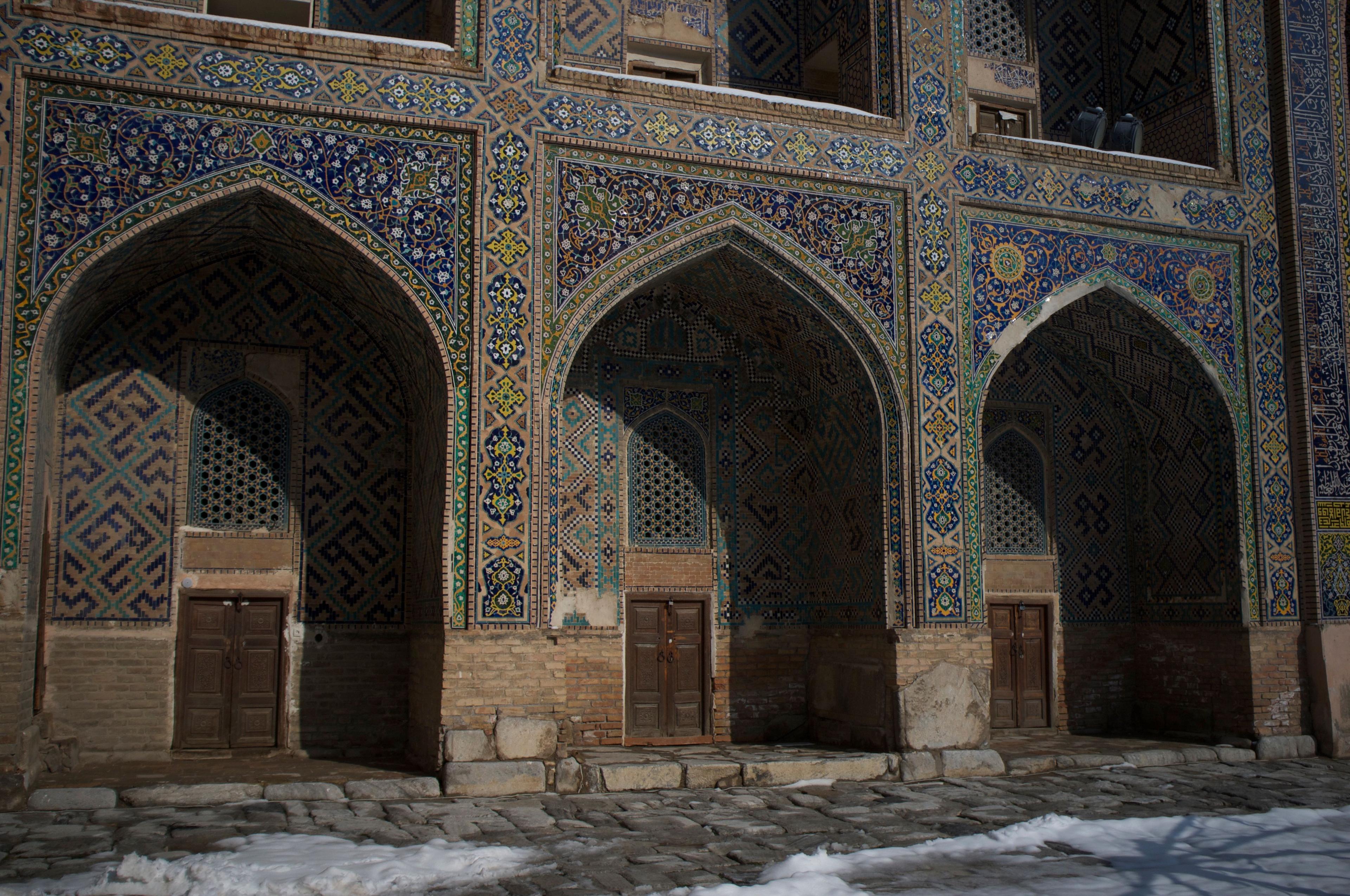
A 4-day Uzbekistan itinerary for short breaks and stopovers: the Afrosiyob train to Samarkand and Bukhara, realistic timings, what to skip, costs as of 2026 and how to stretch the plan to six days.
Facts, prices and schedules checked on November 4, 2026
Four days is a short time for a country with this much history, but it is enough for the two cities that matter most to a first-time visitor: Samarkand and Bukhara. The Afrosiyob high-speed train links Tashkent, Samarkand and Bukhara in two hours or less per leg, which means a 4-day Uzbekistan itinerary does not need domestic flights, long drives or a single wasted morning.
This guide gives the plan day by day, with realistic timings, what to cut when you are tired, and what the trip costs as of November 2026. It works as a long weekend, as a stopover on a longer Asian journey, or as a first taste that makes you plan the longer visit. If you can find a fifth day, our 5-day itinerary adds a proper afternoon in Tashkent; with six days you can add Khiva by air.
Is 4 days enough for Uzbekistan?
For Samarkand and Bukhara, yes. For the whole country, never, and nobody should pretend otherwise.
What four days buys you:
- One full day and an evening in Samarkand: the Registan, Bibi-Khanym, Shah-i-Zinda and Gur-e-Amir.
- One full day in Bukhara: the trading domes, Po-i-Kalyan, the Ark Fortress and the Samanid Mausoleum.
- Two train journeys through the steppe and a connection through Tashkent at the start or the end.
What it does not buy you: Khiva, the Fergana Valley, the desert fortresses of Khorezm, a yurt night or time to sit still. The honest advice is to treat these four days as a very good sampler, not as a complete trip. Skip Tashkent as a destination, see only its station and airport, and spend every waking hour in the two historic cities.
The 4-day Uzbekistan itinerary at a glance
- Day 1: Arrive in Tashkent in the morning, take a midday Afrosiyob to Samarkand. Registan at sunset and after dark.
- Day 2: Samarkand. Shah-i-Zinda, Gur-e-Amir, Bibi-Khanym and Siab Bazaar, with the Ulugbek Observatory if energy allows.
- Day 3: Morning train to Bukhara (about 1 h 50 min). Lyabi-Hauz, the trading domes, Po-i-Kalyan at sunset.
- Day 4: Bukhara. Ark Fortress, Samanid Mausoleum, Sitorai Mohi-Hosa. Afternoon train or flight to Tashkent for your departure.
The skeleton is simple: three nights, two cities, two trains. The only variable is how you enter and leave the country, which we cover below.
Day 1: land in Tashkent, reach Samarkand by afternoon
Many international flights land in Tashkent early in the morning. If yours does, you can be at the main station by 09:00 and in Samarkand by early afternoon. The Afrosiyob timetable as of autumn 2026 has morning departures at about 06:10 and 07:30, and later services during the day; check the live times on the Uzbekistan Railways site (railway.uz) or app, because the pattern changes with the season.
The journey takes about 2 h 15 min. Arrive at the station 30 to 40 minutes before departure with your passport, since documents are checked at the entrance and again at the carriage door. Samarkand's station is some 6 km from the Registan, 15 to 20 minutes by taxi.
- Afternoon: check in, rest, then walk to the Registan, the great square of three madrasahs. Allow two hours. The gilded interior of Tilla-Kari is the one most visitors forget.
- Early evening: the square is lit after dark and is at its best from dusk to about nine. Dinner in the old centre afterwards.
If you land late in the evening, treat day 1 as a transfer: sleep in Tashkent and take the first train on day 2. You then lose the Registan at night but gain an unhurried morning, and you can move Siab Bazaar to the end of the day.
Day 2: Samarkand in one full day
Samarkand rewards a slow day, but one day can cover its core if you sequence it by light and crowds.
- Early morning: Shah-i-Zinda, the avenue of mausoleums climbing a hillside. Go at opening, before the groups, when low sun hits the tilework. An hour and a half is enough.
- Mid-morning: Gur-e-Amir, the mausoleum of Amir Timur, beneath its ribbed blue dome.
- Midday: Bibi-Khanym Mosque, the giant that Timur had built after his Indian campaign, and Siab Bazaar next door for dried fruit, nuts and the round Samarkand bread. Lunch at a chaikhana.
- Afternoon: either the Ulugbek Observatory and the Afrosiab museum, with its 7th-century murals of ambassadors at the Sogdian court, or a rest in the shade. In summer, rest.
- Evening: a second walk past the Registan or a drive to a restaurant with a view over the old town.
If you can only see three things, they are Shah-i-Zinda, the Registan and Gur-e-Amir. Everything else is optional.
Day 3: the train to Bukhara and your first evening there
The morning Afrosiyob from Samarkand, at about 08:23 or 09:43, reaches Bukhara in roughly 1 h 50 min. Bukhara's station is in Kagan, 12 to 15 km from the old town, so allow 25 to 30 minutes by taxi to your hotel.
Bukhara is smaller and slower than Samarkand, and the old town is best on foot.
- Midday: Lyabi-Hauz, the pool beneath old mulberry trees, with the Nadir Divan-Begi madrasah on one side. Lunch here or on a nearby terrace.
- Afternoon: the three trading domes, Toki Sarrafon, Toki Telpak Furushon and Toki Zargaron, where merchants once traded money, caps and jewellery, then the Ulugbek and Abdulaziz Khan madrasahs facing each other.
- Late afternoon: Po-i-Kalyan, the ensemble of the Kalyan Minaret, the Friday mosque and the Mir-i-Arab Madrasah. Stay until the light goes.
- Evening: dinner on a rooftop near Po-i-Kalyan, or back at Lyabi-Hauz.
A good rhythm for the day is to take the train early, see nothing for the first hour except a coffee and a hotel room, and then do the old town in one continuous afternoon walk.
Day 4: Bukhara's citadel, and the way home
Morning is for the Ark Fortress, the emirs' citadel, and the Bolo-Hauz mosque across the road with its painted wooden columns. A short walk beyond is the Samanid Mausoleum, a 10th-century cube of patterned brick that many visitors call the most beautiful building in the city.
If time allows, add one of two extras:
- Sitorai Mohi-Hosa, the last emir's summer palace, about 4 km north of the centre.
- Chor Minor, the small gatehouse with four towers in the back streets.
Then comes the return, with two sensible options.
- Afrosiyob to Tashkent: about 3 h 50 min. A one-way economy seat cost 509,000 som (about US$43) as of November 2026. It is comfortable and city centre to city centre.
- Fly Bukhara to Tashkent: about an hour in the air. Uzbekistan Airways' cheapest fares on the route started around 241,000 som (about US$20) after its October 2026 fare cut. Airport time makes it only slightly faster than the train.
If your flight home leaves Tashkent after midnight, you can stay in Bukhara until the late afternoon. If it leaves in the morning, build the night in Tashkent into the plan and cut the Ark or the extras.
Smarter ways to arrive and leave
The default plan runs Tashkent in, Tashkent out. Two alternatives save time on a four-day trip.
- Fly into Samarkand. Samarkand International Airport has direct flights from Istanbul and Dubai, among others, as of 2026. Landing there removes the first train and gives you a full first afternoon. Check the airline schedule for your dates.
- Open-jaw: fly into Samarkand, finish in Bukhara and fly out of Tashkent the next morning, or the reverse. Most airlines price open-jaw tickets only slightly above a return, and it removes the last train.
If you are connecting through Istanbul, Dubai or Doha, our separate guide to a Gulf or Istanbul stopover shows how to pair them with Uzbekistan. For a deeper look at the trains themselves, see our Afrosiyob guide and the article on booking train tickets.
What to skip, and what to add if you have six days
When time is short, cut in this order:
- Tashkent. Keep it to the station, the airport and perhaps one dinner.
- The Ulugbek Observatory, the Afrosiab museum and Sitorai Mohi-Hosa.
- Chor Minor and any second museum.
Never cut Shah-i-Zinda, the Registan at dusk, Po-i-Kalyan or the Samanid Mausoleum.
With two extra days, the gain is large:
- Add a second night in Bukhara, which turns a rush into a walk, or a half day at Gijduvan and the Seven Pirs shrines.
- Fly from Bukhara or Tashkent to Urgench for Khiva, whose walled Ichan-Kala takes a full day. Our Khiva guide explains the connection.
- Add a day in Tashkent for the Hazrati Imam complex, Chorsu Bazaar and the metro.
Booking, season and what 4 days costs
Book the trains first. Uzbekistan Railways opens sales up to 60 days before departure, and popular morning Afrosiyob services can sell out in April, May, September, October and around Navruz in March. Foreign passports are accepted and cards work online.
Fares as of November 2026, one way in economy: Tashkent to Samarkand 311,000 som (about US$26); Samarkand to Bukhara roughly 165,000 to 200,000 som (about US$14 to 17); Bukhara to Tashkent 509,000 som (about US$43). Business class costs more.
Best months are late March to May and September to early November. July and August often pass 40 degrees in Bukhara, and a four-day plan survives that only if you sightsee early and late. Winter is cold, clear and quiet.
Typical costs in 2026, per person and excluding international flights: trains about US$55 to 60 in economy for the four legs used here, boutique hotel doubles from about US$50 to 100 a night in the old towns, entrance fees of roughly US$30 to 45 across the trip, lunches at US$4 to 8 and dinners at US$15 to 30. An independent traveller in mid-range hotels spends roughly US$300 to 500 on the ground for four days. A private guide and car are typically US$50 to 100 a day each, as of 2026.
Doing it with TourEast
We run this four-day route as a private journey with a guide and driver, and we can book the Afrosiyob seats as soon as sales open, meet you at each platform and adapt the days to your flight times. Tell us when you land and when you leave, and we will plan the days around them, or build the version with Khiva in our trip builder at /trip-builder. You can also message us on WhatsApp with your dates.