Planning Uzbekistan from South Korea: the visa-free rule to confirm, direct flights between Seoul and Tashkent, kuksi and Korean salads in Tashkent, a respectful visit to Koryo-saram heritage, and a route that fits eight to ten days.
Facts, prices and schedules checked on November 4, 2026
South Korea and Uzbekistan are closer than the map suggests. The flight between Seoul and Tashkent takes about six hours, Korean passport holders can enter Uzbekistan without a visa for a short stay, and Tashkent has one of the most unusual Korean communities in the world, the Koryo-saram, whose ancestors arrived as deportees in 1937 and whose food is on every bazaar stall in the country.
This guide is for Korean travellers planning a first trip: the entry rule to confirm, the flights, how to eat well if you miss spicy food, how to visit Koryo-saram heritage with respect, and a route of eight to ten days through Tashkent, Samarkand, Bukhara and Khiva. It is a different angle from our article on the Koryo-saram themselves, which tells the history in detail; here the focus is practical.
Everything is as of November 2026. Visa rules and flight schedules change, so confirm them with the official sources before you book.
Do Korean citizens need a visa for Uzbekistan?
Most sources, including Uzbek tourism officials speaking at a Seoul tourism forum in 2025, say that citizens of the Republic of Korea can enter Uzbekistan without a visa for up to 30 days from the date of entry. The regime dates from a 2018 decree that also covers Japan, Singapore, Malaysia, Indonesia, Turkey and Israel.
Two cautions. First, a 2018 foreign ministry notice listed Korea under a longer stay, so older pages disagree; the 30-day figure is the one used in the decree and recent guides. Second, rules change, so check current rules on the Uzbek e-visa portal or with the Embassy of Uzbekistan in Seoul before travel.
Carry a passport valid for at least six months, and an onward or return ticket. Hotels register foreign guests automatically within three days of arrival; if you stay in a private home, ask your host. If you plan to stay longer than 30 days or to continue to a neighbouring country, check the rules for each border in our Central Asia visa guide.
Are there direct flights from Seoul to Tashkent?
Yes. Direct flights link Incheon and Tashkent, and the flight takes about six hours. As of November 2026 the main operators reported by schedule databases are:
- Uzbekistan Airways, with Boeing 787 aircraft. Flights typically leave Tashkent in the late evening and land in Seoul the next morning, with the opposite pattern on the return.
- Korean Air, which sells seats on the Uzbekistan Airways flights under a codeshare on certain days.
- Centrum Air, a private Uzbek airline, which began regular direct flights between Tashkent and Incheon in July 2025.
Aggregator sites disagree on the number of weekly flights and on which airlines are included, with estimates from about 14 to 20 a week at different dates in 2026. Do not rely on a single aggregator. Check the airlines' own sites for your dates. Uzbekistan is four hours behind Korea, so jet lag is mild.
Plan the first day as a rest day. Many eastbound flights land at Tashkent in the early morning, and an immediate train to Samarkand tends to spoil the day. See our guide to Tashkent airport for the arrival process.
Korean food in Tashkent
You will not go hungry if you miss Korean flavours. Uzbekistan has a distinct Korean cuisine created by the Koryo-saram, and it is part of everyday eating.
- Kuksi, a cold noodle soup in a beef broth with vegetables and egg, popular in summer.
- Morkovcha or Korean carrot, a shredded carrot salad with garlic, vinegar and chilli, sold at every bazaar.
- Other Korean-style salads, such as marinated vegetables and eggplant, sold by weight at stalls.
Start at Chorsu Bazaar, where rows of women sell Korean salads by weight. For a sit-down meal, Tashkent has a growing number of Korean restaurants serving both the South Korean community and locals. We have not confirmed the current opening status of specific restaurants, and restaurant lists go out of date quickly, so check recent reviews and hours or ask your guide. Do not expect Seoul-standard kimchi everywhere: Koryo-saram dishes are an adaptation of Korean cooking, and Korean visitors often find them familiar but different.
Alongside, try the local dishes that Korean palates tend to like: lagman noodle soup, manti dumplings, samsa pastries and grilled kebabs. If you need a mild or spicy fix, ask for chilli on the side. Our guides to Uzbek food and street food cover the table.
Visiting Koryo-saram heritage with respect
The Koryo-saram are ethnic Koreans of the former Soviet Union. In 1937 the Soviet authorities deported about 172,000 Koreans from the Russian Far East to Kazakhstan and Uzbekistan, and many families still carry that memory. Today the community is part of Uzbek life.
A few points on how to approach it:
- Most Koryo-saram speak Russian as a first language, and few speak Korean fluently. Do not assume a shared language.
- Ask questions about family stories, food and traditions, and listen. Avoid asking about death tolls or politics.
- Do not reduce the community to its cuisine, and do not photograph people without permission.
- A guide who knows the history and local families can introduce the story with care.
In Tashkent the House of Korean Culture and Art is a place to begin, and Chorsu Bazaar is where the food culture is most visible. Our Koryo-saram article describes the history and the dishes at length.
What to eat in each city if you like heat and noodles
Korean travellers often ask about spicy and noodle dishes, so here is a quick map of the route.
- Tashkent: lagman, hand-pulled noodles in a rich vegetable and meat sauce, and kuksi at the bazaar. Achichuk, a salad of thin tomato and onion, is the usual side.
- Samarkand: plov, samsa from clay ovens and fresh bread from Siab Bazaar. Samarkand bread is a good snack to carry.
- Bukhara: shurpa, a clear meat and vegetable soup, and kebabs in the old town.
- Khiva: shivit oshi, green noodles served with a yoghurt-like sauce, and tukhum-barak dumplings.
Uzbek food is seasoned with cumin, black pepper and herbs rather than chilli, so ask for a chilli sauce if you want heat. Dairy and bread are central, and tea is served with every meal. Our regional cuisines guide goes deeper.
Etiquette notes
Greetings are warm, with handshakes among men and a hand on the chest as a courteous gesture. Remove your shoes when entering a home or a prayer hall, and never refuse an offer of tea outright. Bread is treated with respect, so do not put it face down on the table. Dress modestly at mosques and shrines. Our culture and etiquette guide covers the details.
A route for Korean travellers
An eight to ten day plan works well with the direct flights and suits Korean travellers who like a mix of culture, food and photography.
- Day 1: Arrive in Tashkent, rest, then Chorsu Bazaar and a Koryo-saram lunch.
- Day 2: Tashkent: Hazrati Imam complex, the Tashkent Metro stations, the House of Korean Culture and Art. Evening Afrosiyob to Samarkand or an early train the next day.
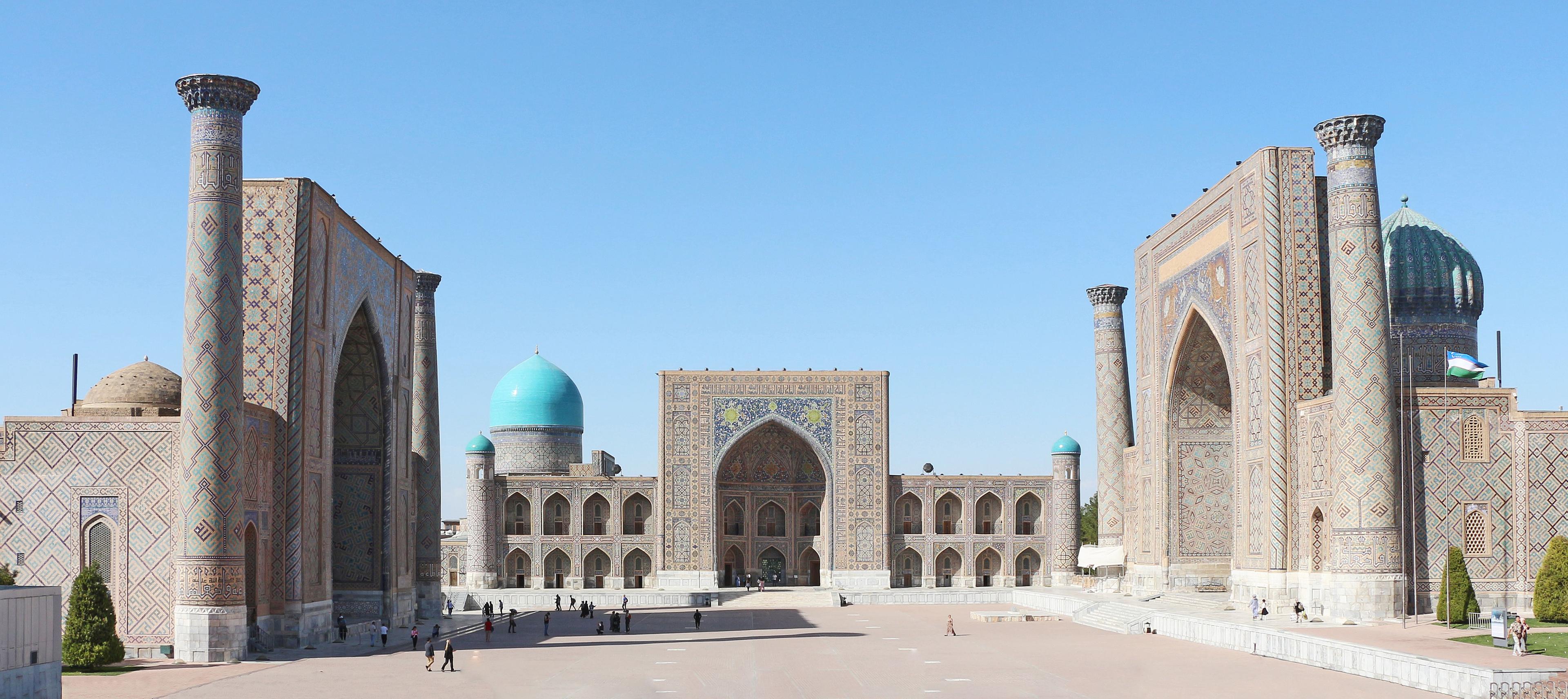
- Days 3 and 4: Samarkand: Registan by day and at night, Shah-i-Zinda, Gur-e-Amir, Bibi-Khanym.
- Days 5 and 6: Bukhara: Lyabi-Hauz, trading domes, Po-i-Kalyan, Ark, Samanid Mausoleum.
- Days 7 and 8: Khiva: Ichan-Kala, then fly back to Tashkent.
- Days 9 and 10: Tashkent or an optional day trip into the Chimgan mountains.
Our classic 8-day tour and the Silk Road grand tour follow a similar shape. For the best weather, travel in April to early June or mid-September to October. Summers pass 40°C in Bukhara and Khiva, and winters are cold. Korean travellers who ski may consider Amirsoy or Chimgan between December and March.
Practical tips for Korean visitors
- Maps and messaging. Naver and Kakao Map do not work well in Uzbekistan. Use Google Maps or Yandex Maps, and Yandex Go for taxis. Telegram is the most widely used messenger.
- Money. Bring US dollars in clean notes to exchange, or withdraw som from ATMs. Cards work in hotels and many restaurants. See our money guide.
- SIM. Buy a local SIM or an eSIM on arrival. See our SIM guide.
- Guides. English-speaking guides are standard. If you would like a Korean-speaking guide, ask us early, since they are not always available.
- Language. Russian and Uzbek dominate. A few words go a long way.
- Dress. Modest clothing at mosques and shrines, with shoulders and knees covered.
Planning your trip with TourEast
We can build a private or small-group trip around your flight times, with a Koryo-saram half day in Tashkent and the classic Silk Road cities. Tell us your dates and interests and we will suggest a route, or sketch one in our trip builder at /trip-builder. You can also message us on WhatsApp.