A Samarkand itinerary hour by hour: the best order for the Registan, Gur-e-Amir, Bibi-Khanym and Shah-i-Zinda, when the light is right and the groups have gone, the Registan light show, a one-day version and ideas for a third day.
Facts, prices and schedules checked on November 4, 2026
Two days in Samarkand is the sweet spot for most travellers: enough to see the Registan, Gur-e-Amir, Bibi-Khanym and Shah-i-Zinda without rushing, to catch the right light on each of them and to be on the Registan steps when the floodlights come on. This Samarkand itinerary is the schedule, hour by hour, in the order we would suggest.
We do not repeat the history of each monument here. Our Samarkand travel guide and the separate guides to the Registan, Shah-i-Zinda, Gur-e-Amir and Bibi-Khanym, and Samarkand beyond the Registan cover what you are looking at. This page answers the practical questions: what to see first, when the groups arrive, where to be at sunset, what time the light show starts, and how to adapt the plan if you have one day or three.
All times assume spring or autumn, the most popular seasons. We explain at the end how to shift the plan for summer heat and short winter days.
How many days do you need in Samarkand?
- One day: possible, and many people do it as a day trip from Tashkent on the Afrosiyob train. You will see the four great monuments, but from the outside more than the inside, and you will probably miss the evening lights.
- Two days: our recommendation. The classic sights on day one, Shah-i-Zinda at its quietest and the older city on the Afrosiyob hill on day two, plus two evenings.
- Three days: time for a slower pace and a day out of town, such as Shakhrisabz, the Konigil paper mill, the Urgut bazaar or the Imam al-Bukhari complex.
Two days usually means two nights, ideally arriving the evening before or on an early morning train. Most travellers come in from Tashkent on the Afrosiyob, which takes a little over two hours, and continue to Bukhara in under two hours. Our guides to getting from Tashkent to Samarkand and from Samarkand to Bukhara cover the trains.
Before you start: distances, light and crowds
Samarkand's main sights sit along one line, which makes planning simple. From south-west to north-east: Gur-e-Amir, then the Registan about 10 minutes' walk away, then the pedestrian Tashkent Street running 10 to 15 minutes to Bibi-Khanym and the Siab Bazaar, then Shah-i-Zinda another 10 minutes beyond. The Afrosiyob Museum and the Ulugh Beg Observatory are a short taxi ride further north-east. Yandex Go works well and city rides are cheap; our guide to getting around Uzbekistan's cities explains it.
Three rules shape the schedule:
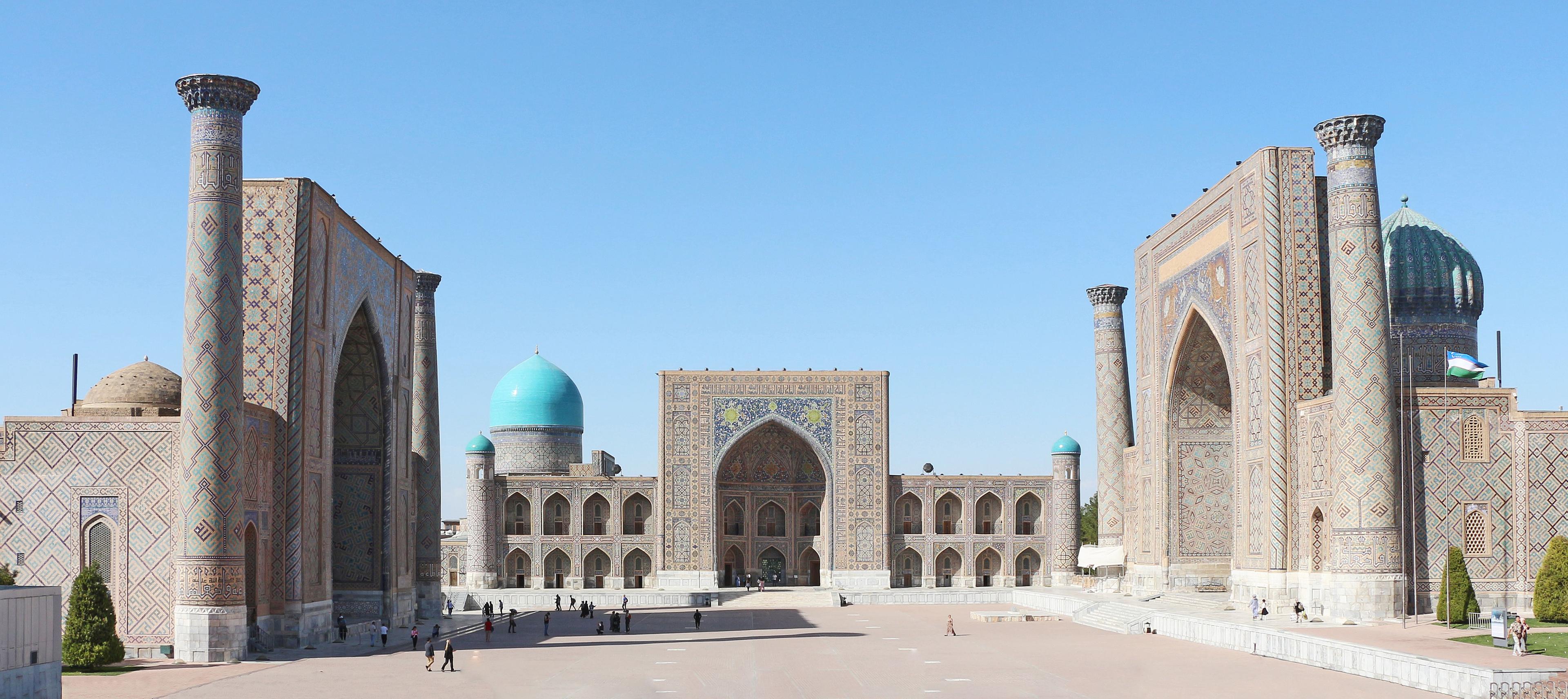
- Light. The Registan opens to the south. The Ulugbek Madrasah on the west side catches the morning sun, the Sher-Dor on the east side, with its famous tigers, glows in the late afternoon, and the gilded interior of the Tilya-Kori mosque is at its best in the morning. Shah-i-Zinda's narrow lane is softest early in the day.
- Crowds. Tour groups tend to reach the Registan from mid-morning and again in the late afternoon, and Shah-i-Zinda fills up after lunch. Wedding couples pose on the Registan and at Shah-i-Zinda in the afternoon, especially at weekends.
- Heat. From June to August, afternoons pass 35°C. Plan to be indoors or resting between about 13:00 and 16:00.
So the logic is simple: the Registan early, Shah-i-Zinda early on the other day, museums and lunch in the middle of the day, and the evenings for the lit-up monuments.
Day 1 morning: the Registan and Gur-e-Amir
- 07:30 Breakfast at your hotel. Most open early.
- 08:00 to 08:30 The Registan at opening time. Buy the single ticket that covers all three madrasahs. Start in the Ulugbek Madrasah while the morning sun is on its portal, then cross to the Tilya-Kori and its gilded mosque while the light comes through the doorway, and finish in the Sher-Dor courtyard. Allow one and a half to two hours.
- 10:15 Walk south-west to Gur-e-Amir, about 10 minutes. The golden hall under the ribbed dome takes 45 minutes to an hour. Look also at the ruins of Muhammad Sultan's madrasah in the courtyard.
- 11:15 If you have energy, walk five minutes to the seated statue of Amir Timur on University Boulevard, or simply take a tea break in the shade.
- 12:30 Lunch. Samarkand plov is a lunchtime dish, cooked in the morning and often sold out by mid-afternoon, so this is the moment for it. Our guide to Uzbek plov explains the Samarkand style.
The Registan ticket is valid for a single entry according to recent visitors, so see the interiors in one visit. You do not need a ticket to come back in the evening: the viewing platform and the steps facing the square are free.
Day 1 afternoon and evening: Bibi-Khanym and the Registan light show
- 14:00 Rest at your hotel, especially from May to September. In cool months, use the time for the Siab Bazaar instead.
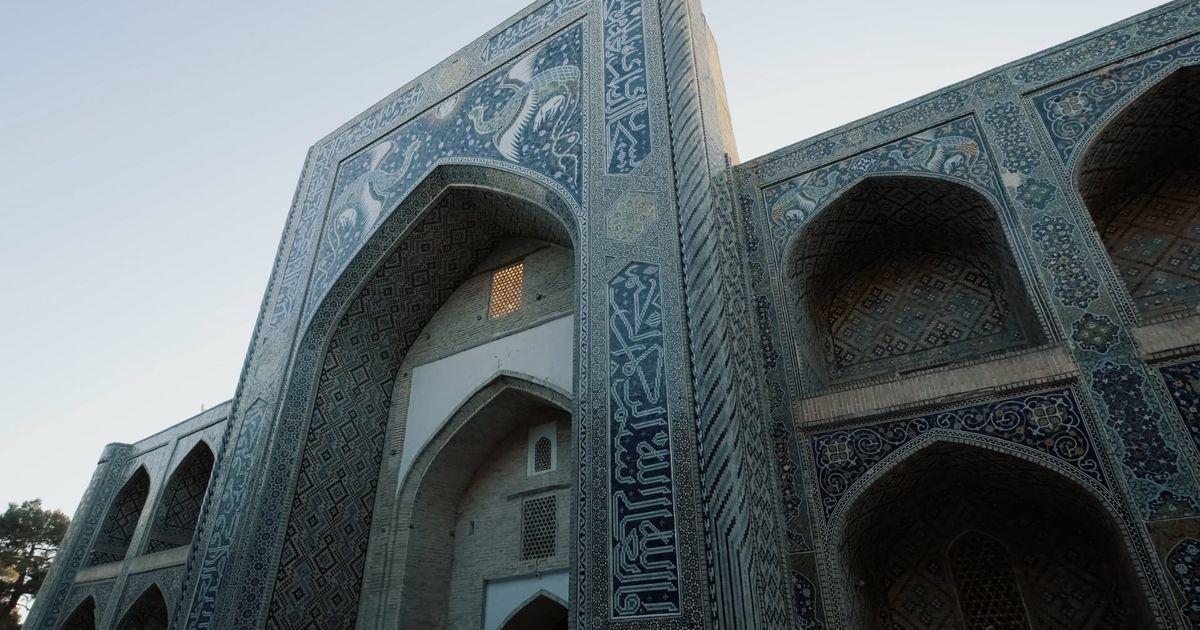
- 15:30 Walk up Tashkent Street from the Registan to the Bibi-Khanym Mosque. Its courtyard and the giant marble Quran stand are at their calmest in the late afternoon. Allow 45 minutes to an hour, plus 30 minutes if you cross the road to the Bibi-Khanym Mausoleum.
- 16:45 Climb the steps to the Hazrat Khizr Mosque, five minutes away, for the view back over Bibi-Khanym and the bazaar domes. It is a working mosque, so dress modestly and avoid prayer times.
- 17:30 Walk back down Tashkent Street to the Registan. This is when the Sher-Dor façade takes the warm side light, the best hour for photographs of the tigers from the platform.
- Sunset and blue hour: stay on the steps. About 20 to 30 minutes after sunset the floodlights balance with the last colour in the sky.
- After dark: the sound and light show, then dinner nearby.
What time is the Registan light show? There is no official timetable. Recent reports put the square's illumination from about 20:00 in summer and a show of around 20 minutes from about 20:30, with earlier starts in spring and autumn when the sun sets sooner. It is free to watch from the platform and steps. It is not held every night: special events on the square can replace it, and in winter 2025 to 2026 it paused from late November until late February. Ask at your hotel or your guide on the day.
If there is no show, the lit square is still worth the walk, and Gur-e-Amir at night, 10 minutes away, is just as beautiful.
Day 2 morning: Shah-i-Zinda at opening and the Afrosiyob hill
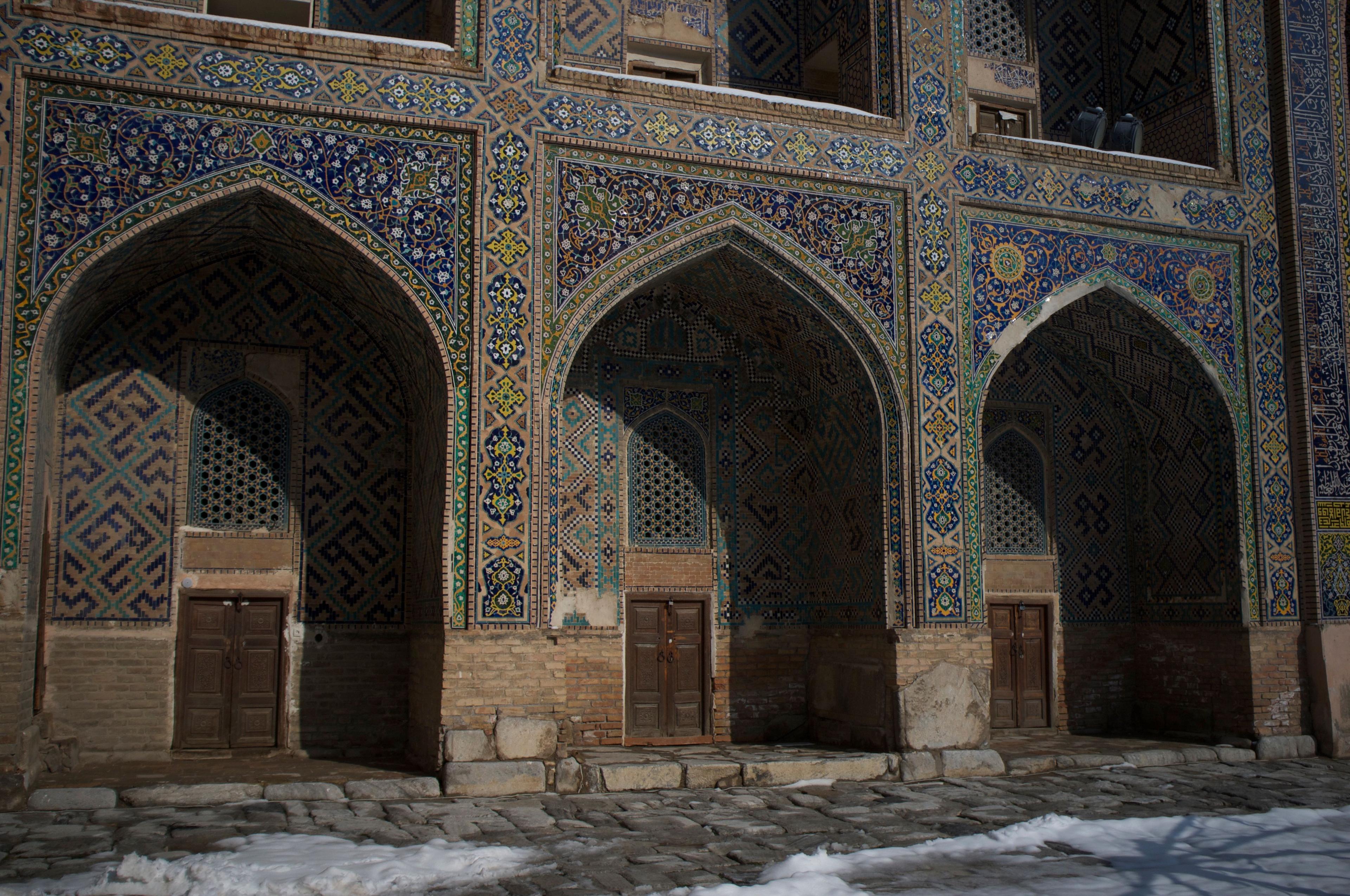
- 07:30 to 08:00 Shah-i-Zinda as it opens. Opening hours vary by season, so check the evening before. At this hour you share the lane mainly with pilgrims, and the carved tiles are lit evenly without glare. Climb slowly, see the upper shrine of Kusam ibn Abbas, then walk back down; the views differ in each direction. Allow one to one and a half hours, and cover shoulders and knees.
- 09:30 Taxi or walk to the Afrosiyob Museum, five minutes by car, for the 7th-century Ambassadors' Painting. Allow 45 minutes, and 20 minutes more if you want to walk out onto the mounds of the ancient city.
- 10:45 Optional: the Mausoleum of Daniel (Khoja Doniyor), about 1.5 km on, a quiet pilgrimage site with a view over the river valley. Allow 30 to 45 minutes.
- 11:45 The Ulugh Beg Observatory, a few minutes by taxi. The museum and the trench of the great sextant take 45 minutes to an hour.
- 13:00 Back to the Siab Bazaar for bread, dried fruit and nuts, then lunch nearby.
Several sources say the Siab Bazaar is closed or much quieter on Mondays. If day two falls on a Monday, swap it with the afternoon of day one.
Day 2 afternoon and evening: workshops, Gur-e-Amir by night or the Eternal City
- 14:30 A rest, or the silk-carpet workshop on Hujum Street near Bibi-Khanym, where you can follow a carpet from cocoon to loom. Entry is free, and weekday working hours are best to see the weavers.
- 16:00 Choose one:
- The Konigil paper mill, about 20 to 25 minutes by taxi, for Samarkand paper made by water-wheel in a shady garden. Good with children and on hot afternoons.
- A slow return to the Registan or Bibi-Khanym for photographs you missed on day one.
- Shopping in the craft workshops in the Registan madrasah cells.
Evening: two good options.
- Gur-e-Amir by night. The ribbed dome lit against the dark sky is many people's favourite image of the city. In September 2026 the national tourism committee announced that the mausoleum and the Bibi-Khanym complex stay open until 23:00 as part of a night-tourism programme, so you may be able to step inside the gilded hall after dark. Check locally, especially in winter.
- The Eternal City at the Silk Road Samarkand complex, about 20 minutes by taxi: a modern reconstruction of regional streets with craftspeople, teahouses and evening performances. The complex's website lists 10:00 to 22:00 from Monday to Thursday and until 23:00 from Friday to Sunday.
One day in Samarkand: the day-trip version
If you only have one day, for example as a day trip from Tashkent, keep it tight and accept that you will see more façades than interiors.
- 06:10 or 07:30 Afrosiyob from Tashkent, arriving a little over two hours later. Take a taxi from the station, 15 to 20 minutes to the centre.
- 09:30 Gur-e-Amir, close to the route in from the station.
- 10:30 The Registan, interiors included. Allow at least an hour and a half.
- 12:30 Lunch with plov near the Registan.
- 14:00 Walk Tashkent Street to Bibi-Khanym and the Siab Bazaar.
- 15:30 Shah-i-Zinda.
- 17:00 Taxi to the station for a late afternoon or evening train back, such as the departures at about 17:40 or 18:49.
The price of a day trip is the evening. If you can, stay one night: you gain the Registan lights, Gur-e-Amir by night and Shah-i-Zinda at dawn, which are three of the best moments in Uzbekistan. Our article on the Tashkent to Samarkand train has the current departure pattern; check the live timetable on the Uzbekistan Railways site.
Three days in Samarkand: options for the third day
With a third day, leave the city or slow down. Good choices:
- Shakhrisabz: Timur's birthplace and the ruins of his Ak-Saray palace, across the Takhtakaracha Pass in about two hours each way. A full day; our Shakhrisabz day trip guide has the details.
- Urgut bazaar: about an hour south-east, best on Sunday mornings for suzani and old textiles. Combine with the ancient plane trees of the Chor-Chinor garden.
- The Imam al-Bukhari complex: the memorial to the great hadith scholar, about 30 minutes north of the city, a place of pilgrimage. Our ziyarat guide covers etiquette.
- Konigil and the Eternal City at a gentle pace, if you skipped them on day two.
- Panjakent in Tajikistan, if you hold the right documents: the border is about an hour away. Our Panjakent and Khujand article explains the crossing.
Or take the day for things the two-day plan rushes: a cooking class, a long lunch in a teahouse, and the Registan a third time, in the late afternoon when the light is warmest.
Adjusting the plan for summer, winter and Ramadan
- Summer (June to August): start at 07:30, rest from 13:00 to 16:00, and do the Afrosiyob Museum and Ulugh Beg Observatory in the morning. Evening opening hours make the city easier in the heat. Sunset is around 19:45 to 20:00 in June and July.
- Spring and autumn (April, May, September, October): the plan works as written. Sunset falls roughly between 18:00 and 19:30 depending on the month.
- Winter (November to March): monuments typically open later and close at about 17:00 to 18:00, and sunset comes at about 17:00 in December. Start at 09:00, move Shah-i-Zinda to late morning, and check whether the light show is running.
- Ramadan and Fridays: Shah-i-Zinda, the Hazrat Khizr Mosque and Khoja Doniyor are active religious sites. Avoid Friday midday prayers, and during Ramadan expect some teahouses to open only after sunset.
Our weather by month guide and our articles on Uzbekistan in spring, summer, autumn and winter give the bigger picture.
Samarkand entrance fees for a two-day visit in 2026
Each monument has its own ticket office, and cash in som is safest. Typical prices for foreign adults as of November 2026:
- Registan (all three madrasahs): about 100,000 som
- Shah-i-Zinda: about 50,000 som
- Gur-e-Amir: about 65,000 to 75,000 som
- Bibi-Khanym Mosque: about 65,000 to 75,000 som
- Ulugh Beg Observatory: about 40,000 som
- Afrosiyob Museum: about 25,000 to 40,000 som
- Siab Bazaar, the carpet workshop and the Registan viewing platform: free
That adds up to roughly 350,000 to 400,000 som per person, about US$30 to 34, for the full two-day plan. Prices rose sharply in 2025 and are revised without much notice, so check at the ticket office. Our money guide explains cash and cards, and our travel cost guide puts these figures in context.
Do you need a guide? Not to find your way, but a good guide changes what you see: the stories behind the tiles, the order that avoids the queues and the quiet corners the groups miss.
Planning Samarkand with TourEast
Our Samarkand guides time each visit around the light and the crowds, exactly as above. We can build these two days into a small-group tour or a private itinerary with a car, and add the third-day trip that suits you.