A 6-day Uzbekistan itinerary that adds Khiva to Samarkand and Bukhara by using the high-speed train and one domestic flight. Day-by-day plan, a Tashkent versus Khiva decision, what gets compressed and what it costs in 2026.
Facts, prices and schedules checked on November 4, 2026
Six days is the awkward length for Uzbekistan. It is one day more than the compact Tashkent, Samarkand and Bukhara loop, and one day fewer than a week, which is the time most itineraries need to include Khiva comfortably. The good news is that the trains and flights have improved enough that a 6-day Uzbekistan itinerary can now take in Samarkand, Bukhara and Khiva, the three great Silk Road cities, with only a half-day in Tashkent.
The trade-off is pace. This plan compresses Bukhara and Khiva to roughly a day each, and we say plainly where. If that sounds too tight, the alternative is the same route without Khiva, with a calmer second night in Bukhara or a full day in Tashkent. Both are laid out below, with train times, costs and the decision to make before you book.
Everything here is as of November 2026. Transport schedules change often, so confirm times on the operators' own sites.
Is 6 days enough for Uzbekistan?
For the three historic cities, yes, if you accept two compromises. First, Tashkent becomes a transit point. Second, Bukhara and Khiva each get a single night.
What six days gets you:
- Samarkand with two nights, which is enough for the Registan by day and at night, Shah-i-Zinda, Gur-e-Amir and a morning at the Ulugbek Observatory or the Afrosiab museum.
- Bukhara with one night and two part-days: a first afternoon and evening, and most of the next morning.
- Khiva with one night: an evening on the walls and a morning inside Ichan-Kala before your flight.
- A half-day of Tashkent: one afternoon at Chorsu Bazaar and the Hazrati Imam complex, or nothing, if you land early and take the first train.
What it does not get you: the Fergana Valley, the desert fortresses of Khorezm, a night in a yurt in the Kyzylkum, or any slow time. If you can add a day, our 7-day itinerary adds a second night in Bukhara, and the 10-day plan adds the desert and the Nuratau mountains.
The 6-day Uzbekistan itinerary at a glance
- Day 1: Arrive in Tashkent. Chorsu Bazaar, the Hazrati Imam complex, plov. Overnight Tashkent.
- Day 2: Early Afrosiyob to Samarkand. Registan, Bibi-Khanym Mosque, Siab Bazaar, the Registan after dark. Overnight Samarkand.
- Day 3: Shah-i-Zinda, Afrosiab museum, Ulugbek Observatory, Gur-e-Amir. Overnight Samarkand.
- Day 4: Morning train to Bukhara. Lyabi-Hauz, the trading domes, Po-i-Kalyan at sunset. Overnight Bukhara.
- Day 5: Ark Fortress and Samanid Mausoleum, then the afternoon high-speed train to Khiva. Evening on the walls. Overnight Khiva.
- Day 6: Ichan-Kala in the morning, then fly Urgench to Tashkent and connect to your international flight.
Train time is about 4 hours on the way to Bukhara, plus roughly 4 hours on the Khiva leg, and one flight of about 1 hour 30 to 40 minutes. It is a busy plan, but every day has a clear anchor.
Day 1: Tashkent, kept short
Land, rest and keep the first afternoon simple. After a long-haul flight, nobody sees Tashkent at its best.
- Late morning: check in, shower and eat. If it is your first meal in Uzbekistan, make it plov at a plov centre or a neighbourhood chaikhana.
- Afternoon: the Hazrati Imam complex in the old town, with its madrasahs and the library that holds the Uthman Quran, then Chorsu Bazaar under its blue dome. Both are close to each other.
- Evening: a couple of stations on the Tashkent Metro, then dinner near Amir Timur Square.
If you land before about 05:00 and feel fresh, you can instead take a morning Afrosiyob straight to Samarkand and gain a whole day, ending the trip with a few extra hours in Tashkent. If you land late at night, treat day 1 as a transfer and move the Tashkent sights to the end of day 6.
Day 2: Afrosiyob to Samarkand, and the Registan at night
Take an early Afrosiyob from Tashkent's main station. Typical departures are around 06:10 or 07:30, with a journey of about 2 hours 15 minutes. Arrive at the station 30 to 40 minutes ahead with your passport, which is checked at the entrance.
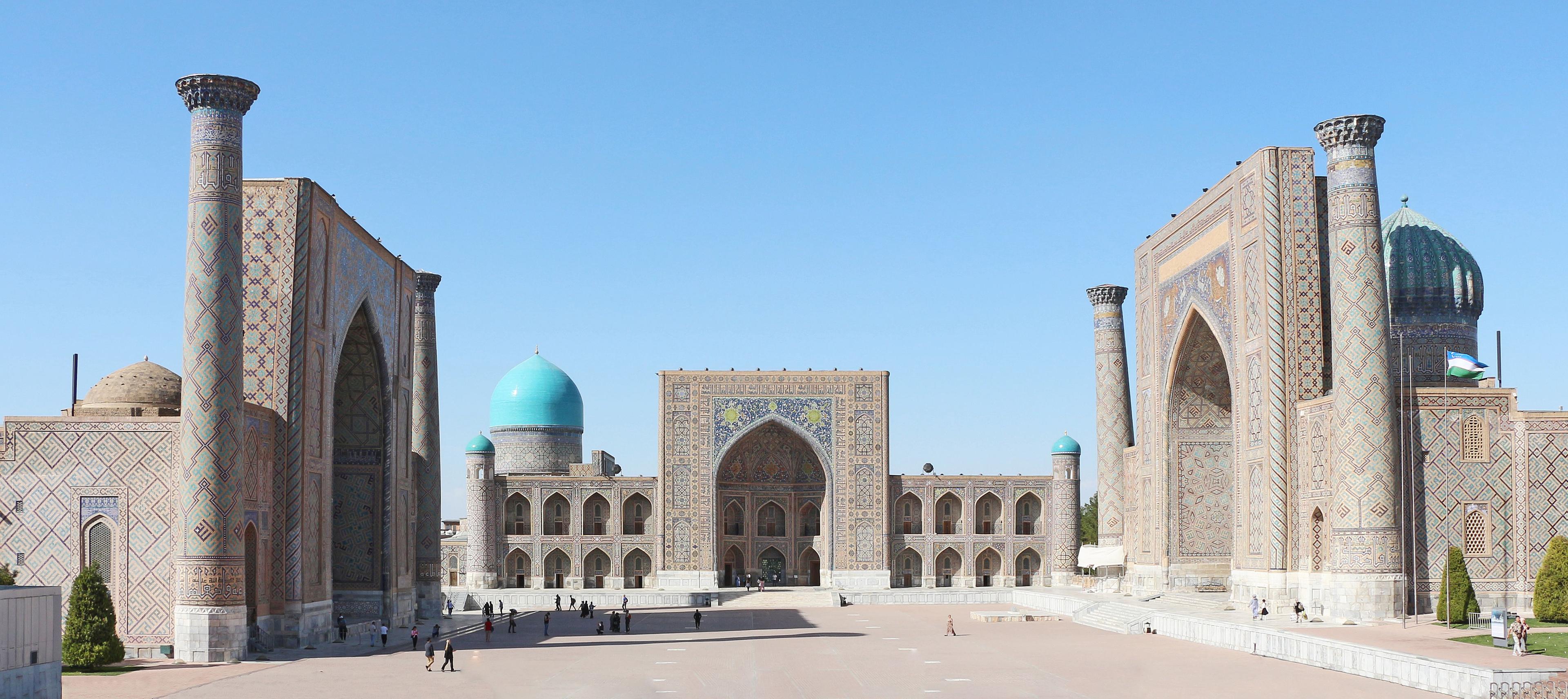
Samarkand's station is some 6 km from the Registan. Leave your bags at the hotel and start with the square itself: the Ulugbek, Sher-Dor and Tilla-Kari madrasahs. Then the Bibi-Khanym Mosque and Siab Bazaar for dried fruit and Samarkand bread. Rest in the heat of the afternoon, then return to the Registan at dusk, when the square is lit. The evening sound and light programme has been reported to start around 20:30 in summer, with a separate ticket for foreigners. It does not run every night of the year, so check when you book. Our guide to evenings in Uzbekistan has more.
Day 3: Samarkand in depth
Day 3 is what makes the two nights worth it.
- Early morning: Shah-i-Zinda, the avenue of mausoleums climbing the hill. Go at opening, before the groups, when the tilework catches low sun.
- Mid-morning: the Afrosiab museum, with its 7th-century Sogdian murals, and the Ulugbek Observatory.
- Late afternoon: Gur-e-Amir, Amir Timur's mausoleum, quieter once the tour buses leave.
- Evening: free. Samarkand's dinner scene is lively around the old centre.
If you are short on energy, drop the observatory. Never drop Shah-i-Zinda.
Day 4: the morning train to Bukhara
Typical Afrosiyob departures from Samarkand are around 08:23 and 09:43, and the journey takes about 1 hour 50 minutes. Bukhara's station is in Kagan, 12 to 15 km from the old town, so allow about half an hour by taxi.
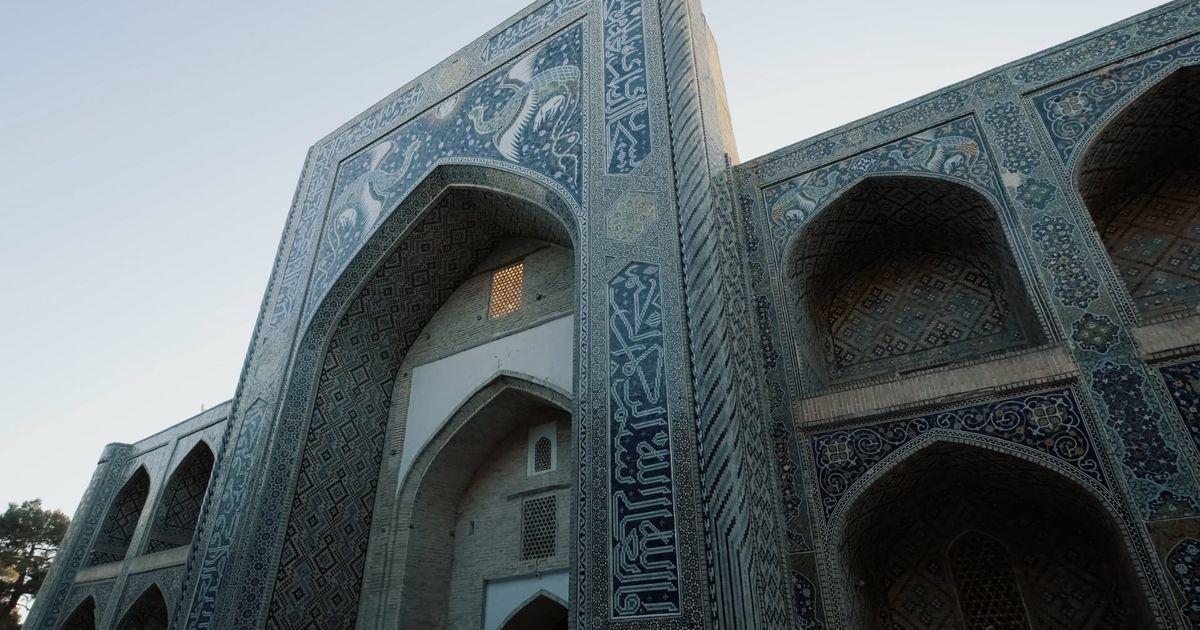
Because you have one night here, use the first afternoon fully. Start at Lyabi-Hauz, the pool shaded by mulberry trees, then walk the three trading domes and the Ulugbek and Abdulaziz Khan madrasahs. Finish at Po-i-Kalyan, where the Kalyan Minaret of 1127, the Friday mosque and the Mir-i-Arab Madrasah are at their best at sunset. Dinner can be on a rooftop near Po-i-Kalyan or back at Lyabi-Hauz. A folklore dinner show in the Nadir Divan-Begi madrasah is popular, but book ahead and confirm the time.
Day 5: Bukhara's citadel and the high-speed train to Khiva
Spend the morning on the Ark Fortress, the emirs' citadel, and the Samanid Mausoleum, a 10th-century brick cube in the park beyond. If you have time, add the Chashma-Ayub shrine or the small Chor Minor gatehouse.
Then take the afternoon Jaloliddin Manguberdi high-speed train to Khiva. In autumn 2026 timetables show a departure from Bukhara at about 15:30 reaching Khiva at about 19:50, and another earlier train at about 10:55 to 11:15 reaching Khiva at about 14:30 to 14:45. Frequency has changed several times since the service began in May 2026, and some reports describe it running on alternate days, so check the live schedule on the railway's official site before you build the plan around it. The journey is roughly 3 hours 30 minutes to 4 hours 25 minutes across the Kyzylkum, and the train stops in Urgench before Khiva. Stay on board to the terminus.
If the afternoon train gets you to Khiva after dark, the walls are still worth a short walk. The old town is lit in the evening and quiet, and the contrast with Samarkand and Bukhara is immediate. Our Bukhara to Khiva guide covers the train, the road and the alternatives.
Day 6: Khiva in the morning, then home
Ichan-Kala, Khiva's walled inner town, is small enough to see in a morning: the Kalta Minor, the Kunya-Ark, the Juma Mosque with its forest of wooden columns, Tash-Hauli palace and the Islam Khoja Minaret. Start early, when the light is soft and the streets are empty.
Then fly. Urgench airport is about 35 km from Khiva, a drive of roughly 40 minutes. Flights to Tashkent take about 1 hour 30 to 40 minutes, and Uzbekistan Airways' cheapest fares started at about 442,000 som (around US$37) after a fare cut in October 2026, with other carriers on the route. Domestic flights use Terminal 3 in Tashkent and international flights Terminal 2, so allow at least three hours between landing and an international departure. A late-evening or night departure from Tashkent suits this plan well. If your flight leaves in the morning, add a night in Tashkent.
Tashkent or Khiva for the last days?
This is the main decision. If you are unsure, use this rule.
- Choose Khiva if you want three historic cities and do not mind a tight last day. It is a different world from Samarkand and Bukhara, and flying out of Urgench is easy.
- Choose Tashkent if you prefer a slower trip. Take the second night in Bukhara, return by Afrosiyob on day 5 and spend day 6 in the capital: the Hazrati Imam complex, Chorsu Bazaar, the Tashkent Metro and the Soviet-era monuments. Save Khiva for a longer trip.
A third option is to fly into Urgench first and reverse the route, finishing in Samarkand and Tashkent. That makes the Registan the final image and puts the long train ride early, but it needs flight times that suit it.
What 6 days in Uzbekistan costs, and when to book
Typical costs in 2026, per person, not including international flights:
- Trains: Tashkent to Samarkand about 311,000 som (around US$26) in economy, Samarkand to Bukhara roughly 165,000 to 200,000 som, and the Khiva train in a higher range, which we recommend checking on the railway's site. Business class costs more.
- Hotels: boutique doubles in the old towns of Samarkand, Bukhara and Khiva typically start around US$50 to 100 a night, more for the larger international brands and restored merchant houses.
- Entrance fees: roughly US$40 to 70 for the whole route.
- Food: a chaikhana lunch US$4 to 8, a good dinner US$15 to 30.
- Private guide and car: typical 2026 rates are US$50 to 100 a day each for a guide and a car with driver, shared between the group.
An independent traveller in mid-range hotels typically spends about US$550 to 850 for the six days on the ground. A fully guided private trip with transfers costs more, and a small group tour sits between the two.
Booking and timing. Book the Afrosiyob and Jaloliddin Manguberdi tickets as soon as sales open, which is up to 60 days before departure. In April, May, September, October and around Navruz in March, popular morning trains can sell out quickly. Then book hotels and the Urgench flight.
The best months are late March to May and September to early November. July and August often pass 40°C in Bukhara and Khiva, and a plan this compressed leaves little room for midday rest. Winter is cold but clear and quiet, with fewer visitors, but daylight is short and some seasonal shows are not running.
Doing it with TourEast
We can run this route as a private trip with a guide and driver, or as part of a small group, with the train seats booked as soon as sales open and a guide on each platform. If the pace looks tight, tell us and we will suggest the seven-day version or a different last day. You can also sketch the route in our trip builder at /trip-builder or send us a message on WhatsApp.