A 5-day Uzbekistan itinerary that works: Tashkent, two nights in Samarkand and two in Bukhara, linked by the Afrosiyob train. Hour-by-hour plan, a Khiva variant, what to drop, when to book trains and what it costs in 2026.
Facts, prices and schedules checked on November 4, 2026
Five days in Uzbekistan is the most common request we receive, and it is a realistic one. Tashkent, Samarkand and Bukhara sit in a line along the old caravan road, the Afrosiyob high-speed train links them in two hours or less per leg, and the two historic cities each deserve two nights. A 5-day Uzbekistan itinerary built that way is not a sprint: it is three cities at a walking pace, with one long evening on the Registan and one slow morning under the domes of Bukhara.
This guide gives the plan hour by hour as of November 2026, with train times and fares, two variants (Khiva instead of Tashkent, and the route in reverse), what to leave out, when to book and what the trip costs. It assumes you arrive on day 1 and fly home late on day 5 or early on day 6. If you have more time, our 7-day and 10-day itineraries extend the same spine westwards to Khiva.
Is 5 days enough for Uzbekistan?
Enough for the three central cities, yes. Not enough for Khiva as well, unless you fly and accept a single night there, which we cover below.
What five days gets you:
- Samarkand with two nights, so you see the Registan both in daylight and lit up after dark, and Shah-i-Zinda without a watch in your hand.
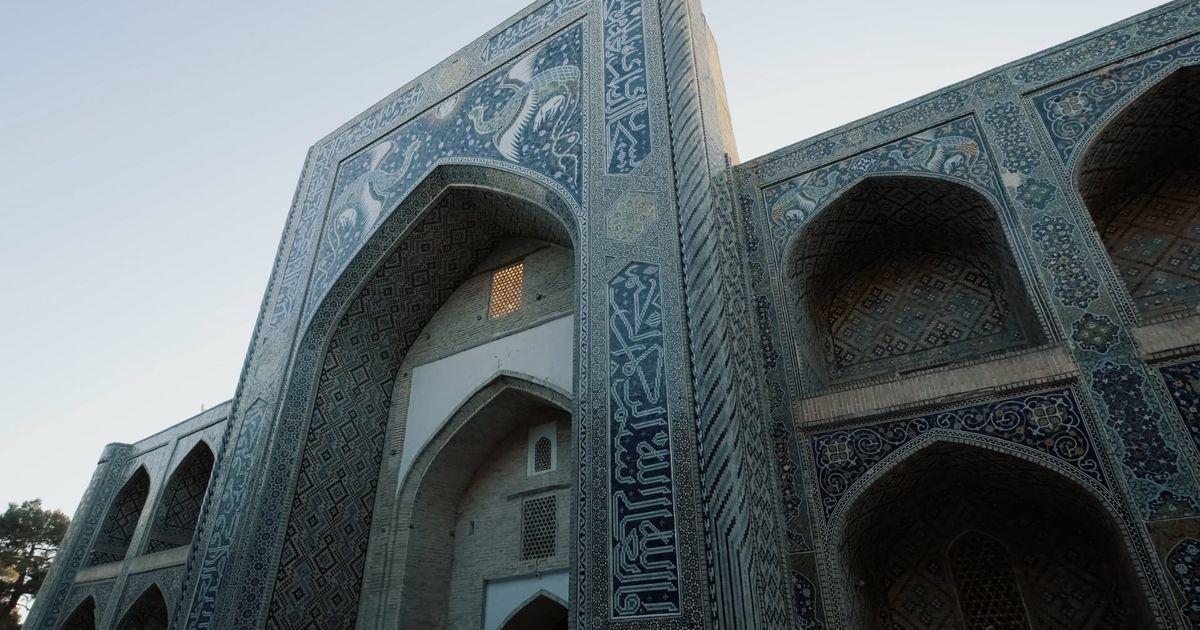
- Bukhara with two nights, enough for the Ark Fortress, Po-i-Kalyan, the trading domes and a quiet evening at Lyabi-Hauz.
- Tashkent as a half day at either end: Chorsu Bazaar, the Hazrati Imam complex and a few stations of the Tashkent Metro.
What it does not get you: the Fergana Valley, the desert fortresses of Khorezm, a yurt night in the Kyzylkum or a day in the mountains. Those are reasons to come back, and five days is the minimum we recommend for a first visit precisely because it leaves Samarkand and Bukhara intact rather than skimmed.
The 5-day Uzbekistan itinerary at a glance
- Day 1: Arrive in Tashkent. Afternoon in the old city, evening plov.
- Day 2: Early Afrosiyob to Samarkand (about 2 h 15 min). Registan, Bibi-Khanym, Siab Bazaar, Registan at night.
- Day 3: Samarkand. Shah-i-Zinda, Gur-e-Amir, Ulugbek Observatory, Konigil paper mill or a wine tasting.
- Day 4: Morning Afrosiyob to Bukhara (about 1 h 50 min). Lyabi-Hauz, trading domes, Po-i-Kalyan at sunset.
- Day 5: Bukhara. Ark Fortress, Samanid Mausoleum, Sitorai Mohi-Hosa. Evening train or flight to Tashkent for your departure.
Total train time: about four hours on the way out, plus about 3 h 50 min back on the Afrosiyob or an hour in the air. Everything else is on foot or in short taxi rides.
Day 1: Tashkent, the gentle start
Most international flights land in Tashkent in the morning or around midday, which leaves an afternoon. Do not try to see the whole capital; keep it to the old city.
- Late morning: check in, shower, and eat. If it is your first day in the country, lunch is plov, cooked in enormous kazans at the Central Asian Plov Centre next to the TV tower or at a neighbourhood chaikhana.
- Afternoon: the Hazrati Imam complex, with the Barakhan Madrasah and the library that holds the 7th-century Uthman Quran, then Chorsu Bazaar under its blue dome, a ten-minute walk away.
- Early evening: ride the Tashkent Metro two or three stops for its Soviet-era stations (Kosmonavtlar and Alisher Navoiy are the famous ones), then walk Amir Timur Square and Broadway.
Sleep early. Day 2 starts before seven. If you arrive on a late evening flight instead, treat day 1 as a transfer and move Tashkent's sights to the end of day 5.
Day 2: the Afrosiyob to Samarkand, Registan by day and night
Take the 06:10 or 07:30 Afrosiyob from Tashkent's main station; both reach Samarkand in about 2 h 15 min, in time for a late breakfast. Be at the station 30 to 40 minutes before departure, passport in hand: Uzbek stations check tickets and documents at the entrance and again at the carriage door.
Samarkand's station is about 6 km from the Registan. A Yandex Go taxi takes 15 to 20 minutes. Leave your bags at the hotel and walk.
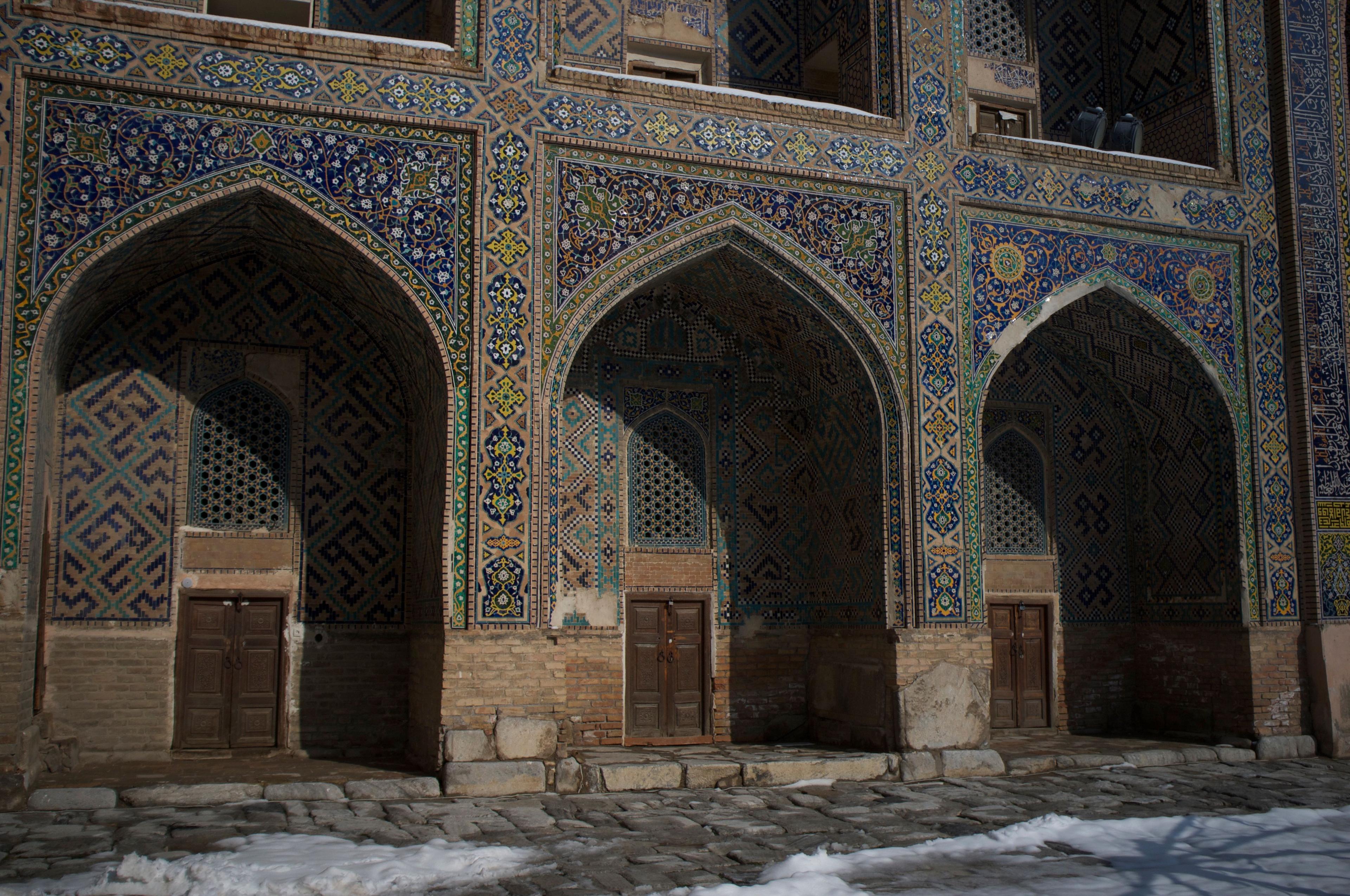
- Late morning: Registan Square and its three madrasahs, Ulugbek, Sher-Dor and Tilla-Kari. Allow two hours; the gilded interior of Tilla-Kari is the one people forget.
- Lunch near the square, then the Bibi-Khanym Mosque, the giant Amir Timur built after his India campaign, and the Siab Bazaar beside it for dried fruit and Samarkand bread.
- Late afternoon: rest. Samarkand is hot from May to September and the light is better after five anyway.
- Evening: return to the Registan. The square is lit after dark and is at its best between dusk and about nine. Dinner afterwards in the old Jewish quarter or along Tashkent Street.
If you are travelling with us, your guide meets you on the platform and the car takes the bags, so you can start at the Registan directly.
Day 3: Samarkand in depth
This is the day that makes two nights worthwhile.
- Morning, early: Shah-i-Zinda, the avenue of mausoleums climbing the hill from the Bibi-Khanym side. Go at opening, before the groups, when the tilework catches low sun. Allow an hour and a half.
- Mid-morning: Afrosiab museum on the site of the pre-Mongol city, for the 7th-century murals of ambassadors at the Sogdian court, then the Ulugbek Observatory and the arc of the great sextant cut into the rock.
- Lunch: a chaikhana for shurpa or manti, or a visit to the Khovrenko winery for a tasting if that appeals.
- Afternoon: Gur-e-Amir, the mausoleum of Amir Timur, quieter in the late afternoon. If you have energy left, the paper mill at Konigil village makes mulberry-bark paper by hand and sits by a stream, a good place to slow down.
- Evening: free. Samarkand's restaurant scene has grown quickly since the Silk Road Samarkand complex opened; the old centre still has the better atmosphere.
What to drop if you are tired: the observatory or Konigil. Never Shah-i-Zinda.
Day 4: train to Bukhara and a first evening under the domes
The 08:23 or 09:43 Afrosiyob from Samarkand reaches Bukhara in about 1 h 50 min; the new Jaloliddin Manguberdi, which continues to Khiva, also stops here at about 09:13. Bukhara's station is in Kagan, 12 to 15 km from the old town, so allow 25 to 30 minutes by taxi.
Bukhara is smaller and slower than Samarkand, and the old town is best done on foot in one continuous walk.
- Midday: Lyabi-Hauz, the pool shaded by old mulberry trees, with the Nadir Divan-Begi madrasah and khanaka on either side. Lunch here.
- Afternoon: the three trading domes, Toki Sarrafon, Toki Telpak Furushon and Toki Zargaron, with the Magoki-Attori mosque between them, then the Ulugbek and Abdulaziz Khan madrasahs facing each other.
- Late afternoon: Po-i-Kalyan. The Kalyan Minaret of 1127, the great Friday mosque and the Mir-i-Arab Madrasah make the finest ensemble in the country. Stay until the light goes.
- Evening: dinner on a rooftop near Po-i-Kalyan, or back at Lyabi-Hauz.
Day 5: Bukhara's citadel and the road back
- Morning: the Ark Fortress, the emirs' citadel, with the Bolo-Hauz mosque and its painted wooden columns across the road. Then the Samanid Mausoleum in the park beyond, a 10th-century cube of patterned brick that many visitors call the most beautiful building in Bukhara, and the Chashma-Ayub shrine next to it.
- Late morning: Sitorai Mohi-Hosa, the last emir's summer palace, 4 km north, for its mirrored white hall and peacocks. Alternatively, Chor Minor, the small four-towered gatehouse in the back streets.
- Lunch and a last walk through the domes for souvenirs: Bukhara is the place for suzani embroidery, miniatures and knives.
Then the return. Two good options:
- Afrosiyob to Tashkent: afternoon departures from Bukhara take about 3 h 50 min, arriving in the evening. An economy seat costs 509,000 som, about US$43, as of November 2026. Comfortable, scenic across the steppe, and city centre to city centre.
- Fly Bukhara to Tashkent: about an hour in the air. Uzbekistan Airways' cheapest hand-luggage fares on the route start at about 241,000 som (around US$20) after the October 2026 fare cut; Silk Avia turboprops also serve it. With airport time it is not much faster than the train, but it suits a late international departure.
If your flight home leaves Tashkent after midnight, as many European and Gulf connections do, you can stay in Bukhara until late afternoon and still make it. If it leaves in the morning, stay the fifth night in Tashkent.
Variant: Khiva instead of Tashkent
If you have seen enough modern capitals and want three Silk Road cities, swap Tashkent for Khiva. It costs a flight and a very early start, and it works best in this direction:
- Day 1: Land in Tashkent and connect to a Tashkent to Urgench flight (about 1 h 30 min to 1 h 40 min; several a day; the cheapest Uzbekistan Airways fares start at about 442,000 som, around US$37). Urgench airport is a 40-minute drive from Khiva. Evening walk in Ichan-Kala, the walled inner town.
- Day 2: Khiva morning, inside the walls: Kunya-Ark, the Juma Mosque with its 200-odd wooden columns, Tash-Hauli palace, the Islam Khoja Minaret. Afternoon Jaloliddin Manguberdi high-speed train from Khiva to Bukhara, 3 h 30 min to 4 h 25 min across the Kyzylkum. Two nights in Bukhara.
- Days 3 and 4: Bukhara, then the morning train to Samarkand. Two nights in Samarkand.
- Day 5: Samarkand, then an evening Afrosiyob to Tashkent (about 2 h 15 min) for your departure, or fly straight out of Samarkand's international airport if your route allows.
The catch is the first day: a long-haul arrival followed by a domestic flight and a 40-minute drive. Tashkent's domestic flights leave from Terminal 3, a separate building from international Terminal 2, so allow at least three hours between flights. The reward is seeing Khiva, which is a different world from the other two cities, without adding days.
Reverse order and other tweaks
Running the route Bukhara first and Samarkand last works just as well, and it is the better choice if you want Samarkand's Registan as your final image rather than your first. Take the evening Afrosiyob from Tashkent to Bukhara on day 1 (it leaves at about 19:48 and arrives around midnight) or a morning train on day 2, and end with an evening train from Samarkand to Tashkent on day 5, a shorter leg than Bukhara to Tashkent.
Other adjustments we often make:
- One night in Tashkent at the end instead of the start, for travellers who land late at night.
- Replace Sitorai Mohi-Hosa with the Chor-Bakr necropolis outside Bukhara, quieter and older.
- For families, drop the Afrosiab museum and the observatory and add the Konigil paper mill and a plov cooking session.
- For a long weekend of four days, cut Tashkent entirely and fly in and out via Samarkand.
Booking trains, and when to go
The trains shape this itinerary, so book them first and the hotels second. Uzbekistan Railways opens sales up to 60 days before departure on its official site, reached via railway.uz, and on its app; a foreign passport is accepted as ID and you pay by card. In April, May, September and October, and around Navruz in March, the popular morning Afrosiyob departures can sell out within days of release. Book the moment your dates are fixed, or ask us to do it.
Fares as of November 2026, one way, economy: Tashkent to Samarkand 311,000 som (about US$26); Samarkand to Bukhara typically 165,000 to 200,000 som (about US$14 to 17); Bukhara to Tashkent 509,000 som (about US$43). Business and VIP classes cost more. If the Afrosiyob is full, the slower Sharq express runs the same route in roughly three hours to Samarkand and six to Bukhara.
Best months: late March to May and September to early November. July and August regularly pass 40°C in Bukhara, and this plan survives it only if you sightsee early and late and rest in the middle. Winter is cold but clear, cheaper and almost empty.
What 5 days in Uzbekistan costs
Typical costs in 2026, per person, not counting international flights:
- Trains, the full loop: about US$80 to 90 in economy, US$120 to 140 in business.
- Hotels: boutique doubles in the old towns of Samarkand and Bukhara from about US$50 to 100 a night; more for the international brands and the restored merchant houses.
- Entrance fees: most major monuments charge a modest fee, usually the equivalent of a few dollars; budget about US$40 to 60 for the whole trip.
- Food: a chaikhana lunch for US$4 to 8, a good dinner with wine for US$15 to 30.
- Private guide and car: typical 2026 rates are about US$50 to 100 a day for a guide, similar for a car and driver, shared between the group.
An independent traveller staying in mid-range hotels spends roughly US$450 to 700 for the five days on the ground. A fully guided private trip with transfers and good hotels is more, and a small-group tour sits between the two.
Doing it with TourEast
This five-day route is the spine of our classic Uzbekistan tours, and we run it as a private itinerary with your own guide and driver, or as a small group on fixed dates. We book the Afrosiyob seats as soon as sales open, meet you on each platform, and set the pace of each day around the light and the heat. Tell us your flight times and we will shape the days around them, with Khiva or the reverse order if you prefer.